Tuesday, 31 May 2016

400. Super-Rabbit (1943)


with BUGS BUNNY
Warner cartoon no. 399.
Release date: April 3, 1943.
Series: Merrie Melodies.
Supervision: Chuck Jones.
Producer: Leon Schlesinger.
Starring: Mel Blanc (Bugs Bunny / Cottontail Smith / Various voices), Kent Rogers (Professor Canafrazz), Ted Pierce (2nd observer).
Story: Ted Pierce.
Animation: Ken Harris.
Musical Direction: Carl W. Stalling.
Sound: Treg Brown (uncredited).
Synopsis: Bugs Bunny develops superpowers and goes on a mission to challenge Cottontail Smith - a cowboy who despises rabbits.

Animation by Ben Washam
In the early 1940s, the Superman franchise (who debuted in Action Comics #1, 1938) had become incredibly popular - even so, that the Schlesinger Studio leapt at the chance of producing a parody of their own. Due to Chuck Jones' success of his Rover Boys parody a year earlier - he becomes an obvious candidate to conceive a Superman take-off.

The franchise had also been very popular on radio, as well as a series of animated shorts produced by the Fleischer Studios - which is arguably their most elaborate work. The shorts were popular enough that their opening montage sequence for each short were directly spoofed shot-by-shot in Jones' parody.

A still from the Superman series -
seen at the opening of each short
from 1941 and 1942.
Its infamous opening narration which establishes Superman goes: "Faster than a speeding bullet! More powerful than a locomotive! Able to leap tall buildings in a single bound!" were presented in a montage form in the Fleischer shorts.

However, Jones and Ted Pierce visually lampoon the opening with their Warner Bros. style - to some extent they channel the same level of humour Tex Avery used for his late 1930s shorts. (02/06 Edit: In relation to Eric O. Costello's comment - it's reminded me that Ted Pierce's experience at the Fleischer Studios proved handy, even more so as he had story credit for one Superman cartoon - The Arctic Giant.)

Instead of a dry-brushed bullet zipping past the screen; a cork gun is replaced. A streamlined locomotive in the Fleischer short is replaced with a fatigued steam train - a visual contradiction the "faster than a locomotive" statement. Finally, the leap to the highest building gag is topped - with Bugs accidentally trips his foot on the pointy top of the skyscraper, causing him to fall.

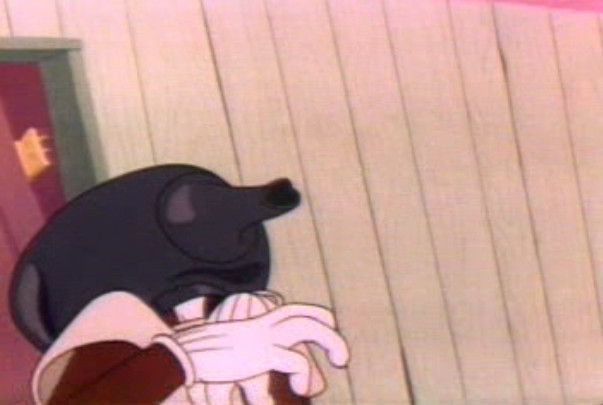
To make the parody more conspicuous; John McGrew sticks to a similar style to the Fleischer shorts in order to take advantage of Jones' direct parody on the montage. Alas, Bugs Bunny channeling the iconic Clark Kent/Superman image has a nice touch to it - as Bugs retains his own personality while still posing as a superhero. He is partly animated in the scene as his legs are held while he munches his carrot.

Ted Pierce also conceives certain gags directly spoofing recurring elements in Superman. Once Bugs Bunny reads a cut-out newspaper article of Texan cowboy Cottontail Smith's plan to eradicate all rabbits in the laboratory; he declares: "This looks like the job, for Super-Rabbit!".

He hops into a booth to change into his costume but finds himself dressed as the wrong alter-ego - as Bo Peep. Bugs quickly returns to the booth and comes back with the correct superhero costume. A nicely executed gag by Pierce full of spontaneity while maintaining Bugs' characteristics of being in drag.

Animation by Ken Harris
The sequence of Bugs flying to Texas is a fine example of Chuck  Jones taking pride with his flair for comedy and lack of logic.

As Bugs casually flies he greets a horse walking on air - a gag which feels very Clampett-esque. The horse greets Bugs back, and goes into a double take: "A rabbit? Up here?!". A hysterical gag which boasts about it's nonsensical environment in contrast to more realistic Fleischer shorts.

Pierce conceives another great gag where Bugs' ability to fly begins to trigger, as he munches another carrot to "recharge his batteries" - indicating that Bugs' superpowers aren't reliable or perfect compared to Superman.

John McGrew brings a slightly less ostentatious look as far as layouts go. The designs aren't as experimental or avant-garde as seen in the Texas sequence. The laboratory sequence at the beginning shows more of his simplistic, dynamic approach to style.

The pan shot of Professor Canafrazz preparing his experiment shows McGrew going to town in a complex camera pan arrangement. The effects animation (probably by Ace Gamer) are incredibly elaborate and appealing to watch, too.

The camera pans from Canafrazz's many flasks and viles; and along the way an "Eat at Joe's" gag is inserted. The pan stops momentarily at a radiated carrot - and ends with Bugs Bunny sitting in an "experimental rabbit" box. Note the box is labelled in apparent Latin "rabbitus idiotus Americanus"; a descendant gag of Chuck Jones which would be more popularised in his Road Runner shorts.

Animation by Bobe Cannon
In response to Bugs' "What's cookin', doc" phrase - Canafrazz reveals his experiment as he examines the carrot: "I'm cooking, as you so kindly put it, my great--my great--my greatest experiment! A super-vitamized, locked-in flavourized, ariumized, modern-designized super carrot".

Canafrazz's voice actor, Kent Roger, does an unbelievable impression of English actor Richard Haydn (today best known as Uncle Max in The Sound of Music), by nailing his own characteristics and distinctive dialect. Bugs' comes up with some witty lines conceived by Ted Pierce, like "Aw, you shouldn't have ought to have done that, Edison" when Canafrazz reveals he intends to give him superpowers. Also, any idea on the meaning behind Bugs' line; "Yeah, what are you gonna do with it, Burbank?".

For the introduction of rabbit hater Cottontail Smith - Ted Pierce's knack for creating exceptionally witty, unpretentious dialogue and gag development presents wonderful exposition for Bugs' first encounter of him. Bugs discovers the trail for Cottontail Smith as he watches a group of rabbits fleeing the area - leading him to go undercover in order to infiltrate and trick him.


As Cottontail Smith and his horse hop across the Texan desert - Bugs hops along with them, and states his business. This leads to a complex yet fun piece of layout work where the characters hop in and out of the scene - and in each hop, there is a different action.

First, Smith is riding on the horse and Bugs hops - and several hops later, the action is reserved as Bugs rides the horse. As each hop goes, the nuttier the gag gets - leading to Bugs riding on top of Cottontail Smith.

It's a hilariously executed sequence that's been perfected from every department - from McGrew's layouts to Chuck's timing - as well as Ted Pierce's creative abilities. Cottontail's dialogue is extremely amusing while establishing his personality, as heard in the line: "I hate rabbits! If thar's anythin' I hate more than a rabbit - it's two rabbits!". A perfectly written line which is kept simple and to the point - and a perfect emphasis for his hatred of rabbits. It's famously known that Cottontail Smith is a precursor to Freleng's Yosemite Sam as Mel Blanc uses the same persona and voice for the character.

Chuck Jones has already excelled in the pace of the Warners style - and takes pride with it in an energetic sequence involving Bugs' improvised basketball game. Cottontail Smith has attempted to exterminate Bugs by firing a cannon - although Bugs takes advantages of his powers by quickly grabbing the cannonball and turns this into a game of basketball. Bugs uses his quick wits to trick Cottontail Smith and the horse in participating.


The sheer energy and timing couldn't have been handled superiorly by Bobe Cannon. His great use of drybrush and speed captures the tone and pace of not only the sequence, but the action of the sport.

Bugs hasn't finished his fun as he continues to exploit Cottontail and his horse's gullibility by having them chant with him in a cheerleading rally. Mel Blanc nails the charisma and vocal clarity of the performance as he chants, "Bricka-bracka, firecracker...Bugs Bunny, Bugs Bunny rah, rah, rah!".

Ken Harris also carries out the scene with his outlandish animation. It's very daring for Harris to use that level of exaggeration in a scene like this; who takes complete complete advantage of the fast action with smear animation. It's a very loose, but solid looking piece of animation at the same time.

Successive timing asides, Chuck's great use of continuity and bold expressions also carry out the cartoon. In an attempt to make each facial expression inventive and new in each cartoon - Chuck pulls off a unique 'burn take' for Cottontail Smith. Once Bugs has tricked Cottontail into thinking he's a horse - he double-takes and burns in effigy, realising Bugs is a rabbit - while still wearing a grazing muzzle.


The anger in Chuck's expressions read very clearly - especially when much of his face is covered from the muzzle. Chuck also pulls off a red glow effect surrounding his head; to help emphasise his anger. An effect rarely used by Chuck.

Some innovative pieces of dynamics and staging are taken advantage of in the following scene of Bugs supposedly making his sacrifice to Cottontail. The POV shot of Cottontail navigating his  scope shaped in the form of the rabbit shows great coordination as far as layouts go.

While standing in position; Smith fires multiple bullets at "Bugs" - but finds the real Bugs is standing behind a model of himself. By this time; audiences have become familiar of Bugs' conniving ways of avoiding his own peril - making the suspense build-up deliberate.

The sequence of Bugs being patrolled by Cottontail Smith and his horse on a piece of aircraft is comparable to the action scenes depicted in the Fleischer shorts - except it's played up for laughs. McGrew and Jones tackle some ambitious layout navigations and dynamic angles to make the action as compelling and intricate as the Superman shorts. A POV scope shot targeting Bugs is very ambitious as far as a Warner short goes.

Bugs once again defeats Cottontail as he effortlessly holds onto plane; causing it to detach - leaving the pair floating in mid-air. Animation acting couldn't have been topped in the shot of the horse tapping Cottontail to hint the perilous situation they're in. Cottontail looks down; then turns back and immediately they fall from the remains of their plane. It's a hilarious piece of animation delivery - the anticipation of Cottontail turning back and supposedly expecting the giant fall from the sky is an icing on the cake.

While Bugs Bunny has enjoyed his victorious running time in the short; Ted Pierce constructs an exceedingly exciting climax to meet new challenges for Bugs. While flying, Bugs finds he has lost his energy to fly and opens his carrot case; but clumsily lets all the carrots fall to the ground.


After hitting the ground in a great piece of squash and stretch motion; he finds that all of the carrots have been eaten by Cottontail Smith and his horse who morph as superheroes - making Bugs Bunny feel threatened.

A quick thinker, he declares: "This looks like the job for a real superman!". He quickly rushes inside a booth while Cottontail Smith and his horse anticipate an attack action. As the door opens, they very quickly salute as Bugs marches out wearing a Marine uniform, while singing The Marines Hymm.

He briefly pauses and turns back to the pair, "Sorry fellas, I can't play with ya any more. I've got some impoitant woik to do!". He continues his march and walks past a sign where he is heading for Berlin or Tokyo. A now slightly-dated gag - it works well in Bugs Bunny having the last laugh - escaping the dangers of Cottontail Smith from then on.

A short that Chuck Jones felt he finally achieved the comedy standards he was looking for - Super-Rabbit is an excellent parody of the Superman franchise as well as a riotous adventure for the wascually wabbit. As parody is a difficult theme to write successfully - Ted Pierce doesn't let it get in the way of the story - creating a healthy balance for the Superman references and gags for a typical Bugs Bunny short. Jones' confidence is all over the cartoon - and perhaps creating one of the funniest parodies from the Warner Bros. cartoon library. Not only does the short scream with energy and excitement - but it takes complete pride of the studio's style of animated shorts; and it shows that when lampoon Fleischer, as the gags are done so creatively and incisively. Ted Pierce conceives Cottontail Smith wonderfully; by establishing a perfect rival for Bugs - due to his extreme hatred for rabbits; which is hilarious itself. The ending sequence might have aged overtime; although it doesn't let the whole cartoon itself suffer at all.

Rating: 5/5.

Sunday, 29 May 2016

399. Hop and Go (1943)

Warner cartoon no. 398.
Release date: March 27, 1943.
Series: Looney Tunes.
Supervision: Norm McCabe.
Producer: Leon Schlesinger.
Starring: Pinto Colvig (Claude Hopper), Mel Blanc (Scottish Rabbits).
Story: Melvin Millar, Don Christensen (unc.)
Animation: Cal Dalton.
Musical Direction: Carl W. Stalling.
Sound: Treg Brown (uncredited).
Synopsis: Two Scottish rabbits attempt to challenge Claude Hopper's statement as the greatest hopper in the world - even going so far as to cheat.

Norm McCabe rarely had the opportunity to develop a personal style like Chuck Jones or Bob Clampett; as he was typically lumbered with war-themed shorts. However, McCabe's take on a one-shot cartoon with a plot not heavily reliant on wartime references states his potential.

Millar and Don Christenen's story is in the same vein of a standard Warner Bros. short: a dim-witted kangaroo named Claude Hopper boasts about being "the best darn hopper in the whole world"; and two eavesdropping Scottish rabbits decide to use him for their own amusement.

The opening sequence indicates no sign of McCabe's lowering standards. For example an impressive camera shot features the camera hopping in rhythm to Claude's hopping action - an effect used similarly in Friz Freleng's Hop, Skip and a Chump.

Carl Stalling composes a little hopping rhythm which gives some added personality on Claude, and of course, Pinto Colvig's singing voice in the persona of Goofy is always entertaining to hear. The layouts on the opening shot and Claude Hopper hopping in perspective indicate Dave Hilberman's enjoyment of problem solving on complex layout work.

 Characterisations and personas are also typical in the spirit of Warner Bros. in this short. Claude Hopper is portrayed as ignorant based on his heavy size and Pinto Colvig's Goofy persona. There's also a subtle reference of Colvig, too.


Claude brags to the rabbits about his hopping by declaring, "I've got a certificate to prove it", with the certificate reading "This guy is a goof" - a possible reference to Colvig known as the original voice actor for Disney's Goofy.

The Scottish rabbits, on the other hand are depicted as much smaller and slender in size - adding some craftiness to their low cunning. Mel Blanc is always reliable for giving some added personality (like the Scottish dialect on the rabbits) to characters who are portrayed as conniving, if nothing else.

Their contrasting size and personalities are put to good use in a sequence involving Claude Hopper's attempts of accomplishing the longest jump. As Claude leaps; the rabbits are hanging onto the end of his tail. Once Hopper lands, they leap from his tail and land on the ground in front of him. So, the rabbits take advantage of his gullibility by measuring the other rabbit in front - deceiving Claude into thinking he's been narrowly beaten.

Astonished, Claude attempts the jump once more but finds he's landed in the exact position as before. In an attempt to break the record one last time; Claude empties various heavy objects from his pouch to reduce the weight. The scottish rabbit takes his chance by placing a piece of bubble gum underneath Claude's tail.

McCabe's comic timing plays along nicely by giving impact and weight to the strength of the gum. Treg Brown's resourceful sound effects add to the right touch, also. Falling back from the stretchiness of the gum; Claude falls backwards and crashes onto a pile of junk that had fallen from his pouch - once again, outsmarted by the rabbits.

At the same time, Norm McCabe continues to fulfil his potential as a director - by using dynamics and uncommon styles of pacing and shot angles for sequences requiring it. Dave Hilberman's layouts are better appreciated in scenes involving Claude hopping on the branch of the tree, and landing backwards on a birds nest - resulting in the birth of a baby bird screeching "Mammy!" to Claude.


McCabe's use of dynamics are most revealing in the sequence where the rabbits attempt to loosen a giant boulder. The boulder is intended to land at one end of a log - in hope for Claude to have a grand leap.

Not only are the great compositional shots effective but also appropriate in its visual storytelling. For the scenes of the boulder falling - McCabe channels a little of Chuck Jones from this era (see My Favourite Duck and Flop Goes the Weasel).

The falling boulder is witnessed by each character with the aid of rapid pacing and several quick shots to make the anticipation gag more effective and dynamic. A daring feat to accomplish, McCabe's timing proves competent as he navigates through Hilberman's layouts wisely and effectively.

The boxing match sequence is another example of depicting both character personalities and use of creative pacing, as analysed earlier. Although the payoff itself is a little weak in creativity and execution.

The rabbits speed past Claude, creating him dizzy spells. Out of nowhere, one of the rabbits pulls out a fighting canvas effortlessly. This is also an occurrence with Claude's "goof" certificate.

Claude's bragging and boasting continues to do no favours as he considers himself an athlete. A taste of cartoon logic is taken for granted as one of the rabbits unexpectedly pulls out a switch from the fighting pole - causing one of the ropes to arise; causing Claude to spin around the rope in the style of an acrobat. The execution feels a little weak as the sudden appearance of a switch seems to not depict the rabbit's slyness as seen in the long jump sequence which follows after.

Some gags use some cliches typical of the Warner Bros. style of humour. This is evident in the sequence of Claude Hopper after being rescued from his collision with a tunnel.

He is brought back from the river, where one rabbit uses his tail like a hand pump; while the other rabbit rinses himself (with the dripping water coming from Claude's soaked hair) whilst singing Singin' in the Bathtub - a popular song choice whenever a character showers or bathes. The scene of the principal rabbit washing his hands on the water's pouch like a sink is a decent visual gag itself; and the unexpected delivery of the rabbit pulling the plug out for the water to fade is hilarious itself.

Like many McCabe shorts; the finale sequence is heavy on war-related references. Although some of the gags have aged overtime; some of the visual effects work still hold up well. Claude has begun his long continuous leap and on the way he encounters several war planes, as well as references to food rations - like the bizarre "price ceiling" pun.

McCabe completely manipulates time and length of his leap as the sequence cross-dissolves into nighttime. The colour styling and tone of a silhouetted Claude beneath a night sky is incredibly stunning and rich in style. As Claude strikes a match - the light reflections on Claude enhances the quality.

Claude encounters a calamity as beam lights flash right at him; as an unseen enemy targets and attempts to fire ammunition at him. A silly, funny little gag in the style of Avery or Clampett occurs in between as Claude attempts to shout, but to no avail due to the loudness of the firing. Then, he bellows: "Sorta noisy, ain't it?" as the firing halts momentarily.


Unaware that he is carrying a box of dynamite the rabbits planted underneath his pouch - he panics as he begins to lower at the ground. And so, Claude successfully hops out of sight as the box of dynamite detonates - creating mass destruction of the site.

As the smoke unveils - a smug Claude remarks, "Well folks, I guess we know who's champeen now!". In the following long shot; it's revealed that Claude placed the dynamite in the city of Tokyo - making him a hero for unintentionally causing destruction for the enemy. Without doubt, a hysterical ending for war-time audiences and film enthusiasts although the gag would date very quickly once the Japanese surrendered only two years - making the ending seem out of plate for contemporary standards.

A good change from Norm McCabe's usual war-related plots - although Hop and Go only contains some good elements in vein of the definitive Warner Bros. humour. Although the characters are stock personalities - they work well enough to create elaborate, dynamic sequences like the boulder and Claude's enormous leap finale. McCabe continues to expand and search for his personal style. It's a real pity this became McCabe's second to last short for Warners; diminishing his chance of being in the spotlight of other Warner stalwarts like Freleng or Jones. Despite such elements, McCabe's use of war-time references have dated the short and making the short underrated.

Rating: 3/5.

Wednesday, 27 April 2016

398. Flop Goes the Weasel (1943)

Warner cartoon no. 397.
Release date: March 20, 1943.
Series: Merrie Melodies.
Supervision: Chuck Jones.
Producer: Leon Schlesinger.
Starring: Mel Blanc (Baby Chick / Weasel), Ruby Dandridge (Mother Hen).
Story credit unknown.
Animation credit unknown.
Musical Direction: Carl W. Stalling.
Sound: Treg Brown (uncredited).
Synopsis: A weasel steals a newly-hatched egg; where the chick mistakes the weasel as his mother. Desperate to eat him, the weasel plays along.

For the sake of "politically correct" readers; let's brush this out of the way. The short is perhaps known today for its racial imagery and stereotypes: especially on the mother hen and her newly-hatched chicken. The mother adorns the stereotype, as she wears a kerchief and speaks in a Southern accent.


However, as a reviewer: it's important to understand the cultural context of the era it was produced - as it's otherwise ignorant to write off the past as if it's never happened. The stereotypes themselves aren't the central focus of the short: which more importantly deals with the antics of a baby chicken and a weasel.

The stereotypes themselves are so subtle, especially on the baby chicken that it goes inconspicuously throughout the short - as the funny portrayals of a baby chick outwitting a foxy weasel makes it stand out. Enough of the malarkey and on with the cartoon:

The opening status quo reveals a mother hen awaiting for her child to hatch as she knits and hums tenderly to Mammy's Little Coal Black Rose. The mother feels a rhythmic tapping from the egg; and leaps happily of a seemingly merry moment. She temporarily leaves her coop for the lookout of a "southern fried worm". As she leaves; a foxy weasel takes his chance to steal the egg himself to eat.

The weasel's introduction is a broad, exaggerated portrayal of his characterisation and discreet nature. He hides at various spots surrounding the coop to reassure himself he is unseen; and the gag overplays that nicely. As seen in his opening scene - the weasel hides behind the coop and peeks his head back and forth at different positions. Then he quietly hides at different spots like a fencepost, dustbin, and a tarnished stove.

Finally he returns to the coop he had already started and steals the hatching egg. It's a funny, colourful scene that gives his personality too much paranoia and suspicion.

Chuck Jones' timing and John McGrew's layout mechanics are a perfect blend altogether; as Jones has to time the weasel's peaking here and there briskly in accordance to McGrew's complex staging.

It would seem unethical for the reviewer to completely overlook the forward-looking art direction of McGrew's layouts underneath Jones' vision. A common analysis for a Jones-McGrew cartoon of the era; each short they worked on is always unique from the other - by not following the standard "classic" formula often associated with other studios.

For Flop, McGrew gives the backgrounds a non-traditional, slanted view which is used creatively in animation rather than just a decorative function. Perhaps the most striking of McGrew and Fleury's work in the short is the scene of the weasel attempting to trap the chicken in the basement.

There is a strong emphasis of low-key lighting and silhouette which works effectively and perhaps an attribute to the lighting style of live-action features of the era. As the baby chick is hiding inside a lightbulb, the weasel attempts to reach after him by foolishly placing his hand inside the socket - creating an effective, bold electric shock which is prosperous in colour and outcome.

Chuck's explorative ways of advancing comic timing is put to good use for throwback gags. A golden oldie, the baby chick gives the weasel a hot-foot when the weasel attempts to sabotage a hide and seek game - which results in him to reacting hysterically. Chuck makes the reaction more advanced - as the weasel shoots up like a rocket and runs around the house in a very complex layout setup.


A very courageous move from Johnny Burton's camera department who nail the camera mechanics - up to the finishing close-up of the weasel's foot. Alas, Chuck nails the expressions of the weasel's easing face as his foot is resting in a bucket used "in case of hot foot only".


Other times in the short, Chuck's experimenting doesn't quite meet great results. A striking example occurs in the sequence of the weasel hiding behind a wall, waiting for an unsuspecting chick to be smashed by a cleaver. Unbeknownst to the weasel, the chick is standing on the shelf and strikes him with a mallet.

For the gag; Jones channels a little of Frank Tashlin as the anticipation and the weasel's collapse occurs in five separate shots lasting a total of five seconds. It's an imaginative effort but Chuck's timing is a tad sloppy as the rapid-pacing feels sluggish and forced.

As far as writing and story goes; it's a great showcase of the struggle for identity - a regular formula from the Schlesinger staff. As the baby chick is newly hatched, he immediately mistakes the weasel as his mother - delaying his chance to eat the chick.

The weasel responds: "Ain't that touchin'? The kid thinks I'm his mother. It kinda gets you here", and then reveals his true colours: "Too bad I'm so fond of, um, chickens." The role-play is extended as the weasel disguises himself as a "mammy" by wearing a kerchief. Here, the embracement of the stereotype is used cleverly.

Mel Blanc exceeds in both performances; as he nails the inquisitive chick who asks: "What is we mammy?" and impersonates several animal noises; while also giving the weasel some added character with the Southern falsetto. Blanc's range and ability at cartoon acting gives the weasel two different voices (his own - and the falsetto) which really gives it a personality of its own.

His quick wits are put to great use when he swiftly tricks the baby into thinking he's a weasel. He manipulates him into believing he's seeing a reflection of himself from a infant photo of the weasel; and places the sailor hat to add the right touches. As a result of being "Blue Ribboned" in recent years; it's a pity there is no available information on the short's writer...who develops the characterisations and role-play of the weasel so creatively. To hazard a guess, it's most likely Ted Pierce (Chuck's regular writer then), or perhaps Michael Maltese - who would sporadically write a short for Chuck before becoming his principal story man in the late 40s.

Without doubt - the most fulfilling and executed sequence in the short is centered on the weasel's violent sneezing. The weasel foolishly tosses pepper across the room to distract the chick, who as a result accidentally turns on a fan - causing the pepper to ricochet and land on the weasel's face. This results with an abundance of violent sneezing completed with a string of visual gags.

The visual gags are very innovative and hysterical in delivery - it's a sample of how capable Chuck Jones could be in pulling off far-out gags which is otherwise out of his usual tastes. He takes complete advantage of his comic timing gift to make particular gags have great effect.

Jones pulls this off beautifully in the teapot scene. The weasel has his head caught inside a teapot; and builds up to another violent sneeze. as a result: the teapot reacts violently from the sneeze and spikes upwards, in the shape of a crown.

The gag is built up further as the weasel's sneeze causes him to crash several objects like a stove and a rug - and rolls out dressed like a king sitting on a throne. As inventive and outrageous the gags are - the sneezing fits get carried away as it clocks in for almost two minutes. It builds up from gag to gag making the action feel anti-climatic and choppy in pacing. The chick's mistake for the pepper as smelling salts however, has a hilarious delivery to it gag-wise.

A couple of wartime references in the short which are worth the mention. A gag which can go completely oblivious to a contemporary viewer is centred at the weasel's kitchen. The weasel sings the recipes as seen in a close-up of the list. One of the recipe lists "an ounce of sugar" which the weasel hesitates at the indication of sugar on the paper.

The weasel abruptly pauses, and then sighs "Oh well" as he carries on with the recipe. A very dated gag by today's standards; sugar was rationed during World War II, which is what's hinted in the subtle delivery of the off-screen weasel.

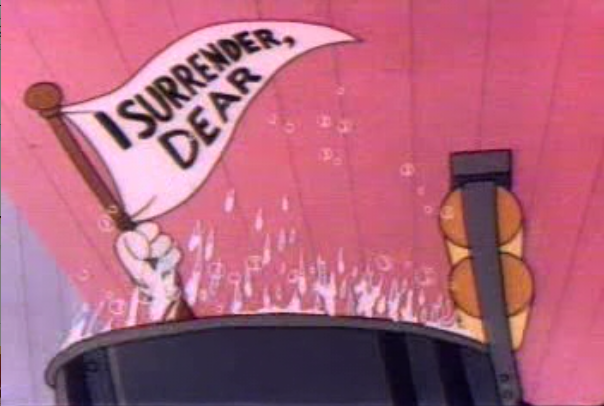
At the climax of the short - the weasel is defeated while suffocating in a wringer washer. To admit defeat, he holds a white flag to show his surrender - as evidently written. It's possibly a subtle indication of the audience's desires for peace from their enemies during the war.

Animation by Bobe Cannon.
Back home safe to his mother, he recounts the story on how he outsmarted the weasel. "But ah fooled him mammy, ah fooled him good!", the chick boasts. The mother cuts in, responding skeptically of his story: "Tellin' such big lies!". The chick insists he's telling the truth, with an injured weasel stepping in to back him up, in the hilarious closing lines: "He ain't just whistlin' Dixie, mammy!". Animator Bobe Cannon adds to the right touches with some exaggerated animation poses of the weasel's anticipated sneeze fit; which wouldn't likely appear under Chuck Jones' direction and character layouts.

Flop Goes the Weasel is a great representation of some of Chuck Jones' underrated works. The stereotypes are a possible factor to why the short hasn't been released to home media as well as being rarely seen in general. Despite the stereotypes outdating the short; there are still great elements altogether. The weasel shows a lot of entertainment and personality under one roof; and the newly-born chick's innocent nature creates a great foreshadowing of the weasel's fate. Chuck Jones completely went to town as far as experimenting with layouts and comedic timing goes: which is altogether a mixed blessing. The sneezing fits itself is a great example. Whilst the gags are very creative and full of energy; it is slightly padded to add up its running time.

Rating: 3/5.