Showing posts with label Looney Tunes. Show all posts

Sunday, 30 September 2018

425. I Got Plenty of Mutton (1944)

Warner cartoon no. 424.
Release date: March 11, 1944.
Series: Looney Tunes.
Supervision: Frank Tashlin.
Producer: Leon Schlesinger.
Starring: Mel Blanc (Wolf / Killer Diller).
Story: Melvin Millar.
Animation: Izzy Ellis.
Musical Direction: Carl Stalling.
Sound: Treg Brown (uncredited).
Synopsis: A raw-boned wolf, deprived of meat due to wartime rations; reads a newspaper about a sheepdog, leaving his flock to join the army. The wolf seeks an opportunity.

It's no secret that American civilians faced tough conditions on the home front during WW2. Rationing was enforced at a greater scale, from food resources to tires. But there was no shortage of humour, as far as the WB cartoons were concerned. A scenario involving a wolf, suffering from war-time rationing, paves the way for comedic opportunities - which will be broken down in this cartoon.


Once Frank Tashlin upgraded to making Technicolor cartoons (when B/W production ceased on the Schlesinger shorts); he slowly starts to turn his attention less on cinematic staging; and more on design and timing. His flamboyant cinematic style peaked with his B/W magnum opusesPorky Pig's Feat and Puss 'N Booty. Maybe Tashlin felt he exhausted himself on the technique; and wanted to look for other forms of innovation. Regardless, it would still provide a unique flavour to his cartoons.

In the case of this opening sequence depicting the wolf's suffering of wartime rations, Tashlin isn't thinking just cinematically. Instead, it's how character animation and direct staging can provide entertainment. It's no secret that Tashlin was also an avid designer, and the wolf in particular has an impressive, funny design that evokes starvation - especially on the deformed chest that's hunched from the rest of his emaciated body.

The opening sequence that serves as exposition for the wolf's starvation, is enough of a showcase for Frank Tashlin's versatility and calibre. From the newspaper on the table, the camera pans to an elaborate layout of the wolf's hands pumping out water into a pot. The camera pans to follow the wolf, walking from the foreground into the background, to place the pot by the fireplace.

Tashlin's timing comes into effect in a scene of the wolf shooing away the rats, who are stealing the wolf's rations by drinking from his weak meat broth. An appropriate multiple effect drawn on the wolf is applied to capture the wolf's incessant pursuit of survival. The wolf turns the cauldron over, realising his broth is now significantly rationed to the point of a singular drop of water.  Tashlin's timing comes to aid as the wolf gets ready to take the last drop until a rat zips into the scene, and on top of the wolf's nose - taking the last drop for himself.


Tashlin's keen eye for entertainment results in how nicely executed it is. For instance, when the wolf pulls out the tureen from a dish - a mist of steam flows around the plate; obscuring what's on it. The steam unveils to reveal a pitiful, singular pea. The effect alone is both hilarious and powerful. The audience knows his predicament too well.

The wolf's frail design is taken advantage of in the following scene as he eats the pea. His frailty is so severe that the pea struggles to slide down his throat - as it zigzags across. In a vertical setup, the camera pans down to the body, with the pea landing at the bottom of his stomach and bouncing gently. With no animation on the wolf from the neck below, Treg Brown's sound work has nice touches to the entertainment values of this scene.

Tashlin's starvation sequence is a nice blend of how he directs a scene both comedically and powerfully. Some of the gags are quite sadistic, but it's executed in a light-hearted way to overlook that. Carl Stalling's score is foreboding in a sense of echoing the macabre subject of starvation. And yet, Stalling has time to apply his musical touches for comedic value - like the pea-eating gag.

And so, the wolf's delight - a newspaper headline reveals that dogs are being drafted for the war effort. An amusing photograph illustration reveals the emotional parting of the sheep dog and his flock; the latter who likely sense a premonition.

The wolf takes this chance to prey on the flock, and put an end to his starvation. Tashlin's feel for energy and characterisation are met with a series of fast cuts, to emphasise the wolf's full force and burning desire.

Tashlin already had roots with the technique, going back to his earlier directorial efforts like Porky's Romance (1937) or Porky in the Northwoods (1936). The effect was very encouraging, but less effective. By the time of this cartoon's production, Tashlin had already blossomed as a director - that the results proved successful.

Once the wolf leaps from the boulder to prey on the flock; there are a series of eclectic angles, ranging from wide-shots to close-ups. They all connect masterfully and the matter of seconds it takes, makes the result feel effortless.

Johnny Burton's camera department deserve special credit for successfully pulling off the point of view shot of the flock trucking in closer, during the dive. As a single frame, the flock are drawn within the background due to economic reasons. However, due to how quickly the shot goes; it doesn't detract from the experience at all.

After an excellent showcase of Tashlin's rapid-cutting endeavour, another niche of Tashlin takes form in the following scene. The wolf freezes at mid-air at the threatening sight of a fearless ram - who intercepts the wolf's ploy to eat the flock.

The wolf encounters a new dilemma -
as revealed in a Tex Avery-esque sub-heading.
The staging of the two characters is both broad and angular. Much of the animation is kept in a held pose - save for the wolf's hysterically sheepish grin. The use of limited animation conveys the comedy in an innovative matter - the fewer the drawings, the better the impact.

The wolf quickly looks at the newspaper again, to discover the identity of the ram, as Killer Diller--the new caretaker of the flock. And so, this results in a typical battle of wits sequence; full of fun animation and layout work.

Tashlin's sense of design and caricature is used broadly in a sequence of the wolf setting up his disguise. In the scene, animated by Cal Dalton, the wolf takes on the disguise of a sheep. Dalton's animation is grotesque in a sense that it's fitting with the character. It serves a purpose. The wolf attempts to enhance attractiveness by applying makeup on; but to little effect.

The use of caricature and cartooning is a hysterical showcase of ugliness - especially when the wolf puts on fake eyelashes that are hideously long. Dalton's animation typically involved pudginess in the characters he drew - and it seems he was a natural choice for this assignment!

Once the wolf poses in front of Killer Diller in his sheep costume, he becomes his own victim! The scene presents a good case of role reversal between those characters - the wolf is in sheep's clothing, while the ram becomes a lusty wolf!

Although sexual burlesque was becoming all the rage in animated cartoons (most notably starting with Tex Avery's Red Hot Riding Hood); it was being skirted around Hollywood movies too, during the early 40s. For example, Billy Wilder's The Major and the Minor (1942) is played harmless from the Production Code's point of view, but the film as a whole it's riddled by such sexual tension and tendencies.

Regarding this sequence, it's extremely suggestive from a visual standpoint. Take the close-up of Killer Diller, who's so horny that his curved horns erect, piping hot. On the face of it, it looks like a wacky cartoon gag, but the phallic symbol of his horns is extremely suggestive and hard to overlook.

Killer Diller embraces the disguised wolf, and lusts seductively with a French accent. Art Davis' animation in this segment exhibits his flair for personality animation, such as the subtle touches of the wolf looking for a club to hit Killer Diller, which bursts into energetic animation of the wolf whirling in a drybrush effect, after striking the club on a tree branch.

The disguise flies off the wolf, causing him to frantically escape Killer's arms and return to his disguise - in a surrealistic, topsy-turvy pose that almost feels inspired by the Cubism movement.

The remainder of the cartoon deals with the wolf trying to escape Killer Diller's consistent advances towards him. At a time of war, the wolf attempts to dispose Killer Diller with an anti-aircraft gun, but the ram pulls him inside, to kiss him.


The chase advances into the night - and for the first time, the wolf speaks, in a fit of rage. Exasperated, he tears off his disguise in a fit of outburst: "Look, ya dope! Look! I'm not a sheep! I'm not a sheep! I'm a wolf! I'm a wolf!"

Unfazed, Killer Diller responds: "So what...so am I!" and howls. The sexually risque dialogue and hilarious topper of a closing gag also feels genuine. No matter what the circumstances are - love can be found in all sorts of weird places. The bona fide spontaneity and sophistication of the innuendo is what makes Warner Bros. stand out from the rest! And indeed, it predates the immortalised ending from Wilder's Some Like It Hot - which was surely coincidental. Great minds think alike!

For a cartoon that favours pantomime over dialogue; it could've been a natural assignment for Chuck Jones to direct; but Tashlin's masterful directing proves that any competent director is capable of handling such material! Despite the wartime themes, this cartoon still feels timeless due to its simplistic battle-of-wits formula. The writers at Warner Bros' ability to make light of real-world problems, like wartime rationing, is remarkable; especially when they take on a cliched narrative that becomes less cliched and more spontaneous. Amongst several sexual-oriented cartoons that occurred during this era, Frank Tashlin's take has a more sophisticated quality; whereas, say, Bob Clampett's is more gross-out, and Tex Avery's more boisterous. Overall, Tashlin's tricks of the trade resulted in a highly entertaining, spontaneous cartoon that emphasises why the Warner cartoons are worth a damn!

Rating: 4/5.

Saturday, 19 May 2018

423. Tom Turk and Daffy (1944)

featuring PORKY PIG
Warner cartoon no. 422.
Release date: February 12, 1944.
Series: Looney Tunes.
Supervision: Chuck Jones.
Producer: Leon Schlesinger.
Starring: Mel Blanc (Porky Pig, Daffy Duck), Billy Bletcher (Turkey).
Story: The Staff.
Animation: Ken Harris.
Musical Direction: Carl W. Stalling.
Sound: Treg Brown (uncredited).
Synopsis: Daffy Duck protects a turkey from becoming a Thanksgiving dinner, hunted by Porky Pig. Soon, he turns into a "stool pigeon" by betraying the turkey's trust.

Before I commence with the review; I'm not going to theorise too much on the story credit for this cartoon. The context of "The Staff" credit has been forgotten overtime; much to the chagrin of some cartoon fans. Don't take my guess for granted; but I believe it was simply a joke by the Schlesinger crew. After all, would 1944 audiences really care on who wrote the cartoon?


If I had to pinpoint a writer, I'd say Mike Maltese, or maybe Ted Pierce. Then again, Leon Schlesinger also employed gagmen in his service. Hubie Karp worked as a gagman for Michael Maltese, although he wasn't hired until late 1944. Any idea who might've worked alongside Mike around the time of the cartoon's production?

Onto the review: Porky and Daffy continued to be a successful duo in animated cartoons, that a hatful of story opportunities were open to them. For this cartoon, the locale is centered during the Colonial era. Porky assumes the role of a pilgrim, hunting for a turkey to feast for his Thanksgiving dinner, but Daffy intervenes by hiding the turkey from harm.

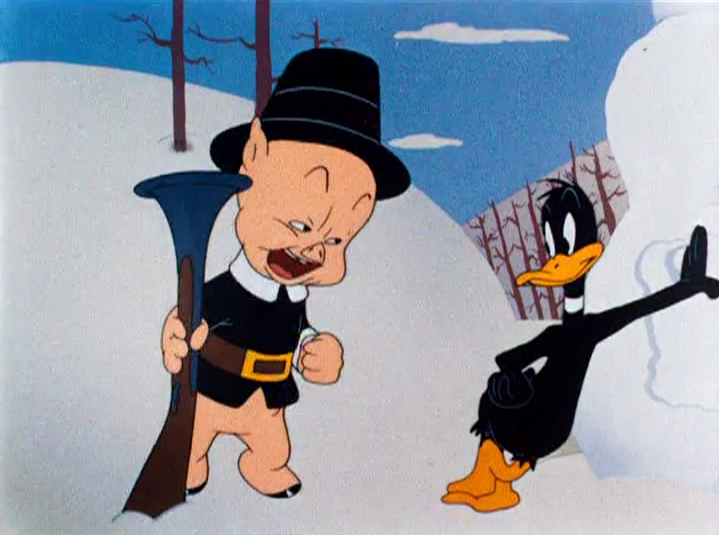
The opening sequence serves as exposition for the entire cartoon. In a wintery scenario, Daffy is contentedly building a snowman. Daffy reacts to the off-screen gunshots in a vigorous manner, as broadly depicted in the frame grab. Daffy encounters a desperate turkey, vulnerable from the shooting.


Some wonderful character animation from Bobe Cannon who depicts despair and cowardice in a comical fashion. The turkey cries, "Don't let 'em kill me! I'm too young to die! I've got my whole life before me: love, travel, good books!", and proceeds to climb on top of Daffy, whose weight burdens him, yelling and sobbing "HIDE ME!".


Daffy's nonplussed expression as he sinks slowly in the snow is priceless. It's a beautiful presentation of how one might respond awkwardly to such a plea.

Billy Bletcher clearly has a blast with his vocal performance for the turkey's plea - and wonderfully versatile in vocalising comedy. It's more refreshing from the standard, villainous voice; for which he was typically typecast in cartoons.

Animation by Ken Harris.
Ken Harris' animation beautifully portrays Daffy as ignoramus by showing that the character has no consideration for the turkey's well-being, by physically forcing him down potential hiding places; to no avail. First, he attempts to hide the turkey under a lump of snow and in another attempt down a rabbit hole.

Daffy's characterisation is portrayed in a hilarious fashion, as he jabs the turkey with a pole down the hole, until he reconsiders: "Nah, even more obvious-er."

Daffy's ideas for hiding places become even more hysterically ridiculous as he tries to stuff the turkey inside a narrow tree. Whilst Porky is seen from the distance, Daffy chooses the final hiding spot; and hides the turkey inside a snowman.


Once Porky arrives and meets Daffy, he guards the snowman and attempts to stall Porky. To begin with, Daffy appears to be resilient and defensive; by declaring: "My lips are sealed." In a close-up; Daffy's "loyalty" is featured as a visual metaphor, with a dissolve of padlocks and a vice; supposedly closing his bill tight.

The opening scenes have already established the premise in a precise manner. Daffy hides a turkey, and defends him from hunter Porky. This paves the way for some comedy opportunities based on these characters. Daffy is clearly portrayed as careless and ignorant - so it begins to transcend that.

Porky walks away with disappointment, complaining: "I had everything ready for a nice, big turkey dinner." The following close-up exquisitely illustrates temptation and battling good vs. evil. Daffy is enticed by Porky's remarks about a roast dinner, so much so, that he desires it. Without being wholly corrupted; he forms like an angel, declaring: "I'm no stool pigeon." But, his halo disappears and devil horns appear at the thought of cranberry sauce!


Background colour play a pivotal part in Daffy's torn emotions. He's literally "torn" to the point when the colours are divided to coincide with the staging of the scene. A celestial blue colour depicts his willingness to do good; whilst a more vibrant purple colour suggests a sinister nature consuming him.

Chuck Jones' posing are broad and nutty in a sense, but Daffy's emotions feel very human in his hopeless attempt in fighting temptation; and his corruption. The point-of-view shot of Porky walking away is crisply inter-cut to evoke Daffy's increasing impulse.


Alongside mashed potatoes, chestnut dressings and greened peas; a favourite of Daffy's, candied yams, was also prepared for Porky's dinner. So, Daffy breaks down crying as he bellows: "The yams did it! The yams did it!". He impersonates a stool pigeon and begins to coo (squeal), indicating that Daffy is perfectly willing to reveal the turkey's whereabouts.

Daffy's breakdown serves as an unforgettable scene throughout his entire legacy. Succumbing to temptation and attempting to divert the blame correlates with the human mindset, and yet his betrayal is impeccably funny; right down to the animation and Mel Blanc's voice work.

Of course, like a Chuck Jones cartoon, Daffy directs the turkey's location to Porky with numerous signs, as though his desire isn't escalating any further. Dissolve inside the snowman, the turkey refers to Daffy as: "quisling".


The cartoon takes a different direction with the turkey plotting retribution for Daffy's treachery. The turkey steps in as a plot device to turn the conflict towards Porky and Daffy, rather than what the opening exposition established.

The turkey trails under a pile of snow and hides behind a remorseful crying Daffy. He sacrifices his own feathers to plant them on Daffy's rear end (without his knowledge), and gobbles to attract Porky's attention.

With the exception of Bugs Bunny, the Schlesinger cartoon writers knew fully well that their characters were dumb and unsophisticated. Despite just meeting Daffy a moment ago, Porky completely overlooks this and takes Daffy for a turkey. Daffy's denial isn't enough for the obtuse Porky; which puts him in a vulnerable spot.

Several gags during the chase sequence feel like a throwback to early Chuck Jones cartoons, which involved inanimate objects personified to challenge the character. This is evident in the scene of Porky getting attacked by Daffy's snowballs. Snowballs strike Porky from different directions, including two from opposite sides. Porky comes face-to-face with a large snowball, who mimics every  movement of his. Daffy arises and strikes him with a mallet.


Although Chuck had explored these gags several times in his earlier years (i.e. Elmer attempting to blow the candle out in Good Night, Elmer), the timing is advanced and the gag is kept spontaneous; with Daffy merging from the large snowball.


Further gags take advantage of the winter locale in the cartoon. Daffy fills up a bucket from a lake and tosses the water out of it. The running water solidifies into a piece of ice, and strikes Porky - with forceful timing to illustrate pain.

Daffy showcases his zany ability as he loiters by a tree and pours a glass of water over him, forming into ice. Porky's attempt to crack the ice with his gun creates a comical staggering effect from Ken Harris' animation.

Chuck Jones' innovative use of funny expressions are uniquely showcased in a scene of Porky that's remarkably broad. Porky has been fooled by Daffy from the "toll bridge" gag. He skids from the snow and has a moment of thought. After a series of visual gags highlighting Porky's stupidity, he completely boils up. Porky slams his gun in the ground and is all-out exploding with rage. He anticipates a huge sprint, as he digs up a lot of heavy snow before he exits the scene - animated sublimely by Bobe Cannon.

During the buildup, Porky goes through several angry expressions which are very far-fetched for a character whose relatively tamer compared to Daffy, or even Bugs. It's a unique form of outrageous posing that has seldom been seen in Porky or since. It's a pity that Cannon reportedly despised animating broad and wild, despite how well he excelled in it.

The wildness doesn't end, as during the chase, Porky's rage and speed are executed in a perilous and yet exaggerated sense. To begin with, he transforms into a war tank; symbolising force and danger. Such a gag easily rivals the more outlandish gags Tex Avery would conceive. The great use of energy in Porky's wrath causes a snowy hill to break open into a chasm. The cutting and timing of the chase scenes are a contender for Clampett's more flamboyant energy.


The final scenes of the cartoon are represented as a bookend to the entire cartoon. The turkey is contentedly building a snowman, but is ambushed by a cowardly Daffy. It perfectly matches the opening scene, to demonstrate the changes made through the course of the cartoon - and the heavy emphasis on the characterisations reverse.

The turkey gets the last laugh, as he deliberately re-enacts Daffy's careless attempts to hide the turkey. Soon, his "attempts" to hide Daffy turns ruthless as the turkey kicks Daffy up a tree; and cuts the tree down with an axe, causing it to land on his body.

The fast-cutting becomes very slick and abrupt to showcase the turkey taking pleasure in fulfilling retribution on Daffy. For the final scene, the cartoon ends very appropriately on the turkey continuously beating up Daffy Duck into the night - long after Porky Pig is out of the picture.

So far, Tom Turk and Daffy has become one of Chuck Jones' fastest paced cartoons; and definitely worthy of rivalling Frank Tashlin or Bob Clampett. The writing and structure is sublime and true to the animated cartoon spirit, and the conflict is executed hilariously from a writing standpoint between the three characters; that it keeps the whole viewing experience engaging and spontaneous. I can't emphasise enough on how overly entertaining this cartoon is; all down to its impeccable wit and execution.

Rating: 5/5.

Sunday, 9 July 2017

419. Puss n' Booty (1943)

Warner cartoon no. 418.
Release date: December 11, 1943.
Series: Looney Tunes.
Supervision: Frank Tashlin.
Producer: Leon Schlesinger.
Starring: Bea Benaderet (Woman); Mel Blanc (Hiccups).
Story: Warren Foster.
Animation: Cal Dalton.
Musical Direction: Carl W. Stalling.
Sound: Treg Brown (uncredited).
Synopsis: Rudolph awaits for a new canary to arrive, with the intention of eating it. Little does he realise how resilient his prey is.


By April 1943; Warner Bros. had ordered for all cartoons from the Looney Tunes series to be produced in colour for the 1943-44 season. Not only would all of Leon Schlesinger's cartoons feature colour, but the distinction between the Looney Tunes and Merrie Melodies segment would cease to exist. Prior to the demand, only a handful of cartoons from the series were still being produced in black-and-white under Frank Tashlin.

Tashlin's first few cartoons during his second directorial stint at Schlesinger's that screamed with lavish film techniques and strong uses of cinematic staging. Once Tashlin moved over to colour cartoons - he begun experimenting more with design work and angular movement.

For the final Looney Tunes short produced in black-and-white; Tashlin ends the tradition with a satisfying sendoff. If Porky Pig's Feat was Tashlin's finest cartoon in terms of its successful use of comedy and experimental filmmaking blended together; then Puss 'n Booty is arguably Tashlin's finest cartoon as far as dynamics, pacing and audacious camera angles.

The cartoon's premise is a cliched formula, which consists of a duelling cat and canary. Warren Foster brings innovation to the characterisations - by making a seemingly harmless canary more potent based on its true colours. Foster finally has an opportunity to showcase his talents as a story man. Although he worked on many classic Bob Clampett cartoons - the stories always feel more like Clampett's than Foster's. The concept is largely a forerunner for the Sylvester and Tweety series. The cartoon itself would be remade with the duo in I Taw a Putty Tat (1948). Frank Tashlin turns such a formula-ridden idea into a cinematic experience!

Tashlin's ability to stage animated scenes in the style of a cinematographer never fails to impress. Such planning might've been a burden for the layout artist or the cameraman; but the results were worth it.

In the opening scene of the lady entering her house, the shot is depicted from point of view. The camera pans at various corners and edges of the house; once the woman discovers the disappearance of her missing canary, Dicky - (gettit?).

Johnny Burton's camera department have the delicate assignment of nailing the timing of the panning; to make the simulated P.O.V. convincing. The mistress's point of view ends once her cat Rudolph, is introduced to the audience, supposedly snoozing away.

The mistress asks for the whereabouts of Rudolph, who shakes his head. The evidence is revealed once Rudolph accidentally hiccups bird feathers from his mouth. Tashlin applies some intriguing timing of the cat burying the evidence with him. Much of Rudolph's frantic action of retrieving the feathers consists of approximately twenty frames: one feet and four frames in animation, or just slightly under a second. The following frame immediately cuts to Rudolph pretending to be asleep; which looks very jerky in motion whilst freeze framing. Such jerkiness works to an advantage by adding emphasis of a cat, hiding his crimes.

Although Tashlin's keen usage of cinematography is evident, he doesn't go too farfetched to the point it could potentially interfere with scenes involving character personalities or bits of exposition. Tashlin keeps a fair balance between characterisation and cinematic techniques.

Following the opening; Rudolph's character is devoted some time - by establishing his conniving persona. He tricks his owner by opening a window, mimicking canary whistles, and pretending to cry of despair.

The mistress is tricked into believing the canary had flown away. A fair use of exposition reveals that five canaries have been eaten by Rudolph in a month - but "lost" from the perspective of the owner.

It always strikes me as odd how the mistress never suspects Rudolph of her "missing" canaries, in that short span of time - especially when her cat is home alone regularly. I'd imagine Rudolph pulls the same trick on the lady for each canary. Such naivety would be legit for a Warner Bros. cartoon, that oughtn't to be questioned.

The sequence ends with a simple solution for the mistress: order another canary from the pet shop - to the satisfaction of both the lady and Rudolph. The shot of Rudolph curling around his owner's legs is very striking and insightful of the character - who hides his sinister nature in the presence of the lady. Rudolph's two-faced personality and motive has firmly been established by the end of the sequence.

Suspense and tension begins to build during a sequence of Rudolph impatiently awaiting for the delivery of the canary. The dreaded wait is hilariously illustrated through Art Davis' animation. Rudolph paces back and forth on top of the front wall of 1605 Maple Drive. Once Rudolph turns to pace back; his head turns after his body begins walking!

Carl Stalling's music enhances the tension of the wait - further emphasised in Rudolph's restless walk cycle on the wall. Stalling also briefly uses a part of Powerhouse with a tense musical arrangement that fittingly provides atmosphere to the cat's desperation.

Tashlin experiments with scene transitions when a different truck representing a gas company drive past the house. Rudolph is already standing on the sidewalk; attempting to attract the attention of the driver by literally ripping off the house sign from a brick wall!

In a side shot, the truck drives through the shot - but once the vehicle disappears, Rudolph has returned to pacing anxiously on top of the wall. It's a dangerously ambitious piece of staging, that makes the transition very unique as far as timing's concerned.

Already Frank Tashlin was gradually experimenting with angular, stylised poses for his characters. It would eventually take its course during his last few cartoons for Warner Bros. - but elements of it started to crop up in his black-and-white shorts. A scene of Rudolph whistling desperately for the pet store van is not only broad in animation; but also shape-like in proportions.


Once the delivery man walks to the front door of the house; Rudolph discreetly sneaks behind. Rudolph's tiptoe cycle is economical, but without lesser quality. Rudolph's body is a held drawing, but only his paws and feet are animated. It's an innovative, stylised piece of animation that might cut corners, but still exemplify Rudolph's slyness.

It looks like Tashlin was influenced by the avant-garde layouts Dave Hilberman provided for him. In one shot; Rudolph's body aligns with the shape of the porch steps as he follows the delivery man carrying a cage.

By the time the canary, now named Petey, has settled into its new surroundings and left alone from the mistress - the action begins. Extensive use of fast-cutting and perspective heightens the tensity of the scene. To begin with, the mistress places a saucer of milk on the floor and leaves the scene. Rudolph spits out the milk with heartfelt disgust, and sneakily advances towards the birdcage.

Perspective animation is applied to create the illusion of a continuous shot; as Rudolph's body obstructs the camera, and walks to the birdcage - facing rearwards at the audience. The technique isn't quite perfected, as an obvious cut occurs once Rudolph's body blocks the camera. It's a daring device that deserves credit for effort.

After the elaborate perspective shot; Tashlin's fast-cutting makes up a lot of the action of the cat pouncing coinciding with the canary's reaction. The intercutting builds suspense and danger for the canary; whose seen as helpless from a viewer's perspective.

Spontaneously, the canary lifts the birdcage upwards; causing Rudolph to narrowly miss his prey. The spontaneous delivery of the canary is a nice payoff from Rudolph's pouncing action staged as a nail-biting moment. The cat crashes onto a wall; taking the physical shape of a coin that rattles on the floor after the impact.

The nighttime sequences occurring during the cartoon's climax; exhibits Tashlin's finest use of a cinematic mode. The layout work of Dave Hilberman (who worked with Tashlin around that time), is a masterpiece in dynamics. Each shot is uniquely staged and framed; and it flows effortlessly in continuity action. The build-up and use of dynamics are comparable to auteurs like Alfred Hitchcock or cinematographer Gregg Toland.

The scenario consists of very imposing camera angles, as well as an emphasis of low-key lighting and silhouette. It's largely a homage to the film-noir style of filmmaking - which was all the rage during 1940's Hollywood.

Samples of beautiful staging are too many to analyse. Very impressive ones feature a low-angle shot of the canary looking up at Rudolph sneaking up on the rafters. The scenes manage to use the 180-degree rule effectively from very complex camera angles.

Effects animation is strikingly utilised in a shot of Rudolph's paw seen in silhouette form - attempting to slowly catch the canary. Unexpectedly, the canary quickly responds to the threat by striking Rudolph's paw with a cartoon mallet. Elements of comedy are applied in this sequence; but the complex staging is applied extensively to emphasise suspense and buildup.

After an artistic tour de force of suspense and staging; the final battle between Rudolph and Petey commences. The cat pounces on top of the bird cage - resulting in some broad action of Rudolph crashing upwards and downwards. The canary almost encounters a close call; as he narrowly escapes the jaws of Rudolph.


The rest of the battle isn't seen, but interpreted through crashing noises - as the scene focuses on the disturbed mistress, who wakes up from her sleep.

The cartoon's ending works as a juxtaposition of the opening scene. In a throwback to much earlier, the camera pans across the room from the P.O.V. of the mistress, concerned of Rudolph's absence. She "awakens" Petey, asking: "Have you seen Rudolph?".

Petey shakes his head; but accidentally hiccups Rudolph's ribbon from his mouth - strongly implying his own demise. The punchline is both wacky in its depiction, if considering the laws of physics. The element of dark humour may be jarring; but serves as fine justice for poor Rudolph!

For the final black-and-white cartoon in the Looney Tunes series - you'd wish to see more shorts paying homage to the film-noir technique. Puss 'n Booty is perhaps Frank Tashlin's greatest cartoon, in terms of impressive staging and suspense. The use of camera angles are not only sublime; but its masterful pacing and structure that's almost equivalent to the works of Alfred Hitchcock. The short also remains funny in its characterisation and timing; with the talents of Warren Foster fulfilled. The canary is illustrated unpredictably - a fine showcase of how there's more than what the eye sees! Although the tradition of black-and-white would fade from the series - it's last cartoon is a testament of how visually appealing it can be.

Rating: 5/5.