Showing posts with label Private SNAFU. Show all posts

Tuesday, 3 October 2017

SNAFU: Booby Traps (1944)

Director: Bob Clampett.
Release date: January 1944.
Starring: Mel Blanc (Snafu),
Robert C. Bruce (Narrator).
Music: Carl W. Stalling.
Sound: Treg Brown (uncredited).
Synopsis: Private Snafu claims he's smart enough to spot
booby traps but soon finds himself inside a chamber
that consists of them.

Today's cartoon informs soldiers of the potential dangers of booby traps. As indicated by Bob Bruce's narration, some booby traps are "more alluring and ingenious than others." For entertainment and educational purposes, much of the devices and traps are exaggerated - a hint for soldiers to take no chances.

For the cartoon premise, Snafu's duty involves patrolling the North African desert. Although the base was abandoned by the Axis; a lot of traps remain intact to deceive the ignorant. Snafu however, mimics childishly: "I ain't no boob and I won't be trapped!".

Snafu's careless regard of duty is wonderfully emphasised by his carefree skip jump. To begin with, Snafu is almost deceived by a camel with a contact mine for an udder. Although Snafu realised the danger before it was too late; it serves as a foreshadow for what lies in store for him. Soon afterwards, he discovers a desert bordello, featuring multiple attractive beauties. Driven by sexual desire, Snafu lures himself inside the chambers - blinded by the potential consequences.

Animation by Rod Scribner.
Much of the traps established in this cartoon are burlesqued with sexual imagery. Snafu has already been established as a character with sexual desires - and how it corrupts his concentration. Snafu's sexual frustration becomes his undoing. It's fitting that Bob Clampett is assigned to direct this entry - who utilises his more juvenile, sneaky humour to its fullest extent.

Clampett uses the term "booby" cleverly throughout the cartoon. Earlier on, the narrator remarks: "If you are a boob, you will be trapped!" - leading to Snafu's denial of his "boob" persona. In the hands of Bob Clampett, a lot of fun can be made from the word.

Clampett later takes the "booby traps" concept literally during the harem sequence - by putting the 'booby' in booby trap. A lot of the saucy, risque humour serves as a hilarious plot device to fool Snafu.

Snafu is seated next to a barely-clad woman - increasing his arousal. He attempts to hit her on, "Hiya, toots! What cooks!". Snafu anticipates an action of slapping her rear end, but his hand gets a bad reaction from the impact - met by Rod Scribner's funny expressions, as seen in the screen grab.

In a revealing close-up; Snafu's hand moves around the curves of the buttocks to observe the texture. Unbeknownst to Snafu, the cheeks are replaced by circular bombs. He flicks the iron of the bombs - and impersonates Jerry Colonna, "Something new has been added!".

The girl's brasserie drops - also reveals her breasts to be explosive bombs! Snafu stutters with astonishment, utilised by Mel Blanc's hilarious delivery, "B-b-b-booby trap", and screams! The sequence remains hilarious as it's built entirely on visual gags, to enhance the alluring qualities of a booby trap. It still remains a fascinating insight of the liberties Clampett took, without the interference of the Production Code.

The cartoons also features one of the most recycled gags in the Warner Bros. cartoon library - Endearing Young Charms. The 1808 song, written by Irish poet Thomas Moore, has been immortalised by the WB shorts. Snafu encounters a piano, with a music sheet for the song. He attempts to play the first few notes - but hits the wrong key, which happens to be connected to a bomb device!


After hitting the wrong note several times, Snafu quickly gives up: "Ahh, the hell with it! I never could get that last note anywho!" - and moving on to the next booby trap.

Warren Foster repeated the gag several times in some of Freleng's cartoons, notably Ballot Box Bunny (1951), and Show Biz Bugs (1957). The gag might've originated in a Clampett cartoon - but overtime, the gag was refined and timed out better by Friz Freleng for comedic value.

The gag was used to enhance funnier conflict, whether it involved Yosemite Sam or Daffy Duck. In this situation, it highlights Snafu's naivety and ignorance.

The gag continues its purpose later in the cartoon, when a Hitler-esque mechanical figure chimes the correct notes of the song inside Snafu's ear. And so, Snafu rushes inside the harem; to play the correct notes - only to end with his demise! Snafu's vulnerability towards booby traps is further exaggerated in the final gag. Even in heaven, Snafu's harp is a booby trap!

Although Clampett only wound up directing two Snafu cartoons - Booby Traps showcases some of his most risque humour that serves as his pride in his work. By putting the "booby" in booby trap; some of Clampett's more juvenile tastes adds up to a charming cartoon - supported by hysterical character animation and pacing. The use of Snafu's sexual desires to multiply his danger - works wonderfully in comedic values! At the same time, the message still serves its purpose. Each soldier must be very cautious whilst patrolling the enemy's barracks - no matter how sexually frustrated or one soldier can be.

Friday, 14 July 2017

SNAFU: Rumors (1943)

Director: Friz Freleng.
Release date: December 1943.
Starring: Mel Blanc (Snafu / Various voices); Frank Graham (Narrator).
Music: Carl W. Stalling.
Sound: Treg Brown.
Synopsis: Snafu spreads a rumour about a recent bombing that grows more exaggerated - eventually leading a panic at the base.


The Snafu series utilise the message of "loose lips sink ships" satirically yet effectively, like in Spies, which exaggerates the potential threat of eavesdroppers. Rumors follows a very similar message; but it also illustrates the potency of rumours and its side effects.

Rumours and gossip might be a part of human nature, but it can be dangerous for a large number of factors. It's an endearing feature of the human psyche; evoking emotion and sparkling attention. The more spread the rumours are, the more exaggerated and ridiculous they become. Rumours that become misleading can potentially start panics amongst soldiers - creating distractions and weakening courage.

The opening sequence showcases Snafu's ignorance as he misinterprets a fellow comrade's remark, "Nice weather for a bombing" during small talk in a latrine. Diagram shots are applied heavily during the opening scenes; such as Snafu's mind visually portrayed as a hot stove, receiving and repeating: "Bombing weather".

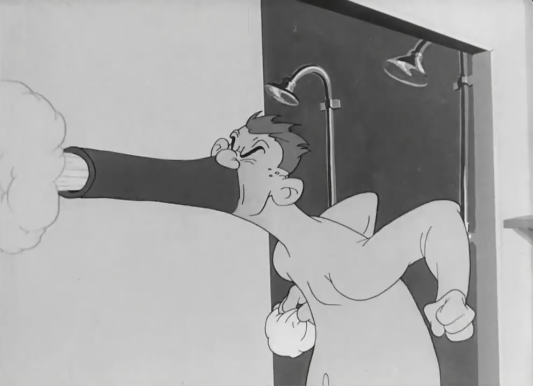
This motivates Snafu to begin a rumour next to a man shaving. So, Snafu tells him about a possible bombing occurring at their base. The use of visual metaphors applied in animated form are innovative in its portrayal of how gossip travels - such as the "hot air" shown as steam ascending to the listener's ears.

So, the listener informs the rumour to another person - but more misinterpreted than Snafu's message. Frank Graham's narration supports the diagram shots of the human mind, as he remarks: "That's right, exaggerate it! Stretch it! Multiply it!". The diagram of a listener's head reveals its mind operating like gears; as mechanical hands stretch out a piece of baloney.

Consequences of travelling rumours are largely satirical throughout this cartoon. The rumours are personified through imagery as zany-looking characters who fly through the camp once the gossip spreads like wildfire. To begin with, the rumours are symbolised as "flying baloneys". The visual metaphor/pun literally features flying pieces of bologna with wings.


The layout work is stunning by portraying anxious soldiers speaking of rumours inside their tents. The soldiers are featured in silhouette - an effect used similarly for the celebrating clowns in Disney's Dumbo.

The rumours grow more exaggerated, as soldiers speak such tales like: "They blasted the hell out of Brooklyn Bridge", "What's the matter with our planes? They popped them off like kites!". In one tent, it sounds like Mike Maltese and Ted Pierce provided their voices to some of the conversing soldiers.

Much of the surreal imagery in this cartoon feels heavily influenced by Ted Geisel's (Dr. Seuss) work. Geisel had contributed to the earlier Snafu cartoons and his presence is felt as far as visual storytelling and character designs are concerned. Such analogies like the "flying baloneys" are used to represent false information taken seriously, and the possible consequences following.

Animation by Gerry Chiniquy.
Soon enough, the rumours begin to haunt Snafu in surrealistic fashion. In a sequence of Snafu eating breakfast inside a mess hall; the piece of bologna begins speaking to him - claiming it has "nothing to fight with". Once the piece of meat flies away, Snafu ignores it by cracking a boiled egg - causing a horned bird to arise, shouting: "And furthermore, the Japs are in California!" (line corrected: see comments below).

The following climax is a hilarious and yet surrealistic portrayal of Snafu's panic amidst flying baloneys or horned creatures taunting him of such rumours. The visual imagery represents how rumours can haunt the person who begun them.


So, Snafu runs across the army camp; attempting to seek refuge from the gossip; but he can't escape them. He attempts to escape inside dustbins and on telephone wires, but discovers even inanimate objects are plagued by rumours.


Much of the creepy imagery feels like a throwback to early 1930s cartoons produced by the Fleischer Studios or Van Beuren - the former's Swing You Sinners comes to mind. The use of inanimate objects briefly forming to life is certainly feels reminiscent of that era.

The climax involving Snafu attempting to escape the zany creatures are disturbing enough in execution. Friz Freleng's cutting style and the use of voice effects add to that effect. They haunt Snafu with more outrageous rumours concerning the war: "The Russians have surrendered", "The British are quitting", etc. Soon, Snafu falls to the ground after falling off a flying baloney - as he falls, a cloud of dust speaks melancholily, "It's all over. We've lost the war...", until Snafu crashes.

At the cartoon's resolution; it's been revealed that the army camp has been quarantined for "rumor-itis". The camera pans to a padded cell, which dissolves inside to reveal Snafu as a patient, driven insane by his rumour episode. Snafu wriggles and incoherently blabs "Rumours", whilst laughing hysterically.


Snafu stops wriggling and momentarily regains his conscience, remarking: "Nice weather for a rumour". A baloney arises from a patch of padding with both characters jumping across the cell.

After the cartoon's iris close, an additional gag is inserted of a cameraman rolling a film camera. He forces a piece of bologna inside the camera like a grinder - with slices falling from the lenses. The cameraman turns at an angle facing an audience, with the camera trucking in on the words: "Sees - Hears - Knows - Nothing". The gag is a nice little touch that sums up the unreliability of rumours. The composition of the scene serves as a parody for the closing newsreels featured in Paramount News.

All Snafu cartoons are built around morale and hard lessons, but Rumors remains unique for portraying an important message in surrealistic fashion. The use of "flying baloneys" are absurdist in its conception - but it's an innovative portrayal of how dangerous rumours can be, and the possible consequences that even a nation could suffer from. The themes are dramatised through both wit and nightmarish scenery. Friz Freleng enhances the zany imagery believably; enough to make the creepy imagery have a lasting impact amongst army recruits watching this short. Despite the cartoon's age; its overall message and theme hasn't dated at all. It remains a strong testament of how rumours can travel fast through word of mouth, and before the existence of social media or e-mail!

Tuesday, 27 June 2017

SNAFU: The Home Front (1943)

Director: Frank Tashlin.
Release date: November 1943.
Starring: Mel Blanc (Snafu).
Music: Carl Stalling.
Sound: Treg Brown.
Synopsis: A homesick Private Snafu complains about the easy life of civilians like his family. However, he discovers they're also contributing to the war effort as he does.


Wars have the tendency of highlighting soldiers fighting combat as well as bearing the burden of military life. It's a pivotal example of war duty - but so is the home front. For civilians who are uninvolved in combat (whether it concerns the elderly or folks with 4-F ratings), society can contribute to the war effort through various kinds of factors. It ranges from various resources such as industrial or human, so the home front is still significant to a cause. The Snafu cartoons themselves were a contribution to the war effort. Every bit helps!

In this entry, Private Snafu underestimates how other forces contribute to the war effort besides armed forces. With magical guidance from the Technical Fairy, Snafu observes the various home front duties that's all beneficial for the war effort.

An intriguing element in this short that's set apart from a lot of Snafu cartoons is the character's relatively passive role. A chunk of the cartoon focuses on Snafu's family, based on what he thinks they're doing in contrast to what they're really up to. Instead of calamities that characterises Snafu; he is portrayed as an observer in this cartoon instead.

Nevertheless, Snafu's presence is felt during the cutaway sequences surrounding his family. Each of his family members are stereotyped based on Snafu's observations. He assumes his father is casually playing pool at Kelly's. His mother is portrayed as gossiping away with her lady friends whilst playing bridge.

Frank Tashlin uses sight gags as little touches to personify their apparent nature. His father uses his cigar smoke to push a cue ball that's standing at the edge of the pocket. His mother and her friends visually dissolve into a flock of hens. Such gags are amusing in Snafu's unfair interpretations of their family.

Perhaps the most hilarious observation from Snafu is seen from his interpretation of his grandfather - who he claims, "never did a day's work in his life". He is stereotyped as a perverted old coot who pleasures himself of using his binoculars to watch stripteases at a burlesque show. Some great lustful exaggeration is prominent in a shot of his eyes erecting through the binoculars.

A more personal perspective from Snafu is his girlfriend, Sally-Lou. His paranoia kicks in at the thought of her already having an affair with a sophisticated philanderer. All those stereotypes are funny interpretations based on Snafu's homesickness - which makes him relatable as a character.

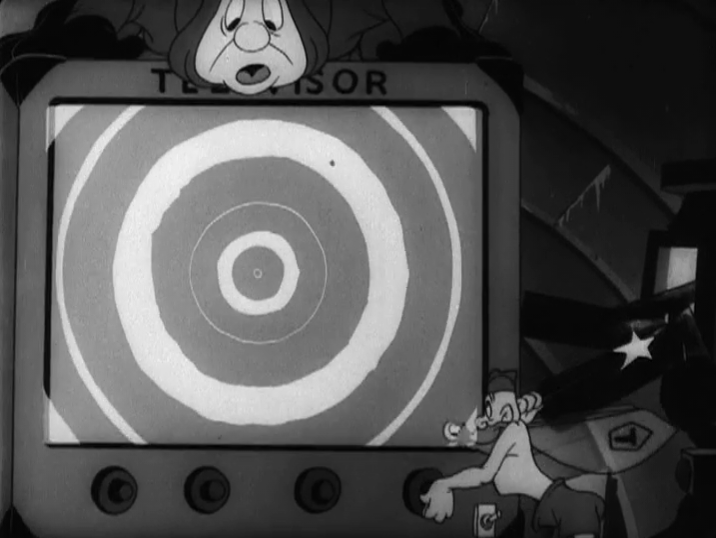
By the time the Technical Fairy arrives - he gives Snafu a special insight of his family's current activity through a telelvisor - which today, is a dated noun for a regular television set. Since television was a relatively new invention in 1943 - it's exaggeratedly portrayed as a magical device to watch people's current lives. As Snafu discovers; his father and grandfather are both contributing to industrial resources, his mother is planting a victory garden and Sally-Lou is working as a WAC. By the end of the short, Snafu comes to his senses when he realises his family are all "working in the old home town" - sung in the style of Tenting On the Old Camp Ground.

Frank Tashlin utilises some his knowledge of camera panning during the opening scene of Snafu inside a shelter during a blizzard. His only source of comfort is a phonograph ironically playing Home Sweet Home. The camera pans to the record player, then pans towards a miserable Snafu attempting to keep warm by sitting on a stove. The camera pans back to the record player, which violently malfunctions and breaks apart.


The camera pans back to Snafu when he expresses his homesickness by complaining about a possible luxury his family are having back home: "They don't even know there's a war goin' on!".

It's a complex use of camera pan that's consistently kept busy throughout the sequence. If you're aware of how cels, backgrounds and camera stands compile together, it's a great deal of effort. Frank Tashlin is fearless when it comes to taking the liberty of moving the camera much more freely. This allows the scenario to have more space instead of a claustrophobic atmosphere.

Frank Tashlin appears to approach some economic tactics in his direction - likely attributed by the smaller budgets the Snafu shorts provided. Economical or experimental, Tashlin utilises both in scenes that contain little or no animation.

Tashlin explores his timing abilities in sequences that contains no animation. This is especially evident during the victory garden sequence dug up by Snafu's mother and her pets. After ploughing the garden and planting the seeds; the crops grow rapidly to great effect.

This is achieved with no animation and the crops are likely drawn on separate levels. The effect would've been heavily reliant from the skills of Johnny Burton's camera department - who "animated" the crops growing. Not only did the department have to carefully time the effect; but also in rhythm to Beethoven's 5th symphony.

Snafu's girlfriend in a figment of the nightclub scene is drawn as part of the background. Only the seductive gentleman is completely animated in the shot. One could say it's merciful in sparing the animator from painstaking drawing skills. However, she is very passive and aloof to the gentleman during the scenario; so full animation would've been unnecessary. It showcases Tashlin's judgement of using economical factors to good use.

Elements of risqué humour are no secret in Snafu cartoons. Some of the more edgier gags surface in this short. For example, in the opening shot of a blizzard, the narrator says: "It's so cold, it would freeze the nuts of a Jeep!". The context needs no explanation, but effects animation is applied to feature two nut bolts from a Jeep actually drop and fall to the ground. Keeping the context subtle makes the delivery all the more hilarious.


The burlesque sequence probably has the biggest shock value in this cartoon. Snafu's grandfather is watching a trio of young ladies performing a saucy strip tease on stage. Stripteases have proven a fun source for gags in several Warner Bros. cartoons; but never as indecent or obvious in this Snafu cartoon.

The trio strippers are seen completely bare; save their breasts and genitalia which are covered. Sometimes Frank Tashlin underplays the racy scenario as the camera trucks in on a girl's leg whilst undoing a bra. The assistant and drawing work in those scenes are a tad sloppy, but otherwise the clarity's all there. The series of shots featuring full-frontal nudity indicates the freedom the Schlesinger studio enjoyed from the Snafu shorts.

The Home Front is an intriguing approach for a Snafu short that doesn't follow a story arc. The first half of the cartoon features Snafu's interpretation of how he sees his family back home; whilst the second half features them contributing to the war effort. Frank Tashlin would be an appropriate candidate for a cartoon that doesn't rely heavily on formula or structure. Not only is this cartoon one of the rarest occasions where Snafu doesn't meet disaster, but also the downplaying of his role. It's takes a different spin on the premise's usual formula, but it manages to clarify its message just the same.

Tuesday, 2 May 2017

SNAFU: Fighting Tools (1943)

Director: Bob Clampett.
Release date: October 1943.
Starring: Mel Blanc (Snafu / various voices).
Music: Carl Stalling.
Sound: Treg Brown (uncredited).
Synopsis: Private Snafu brags about the U.S. having the greatest artillery, if properly cared. Once he approaches a Nazi - Snafu's incompetence and poor handling of fighting tools becomes unpromising.

To some extent, the cartoon is both propaganda and satirical. It has propaganda elements incorporated into it - such as: a U.S. front headline bragging about their soldiers having the best artillery in the world. However, there is a hint of honesty in the article - perhaps, to prevent unwanted arrogance from army recruits. It's reported that the U.S.'s fighting tools are superior - but only if they're handled properly. Bob Clampett has Private Snafu as a guide on how to screw up.

The propaganda tendencies are fairly deliberate - in order for satirical sequences of Snafu's arrogance and incompetence. Watch out for the small Hitler suicide headline on the front page, a hidden gag which Clampett appeared to take pride with - by using it previously on Tortoise Wins By a Hare and again in What's Cookin, Doc?

Bob Clampett applies an attractive montage of the different fighting tools the U.S. army have - with images of the artillery split between illustrations and photographs. Although the effect was used for propaganda purposes, it's a intentional setup on how Private Snafu would react to the news - with arrogance.

Indeed he does, the scene cuts to animated form of Snafu bunking in his tent reading the same newspaper. The ultimate comedy of errors sings with pride and arrogance, "I'll be the world's greatest hero - with these guns, I've have nuthin' to fear-o!". Throughout the short, Dr. Seuss' rhyming scheme is sung in the style of The Gay Caballero. A part of me ponders on whether the choice of melody was Clampett's or Theodore Geisel's vision.


The following scene cuts to a shot of Snafu's tent - surrounded by various fighting tools - like his gun and cannon, indicating his assurance of safety and invincibility. The scene features beautiful posing and animation acting by Schlesinger's master animator Bob McKimson.

Meanwhile, a mean looking Nazi soldier is crawling across the field, with a hand grenade attached to his hand. His offended reaction to Snafu's line: "My wonderful guns, will moider dem bums! / an' I'll bury them in their latrin-o!" is priceless in both caricature and exaggeration.

Once Snafu finishes his little song, he senses presence in the wilderness and pulls his shotgun digged in soil - the first sign of inadequate care on weaponry. Similar to Chuck Jones' The Infantry Blues,  a comedy rule of three is utilised throughout this cartoon to showcase Snafu's incompetence and his struggle to maintain his confidence.


As "cheeky" as Clampett goes, Snafu prods his gun right at the Nazi's rear end, yelling: "Stick 'em out, or I'll blow ya brains out!". Got to love the irony of Snafu's dialogue, as Snafu's gun is pointed elsewhere besides his brains.

The Nazi soldier reacts wildly to the weapon as he raises his arms, staggering. Watching the soil dripping from Snafu's gun, the Nazi regains his courage, commenting/singing: "That rifle looks just a bit goo-ey / If you 'tink I'm scared you're plum-screwy!".

A close-up diagram of Snafu's bullet desperately trying to shoot away from the bloated soil, shows controlled, solid timing - followed by an amusing squirt effect justified by Treg Brown's sound work. Intimidated, Snafu gives the soldier a Warner-esque sheepish grin (animated by Rod Scribner), until he bashes him with his gun, without second thoughts.


The following sequence of Snafu's attempt to frighten the Nazi soldier with a machine gun; is structured similarly to the previous sequence. Snafu will at first, intimidate the Nazi. At a moment of arrogance, he'll fire the machine gun at him. He'll keep doing so at the cost of overheating the gun into deteriorated condition.


So, the German soldier would return and sing: "That gun was neglected - no water connected!". Snafu's characterisation is established well by enhancing a morale that arrogance can be a factor of inadequate care.


The Nazi points out how their weaponry also work fine and are given the proper treatment and care. From what appears to be a rare insight on Nazis' strengths by American propaganda - it ends up poking at them, by revealing a close-up of a Nazi revealing a rusty pocket knife.

While the propaganda is still fairly biased, the timing of the Nazi revealing the pocket knife is effective and daring - with Treg's "boing" effect to enhance some comedy. Snafu timidly comments, "Yipe" - until he runs away from the Nazi - and onto Snafu's last chance of treating artillery with proper care.

Animation: Virgil Ross.
Like the previous two sequences; the following follows a similar structure. This time, the Nazi encounters a much more threatening weapon, the cannon. Notice how in each sequence; the weapons become more threatening.

Clampett's sense of comedy saves the German soldier from doom, as we encounter a hysterically camp-ish mouse - with sublime work by Virgil Ross and Mel Blanc's delivery. Ross adds some wonderful touches of the mouse swiping the dust from the cannon with its finger.

The Nazi learns further about the cannon's unstable condition as a group of ducks (resembling Daffy Duck), fly away from it - complaining about its stench. Clampett's charm is also enhanced as a baby duck, impersonating Katherine Hepburn, comments "Rally they are!" on the cannon's rusty state.

In response, the Nazi blows inside the cannon - causing the dust and debris to fly inside Snafu. Realising, all his tarnished weaponry is hopeless against the Nazi - he attempts to make an escape on his Jeep, but struggles to start the engine due to low car battery.

Clampett applies some nice dynamics of close-ups with the angry Nazi, that inter-cuts with a frantic Snafu struggling to start his Jeep. At that moment, he tosses the hand grenade - which meets Snafu's doom - but not by death.

The closing scene features a full-frontal naked Snafu held captive at a Nazi concentration camp. Clampett exploits the freedom he has from Production Code censors, by applying his juvenile tastes into nudity. The Nazi soldier has the last laugh, singing: "Like all careless gents / He vinds up behind fence / Snafu is the vorld's greatest zero!".

Ending with an Axis victory - Snafu looks at his buttocks, which morphs into a mule's rear end. The lesson learnt, to treat your fighting tools with the right care. While Private Snafu meets a tragic consequence as per usual - at least it's more light-hearted and humorous a la Bob Clampett.

This Snafu cartoon represents one of only two that were directed by Bob Clampett. I'm curious whether it's attributed by Clampett's habits of falling behind schedule - indicating his minimal output on Snafu shorts. Even so, he remains faithful to the series' premise, by offering his directorial talent to create more innovative disasters for Snafu. Although the Snafu shorts are built largely on dark comedy and morale - Clampett appears more interested in entertainment value and toilet humour. At the same time, he creates a fair balance of cartoon action and morale. Despite his low output on the Snafu shorts, it remains a fine effort.