Showing posts with label Ted Pierce. Show all posts

Sunday, 26 August 2018

424. Bugs Bunny and the Three Bears (1944)

Warner cartoon no. 423.
Release date: February 26, 1944.
Series: Merrie Melodies.
Supervision: Chuck Jones.
Producer: Leon Schlesinger.
Starring: Mel Blanc (Henry, Bugs Bunny), Kent Rogers (Junior Bear), Bea Benaderet (Ma Bear).
Story: Ted Pierce.
Animation: Robert Cannon.
Musical Direction: Carl W. Stalling.
Sound: Treg Brown (uncredited).
Synopsis: The three bears attempt to lure Goldilocks with carrot soup, but only Bugs Bunny arrives at the household.

If Disney mastered in evoking fairy-tale fantasy for his features and Silly Symphonies; then Warners certainly mastered in satirising them. Several adaptations had been done on Goldilocks and the Three Bears in animated cartoons, particularly Ub Iwerks and Terrytoons. Tex Avery directed a "semi-epic" version, in The Bear's Tale.

For this cartoon, it's an unwholesome take on the more endearing tale. The three bears are portrayed as a dysfunctional family, each having a distinctive personality and defect. Papa Bear (or Henry) is depicted as the smallest sized of the clan, who bears (no pun intended) a Napoleon complex. Junior Bear is simply an overgrown, differently-abled child (a la Lennie Small), whilst Ma Bear is the long-suffering, passive wife, burdened with a deadpan expression.

The family portrayal is more cynical than the "ideal American family" image audiences might expect to see in a Andy Hardy picture. In this case, the three bears are the kind of family one might find in a rough and disreputable neighbourhood. One could say it's a prototype to the dysfunctional family comedy, long before Matt Groening popularised it in The Simpsons.

Animation by Bobe Cannon.
The opening scene introducing the three bears living in poverty is pure exposition. Their situation is already established based on their expressions: frustrated and hopeless. This is clarified through held poses for each characters; save Pa Bear drumming his fingers. Carl Stalling's wholesome rendition of In an 18th Century Drawing Room  nicely contradicts the sour atmosphere of the household.


Junior breaks the ice as he wails, "Dad, I'm hungry"; retaliating the abusive Henry to clobbering him on the head, yelling: "Shuddup, Junior! Can't ya see I'm thinkin'?" Already, the audience are aware of how run-down the family are.

Truck in on Henry as he ponders and thinks - (wouldn't it have been easier and less confusing to omit the mouth movement, since dialogue isn't called for?) And so, he pitches his new plot to his family: "Remember the story of the Three Bears? Well, why can't we do the same thing? But when Goldilocks goes upstairs to sleep...WHAM!"

But, Ma informs Henry that there isn't porridge for "Goldilocks" and only a handful of old carrots - a nice piece of foreshadowing on Bugs' part. Infuriated, Pa is forced to compromise: "Well then, make carrot soup!"

This scene, and like so many in this cartoon, suffers from poor assistant and cleanup work. Bobe Cannon's work in this sequence isn't met with justice and it's evident that his work needed a more skilled assistant. For example, the animation of Pa Bear on the table lacks weight and has a floating feel.

The following sequence explores the personalities further, based on how the three bears interpret their line readings during their reenactment of them having carrot soup. In the line: "My soup's too hot"; Ma delivers it in a scatterbrained manner, whereas Henry half-asses his line unenthusiastically. Junior Bear, however, slurps his soup sloppily and delivers the wrong line: "Somebody's been sleeping in my bed."


The timing of Pa hitting Junior with a spoon works to a tee, and the abusive comedy opens for some gag opportunities; which were used several more times throughout the short.

And so, Ma Bear awkwardly delivers her lines, "Now, let's all go for a...walk. And when we return, the--porridge will be--just right." Hysterically, the bears stroll out and back in the house; even putting on a performance that they're a healthy and functioning family. They end the masquerade once they hide behind a curtain under the stairs.

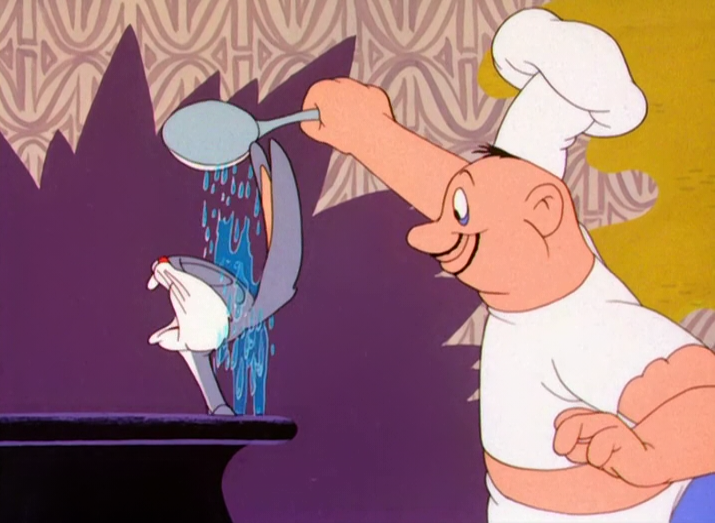
The scent of carrot soup soon lures Bugs Bunny inside the cottage and he starts to guzzle the soups on the table - forcing the bears to disguise themselves as bear rugs. It's a relatively slow-paced sequence on Bugs' part whose calibre isn't fulfilled. The only source of humour appears when Bugs calls for ketchup, and Junior unconsciously walks over to a nearby shelf and passes the ketchup to Bugs. In this case, the humour is coming from Junior, and not so much Bugs.

Ironically, as the cartoon's title suggests, Bugs is downplayed considerably in this cartoon, who functions like a prop. One questions whether Chuck Jones or Ted Pierce wanted to fully explore comical possibilities on the three bears more, but were saddled with Bugs based on the number of cartoons required to make on the studio's most popular star.

This cartoon is notable for its unusual use of long continuous shots - only ten cuts occur through the duration of this short. Was Chuck Jones experimenting artistically or was this an economical practice? After all, his previous cartoon Tom Turk and Daffy is bombarded with fast cuts that possibly ate up its budget.

A fine example of Chuck's long continuous shots is the bedroom sequence, starting with Bugs walking to the room wearing a nightgown, and singing King For a Day. It's a remarkably long piece of character animation tailor-made for Ken Harris, who usually assigned the hardest scenes for Chuck. The scene is 123 feet long, and its all a continuous performance. Surviving animation drawings reveal that this scene was animated in separate levels. Imagine the workload that had to be finished at a set time! And here's the breakdown of the rather long scene:

After Bugs' exit, the bears bump into the door and Pa yells, "Now don't forget your lines!" - followed by another of Junior's comic foils. Like the soup eating sequence, the bears reenact the story up to its point. The bears find Bugs Bunny sleeping in Junior's bed and they pounce on top of him for a beating.

A camera pan, however reveals Bugs to be unharmed. Ma Bear finds Bugs and confronts him, but he bluffs by expressing fake admiration and kisses her - in standard Bugs fashion. It's also the only moment in the cartoon when Bugs contributes something substantial and

Personally, I feel the long continuous action marred the cartoon's pacing in earlier scenes, but it's used effectively and busily for this sequence. It's a stellar performance from Ken Harris, whose work is the cartoon's one saving grace from its somewhat sub-standard animation.

Animation by Ben Washam.
It's clear by the time of this cartoon's production that Bugs Bunny already evolved fast as a character. To resolve the cartoon in a less predictable manner, his wits get the better of him. Bugs' fake flattery to Ma Bear consumes her to blinded affection. She protects Bugs from Pa and Junior, and hopelessly attempts to seduce him: "Tell me more about my eyes?".

And so, Bugs awkwardly tries to back away form Ma's seductive moves towards him. He attempts to turn her down gently, "Now take it easy, you've got me wrong! Just a passing fancy, etc." Blanc takes Bugs into an emotional arc during his dialogue, as Bugs finally has enough and yells: "Stop it! People are looking at us! Compose yourself! Stop!".

It's nicely written dialogue, performed to a fine standard by Mel Blanc, but unfortunately ruined by awkward character animation. The timing of Bugs cringing at Ma's advances towards him, in particular, is executed sloppily and the animation acting lacks clarity. Washam's timing and posing of Ma Bear is frankly not strong, and at times, confusing. Ma Bear comes across as lifeless from her expressions and the surplus of spastic, unrelated movement over Bugs' animation is rather distracting.

The cartoon's ending has the standard pacing and energy of a classic Warner Bros. short as Bugs attempts to escape from the nymphomaniac Ma. Door to door, he finds Ma posing in seductive, saucy outfits. The scene is timed well and Bugs' penetration through the wall is nicely executed.


Bugs escapes safely inside his rabbit hole until Ma's off-screen voice reveals she's hiding inside, once again saying: "Tell me more about my eyes" and kissing him. Mel Blanc delivers some wonderful, hilarious hysteria as Bugs leaps from his hole and runs into the horizon - screaming and panicking.

As entertaining as the sequence is alone, it feels out of place compared to the more uneventful and sluggish sequences seen earlier in the cartoon. Based on Pierce's philandering reputation, it's possible that the ending is a scenario of life imitating art.

Bugs Bunny and the Three Bears is a cartoon I want to appreciate more for its dysfunctional take on the three bears, that definitely had the potential for comedy gold, but it wasn't fully realised in this cartoon. The satire is there, but only marginally. The sluggish pacing throughout this cartoon proved to be a missed opportunity with the concept. The short isn't clear on whether Bugs or the Three Bears should be the focus; when you take into account on how relatively underplayed Bugs is. A healthy portion of the cartoon's gags evolves around the Three Bears, who by far, are the cartoon's scene-stealers. Despite the cartoon's flaws, the comedic opportunities for the three bears wouldn't be missed, when Chuck Jones (and Mike Maltese) would later return to the characters and turn out master-works (i.e. A Bear for PunishmentBear Feat).
Rating: 2.5/5.

Wednesday, 27 July 2016

408. Wackiki Wabbit (1943)

Warner cartoon no. 407.
Release date: July 3, 1943.
Series: Merrie Melodies.
Supervision: Chuck Jones.
Producer: Leon Schlesinger.
Starring: Mel Blanc (Bugs Bunny), Michael Maltese, Ted Pierce (Self-caricatured castaways).
Story: Ted Pierce.
Animation: Ken Harris.
Musical Direction: Carl W. Stalling.
Sound: Treg Brown (uncredited).
Synopsis: Trapped in an uninhabited island, a pair of castaways sees Bugs Bunny as a source for food.

Perhaps the most distinctive element of the cartoon, asides from the background work, are the two castaways. Both characters are self-caricatures of Termite Terrace stalwarts: Michael Maltese and Ted Pierce, who are best remembered for writing Chuck Jones' shorts in his WB career. The premise of the cartoon is centred on two hungry castaways; who discover Bugs as the only source of food in an uninhabited desert island, with a desire to eat him.

Ted Pierce (left), and Mike Maltese (right).
With the self-caricatures portraying the antagonists; one could consider the potential for comedy by adding a unique foe for Bugs Bunny; and using the writers' personalities to blend into their animated counterparts. But, the humour would've been primarily an in-joke; it would've been an innovative concept.


However, I'd doubt Ted Pierce would want to satirise his alcoholism, and this results in the characters having thin personalities which doesn't supplement the caricature. Both caricatures are portrayed with a similar Abbott & Costello persona.

Maltese's caricature comes across as stout and dim-witted; while Pierce's caricature is lanky and a companion of the Maltese castaway. Both characters are granted a running gag, but it has little to show for and no pay off. It merely features the Pierce castaway slapping the Maltese castaway in the face as an acknowledgement of his slow-wits - a very one-dimensional, lame gag.

The opening sequence introducing the two castaways are an example of a wasted opportunity as far as comedy goes. The pair are first seen sitting on a raft, drifting along a choppy ocean. A lot of the action is being overlapped by the elaborate effects of the oceans waving, achieved from Johnny Burton's camera department. An elaborate effect, but very ostentatious, as it overlooks the story elements.


The sequence (animated by Ben Washam) features the two self-caricatured castaways turning delirious, and they go into hallucination spells in wanting to eat one another; while Carl Stalling has Asleep in the Deep playing in the underscore.


It's a pretty stale opening that shows no gag merit and missed opportunities. None of the scenes with the pair tempted to eat one another have comedic values. The quiet, sombre atmosphere feels like a throwback to the awkward pantomime cartoons Chuck Jones was directing only a few years earlier.

The closest the sequence has in getting a gag, is the Ted Pierce castaway's line, "Hold the onions", in a delirious moment of picturing his companion as a hamburger. A popular in-joke in the Warner Bros. cartoons, it's too petty to make the scene worthwhile.

As stated briefly; the beautiful background and layout art are another iconic element in Jones' short. The abstract design almost dominates the short entirely; although it's a stunning portrayal on the castaway's perspective of arriving at a remote island with outlandish scenery. The vertical set-up seen on the right (courtesy of the late Michael Sporn's Splog) is a prime example of abstract, and yet beautifully dynamic.

Whether or not Chuck's layout artist John McGrew had much influence on the layout work is uncertain, as the early Warner cartoons omitted such information. However, the experimental background work in this cartoon is credited to Bernyce Polifka; who replaced McGrew around that same era. So, it's likely McGrew left around the time the short was in early stages of production.

The reception of these background innovations were strong and acknowledged by some artists in the industry. This is evident in a cartoonists' union newsletter, The Animator, dated: December 24, 1943, when Disney layout artist Karl Van Leuven reviewed the background work in this cartoon:
"This opus is notable not for its habit-formed story, but for the imaginative experimentation of its layout and background". 
Van Leuven goes as far as to acknowledge: "Schlesinger is pacing the current background breakaway from cute." It's a great document that reveals the small recognition Fleury and Polifka received from outside the Schlesinger studio; and a rare acknowledgement for its time. For more on the quote, see Michael Barrier's Hollywood Cartoons, p. 446-447.

For the most part; the short is hampered with a quiet atmosphere that feels reminiscent to the sluggish pace of Chuck Jones' earlier cartoons. While the gags are there; they are delivered the wrong way. However, the scene in the castaways's foiled attempt in enticing Bugs to jump into the cauldron to collect the coin is nicely executed.


Bugs' bathing in the cauldron is a gag recreated from Hiawatha's Rabbit Hunt...although in the former, it's delivered much better. Bugs sings as he bathes, and tricks the fat castaway into thinking he's giving him a bath, as he requests to have hot water poured down his back.

The timing and character animation of the scene is slow and awkward; that feels unneeded for a cartoon with potentially hysterical moments. The premise feels misplaced and contrasting to the more vibrant tribal dance scene.

Fortunately, the short's poor opening is swept away with the short's funnier sequence that are inventive and entertaining. The sequence of Bugs' semi-disguised as a native, and greeting the castaways is the short's highlight in my book. Not only is Mel Blanc's delivery on Humuhumunukunukuapa'a'a'a hilarious; but Bugs' foreign language translated into English subtitles is sublime.

The gag features Bugs speaking prolongedly in a foreign accent that deceives the listener into believing the message is long, but the English subtitles reveal he's simply saying: "What's up, doc?". And vice versa, his shorter messages are even longer in English. The subtitle translation are a parody to the gag popularised in Bob Hope's radio shows.

The gag is extended to a funnier follow-up, where the Pierce responds: "Well, thanks"; and takes as he reads the foreign subtitle translations underneath him. The Maltese castaway's remark, "Gee, did you say that?" is a clever, subtle usage of breaking the forth wall.


Bugs' rendition of a tribal dance is hilariously executed by the wonderful work of Bobe Cannon. Cannon brings a lot of spontaneity and haste into his work; that's full of life and energy. Impressed by his dancing, the two castaways attempt to mimic his dance - which results in something silly and hysterical.

Acknowledgement must to Carl Stalling for bringing tribal music into excellent form - creating a believable atmosphere to the foliage island. The off-screen tribal chant is also a nutty but appropriate addition. As the castaways dance awkwardly, Bugs sniggers and walks away; making them a victim of Bugs' infamous pranks.

If Chuck Jones ever had an animator who was reliable for animating the most challenging stuff...it was Ken Harris. Harris has the feat of bringing life and believably to a skinned chicken who advances threateningly towards the two castaways; who are oblivious to Bugs' handling of it like a marionette. Ken uses strong poses to add realism to his work, as well as a sharp eye for clarity.

The skinned chicken, controlled by Bugs Bunny on top of a tree house, threatens the two castaways convincingly by setting the notion that the chicken is possessed, causing the pair to cowardly back away. After all, I'd be fooled if I saw a roasted chicken with the ability to snap a fork.


The sequence also serves as a pinnacle moment for Bugs Bunny who is playing with the minds of the castaways' delirious episodes. The castaways see through the trick; as they look up Bugs at the tree house, struggling to adjust the strings of his marionette piece.

At first, the pair successfully retrieve the skinned chicken, that is, until Bugs yanks the strings away; with the skin that follows. Chuck's strong posing goes unmatched as the castaways break down and bawl over their hopeless circumstance.

At this moment of despair, some hope is immediately restored when they see a ship dock by the uninhabited island. In a series of quick shots; they exclaim: "A ship" and celebrate in a delirious state. Bugs, once again, takes advantage of the situation; and decides to have the last laugh.

He interferes with the celebration by tossing leis at them, as they chant: "We're going on a boat!" He supposedly greets them farewell as they advance towards the docks. It's an amusing piece of incoherency that an uninhabited island somehow has its own docks; but, can be taken for granted.

Then, Bugs connives them in a time-honoured switcher-roo trick; as he boards the ship, while the castaways wave goodbye to Bugs. It's a crafty characterisation that only Bugs could pull off spontaneously. With the pair of them going into a double-take upon realising they've been tricked from going on-board; they realise their situation is even more hopeless. To end the short, the pair go into another hallucination episode where they imagine each other as a hot dog and hamburger; and chasing each other in the distance. While the ending comes across as a humorous resolution - it has a dark approach to it; leaving their fates ambiguous.

Like The Aristo-Cat, the cartoon is dominated with beautiful, abstract backgrounds that would intrigue a variety of artists. As a whole, the short is passable at best. One of the major drawbacks of the short is the missed opportunities from the Mike Maltese and Ted Pierce castaways. It's a pity on how two very funny cartoon writers are playing themselves as two unfunny characters. In comparison to shorts like Super-Rabbit where Chuck excelled in the Warners pace and sheer energy - the short is somewhat lacking in that. With story and direction problems aside; the cartoon contains some gems of its own: primarily the tribal dancing scene, which has the true spirit of a funny Warner Bros. cartoon than any scene here. Bugs Bunny's characterisation and admired quick-wits aren't utilised to its greatest advantage; but he has his moments of brilliance, as depicted in the latter part of the cartoon. All-in-all, a so-so cartoon.

Rating: 2/5.

Tuesday, 26 July 2016

407. Yankee Doodle Daffy (1943)

Warner cartoon no. 406.
Release date: July 3, 1943.
Series: Looney Tunes.
Supervision: Friz Freleng.
Producer: Leon Schlesinger.
Starring: Mel Blanc (Porky Pig, Daffy Duck), Ken Bennett (Sleepy Lagoon) (Kudos to Keith Scott).
Story: Ted Pierce.
Animation: Dick Bickenbach.
Musical Direction: Carl W. Stalling.
Sound: Treg Brown (uncredited).
Synopsis: Daffy Duck is an agent representing Sleepy Lagoon, and attempts to sell his talent to Porky Pig - whom is in a hurry to catch his plane for a vacation.

Friz Freleng's love and creative imagination for music blends well in Ted Pierce's story that consists of a series of gags that takes care of itself throughout the rest of the cartoon - which is utilised here.
Porky Pig, playing a casting director of Smeller Productions is anxious about missing his flight, but is constantly delayed by Daffy Duck, who takes on the role as an agent. He attempts to win Porky over in a procession of musical gags.

While the overall plot structure comes across as thin and stale; Friz Freleng takes the opportunity of turning it into a fresh, compelling concept. Daffy Duck's established personality works well by having Ted Pierce cast him as an agent, since it opens up to many gag opportunities for the character.

Both Porky and Daffy make a successful pairing, and the idea of Daffy attempting to secure an audition for his client has merit. There would be guaranteed broad performances from Daffy who'd go into exhaustive, undisciplined depths in finally getting Porky Pig to allow Daffy's client to audition.

Animation by Phil Monroe.
The opening sequence of Daffy Duck promoting his client to Porky Pig is an exaggerated yet enthralling depiction of Daffy's enthusiasm as an agent. Animator Phil Monroe nails the charismatic performance of Daffy to a tee, to the point where Daffy never loses the audience's attention.

Ted Pierce's knack for quick-witted dialogue springs to mind, as Porky protests: "I've got a very important appointment!" Porky's vague comment leads to Daffy's facetious response, "I'll say you have - my card!", and hands Porky his ostentatious looking agent card.

Daffy Duck introduces himself as a "personal representative of the most sensational discovery since the Sweater Girl" - a reference to then rising popular actress, Lana Turner, infamous for her nickname for wearing tight sweaters. Pierce's funny dialogue is extended as Daffy advertises: "He's colossal! Stupendous!", leading to the outcome being deliberately ironic: "One might go as far as to say--he's mediocre!"


And so, Daffy introduces his client, Sleepy Lagoon (a pun/reference to the 1942 murder, who happens to come across as sluggish, as he sucks on a lollipop.

As though Daffy's enticing presentation wasn't effective enough; he refuses to give up by performing the acts, himself, on Sleepy's behalf. At this point, Daffy has too much determination in his role, to the point where he continues to delay Porky even further - foiling his escape plan in many improbably ways. Ted Pierce portrays Daffy's role so inventively which is evident in Daffy's enforcement of an encore.

Freleng's talent for energetic, hysterical musical sequences is conspicuous. Daffy's first act opens with a performance on the popular song, I'm Just Wild About Harry. Daffy's act is portrayed in the form of vaudeville as he struts around the scenario in his boater hat.

Friz Freleng conveys the excitement and energy of Daffy's number gracefully and captivatingly. Mel Blanc's talent for singing captures the spirit beautifully.

Plus, Daffy's one-time interruption as he busts in on Porky's chair, explaining: "This is a rough idea, you understand?" is hilariously, unpredictably executed in portraying Daffy's desperate manner.

Perhaps the highlight of these musical acts would be Daffy's rendition of a Carmen Miranda dance number. The concept is random and yet it presents Daffy's spontaneity wonderfully. Daffy's number consists of rapid-firing lyrics with background exotic music, that parodies Miranda's talents. It proves to be a feat for Mel Blanc, who meets the challenges of capturing the brogue and speed, effectively like the professional he is. Gerry Chiniquy, the animator on the sequence, nails the crispness of the timing and shows strong accents for Daffy's dancing.

Examples of Freleng's unparalleled timing is spotlighted in the vertical set-up of Daffy galloping Porky down a flight of stairs; floor by floor. Daffy adds improvised lyrics to the infamous William Tell Overture; which makes it another vocal tour-de-force for Blanc. Stalling's musical accompaniment is synced beautifully to Freleng's complex piece of timing. Friz worked out a clever cycle for the gag; which plays effectively just the same.


Like the flight of stairs scene; Daffy's performance as a cowboy is another prime example of an animation cycle that fits with the timing and energy of the action. It's a very involved piece of fast-paced movement that works out cleverly as a cycle.

In the scene, Porky slams the door of Daffy attempting to perform Laugh, Clown, Laugh, and exits a different door - but gets ambushed by Daffy who rides him like a buckaroo. Daffy also sings improvised lyrics by singing "I'm a cowboy, yessir 'am!" in the style of Cheyenne. The gag ends as Porky bucks Daffy away as he lands inside a vault, as Porky's had the final stroke.

After a string of musical acts; Ted Pierce takes the locale into a different direction, to turn away from the short becoming too monotonous. Porky has finally left his office and boarded the plane - presumably away from Daffy Duck. Pierce deliberately conceives a set-up, to receive audiences into believing a resolution's in order. Porky has finally began to relax from ordeal, he discovers that Daffy is flying the plane.

Porky's attempts to escape goes to great measures; as he jumps off the plane with a parachute attached to him. Porky unleashes the parachute open, but double-takes at the realisation that Daffy is the parachute.

Ted Pierce's knack for good structure is evident as he momentarily changes the scenario for the cartoon in keeping the cartoon's pace fresh and exciting. The locale change is paid off with Daffy always on his trail - an exaggeration on his determination.

After a series of outrageous, impetuous performances from Daffy - he declares: "And now the kid goes into a finale, and what a finale!" As he exits to perform the action, Porky is startled from what he perceives. This cuts to a single montage shot of Daffy performing multiple tricks, like juggling, riding a unicycle, etc. Stalling's use of the Can-Can score from Jacques Offenbach's Orphee aux enfers adds to the comic effect.

Animation by Gil Turner.
While the gag is perceived to be showing Daffy performing multiple tricks in a finale; it could be interpreted that Daffy hasn't yet reached his conclusion. So, the use of multiples add to that effect. In that aspect, Porky finally surrenders to Daffy's extreme heckling and persuasion, and allows Sleepy Lagoon to audition.

The shot is remarkable in its complexity of staging, animation and direction; requiring the efforts from many departments. Friz times each action depicted on the screen as a cycle, and his labyrinthine direction is incredibly mind-blowing; considering the number of levels the animator had to do to achieve such a feat. It's also an involved job for the camera department; especially as the multiple actions feature double-exposed shadows that flicker.

Sleepy Lagoon's role in the short serves the purpose of a running gag. In his introduction scene, he comes across as lethargic - as he sits to one corner licking a lollipop, while his agent does all the promotion and performances. Occasionally, he'd silently comment on Daffy's performances and preposterous behaviour with cards that bear rebuses.

A lot of the rebuses were direct insults towards Daffy, like when Sleepy holds a sign of a ham - indicating he's a hammy performer. Another case is the "screwball" or the "corny" signs. It serves as a subtle gesture towards Daffy's absurdity.

For Sleepy's opportune moment; the ambiguity of his hidden talent is finally revealed. He lazily leaves his chair and places the lolly inside a case, then he walks to the centre of the office and begins to sing In the Garden of My Heart in an operatic voice.

He comes across as a naturally gifted opera singer, with skilled vocals supplied by session singer Ken Bennett. He continues to sing divinely until he reaches the high note--but fails to do so. This results in Sleepy coughing vigorously, and croaking "My heart". Even though ending a cartoon with a deadline has become standard of a Warner Bros. cartoon, it's a excellent pay-off, which is hilarious in hindsight considering how Daffy's efforts and annoyance have amounted to nothing.

Not a masterpiece, Yankee Doodle Daffy further emphasises Freleng's love for music; which he uses in an innovative and entertaining way. He exemplifies Pierce's narrative that consist of a series of musical sequences, and turns it into a delightful, fun viewing experience. Ted Pierce explores Daffy's wacky personality into new heights, and his ludicrous job as an agent enhances the character's versatility in cartoons. Porky's role is slightly underplayed in this short, but he still plays a pivotal part in gag set-ups and delivery. The cartoon also cements Blanc's position as a versatile, gifted voice actor who faces the challenges of performing each individual musical piece effortlessly. The short title is a direct reference to the 1942 film, Yankee Doodle Dandy - a fitting pun, as the Jimmie Cagney feature is centred on vaudeville, musical performances, etc.

Rating: 3/5.