Showing posts with label Ben Hardaway. Show all posts

Tuesday, 30 July 2013

293. Little Blabbermouse (1940)

Warner cartoon no. 292.
Release date: July 6, 1940.
Series: Merrie Melodies.
Supervision: Friz Freleng.
Producer: Leon Schlesinger.
Starring: Mel Blanc (Little Blabbermouse), Bill Thompson (W.C. Fields Mouse), William Days (Order Book) and Thurl Ravenscroft (Bad Tobacco Face).
Story: Ben Hardaway.
Animation: Richard Bickenbach.
Musical Direction: Carl W. Stalling.
Sound: Treg Brown (uncredited).
Synopsis: Spot-gag where a WC. Fields mouse gives a tour of a pharmacy store.

Ben Hardaway's last credit for Warners; where he had only briefly headed the Story Department before his departure from Warners in early 1940, except when he came back very briefly to write one cartoon: Bone for a Bone for Freleng about a decade later. He would also go on to contribute a great deal to Woody Woodpecker, as well as providing his voice for a while. Bugs would continue to have his reputation for the most bizarre and insane gags for Lantz, as well as continuing with his trait consisting of unfunny puns.


For Hardaway's departure, he creates a new character for Freleng; but one of Hardaway's own kind of characters. Instead of the characters Hardaway loved; wacky characters who are completely off the wall, he also appears to have an appeal towards chatterbox characters with annoying voices.

He used this before in It's an All Wind; and has been used in previous Warner cartoons, as it was apparently funny in the eyes of Hardaway. Evidently; the character is Blabbermouse; who would prove to last in only one more cartoon, which was released later this year: Shop, Look and Listen.

The opening shot of the pharmacy takes place during night where the camera pans through the dark, empty store. Stalling uses a lovely melody during the underscore of the opening shot. Inside a mouse-hole is a tour guide mouse who is a caricature of W.C. Fields. He gathers the crowd to go through a 'sky ride' tour of the pharmacy store for the price of 10 cents.

The voice of the W.C. Fields caricatured mouse is believed to be voiced by Bill Thompson, ; thanks to Keith Scott for identifying the voice for the character..even if it sounds a little unlike Thompson.

Back in Thompson's early career; beginning with Fibber McGee and Molly, one of Thompson's voices was of a boisterous W.C. Fields voice, although it is partially different in contrast to this cartoon; and he even changed the vocal tone for the voice, whereas in 1939; it was much broader than it was three years earlier. Blabbermouse then makes his screen debut, and of course an unfunny and obnoxious debut where he continuously asks the tour guide mouse questions such as ('What is a Skyride?', 'Could I get in free?', etc.) just like those 1930s voices you've heard in the Warner shorts--it's sped up, and has the exact same deliverance and monotone. The Fields mouse then moves Blabbermouse out the way with his cane, 'Step aside, my little lad!'.

Just as passengers are about to step aboard on the sky ride; through the admission, Blabbermouse approaches the admission counter asking the Fields mouse continuous and annoying questions. He looks at Blabbermouse with grief, 'What? You again?'.

Blabbermouse hands out a dime coin to pay from, and the Fields mouse then makes a very subtle eye-take, as he accepts the price. Friz's comic timing on the eye take couldn't be any more subtle, as it only appears in a few frames, before his eyes remain back to normal.

Just then, he speaks to the remaining crowd for the next sky ride to leave in a few minutes, and Blabbermouse walks through the entrance to the sky ride. Just then, a group of passengers then board the sky rider; where the expedition around the pharmacy is being prepared. The W.C. Fields tour guide then grabs out marshmallows towards any fellow passengers as a 'soft seat to sit on'. Just a lady mouse trips on the steps; he remarks 'Watch you're Ps and Qs, lady', which I believed is used as a abbreviation for manners, or carefulness.

Just as the sky rider then takes off upwards; Blabbermouse finds he is still standing on the ground due to the rails on the floor being far too wide. He makes a take; realising he is back down but the sky ride then drops him back down to collect him. The tour mouse then asks: 'Are you goin' with us or not? What do you want from us, a car?'.

Blabbermouse explains: 'I was standing here like this'. He continues to explain a fastly paced voiced which almost irritates the WC Fields mouse. Freleng's timing on Blabbermouse explaining shows off his particular traits such as the jerky timing when Blabbermouse explains.

Just then, the Field Mouse then halts the continuous taking: 'Okay, skip it! Skip it!'. He grabs out a mat and places Blabbermouse through it, so he wouldn't fall off, and proceeds with the tour. The following scenes shows a very complex animated shot in terms of perspective where the sky rider moves upwards during the horizontal pan, and its perspective is rather realistically animated. Still a technique in animation which is difficult to accomplish, but Freleng achieves the target well.

With the tour beginning with a proper and established start; the W.C. Fields mouse begins to show his passengers the displays in the pharmacy; the first being the newly invented vanishing cream. In a background shot of the vanishing scream; it would've been displayed as a overlay where it would've faded away. He comments: 'Now you see it, now you don't'.

He then chuckles and states, 'No, it wasn't done by mirrors'. Blabbermouse asks annoying questions such as why it vanished, which almost provokes the tour mouse, as he snaps; 'Quiet son, don't interrupt'. Moving on after a little mutter, he gives his passenger a new glance of a 'scientific phenomenon'..which is the reducing pills.

It is labelled so in a bottle, the bottle itself however reduces from the effect. Both very corny and unoriginal spot-gags; although the cork popping out of the bottle was timed fittingly. Another section of the pharmacy store; the sleeping powders. The inanimate packet of sleeping powders have faces where they are displayed as snoring.


Then the 'smelling salts' bottle where the bottle forms into a motion of a dog and sniffs through the table like a dog. The gags and its delivery are very delicate, and sluggish; although the cough medicine shows some good character animation and execution.

The next small sequence is one of those climatical structures which Tex used frequently in his spot-gag cartoons; although Freleng takes it at a different approach. He describes the next tour stop to be 'colossal, stupendous, breath-taking'..the typical praise words to be used from hosts. The passengers then whistle with joy.

From the bottom; the camera pans towards a huge poster; where its staging in terms of the layout is rather challenging. The camera pans to the top, with its music score full of surprise and suspense; features a 'Giant Malt' with a milkshake as the illustration of the poster.

Rather breath-taking for a mouse considering the size. The finishing pun to finish from the host is: 'in contrast, we have a little squirt'...the camera pans vertically horizontally where a spray squirts out perfume. Although this is supposedly meant to be funny in terms of size; its execution and contrast was rather great, but the punchline was very tepid.

Another quick move is the shaving brush, where the shaving brush actually shaves with a shaving blade; as Sinkin' in the Bathtub plays in the underscore. The next gag is explained from the Fields host as, 'the wild man from Texas' which is actually a 'Krazy Mineral Water' bottle which then starts to act wild and nuts. Blabbermouse then ruins the screen to irritate the audience by asking questions concerning of the crazy bottle, and the host just ignores him frustratingly.

Moving onward; the host then exclaims with surprise, 'Ooh, a rubber band, is a liven' breathe'. The box then opens where a group of rubbers stretch upwards and downwards playing their musical instruments. The gag is very punchy, where it is executed well, the animation is realistic, and well as cheery. A great little pun, itself.

Just as the rubber band plays, a pair of 'military brushes' step out as they march to create a percussion rhythm. After the little rubber band finishes, the host remarks: 'Snappy little outfit, was it, or wasn't it?'.

The next part of the tour proves to be a delight where the passengers are to be enchanted for the inanimate objects to sing a various selections of popular songs. For the music and animation enthusiasts, also a real delight..for songs we all would know. It's a great little sequence to be placed at a fitting part of the spot-gag as it jazzes up a whole lot of gags to be combined with the popular songs; which may be a little clever and fun way of organising the songs to match the gags. Instead we'd just ignore the gags itself and enjoy the music which is a pleasing occasion for the spot-gag shorts.

The clocks then sing together in a group to the popular song: (Ho-dle-ay) Start of the Day, which is a popular Stalling cue, particular for the Warner cartoons as well as a very cheerful and catchy tune.

After the little tune; an order book comes to life holding a pencil singing substitute lyrics in the melody to I'd Love to Take Orders from You; with the brief singing covered by William Days.

Following up, a group of dancing powders then perform a little dance routine as Shake Your Powder Puff is being sung by the Rhythmettes, whilst the male vocals are sung by the Sportsmen, thanks to Keith Scott. Following after that is a little cheery scene as a group of coins, two liberty and one a penny with a mohican dancing and singing to We're in the Money--the song we all know. Following that is a a bottle of pink pills which sings solo of the song: You're the Cure What Ails Me.

A pipe tobacco product then features an angel side, and the other a devil side; where considering how tobacco was considered, perhaps: 'naughty but nice'; where the popular song is: Half of Me (Wants to Be Good), William Days, I believe is the angel voice, and Thurl Ravenscroft, himself is the devil voice.


The concluding scene combined with a popular song is Sinkin' in the Bathtub with a bottle of bath suits bathing itself in a tub.

Afterwards; a group of 'Xmas seals' which are stamps though modelled as seals also clap like them as an applaud for the song sequence. After the song sequence finishes; the usual routine is then restored back to the short where the W.C. Fields host mouse then moves over towards the 'Greeting Cards' section. Over there, the cards show illustrated characters who wave and greet the passengers on the sky ride. Listen out for the Jerry Colonna reference mentioned, 'Greetings gate'.

As the host then moves onwards; he then exhibits the dangerous mousetraps which, of course, are very deadly for mice; and they then dash out of the sky-ride; minus Blabbermouse. No, not because the thought of the mouse-traps or the sight of them, the sight of a fierce-looking cat. He continues: 'Now don't go away folks, these traps are perfectly harmless, as long as you keep it a safe distance'.

Blabbermouse then looks upwards of the cat and makes a subtle take as he shakes the host's waistcoat trying to catch his attention of a hungry cat behind him. He then struggles to speak, as he hesitates, panic-strikened in explaining of a cat behind him.

The host then appears to be explaining on a particular object, which ironically is the similar features of the black cat standing right by him. As he explains, he provokes the cat even further by whacking him with his cane before he breaks into a double-take. He exclaims, 'Whoa, who let him in?!'. He then breaks down a policy announcement: 'Due to conditions which we have no control the tour will be temporarily discontinued'.

 This then results into a brief action scene as the sky rider then zooms through the table knocking over medicine bottles. The sky rider then manages to escape to the exit throughout the mousehole; with the cat knocking to the wall, just missing them. The host and Blabbermouse heavily breathe due to the intense action and risky escape. Just then, Blabbermouse starts to chatter towards the host; which then almost drives him to the limits.
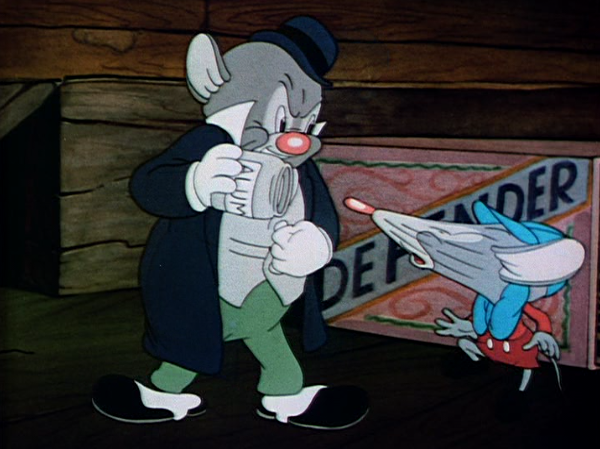
He explains quickly on how he would his father, whose supposedly an officer to stop the cat. The host, not caring, then grabs out a bottle of aluminium and stuffs it at Blabbermouse's mouth. Just then, the host removes the bottle away from Blabbermouse. In the final shot, Blabbermouse asks:

'Why did you do that? I don't see why you got mad at me. I'm not mad at you at all. All I ever did was ask you many--' at this point his lips then get compressed tighter and tighter. Of course, being the obnoxious Hardaway concept created; and of course the ending was probably not what Hardaway interpreted to be, at least Blabbermouse got his justice.
Overall comments: With a supposedly new character being introduced; it still had the same formula of obnoxious, chatterbox characters which were used in previous cartoons (i.e. I Wanna Be a Sailor, It's an Ill Wind, She Was an Acrobat's Daughter, just to name a few). In most of those shorts, the character really didn't get any justice for annoyance where it was interpreted that those characters were generally meant to be amusing or charming for an audience. Here, Blabbermouse is used as a deliberately annoying character, that the crew working on the short are already aware the character is more irritating than amusing. As for story wise on this short; being sort of a spotgag cartoon it seems, it has been structured a lot more solidly in terms of its pacing and story.

Instead of a typical spot-gag where it shows a string of gags, and also a recurring gag to appear throughout the cartoon..here all sorts of unique activity flow through the cartoon rather juicily. A song sequence is played later in the short; where the audience would be thrilled to hear their favourites played and used as gags, although in that case; the gags would require little attention from an audience. The cartoon also had a little climatic sequence towards the end, where it generally shows that there is certainly a little bit of story going on. If so, the short itself would've been a treat considering Bill Thompson made his appearance as the W.C. Fields caricatured mouse; since he was already a star on Fibber McGee, where Freleng asked him, and he agreed to do the voice. The next short: Shop, Look and Listen would be a definite followup from the short, although it feels more of a continuity, and a less surprising experience.

Sunday, 28 July 2013

292. Porky's Baseball Broadcast (1940)

Warner cartoon no. 291.
Release date: July 6, 1940.
Series: Merrie Melodies.
Supervision: Friz Freleng.
Producer: Leon Schlesinger.
Starring: Mel Blanc (Porky Pig/Clueless Attendee/Trapped Player).
Story: Ben Hardaway.
Animation: Cal Dalton.
Musical Direction: Carl W. Stalling.
Sound: Treg Brown (uncredited).
Synopsis: Porky is a commentator of a baseball game; where he commentates on particular actions.

With the newspaper front headlines; the big news is about a particular baseball game which is seen as national news...Giants pitch Carl Bubble. I believe that 'Carl Bubbles' is a little reference to a baseball catcher Bubbles Hargrave. Over at the press box, the crowd are cheering for the upcoming baseball game.

Past the press box, Porky Pig is in the commentary box where he delivers the news: 'Good afternoon, ladies and gentle--(stutters), folks. This is Porky Pig bringing you a play-by-play description of the decisive game of World Series being played at the  Yankum Stadium'.

Well, without any doubt towards baseball fans or Americans; this is a deliberate, corny pun (probably contributed by Bugs Hardaway) of Yankee Stadium. Just as the big game is about to warm up; Porky mentions metaphorically, 'Tickets are selling like hot cakes'. Hardaway, as it appears, takes the metaphor into a gag where a chef uses a fish slice to give tickets to those attending the match, and pours cream which form into baseball tickets. A very off-the-wall gag, which is very Avery-esque humour.

Whilst Porky comments on the atmosphere of the stadium, he continues: 'The scalpers are having a big day'. In terms of a baseball game, we associate scalper as a person who resells tickets for people. The gag is exaggerated to an Indian who is chasing a few attendees outside the stadium.

Rather politically incorrect in today's standard; but one of the few puns in the short that is mildly amusing. Meanwhile; a particular stubby dog-like person is walking around the stadium seating part looking for a seat; and even uses his ticket to find which row and seat to sit on.

He keeps on walking down the stairs trying to find the row he is sitting on; he keeps looking for the wrong row as he proceeds to keep on walking. He turns towards a row as he asks, 'Pardon me, please'. He walks through the row as he barges through the crowd sitting down, blocking the view. Just as he reaches an empty seat which was for him, he believes its the wrong row and continues to move out of the row annoying the crowd sitting on the row.

Just as the game is about to start; Porky commentates on the giant pitcher to be pitching in the match named Carl Bubble (as mentioned earlier in a newspaper article); which I do believe to be a parody name as Bubble Hargrave.

Pitching for the New York Giants, he is indeed portrayed as a huge giant, as he tosses the ball to the backstopped who even gets a reaction to the ball tossed to his glove. His huge size and proportion would've been an amusing result for an audience of its time.

The next part, Porky commentates on the doubleheader for the opposing team to be a Larry O'Leary from Walla Walla. Hardaway already makes the most of his time with these ridiculous and corny puns where the doubleheader, in fact has two heads. One head speaks to the other, 'You pitch the high runs', whilst the other agrees to pitch on the low runs; which of course would be a very complicating result.

Moments before the big game begins; the umpire walks in; although presented rather amusingly considering he is blind and has a watchdog walking through the stadium. The game is about to begin; the mayor, in honour, is picked up by two assistants as he tosses the baseball in the stadium. The caricature of the mayor is Fiorello LeGuardia; who was a well-loved mayor of New York back then.

More cartoony puns coming on from Hardaway as the 'batboy' flies into the scene with bat-wings handing over a bat to the first batter. At that point, 'the game is on!' in Porky's words. Just then, a turtle backstop watches the first ball about to be pitched.

The pitcher; holding onto the ball, stands in the arena of the pitch but his clothes then sink, and picks them back up. Some great personality animation there where he picks up his sunken clothes, which has a lot of weight. After the nice little personality touch; the pitcher throws the first ball to the batter.

The next sequence; the turtle catcher then persuades for the ball to catch so the first batter would be out. The animation is mainly reused from Boulevardier of the Bronx; a Freleng effort from four years earlier...except the voice of the turtle is only slightly altered.

The first ball is missed by the batter, but hits the turtle in the stomach, not catching it. The turtle walking up, saying 'That's the stuff, etc!' is new animation. The gag then repeats the second time round. The next batter, a dachshund, then takes a strike where Porky commentates the dachshund has made a home run from his view.

The dachshund walks over towards the first body; letting its body stretch from one base to the other. Also reused from Boulevardier of the Bronx.

Instead, he goes through the entire pitch with his entire body stretching through. Although a reused gag; its decent to see some of Stalling's step notes played in the underscore. Porky also makes another comment about the pitcher; 'They got the pitcher in the hole already'. A huge hole, already created from the effect shows the pitcher stepping out feeling rather weary. A little lightly amusing although there is already so much puns being contributed here. Meanwhile, as the game goes on; the same overweight attendee is still looking for a seat to watch the baseball game. Stalling creates a little appealing cue which is used as the theme of the attendee.

The next gag which features a Babe Ruth caricature (also with animation taken from 'Bronx'; some of it) then makes a swing at the bat and hits the ball. The ball screams as it soars through the arena of the stadium. The screaming part is just so like the Warners humour, which helps lighten up the short from its many flaws. The Babe Ruth pig runs around through the pitch and manages to make it home safely.

Back towards the pitcher; who is seen having a problem from his clothes that sink; picks them up once more, with the same animation reuse. He aims the ball to the batter; but the batter strikes back where it causes the batter to duck from the ball striking almost through him. Porky comments on the action, and spots the troubled pitcher; 'Looks like the pitcher is blowing up'.

We'd probably believe the pitcher blowing up, meaning his temper, but literally does blow up. Friz's timing is very useful for this particularly when animated, but just the pacing. He punches it at the funniest moment possible; and the pitcher is completely unseen after the blow-up that his gloves fall into the exact spot he stood at.

After a successful round for the Giants; the Red Sox team takes over as Carl Bubble is the pitcher for the Giants. He then throws, a baseball technique, known as the slow ball. Freleng makes use of the timing where the ball travels very slowly, in this cartoony gag. The pitcher for the opposing team then attempts to hit the ball twice but misses, the third time he hits the ball.

Just as the the player runs around the bases, through Porky's commentary; he comments that he is blocked through the second and third base, 'and he's trapped'. Yes, he's trapped from a rattrap which is laid between the 2nd and 3rd base.

Just then, the player who has his foot trapped from the mousetrap; then start to perform a dramatic panic attack. 'I'm trapped' he exclaims with horror! He then shrieks several times, 'This is hor-r-r-r--ri-b-b-ble!'. Mel, as usual, puts on the great over-dramatic performances that he was great at, and his delivery evidently steals the performance of this supposedly wacky baseball game..even if the game had such light and thin amusing moments.

The following shots then follow through a series of montage scenes from previous, recycled animation that appeared earlier in the short. The montages quickly span throughout what the rest of the time is; and from the looks of it (with the reused animation) it all occurs on 'autopilot' mode.

Just as the game then goes into its final round, Porky Pig commentates on the actions occurring. Meanwhile over at the stadium box, the overweight attendee then appears once more where he has finally found his spot in the row; even though he's made it at the very last minute.

He looks at the seat, and finds he the spot he is sitting at: but unfortunately, his seat is the very unlikely position. He finds he is sitting right in front of a bar just as the finale part of the game finishes off. The crowd then cheer as the Giants win the game. Later that night, the same attendee is still sitting in the exact same position. He is the only person left in the stadium sitting there and twiddling his thumbs. Moments later, he then goes into a hysterical mode as he crashes and breaks everything; due to not getting a chance of watching the match. A rather, amusingly satirical occurring gag throughout the cartoon, but also you can't help but feel sympathy for him.

Overall comments: Like how Clampett had treated Porky in those years; Friz Freleng also does the same for this cartoon. Instead of giving Porky the main star as a leading baseball player for this stadium; he is given a much more unimportant role where he is a commentator. This also strongly; suggests on how Porky was just not an enthusiastic character for the audience in directing a Porky Pig cartoon. Since Ben Hardaway and Cal Dalton lost their positions as directors with Friz's return, he is also assigned to direct a fair share of Porky Pig cartoons, as it is already very evident in You Ought to Be in Pictures where you can see Friz gives Porky the spotlight to carry the cartoon, unlike Clampett. Here, Friz appears to have followed the routine Porky was given, where he has a limited amount of screen time, and hardly lit a candle throughout the entire cartoon. Without Porky, you could say this would be considered another Tex Avery spot-gag on baseball, but completely billed with silly and bizarre puns from Bugs Hardaway.

The short itself is very thin in terms of comedy. Sure, there is comedy in the cartoon, but a lot of it is very poor and is lacking effort. As said, it is riddled with completely ridiculous and corny puns which certainly do not carry the cartoon; and get groan-worthy. The recurring gag for the attendee trying to find his seat was a little fresh idea, and it came down to a witty conclusion, where he misses the entire game and tears up the stadium. Friz's comic timing is evident in some parts; particularly with the pitcher, as well as the explosion gag. All in all, it feels a sort of a 'cheater' short where a considerable amount of recycled animation is repeated; which was used cleverly considering Friz's earlier short which was on baseball..so the reuse wasn't too terrible, except it is noticeably behind the time period of 1940; when animation had already advanced in four years, even for Warners.

Wednesday, 10 July 2013

283. The Bear's Tale (1940)

Warner cartoon no. 282.
Release date: April 13, 1940.
Series: Merrie Melodies.
Supervision: Tex Avery.
Producer: Leon Schlesinger.
Starring: Robert C. Bruce (Narrator), Tex Avery (Papa Bear), Mel Blanc (Wolf), Sara Berner (Mama Bear/Red Riding Hood) and Berniece Hansell (Goldilocks/Baby Bear).
Story: Ben Hardaway.
Animation: Rod Scribner.
Musical Direction: Carl W. Stalling.
Sound: Treg Brown (uncredited).
Synopsis: Loose-parody between the Goldilocks and Red Riding Hood fairy tales; where the two stories end up in a mix.

An all new review; which is also a real Tex Avery epic: clocking in at 9 minutes long. It's plausible that it was intended to become quite a ambitious cartoon for Warner Bros. in terms of story. Here, Tex, and writer Ben Hardaway combine two fairy-tale classics all into one cartoon: Goldilocks and the Three Bears and Little Red Riding Hood...and turn it all into one new cartoon plot with all sorts of twists and turns.

Also, it's also a complete turn for Tex in terms of character design where in this short; it's a complete new style where the characters look go rich in terms of detail that its a significant improvement.

The book opens up; where the cast of the characters displayed credit the following with a Papa, Mama and Baby played by a Papa Bear, Mama Bear and Baby Bear. Goldilocks plays herself. A clever little set-up for the cast credits.

There's also a little lame pun at the bottom which reads: Miss Goldilocks appears through the courtesy of The Mervin LeBoy Productions. Of course, the name is a silly pun of Mervin LeRoy, who was a top MGM director of the 1930s (producer of The Wizard of Oz).
The page turns to what looks like a typical fairy tale illustration with rich looking colours as well as details of the landscape. The narrator enters his cue: "Once upon a time long, long ago...". The page turns where we find a beautiful background shot by Johnny Johnsen of a forest. The narrator continues; "...in the midst of a beautiful, green forest".

Birds fly into the scene whilst Mendelssohn's Spring Song plays in the underscore. Avery himself, is already underplaying the whole Disney opening scenario; and pulls it off rather subtlety, whereas the audience don't yet know what is coming up next. The camera then pans towards the forest; but under the hill; lies a small cottage where the three bears reside. The camera slowly trucks in towards the cottage; where we fade inside the kitchen. "And in this cottage there lived three bears!". The three bears jump onto their seats at the kitchen table, one by one and we get a chance to greet the characters as they are introduced by the narrator.

"The papa bear..."

"the mama bear..."

"..and the baby bear".


After the introduction of the bears; they prepare themselves to eat their porridge for breakfast. The timing for the porridge dropping to the breakfast table one-by-one is such neat timing; and Treg Brown's unique quality for the sound effect dropping is such a perfect touch. The little bear said, "Gee, this stuff's too hot!". The mama bear then sips to try, but gets a reaction, "Ohh, ohh, it IS too hot!".


The papa bear then snorts, "Huh-huh-huh, soup's too hot"...his cocky attitude then encourages him to brag as he takes big scoops of porridge, but then steam rises out of his ears. The father bear then rushes over towards the sink where he drinks from the tap water to cool off.

The papa bear then reacts towards the tap; not realising he drank from the hot tap, in contrast to the cold one. For a deliberate pun intended, the papa bear remarks: "Hot stuff!" and then breaks down into that infectious laughter delivered by Tex, which is the laugh that that really adds appeal towards the character; and his personality stands out a lot more than the Mother and Junior bear. The character animation of the papa bear laughing has so much appeal, and the acting is gold! He really steals the cartoon itself.

The narrator continues on with the story: "Knowing the porridge was too much, the mother bear suggested:", "Come now, let's all go for a ride until the porridge cools". Narrator: "So she picked up her hat". You'll notice Carl Stalling also challenges himself throughout the cartoons where he chooses popular songs to play for the right themes of the action, seen in this short.

An example is this scene where the Mother places her hat on, and the underscore is Put On Your Old Grey Bonnet. The mother bear then turns the mirror around to get a good reflection of her back head in that typical, subtle Avery moment.

So, the three bears then leave their own doors to go for their walk.  Cleverly handled where the doors are spliced in three parts in order of each of the bear's heights. Great personality of the father bear scratching his backside as he departs the house. "Into the beautiful green forest.." reads the narrator. The birds and Mendellsohn's music play and appear briefly; and then back to the action "...went the three bears". The three bears are seen riding on a family bicycle. Before showing them one-by-one; we see more of their personality through the cycling; where the father and mother let go of their pedals; and poor junior has to peddle harder to keep the cycicle moving. A rather funny, cute moment with a lot of personality!

"The papa bear.."
 

"..the mama bear.."

"...and the baby bear".

As a sidenote: Carl Stalling contributes in the personality for each of the three bears rather cleverly through the underscores. It shows it's not only the animation or the voices giving them personality, and Stalling really was a genius for that effect. The father bear's cue is What's the Matter with Father?, and the mother bear's is That Wonderful Mother of Mine, whereas the junior bear's is Rock-a-bye Baby. It all works well very appealingly, and adds weight to their identities.

Meanwhile, outside in the forest; the birds and the music are heard and seen again. Tex uses those little bits throughout the cartoon, but the formula was vital in order to make the pacing of the short, as well as its recurring moments, appeal to an audience. The narrator then introduces Goldilocks towards the story; as we believe the 'Three Bears' story is continuing onwards.

Here, Goldilocks then skips gayly through the forest in theme towards (I think) A-Tisket A-Tasket. The narrator says: "Suddenly, she stopped". Notice how the narrator, throughout the cartoon is in rhythm throughout much of the action of the characters in the cartoon.

It's a rather daring approach which isn't usually attempted in cartoons, but Tex really pulls it off rather subtly. As Goldilocks then skips along to another house, and knocks on the house. Here the fairy tale story deliberately goes off track, as a sleeping wolf lies on his bed, waiting for Little Red Riding Hood. The animation of the door knocking really has an issue in terms of weight, whereas Goldilocks lacks weight in animation, whereas the door reacts as though her knock was heavy. The wolf, believing Red Riding Hood is outside, then responds to the knocking: "Come in Little Red...", the wolf coughs and pulls on a falsetto voice: "Come in, Little Red Riding Hood". A funny little line performed hilariously by the one and only Mel.

Goldilocks walks inside the house, where the wolf makes a take. At this time, the story turns into a sham where Goldilocks kills it by accident (perhaps a subtle blonde reference?). The wolf then demands for her identity, rather irritated of Goldilocks' presence.

She asks: "I'm little Goldilocks, is this where the Three Bears live?". The wolf responds mockingly, "Nah, this isn't where the Three Bears live!".

The wolf then gives her directions to the Three Bear's house, and then pushes her out of the door to leave: "Now scram before you'll spoil everything! This is Grandma's house, and I'm waiting for Red Riding Hood!".

Goldilocks bluffs: "What's Red Riding Hood got that I haven't got!". She then walks away politely. The wolf then laughs at her remark, until at her remarks, it then strikes him in his mind. "Say, why didn't I think of that? Yeah!". The wolf walks over towards a shelf of books, and grabs out the Goldilocks and the Three Bears story, and reads a passage of what happens next in the story. He rushes outside and calls out for a taxi cab towards the Three Bear's house: "To the Three Bears' house and step on it. I'll take care of any tickets". The cab then drives off. A few moments later after the fade out, the wolf creeps through the bedroom of the Three Bears, where he dives into one of the beds.

Back to the Three Bears; they are riding back on their family bike on their way home to continue eating their porridge. In a close-up show; we get some fun from the father who then makes obnoxious siren noise. All completely wacky humour which Tex just pokes fun out of, and a lot of fun has been placed in making this sequence.

Tex's infectious laughter is evident in this sequence; and his siren calls are just completely dopey you can't help but crack a smile. The father bear's personality has so much appeal and is completely likeable, that he's one of those characters you could relate to.

Whilst in the middle of the siren calls; the father then remarks: "Sounds kinda like a police car, don't it?". He then continues to crack out siren calls until he gets slapped in the face by his wife. The camera then pans towards the wife whose seen with an annoyed attitude on her face, which is just a wonderful animated expression which is expressed wonderfully. The father bear also peeking his eyes through his fingers is also wonderfully subtle and human, animation-wise.

Back towards Goldilocks; she skips towards the bear's house as she skips in rhythm to her music cue. She opens the small door; but waiting upstairs is the wolf; whose seen with a believable, impatient attitude as he drums his fingers rigidly impatiently.

"Meanwhile in another section of the beautiful green forest" reads the Narrator. Birds and Mendellsohn's music appear once more, and then the narrator reads: "Came Red Riding Hood". Red Riding Hood then walks into the scene where Stalling plays The Lady in Red as an underscore. Very clever, as well as funny music arrangement which fits into whole 'red' theme perfectly.


Red Riding Hood walks over towards Grandma's house where she opens the door (actions also narrated). She then walks in and calls out Grandma's name. She then discovers a note pinned on Grandma's bed.

Red then picks up the letter and reads it. In a point of view shot; you'll find that the header at the top which reads: READING TIME - 1 MINUTE 20 SECONDS. The heading used to be used on top of articles from Liberty Magazine; which I suppose is meant to be parodied in this letter. The letter then reads the following: "Dear Red:- Got tired of waiting, Have gone to Three Bears' House to eat up little Goldilocks. Love--the Wolf". Red then rushes over towards a telephone operator where he dials the number to the Three Bear's house. Just as Goldilocks is walking up the stairs to take a nap, the phone rings as Goldilocks rushes down to answer it.

Goldilocks then answers the phone; and in this sequence; the screen splits where we get a good angle of the conversation between Goldilocks and Red Riding Hood. Red then answers: "Oh hello, Goldie. This is Red Riding Hood. Say, kid, I just found a note on my Grandma's pillow from that skunk, the wolf".

Tex, immediately breaks the rules for fun, where he hands over the letter towards Goldilocks. "Here, take a look". They then shake each over's hand where Goldilocks realises she almost found herself in trouble. "Well, gee, thanks a lot Red. See ya later". They both then hang up the phone. A coin then rattles in which Goldilocks places her finger to check if the coin has landed, but makes a take, realising nothing was there.

Back towards the Three Bears; they then rush back towards home where they plan on finishing off their porridges. They rush inside the house and back to their positions in the table to proceed eating their meal. The Papa bear looks down at his bowl, makes a take where he finds the bowl are empty. The mama makes the same reaction, as well as Junior.

Junior then cries out, 'And they ate mine all up'. Meanwhile upstairs, the wolf then suddenly starts sneezing, he tries to hold it in with his finger but then loudly sneezes "Ah-choo!!". Downstairs, the three bears shout out "Robbers?" with suspense. They duck under the table.

Notice that little appealing use of perspective animation of the kitchen table moving downward; as the camera pans towards the family hiding under the table. A very difficult assignment to do, but for a director like Tex who wanted to make funny pictures; here he shows a little bit of ambition in terms of animation techniques. Under the table, Papa bear speaks: "Now ma, you and Junior stay right here. I'll go upstairs and take care of that crook!".

After what is intended as a serious part of drama from the father; as soon as he starts walking up the stairs, he breaks down into his dopey self laughing uncontrollably. As he walks upstairs, he breaks the forth wall: "I know there ain't no robber up there, just a little tiny girl named Goldilocks. I read the story last week in Reader's Digest".

The Reader's Digest dig is extremely amusingly put, and quite possibly the best quote all through the film. It's completely full of charm and Tex was completely ahead of his time when creating fairy tale spoofs; where in contrast the Silly Symphony cartoons wouldn't turn out anything like that. The animation of the father laughing upstairs is full of weight, appeal as well as solidity. It's no secret of the fact the animator of that scene is Virgil Ross...who makes the laughter from the father look alive and real.

The father bear walks into the bedroom where he already plans on waking up Goldilocks. He shakes the bed the wolf is sleeping on, "You come out of that bed you cute, little curly-headed rascal". Rather whimsical and warming the line is, from the father. He then pulls out the wolf out of the bed, laughing heartily...believing its all a joke.

After realising, the father bear then stares straight towards the wolf's eyes. He then goes into a range of different expressions where he is rather hesitant and fearful. This is a great character animated scene, and of course, animated by the great Rod Scribner. Scribner makes the father go through so much fearful expressions, that the acting is real gold; and its great to see how Scribner could really be when controlled. The teeth showing from the papa bear during his 'takes' are also wonderfully drawn. Here on the blog; the first GIF to be posted of the father bear's reaction.

The father bear scrams out of the bedroom frantically, as he then carries Mama bear and junior with him, and he crashes through the door, running for his life. In the final shot; over the hills where the sunset reflects, the three bears then scurry over the hills one-by-one. The final part of the 'Baby bear behind' must've been a silly pun by Ben Hardaway, but its character animation of Junior struggling to keep up is solid. "So over the hill went the Three Bears...".

"...the papa bear..."

"..the mama bear.."

"..and the little  bear behind".

Overall comments: A real Tex Avery epic; as I have mentioned earlier. Ben Hardaway made a good contribution in construction of the story; but of course, would have worked with Tex on it, gags and all.   A very ambitious short for Tex in many different levels. The story, for one, is rather ambitious, but more of a story ambition, not technically. Examples include when Tex plays around with the whole Goldilocks and Red Riding Hood tales into the whole short. The short was deliberately intended to be a 'Three Bears' parody, but it all clashes with the Red Riding Hood story, and the whole plot backfires. To me, THAT is what I call a fairy-tale parody. Tex's own use of timing is also ambitious, too. Towards some fans, the cartoon may be slow-paced because it clocks in at 9 minutes. Watching this short and analysing it, Tex really knew what he wanted. All the extra scenes just had to be there, particularly with the narrator's short touches on the opening sequences "and this section of the beautiful green forest", with the birds and the music playing past. It just adds weight and suspense throughout the short, and having it used more than once brings in a much more humorous and intriguing quality to the cartoon itself. 

Of course; other ambitions Tex was going through was timing. You'll notice all throughout the cartoon; the narrator is really in sync towards the action of the characters in the animation. e.g. "She stops" (Goldilocks stops in the forest); all those little bits of detail shine a unique appeal. The cartoon's pacing is very patterned, which was what Tex was striving for, and he knew it would turn out to be constructed very well. Onto the character; there is no doubt that the highlight of the short is the Father bear, himself. The character has so much personality, as he's a hilarious, wacky father who is immediately likeable. Strong character animation was also required for the father bear; and with the likes of Virgil Ross and Rod Scribner all throughout the cartoon, they make the Father bear full of life. Moving onto the music; Carl Stalling does a great job where he has a great taste in bribing the right songs for the right personalities as well as the theme of the sequences which match correctly...as well as using them, humorously. All in all, a very good Tex Avery short for Warner Bros. in 1940; and certainly beats from the repeated spot-gag shorts Tex was making.