Sunday, 17 March 2013

255. Detouring America (1939)

Warner cartoon no. 254.
Release date: August 26, 1939.
Series: Merrie Melodies.
Supervision: Tex Avery.
Producer: Leon Schlesinger.
Starring: Robert C. Bruce (Narrator), Mel Blanc (Mr. Butterfingers/Cow Puncher/Full-Grown Papoose/Mosquito/Praire Dog/Fawn) and William Days (singing part).
Story: Jack Miller.
Animation: Rollin Hamilton.
Musical Direction: Carl W. Stalling.
Sound: Treg Brown (uncredited).
Synopsis: Travelogue parody of a look all-round America.

Last WB credit to animator Rollin Hamilton, as well as animation credit. He pretty much disappeared into oblivion, until his death in 1951. Also, probably well-known as a fact amongst WB fans for being the first Warner Bros. cartoon that was nominated for an Academy Award for Best Animated Short in 1939 since 1932's It's Got Me Again! However, the cartoon lost to Disney's The Ugly Duckling (also Disney's last Silly Symphony) - as Disney dominated the entire decade of the Best Animated Short category. I imagine that Leon Schlesinger had finally omitted his cartoons to be entered for the Oscars, whilst before that, it was rumoured he had boycotted the Academy Awards before that - due to Disney continuously winning them.

This is also Robert C. Bruce's first cartoon he did for Tex Avery's travelogue parodies; and all the other credits I've foolishly credited to Bruce such as Pingo Pongo - will be changed.

Avery begins with an opening card with the 'co-incidental' disclaimer that was of popular use in the 1930s. In the card you can hear a combination of music cues cleverly arranged by Stalling such as: California, Here I Come, Arkansas Traveller, etc. which plays different ranges of U.S. state music.

The America travelogue begins as Bruce narrates: 'We take you on an educational tour of the United States'. The first stop is New York City, and we get a decent horizontal pan of large New York building backgrounds by Johnny Johnsen.

We get a new through the narrator's comments of the Empire State Building, who explains it with such awe. At the height of more than 1250 metres, and made from steel and granite. What's next--it turns out there is a crowd at the sidewalk of the building of a human fly attempting to climb the Empire State Building as the sign reads 'HUMAN FLY will climb building at 2 o'clock' - but the narrator remarks 'We'll see him'. Of course; that is going to be the running gag of the cartoon as already indicated.


The travelogue then moves over to see a military academy whose reputation is considered the most outstanding in the country. During the 'Reveille' call - students rush for roll call. We find a group of soldiers marching as the narrator compliments on the discipline and marching. As the camera trucks back, it turns out that their legs are not routined or straight which is some very funny personality animation.
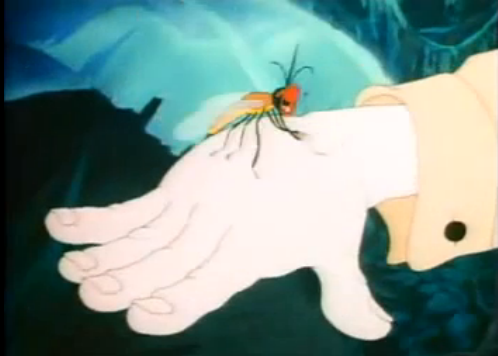

Moving on to the next sequence -we move down south of America in a jungle where a scientist is on the hunt looking for a rare mosquito which is known to have been lurking in the area. Whilst the unsuspecting scientist is looking around the wild forest with his magnifying glass, 'a disease carrying mosquito strikes!'.

The mosquito lands on the scientist's hand. He uses his other hand and smacks the mosquito who shouts 'OUCH!'. The way Mel Blanc delivers the line, as well as his flamboyant and sense of comic performances is absolutely hilarious and believable.

Meanwhile as the travelogue parody moves over towards the Wild West - we view the 'rolling plains of Texas' - and Avery has some fun with his visual puns as he makes the hills of Texas roll which is rather amusing, but typical. Another typical pun for him is we find a typical 'cow-puncher'. It turns out it is a cowboy who is seen punching a cow.

Now the visual pun itself is just plain silly but amusing. The narrator comments: 'Hey this doesn't look right' and it turns out the cow-puncher is a Jerry Colonna caricature.

The cowpuncher comments, 'Ah, so you're wondering, too?' which I can only interpret it was a line Colonna used in a radio show. Then continues to punch the cow. Then we interrupt the travelogue as the human-fly appears in a shot in the middle of climbing up the Empire State Building in this long-shot. The narrator looks at the human fly climb up with pleasure: 'Well - our friend certainly has courage...what a way to make a living'...of course; he will return later in the cartoon.

Moving way further - we move to the arctic circle in Alaska. We continue to horiztonally pan through Johnsen's background paintings until we spot a hitchhiker. No, it's not an eskimo hitchhiker. It turns out to be a Southern slave who happens to be in the arctic. Here he is singing, Carry Me Back to Old Virginny. An eskimo arrives at the spot and gives up the black hitchhiker and carries.

As the background fades, the eskimo has walked the entire way to the Virginia State Line where over there with the Southern scenery in the backgrounds (steamboats, plantations, etc). The singing part of the hitchhiker is provided by William Days.

The whole gag itself is displayed as some gag where it is supposed to have a huge climax, but instead the eskimo just brings him back to Virginia. It's a very corny gag but it has been censored on Cartoon Network. Though I do find the walk cycle of the eskimo just carrying him all the way to Virginia not giving a hoot, is rather amusing, and I also love the fact he just dumps him there and leave.

The narrator of the travelogue parody moves on further in the American presentation where he leads us to the Valley of the Giants, which I believe would be the Valley Giants in Oregon. The narrator continues to praise the culture and nature side of the valley - and describes it as one of 'nature's most breathtaking panoramas'.

The pan through the forest is very slow but also quite effective through colourful Johnsen backgrounds which certainly do dominate the cartoon as well as many of Avery's spotgags.

Of course; the tree backgrounds that overlaps the other background were done by overlays; so it would've evidently been painted separately, but, think of the back painting as one big canvas. The narrator the continues as we look through the river as we find giant California redwoods sailing through the rivers, and in the narrator's words 'cut and bloated, down the rivers to make the homes of tomorrow'. As the logs continue to land, traffic signs pop up as logs from the other side of the river flow past before the logs go past. It's a really corny and gentle gag itself. I love how this just satirising the seriousness and the beauty side of detouring travelogues--Avery managed to pull it off well in this sequence.

As the travelogue looks further at Wyoming - we come across some of the plain fields where they are homes of an American praire dog. A praire dog then pops out of his hole and grabs out a pair of binoculars from underneath. Other dogs look behind him to see.

Through the binoculars he looks through the plain parts of Wyoming to find anything; and all that is seen is a tree. In that point-of-view shot; he trucks back to the tree, and shouts out 'TIMBER' as the whole group of dogs follow.

Of course, a little subtle childish joke by Avery where they have found the perfect spot for them to piss. Meanwhile out in the California desert, we find an occasional prospect who hopes of looking for gold, and digs for it. He manages to find a small golden pebble. After a subtle eye-take, he whispers to the audience: 'Don't tell a soul, I found it at last...gold'. Then a whole group of diggers arrive at the exact same spot digging for gold which is rather amusing as it is shown as a superstition. We return to see the human-fly once again continuing his climb up the Empire State Building; and the narrator declares the height he's reached to would mean a fall of death.

Following on further - we move over towards the Indian territories of South Dakota where they are the homes of an Indian tribe. The Indians are seen walking down the mountains impossibly but its a pretty bizarre gag anyhow.

As we look at in Indian village in South Dakota; we find an Indian doctor who already has a patient and the patient is asking for snake oil. After stepping inside; guzzling the snake oil remedy - the old Indian slithers out of the teepee like a snake which is just nuts!

I do like the 'Wa-Hoo' sign at the top.  Another sequence we see is where a mother is carrying her papoose on her Papoose. She stops carrying him and remarks: 'Here's where you get off. You big boy now'. The huge overgrown Indian baby screams, 'Aw ma! I don't want to get off' and cries on her shoulder. Love the fact the baby is overgrown. Moving onto the next scenario in the Indian village is the Indian snake dance. It is revealed to be actual snakes performing the rain dance which is just a ridiculous, corny gag but I do like the jerky timing of the snakes dancing.

The next sequence moves to the Riverside Geyser in Yellowstone National Park (it could've just been shown straight after the Praire dog sequence as both Yellowstone and the dog sequence was set in Wyoming) which of course is notorious for its reliability, and the sign next to it reads 'Old Reliable Geyser' where we briefly see the eruption about to build up.

The narrator announce of the trembling sounds of the geyser as he speaks. Afterwards; only a drop spits out and lands in a spittoon. A similar gag would be reused in Crazy Cruise. The timing of the pressure is really great.

In another part of the park is a 'timid, little fawn' who approached a wooden cabin in the middle of the woods. The fawn shyly walks over and then bangs on the door, 'Hey in der! How about a handout!'.

After a series of spot-gags all through the cartoon; we then conclude the cartoon with the human fly who is struggling but has managed to make it all the way up the Empire State Building. Some great character animation of the human fly's fingers who is struggling to hold on. The name of the human flyer (Mr. Butterfinger) is asked by the narrator: 'Would you like to say a word to your friends here in the audience?' He responds: 'Yes - HEEEEELP!' as he struggles to keep on holding. The scream and even build up of the gag is a little realistic and amusing.

Overall comments: Of course, the cartoon itself may have been considered rather important of the time it was released. Hell, it was nominated for an Academy Award - which goes to show that the Schlesinger studio had already established the essential Warner Bros. humour -- as by 1939; their own humour was much more acknowledged and recognised -- and I guess Schlesinger probably finally admitted his cartoons to the Academy Awards. Considering that 1939 may have been a weak output for Warners - you can probably name a few entries which you would consider to be classics, such as Thugs With Dirty Mugs, Dangerous Dan McFoo or maybe for fan popularity: Hare-Um Scare-Um. However, they're more popular with modern fans -- but a few may raise an eyebrow: is this cartoon really good enough to be nominated for an Academy Award?

Yes, it may not be a great enough cartoon and it's certainly not an Avery classic - but I guess the idea of Tex's travelogue parodies were really hyped-up when he first made them and had encouraged him to make many more. Then again, I do understand the idea of it being hugely popular as travelogues were made to inspire folks to travel as well as imagination; and the idea of parodying them was considered very clever, even though its very dated. Nevertheless, I will admit it is one of Tex's, probably, better travelogue parodies he did. Many of the jokes were rather amusing, particularly the build-up, but then again this is just a typical spot gag for me, but I will have to give credit towards Blanc for his really hysterical voices he puts in this cartoon, especially the mosquito and human flyer at the end. You also must give credit to Johnny Johnsen for his marvellous and meticulous background work in this cartoon as well as the many travelogues he did for Tex; as they certainly require a lot of realism and detail and Johnsen is very versatile as a background painter.

Sunday, 3 March 2013

254. Hare-Um Scare-Um (1939)

Warner cartoon no. 253.
Release date: August 12, 1939.
Series: Merrie Melodies.
Supervision: Ben Hardaway and Cal Dalton.
Producer: Leon Schlesinger.
Starring: Mel Blanc (proto-Bugs Bunny/John Sourpuss/Dog).
Story: Melvin Millar.
Animation: Gil Turner.
Musical Direction: Carl W. Stalling.
Sound: Treg Brown (uncredited).
Synopsis: Hunter John Sourpuss is disgusted of the soaring meat prices--and so he goes to hunt himself a rabbit. But, he ends up targeting a screwy rabbit who just pesters him.

The new redesign of the proto-Bugs Bunny as the final is similar enough to the final design of Bugs Bunny as we would see a year later in A Wild Hare. However, it has been over discussed and debated that this cartoon was the first to star Bugs Bunny...but I'm not going to count it here. Although he has been named that in public material as well as Charlie Thorson's model sheet--but I don't want it over discussed here, I'm still going to refer the character as still the proto-Bugs; and it is!

Of course, this is Hardaway's attempt on using the rabbit character again, but has redesigned him - as designed by Charlie Thorson who named him 'Bugs' Bunny' in the model sheet. With the cartoon's importance asides; this is probably the most well-known of the Hardaway-Dalton cartoons they directed for that reason. The cartoon has also had a notorious history for its ending eliminated since 1939; and it wasn't until 2009 Dave Gerstein managed to REVEAL the original lost ending to the cartoon - as well as ending the rumour of decapitated heads rolling down a hill. The original version will be reviewed here, as it was recently released to the public on the Looney Tunes Platinum Collection, Volume 2.

So let's start the epic cartoon: - the cartoon begins as we find our antagonist character, John Sourpuss reading a newspaper headline. The newspaper headline reads: Meat Prices Soar. John Sourpuss throws the newspaper to the ground fuming of the meat prices that have increased.

He bellows, 'They can't do this to me! I'm a citizen! And a taxpayer. Who do they think they are?!' He then walks over to collect his shotgun and owes, 'I'll show 'em. I'll get my own meat!'.

He walks behind the curtains to change into his hunter outfit, and whistles for his dog to arrive. It turns out the dog was resting under the armchair that John Sourpuss had just sat on. Jesus, and the dog isn't even suffocated? He then asks him, 'You and me are going hunting! Rabbit hunting! I'll show 'em!'. They leave the house to begin their hunting. This is already a neat introduction on the character: John Sourpuss; and we certainly get a lot of his personality in a matter of 30 years; who is seen as selfish, tight on money and would just kill animals for that cause. The opening sequence I suspect looks a bit like Rod Scribner's timing and animation...as the way Sourpuss uses his arm expressions are very similar to his Tortoise Wins By a Hare animation.

The next scene (where you can hear Stalling's cue for A-Hunting We Will Go used for hunting scenes) John Sourpuss and his dog are on the hunt. His dog is already sniffing for rabbit tracks and in the path he manages to find tracks. John Sourpuss turns and then watches his dog follow the tracks.

Then we find our introduction to the proto-Bugs Bunny; Happy Rabbit...I mean, the rabbit (I guess). You can really tell this is Thorson's design, and it certainly does have a Disney-esque look to it (Max Hare anyone??).

We find the rabbit is already stamping rabbit tracks with a stamper, and is already screwy from the first moment; by masquerading the tracks to trick the hunter. The rabbit then stamps tracks on top of and under the rock. The rabbit chuckles crazily and then rushes out of the scene. The dog arrives at the spot and sniffs on top of the rock, and then digs under. Some funny animation where the dog's tail is holding the spot, which oddly feels realistic and has weight, even if it is impossible. He turns to find the rabbit but the rock drops and the dog then makes a yelp that has given him a fright.

The dog then hides under a log to avoid and prevent himself from pain. The rabbit then pops out on top of the hole and covers the dog where we see a 'Guess who?'. Of course; that would've been a hilarious gag of the time, as it was really goofy--but then again, Tex pulled it off much better when he made the first official Bugs
cartoon.


The dog barks on the first guess, 'Guess again' asks the rabbit. The dog barks again, and the rabbit responds: 'You're getting warmer'. As if the dog barks 'its the rabbit' we won't know, but the rabbit is crazy enough to shout 'You're correct absolutely correct' and jumps around like a lunatic.

The rabbit then ends up pushing the log where the dog is still inside, and the log ends up falling down a hill. Interesting camera movement of the background tilting to make it as though the hill is really falling, instead of having it animated through perspective animation. The log continues to fall, as it continues to bump a few times whilst rolling. There is a stone sitting in the middle of the path, where the rock strikes and lands out of the scene and crashes into a tree with the log cracked open and the dog dazed.

The dog gets up and walks away from the tree feeling very dizzy after rolling down the hill. He walks near a fishing stand, the rabbit arrives at the spot where in doctor uniform. He brings out a stethoscope to test his body. He tuts, 'Too bad. Do you have dizzy spells? Do you see spots before your eyes? Do your ears ring? Are you succumb to fits?'

The dog nods at every question the rabbit asks him...but his responds is, 'So am I...maybe that's what's the matter with me'. He chuckles heartily. He then jumps around the lake acting please -- seriously?? Hardaway is using the Daffy Duck routine for a rabbit to jump out of the lake - may as well be a Daffy Duck cartoon with a gag like that!

John Sourpuss is then the next victim of the rabbit's antics; and he spots 'the rabbit' hopping around hills and shoots straight at it. Believing he has got his target; he rushes over towards the back to check, but has been had when it turns out they are displayed rabbits on moving cartwheels.

He looks towards the rabbit who is seen sleeping. He grabs out a saltshaker and the rabbit immediately wakes up and places a celery stick. He acts crazy, and places a celery in his mouth. John Sourpuss gets mad and tries to rush inside a warren, but an automatic door slams on him. The rabbit opens up and comments, 'Main floor - leather goods, pottery, washing machine, etc. - going up'. He opens up again, 'You don't have to be crazy to do this - but it sure helps', and chuckles once more. Now that is a funny line itself. Now, Sourpuss has already been a target--then it is back to the dog!

The dog is then sniffing around the forest looking out for the rabbit. The rabbit watches what the dog does and then decides to disguise himself as a bitch by placing a female dog costume. He has the costume completely on, and then starts to walk like a posing dog. The dog sniffing already has his attention caught on the rabbit in disguise and follows it.

He walks over towards the log, where he finds her on top of the log and his heart pounds. He sits besides her, and then picks her a couple of posies as a gift. The bitch in disguise then kisses the dog on the face, and he makes a take and already falls the ground, and reacts mildly.

The dog then embraces the rabbit and kisses the dog costume, but has fallen out of the rabbit costume. The rabbit remarks: 'I think you've something there, buddy'. The dog look at the outfit and finds it was a dummy. He tosses it down to the ground and chases fiercely after the rabbit. On a less than educated-guess on these cartoons,  I'm suspecting that the sequence was done by Rod Scribner, with the way he draws eyes but I'm not going to prone that.

As the rabbit is running away from the dog, he hides behind a rock and the dog is still on the run searching for him. The rabbit arrives at the spot dressed as an officer and parking him a fine for speeding. He walks over and gives him a bollocking, 'Goin' a little fast - aren't you buddy? You're on the wrong street, too'.

The rabbit then accuses the dog of being intoxicated by sniffing him, and asks for a licence but quickly moves on. 'You know what this'll cost you? Thirty days. He then appears to list the months as well as Montana (reference anyone) and he whoops around very crazily. I didn't humble at the scene, not understanding the last part; but its just the rabbit coming up with one of his cretinous tricks.

The rabbit then slides down the path and picks up posies; and then starts off in song. Get ready folks for the most obnoxious part of the whole cartoon where he sings his most annoying song which is such a din! Get ready for your earmuffs: 'All the world goes by, swinging on its way...things were looking brighter day-by-day'.

He jumps over the rocks through the pond and comes across a billboard sign that advertises the Looney Tunes cartoons and Porky is on the cover. He then sings, 'I'm going cuckoo - whoo-whoo! Here comes the choo-choo! with a reel of a steam train riding at the scene.

He jumps on a fence and sings, 'I'm so goony-looney-tooney, hatched in the head!' (more like f*cked in the head).  I'll admit the comic timing of Bugs' legs balancing on the gates is very funny. It gets even wackier as a ketchup bottle pops out by MAGIC and he whizzes it around...mmm, Bob McKimson would revive the ketchup gag in some Daffy cartoon I can't remember.

This is a minute of torture -- just imagine if they used the exact same rabbit all through the 40s and 50s with that song played...oh god. That sequence must've pissed off a lot of people in the audience. The song is also substitute lyrics to Corn Pickin'. Again, this is pretty much Hardaway copying Tex with the Daffy Duck song in Daffy Duck and Egghead. He then continues to sing (hiding behind a scarecrow) until John Sourpuss stops the song.

As John Sourpuss aims his gun towards the rabbit's back; he turns and begs him not to be blasted. 'Don't shoot, don't shoot--I was only foolin', honest I was'. Sourpuss responds, 'Oh yeah, well I'm not foolin'. Tomorrow morning you'll be sizzling in my frying pan!'. Great line, and I love the way Blanc delivers a mad cackle on the hunter.

The rabbit begs and gives his reasons in not to be shot (and acts overdramatic). 'Listen chief, you don't want to eat me--why I'm nothing but skin and bones'. He stretches his own flesh where he looks as skinny as a Darfur child.

The pose and even drawing of the rabbit looking extremely skinny is very effective, and even has weight--it feels rather out of there for 1939. He even shows his feet; 'Even the government turned me down' and his foot is printed as 'rejected'.

The whole sequence itself is some original satire of wackiness. Then the rabbit starts to overdramatise of his illness and performs some fake coughing. In close-up John Sourpuss then starts to break down and weep. The rabbit - feeling sorry, offers to shake his hand (with a hand buzzer on him). 'Lets shake and forget the whole thing' the rabbit warmly asks. He shakes his hand and then reacts to the buzzing...knowing that is was just one of the many pesky rabbit's antics being pulled towards him.

At that point - John Sourpuss has finally lost his temper and shouts towards him, 'Come back here and fight like a man! I can whip you and your whole family!'. At that point, a whole group of rabbits arrive at the spot swinging their fists towards John Sourpuss. Of course, in the MANY versions we've grown up to over the years...it ends right at that spot...which I think is really good comic timing--an ending we all have known for over 70 years.

But here - there is more. The whole family beat him up and there is dust that covers up the fighting, and the whole dust flies out of the scene. John Sourpuss is already knocked down in the soil and lost the fight.

Gunshots are heard in the background, and then the rabbit arrives at the spot and responds sternly, 'You oughta get that fixed...somebody's liable to get hurt'. He then jumps around the hill chortling wildly. At that point - John Sourpuss has completely lost his senses. He then jumps around the hill bouncing with his head as the cartoon irises out.

Now for my own thoughts of that original ending: personally, I prefer the cut ending MUCH more than the lost version. If you think about it, the family arriving at the spot (where it cuts to black) - the timing is very funny. It's more of an 'oh shit' ending; while in the extended and original ending: you can tell that Hardaway is already ripping-off Tex Avery's ending to Daffy Duck and Egghead. In my opinion the whole ending slows down the whole cartoon; and it did ruin the funny moment (where the cut version was much funnier). I think it was better off cut, but then again...the fact it still existed is extraordinary.

Overall comments: I'll understand as to why the cartoon is considered a guilty pleasure or a cult amongst enthusiasts and fans. For one thing, this is still a prototype of the Bugs Bunny designs, and the design he is given is certainly not a far cry from the original cartoon. As for me, this cartoon just reminds me of just another crappy Hardaway/Dalton cartoon that they made. Hardaway is clearly strongly influenced from Tex's Daffy Duck cartoons; and he's basically using Daffy Duck; but he's wearing a rabbit costume. I suppose that Porky's Hare Hunt was very successful that it already inspired him to make this cartoon, but with a different hunter. The cartoon is really short of gags - well funny gags anyhow. I'm also not a fan of how the pacing of the cartoon flows: it feels like just a whole gag-after-gag cartoon with no climax until its ending - while when Tex made his Daffy Duck cartoons, he paced them leisurely and at least had climaxes going on.

I just felt there were too many gag-to-gag situations that could've been done much better and funnier...but I'm sure of the time when it was released, it appealed to many audience members. I find the animation there to be more up to standard than the other Hardaway-Dalton cartoons are usually are..though the design of the proto-Bugs isn't very appealing at all..very crude. To me, I thought in the version we were all familiar with; the cut ending was really the only really funny gag as it is delivered very well...whilst when it is extended, it isn't as funny. Nevertheless, this cartoon is already at the peak of Bugs Bunny in gaining his first official appearance. Chuck of course used the Charlie Thorson design for Elmer's Candid Camera. Overall, I wasn't really a fan of the overall cartoon itself as it was just rather tiresome to watch; and the song sequence is already obnoxious enough.

Sunday, 24 February 2013

253. Wise Quacks (1939)

starring PORKY and DAFFY
Warner cartoon no. 252.
Release date: August 5, 1939.
Series: Looney Tunes.
Supervision: Bob Clampett.
Producer: Leon Schlesinger.
Starring: Mel Blanc (Porky Pig/Daffy Duck/Eagle/Baby Duckling/Dog).
Story: Warren Foster.
Animation: Izzy Ellis.
Musical Direction: Carl W. Stalling.
Sound: Treg Brown (uncredited).
Synopsis: Daffy's a new father, but ends up getting drunk. One of his ducklings is captured by an eagle, and its up to him to save the day.

As noticed in this cartoon; Clampett has already given Daffy Duck a new look. Notice how he appears to have shades that are spread around his eyes, and even the ring collar on his neck is still zig-zagged (though he used it already). He would only use that design twice; again in Porky's Last Stand. I can only assume the remake of Daffy wasn't popular amongst Clampett's peers and the audience that his usual design was brought back. Also the first cartoon where you see Daffy Duck is a married man, which of course -- has been used for story ideas from time to time.

The cartoon begins as we find a barn which belongs to the residence of Mr. and Mrs. Daffy Duck. We find Mrs. Duck who is seen quacking happily towards Rock-a-Bye Baby and is also knitting a shirt for her ducklings that are yet-to-be-born. Mrs. Duck looks over her nest to see if they're ready but no luck yet. I would imagine Bob Clampett himself is providing the quacking sounds of Daffy's wife there.

Daffy Duck walks into the scene and his wife hides the shirt, and Daffy is already very suspicious of what she is hiding. She blushes, and doesn't want to show the finished shirt towards him.

Daffy gets his hand out and gestures 'Lemme look'. She then finally hands over the shirt which Daffy looks at with satisfaction. Afterwards, Daffy then jumps with excitement over the fact of having children. In the next sequence - a newspaper headlines reads in the local paper (Barnyard Bulletin): Mr. and Mrs. Daffy Duck Are Expecting a Blessed Event. At the bottom, the journalist is rather personal and remarks: isn't that ducky? Which is just one of Clampett's silly puns. Note the journalist of the Barnyard Bulletin is Jimmy Piddler (parody of columnist Jimmy Fiddler).

It turns out the newspaper shot is a POV shot as Porky's eyes close-in on the newspaper article, as well as the camera. He then speaks enthusiastically: 'Daffy Duck's expecting a baby?!' He continues on: 'Gee, my ol'pal Daffy a father. I can hardly believe it', and then the whole Porky dialogue scene gets really tedious as you feel as though - you get the point. Luckily the dog expresses it sarcastically, 'Amazing' which is how I would feel.


The next sequence we find a pacing Daffy Duck who is pacing up and down waiting impatiently for his ducklings to be hatched. While he paces up and down he takes a swig of corn juice (which is urbanly just liquor that has corn in it). He continues to pace up and down and still keep taking corn juice, which becomes his quirk.

The lack of lip-sync in his scene shows its Bobe Cannon's animation. The next sequence we find a really impatient and worried Mrs. Daffy Duck who is getting very paranoid because her ducklings should already have been hatched by now.

Love the little subtle animation where she breaks the forth wall and shrugs. She walks over to the fireplace to warm her behind, and just at that moment: the ducklings immediately and finally hatch: 'Don't do it! We'll come out' - the delivery and gag itself is very amusing.   The ducklings then sweat with relief.

Porky walks over to pay a visit to see Daffy Duck's new ducklings. He stutters and sings: Rock-a-Bye Baby whilst on the way. Porky finds Daffy and congratulates him on the birth. He sees Daffy as intoxicated, and Daffy immediately hushes him as he's feeling weary.

Mrs. Daffy Duck and her ducklings all walk out of the barn as they show they're gratitude in their characteristic walk. However, one other egg hasn't yet been hatched and so Porky picks up the unhatched egg.

He stutters and gasps, 'Uh-oh - here's one that didn't hatch'. He holds the egg that sits on the palm of his hand, and the egg immediately hatches. The timing of the top part of the egg flipping continuously feels a little unreal whilst the cracking of the egg looked real. Porky looks at the duckling, and of course...Clampett makes the baby duck look all cutesy with the baby duck giggle and even character designs that we're supposed to feel awe. Porky stutters and giggles, 'I bet you think I'm your papa'. The duckling nods but then responds 'Uh-uh' which shows the jokes on Porky.

Daffy is still feeling drunk, and so Mrs. Daffy Duck appears and smells Daffy and quacks; 'Have you been drinking?' Daffy then overreacts and exaggerates, 'Me drinking?' as though it never happened. Really funny when he just impulsively responds, 'Yes', and she whacks him with her rolling pin.

Meanwhile up in the sky is a passing-by eagle. The eagle looks down (in a bird's eye shot) and already the duckling is a victim. The eagle flies down and entices him: 'Hiya bud! Wanna go for a ride?'. The duckling nods but responds 'Yeah' and of course; it so appears the duckling's mind hasn't been developed.

Meanwhile as Mrs. Daffy Duck is seen doing the washing with a washboard; the duckling is seen on top of the eagle waving goodbye to his mother. Mrs. Daffy Duck hears it, and then waves goodbye back....Wait, hang on a minute; HOW did Mrs. Duck manage to HEAR when the eagle was at a CLEAR DISTANCE and yet the duckling's voice was so quiet.

I mean, how is that possible; does she have a super sensitive hearing aid stuck inside her ear or something?? Anyhow, she makes a take and ends up in a panic-attack because of her son in peril. She spreads the news towards Porky and Daffy.

Daffy gets up and shouts with courage, 'I'll save 'em!' He flies up but flies back to take a shot from his corn juice jug. Then he whoops with excitement and flies frantically after the eagle. Also some nice cycle animation of the eagle flying away.

Probably one of the highlights of the cartoon itself is where Daffy is just speeding continuously and effortlessly, but then he pauses and just puffs exhausted -- stopping the action. Then afterwards he continues the chase scenes. That is also a trademark that has been used in later cartoons which is an example of the wildness the Warner cartoons had.

Daffy continues to speed very hastily, and is already in the front of the eagle. He grabs out his whistle and blows to pause the chase. I believe this is also a Bobe Cannon scene, too. Daffy is all drunk, and spits out: 'What's the big idea? Where ya goin' with that kid' and keeps hiccuping the word 'kid'.

The eagle whistles for the other eagles in their cave, where its a bunch of eagles all chasing after Daffy. Daffy takes the duckling out of the eagle's hand and then whoops out of the scene very excitedly.

The eagle in front is charging up towards him, and then rugby tackles him, with the duckling falling to his death. Rather wacky of Clampett to have him Daffy being rugby-tackled in mid-air and yet standing on air. The mother duck and Porky both watch the baby duckling falling, and yet she panics with fear. What is the real need of panicking, why can't she just contribute something and save the damn bird. But no, it turns out Porky has to do it as the mother is just too useless to do anything.

Porky runs at the scene and manages to catch the duckling which lands safely in his hands. Porky skids in the ground and then lands in the lake where the duckling is now absolutely safe. The duckling is already on top of Porky's head where water falls out of his ears, and the duckling titters.

Meanwhile Daffy is still running away frantically from the charging eagles, and makes a land back to the barn and tries to protect himself inside. He looks at the eagles charging towards him who all dash inside the barn, with one standing outside and flips a coin loitering.

Meanwhile at the scene - Mrs. Duck is seen still screaming at Porky in saving Daffy Duck as he is caught inside a barn full of massacre-eating eagles. Porky grabs out a club so he could save Daffy and bash the eagles. Porky enters the barn and asks Mrs. Duck 'Stop pushing me'.

Porky walks inside the barn, and much towards his surprise - he finds that Daffy Duck has already had his way of dealing with the eagles. He got them intoxicated with corn juice, and has managed to save his skin that way. They are all intoxicated and all sing together How Dry I Am - a similar gag which Chuck Jones used earlier in Naughty But Mice.

As Daffy then sings his solo part of the song - he spots the shadow of his wife. Instead of hitting him on the head - she hits the bottle of corn juice which will prevent him from getting drunk anymore.

Overall comments: Daffy Duck plays a much bigger role in this cartoon than Porky was; and you can certainly feel that Clampett was trying to make a cartoon with only Daffy Duck as the lead...but with Porky being the co-star character it was a struggle as he just was only considered a straight-man character. The idea of having Daffy Duck drunk throughout the cartoon certainly adds up to how crazy he is and its also very funny though out the cartoon. The way he had his just deserts with the eagles is also amusing at the end, too. Porky is much of a boring character than he has been most of the 1939 cartoons, and in fact it really doesn't feel like he is in the cartoon, other than being a side character...it would be much better if he weren't included since he doesn't contribute to much, but of course Clampett had no choice.

Nevertheless, the cartoon isn't one of the highlights of 1939 but I'll give credit for some of the funny gags in the cartoon as well as comic timing. The comic timing of Daffy panting whilst chasing the eagle is just top-notch, and no wonder it was used much later on in their funniest era. This is also a cartoon where Daffy isn't really much of a screwball than he was in 1938. Daffy was surely a screwball duck in his earliest cartoons made by Tex Avery and Clampett but in 1939 he appears to have toned down a bit, but the wackiness still remains. The idea for Daffy Duck to be married is also amusing, and the concept has still been used for many other cartoons, but I'd say The Stupid Cupid and His Bitter Half are the most superior.