Showing posts with label 1939. Show all posts

Saturday, 28 September 2013

301. Stage Fright (1940)

Warner cartoon no. 300.
Release date: September 28, 1940.
Series: Merrie Melodies.
Supervision: Chuck Jones.
Producer: Leon Schlesinger.
No cast.
Story: Rich Hogan.
Animation: Ken Harris.
Musical Direction: Carl W. Stalling.
Sound: Treg Brown (uncredited).
Synopsis: Two Curious Dogs wonder around an abandoned arena; where they are fighting over a bone; but they face other problems: especially from a happy seal, and a high-wire stage.

The curious dogs; quite possibly the worst of Chuck's earliest characters, are beginning to be made a lot less, as it is evident Chuck was focusing on his new character: Sniffles...who was modestly popular. In 1939; Chuck had produced three cartoons with the dogs: Dog Gone Modern, Prest-O Change-O and The Curious Puppy. Now, up to the point of Stage Fright; they're only shown in at least one cartoon a year until Chuck finally abandoned the characters by 1943; but of course, the silent personas for the characters never died out; as he would use them much more successfully in his more established career.

Chuck really just relied on the monotonous formula; where the dogs encounter a place which is seen as odd to their point of views: it was done in a futuristic house, an abandoned magician's home, a carnival...here it is being placed in a theatre.

The sequences and story construction is just the repeated formula for the dogs: they try to retrieve a long on a wire-balance display; the dogs then gets trapped by a seal in its tank, but throughout the cartoon they are being outwitted by a bird whose appearance is shown to be almighty; much similar to the Minah Bird in the Inki cartoons.

The magician's bird walks into the scene in rhythm to a Stalling cue; with a particular angry walk; giving the bone back to the dogs, before walking back into his home; and the action is all repeated throughout the short. The seal is the only character who really has the personality of a seal biologically; whereas the dogs are obviously curious; and the bird has a more disgruntled personality.

Throughout the cartoon as well as the particular encounters the dogs go through in an empty stage set...Chuck Jones appears to come up with the whole bizarre concept where the bone always ends up inside the magician's hat, and an angry bird living in the hat just walks out to toss the bone back to the dogs and walk back into the house.

Whereas Chuck is giving the bird a particular little personality, and the musical walk is the cue for the magician's bird; it really is a disadvantage in terms of the cartoon's pacing. It's the wrong sort of music cue, as well as deliverance in timing to have it somehow appear funnier when shown throughout the entire cartoon.

The action is not funny, the timing is very slow, and the action is just monotonous and its lacking any subtle touches. The bird is used for climatical sequences; whereas in the final scene of the cartoon; his threatening gestures come to a conclusion, where he slaps both bones into the dogs' mouths before walking back into the magician's hat.

Chuck had used that little experiment with minor characters, in a few cartoons: one that comes to mind is in Roughly Squeaking; where an inquisitive bird misinterprets the action, believing he is going nuts. The action, the delivery and the wild takes were all wonderfully conceived in a humorous action; whereas the bird here lacks any form of comedy, and Chuck interpreted the action wrong. It's evident that Chuck was trying to get a kick out of the recurring gag; but still could not master the challenge. The bird's design resembles a tiny fraction of Henery Hawk; except both characters are completely different to one another; whereas Henery was more established, and the bird here just merely interrupts the action of the cartoon, slowing down the entire cartoon, by ruining the pacing. All he does is walk with a threatening posture.


Beginning the cartoon; the two curious dogs are fighting over a bone by wrestling it with their chops in hoping to gain full property of it. This ends up with the small puppy winning the bone; but the big dog chases the puppy towards the streets and then into an empty stage set which is displayed for vaudeville; as shown from the poster outside. Lots of sets back been displayed; particularly scenery made from cardboards; a water tank where a wet seal lives inside; it is all presented as empty, and somewhat shallow.

Just from after the first encounter with the angry bird; the bone is no longer property of the puppy; and end up fighting over the bone; until it reaches their first problem: stuck balancing on high-wire. Chuck creates a motivating point-of-view shot of how high the bone is seen from the high-wire; though a similar angle shot is displayed and laid out more effectively in High Diving Hare.

Up onto the diving board: the first problem with collecting the bone then begins.

Carefully and impulsively stepping onto the high-wire; hoping to get some balance...the big dog's balance has a very sloppy piece of control. The vibrating, wobbly effect is presented with some missing touches.

Of course, you can see some of Chuck's attempted bit of comic timing, but it's really missing Treg Brown's touches, and the music cue by Stalling overlaps the action of the animation which doesn't take advantage of the animation; and so the action is just a little dull.

The action with the weight board is a little humorous in terms of timing, though this then creates more useless dilemmas whereas the big dog is seen caught on top of the high-wire; and the little puppy scampers off to find the bone. Though; the camera angle shots are a little intriguing which saves from the poor action of the cartoon; and that Chuck was at least trying several attempts in punching it up..when it is already flawed.

The bone then ends up in another part of the stage set; the water tank which it is home of a seal. This follows on with the typical mushy-paced piece of character animation of the puppy and the bone interacting. Though, it may have been animated realistically, it shows Chuck is trying too hard in terms of pacing and interactions.

The seal, therefore, has the bone. The seal, though, has the instincts of the animal but nothing else. There is no personality for him, whereas the dogs are evidently curious (as its shown in their names); the magician's bird has an annoyed attitude; whereas the seal is just a happy-like creature having fun by using the dogs as objects to perform some skills.

The seal sequence really is key to the cartoon's poor pacing; and the whole sequence almost takes up the entire cartoon: except with fillers of the angry bird approaching the big dog with angry gestures.

The big dog, somehow, makes it down the high-wire act by crossing it; but finds his companion is swimming under the water tank for an efficient bit of time. Whereas the seal appears as a mimic through the window of the tank.

This then turns into a padded sequence where the seal tosses the fish into the dog's mouth, and then the dog's bone being retrieved...oh, and the magician's angry bird approaching the dog.

Then towards the end of the cartoon; the seal uses the dog for generic tricks such as spinning them like a beach ball on the tip of its nose. Though, the airbrush effect on the swirl shows some appeal, even though the timing isn't so crisp.

No matter how slow Chuck's timing is in the cartoon, and how bland the two dogs are: one great scene shows a staggering puppy, with a dizzy spell after his activity with the seal. A great little walk; which shows some great methodical working well as a three-dimensional feel in the works. After a great little staggering walk; his confusion then leads to extra 'padding' where he barks and growls at the bare bone he is facing towards. Ho-hum. Then this ends in a fight, the bird walking past to give back the bone: snapping them, so they get the share of the bone until he walks back into his hat.

Overall, Stage Fright was a pretty terribly paced cartoon, and twice as slow as even the poorly-paced Pluto cartoon would be. I'd nominate this short as quite possibly one of Chuck's most poorly-timed and padded shorts he has ever produced; as there is very little sequences of action taking place, and the action never gets to a point. The bird really lacked any form of appeal or even its similar manner like the Mynah Bird; being almighty, and even having his music theme (anyone know if this is a Stalling cue or song?). The cartoon itself indicates that Chuck still hasn't mastered the pantomime effect on character animation, and most importantly: his timing.


Monday, 29 April 2013

1939 leftover...

I forgot to mention so of my overall views of the director's output of 1939.

I'd usually write so, in every year I have reviewed and completed, but considering I didn't write it at the end of my Curious Puppy review...I feel the need to write a very quick post here:

As you can see, 1939 was a very bad year for the directors, and this was their deteoriating point. Friz Freleng had gone to MGM, and Frank Tashlin headed over to Disney. All of the other directors ended up turning out effortless entries which were much inferior to what they made a year or two back.

Bob Clampett, in my honest opinion, has ranked at the bottom of this year. You can tell he was no longer motivated in his Porky cartoons, his sense of timing and comedy weakened, and he practically almost destroyed Porky's charm. I found he turned out more weak cartoons than any director: (examples: Naughty Neighbours, Porky's Movie Mystery, Jeepers Creepers, Chicken Jitters, just to name a few).
I may be sounding too harsh on Clampett (I'll give Porky's Tire Trouble an exception), but Hardaway-Dalton were almost as weak, though personally, I find their entries at least have a tad bit more effort than Clampett does, even though they're cartoons may have been unoriginal.

Chuck Jones, on the other hand, is an interesting one to argue. Nor was he very weak this year, or was he very strong. His cartoons were certainly the most unique, and you can tell his ego was already there. He experimented from the very beginning with non-dialogue speaking cartoons. His cartoons had beautiful animation and designs, but the pacing of his stories were slow and his cartoons get a little tiresome from watching.

Last but not least at all, Tex Avery. He really did move one step further with his cartoons. For the past three years, Tex was really focusing on making funny, childish humour. Here, he has moved straight to spotgag parodies. The non-spotgag cartoons he created, were of course, excellent (Thugs With Dirty Mugs, Hamateur Night, and Dangerous Dan McFoo meaning)...though his parodies did kind of run down together. But there is no doubt he was still the strongest director this year. Let's see what 1940 brings us: it can always change.

Saturday, 20 April 2013

The March of Time - 1939

Having completed reviewing the entire year of 1939; a year with the biggest input of cartoon released: 44 shorts! Also for completing the entire 1930s; I feel I'd like to mark this post as an occasion to post a little bloodspot; where I view the Termite Terrace Gag Reels of 1939; which were gag reels, and according to Martha Sigall, were shown every year at the Schlesinger Christmas Parties.

I won't, however, post the 1938 Xmas Reel--(although, I should've done so) but I'm posting the '39 gag reels for my celebration of completing a difficult year--for me. The title itself, The March of Time - was a very well-known American newsreel programme which ran for 14 years from 1931 to 1945, and were shown in theatres. For those who are completely unaware of the reel's existence: go purchase the Looney Tunes Golden Collection: Volume 6 if you haven't got a copy. They're a real treat for the public to see life back in the Termite Terrace days, and I'm very grateful for Jerry Beck for putting this together back in 2008, and of course, Martha Sigall for identifying almost all of the artists.

Watching the opening sequence; the opening was a complete parody of what life goes on at the Schlesinger Studio. Dated, but, wacky for the time this was filmed. I wish I'd know who did these solid caricatures of Ray Katz, Henry Binger and Tex Avery--as well as background titles.

As it would've started off--Mel Blanc, here, performs the opening intro for the 1939 Christmas Reel. He uses his hilarious and infamous 'rubber band' noise. According to Martha Sigall, he created that effect from under his armpit. What genius of Blanc! Mel makes the noise in theme of Jingle Bells and the background titles show Father Christmas enjoying his booze.

Great little title card which even parodies the 'disclaimer' opening. Then the music fades to (I think) this is The Old Folks at Home, and it's the exact same music cue Stalling played in the opening of The Early Worm Gets the Bird.

The first gag reel featured; a supposedly reel of the executives working hard on production issues. However, it turns out only Henry Binder, shows grave concerns from his face. I love the fact that his caricature is displayed on the wall right behind him.

The camera pans, where Ray Katz gives the hotfoot to Binder, and Leon Schlesinger, himself, gives Ray the hotfoot. Ray's laugh is no doubt, Tex's laugh, but I wonder whether this was already recorded from a production (A Bear's Tale - maybe?). It's great to see Leon Schlesinger already having fun, and now that's what I'd call 'boss'. If you still believe in Chuck Jones' view of Leon (which is pure B.S.), this shows a great example of how Leon loved his studio, and is willing to make a fool out of himself, much like everyone else.

The next gag reel: we find a staff member walking through the corridors. Martha Sigall identifies her as Sue Dalton. No relation to Cal Dalton, I suppose? Anyway, we find assistant animator Alex Ignatiev, who was Russian, who is carrying a bomb with him and is portrayed as a Russian terrorist. Then Bugs Hardaway walks into the reel, picking his nose.

Sure wonder whether this was a habit of his, but I suppose we'll never know. The picking-nose sound effect is absolutely great.

The next gag reel, shows Johnny Burton, who has been a long-time production supervisor for many years at Warners, is seen having problems with cartoon production. Knowing it's going to be a great gag, we find him struggling in his desk. With three cel-washers: Charlie Jones (no, not the Chuck), John Marks (the black cel-washer) and Eddie Swift--who all walk in to place bets on the 'football pool'. I'll admit, funny as it may seem back then, but Blanc's stereotypical voice for John Marks isn't very fitting. Revealing, the struggles he's having on paper: he still can't figure out "2+2".

Another short gag features an ambitious inbetweener who aspires to become a motion picture executive. The reel then shows his frustration with Blanc's hilarious delivery, of Lee Halpern shouting and complaining incoherently, and mussing up his hair.

The next sequence features, what I consider, a treat: we get to see a brief studio recording of Carl W. Stalling conducting for a new cartoon.

The only known-recording of a cartoon score to exist is Putty Tat-Trouble, but here you get to see a brief sample of Carl Stalling recording for Chuck's cartoon: Mighty Hunters. What's great and intriguing to see is they used indians for the drumming that would be used for the cartoon. Carl has his moment of foolishness when he bows in rhythm of the drums bouncing.

After a brief moment at the Ink & Painting Department: which shows Treg Brown, teasing the ink and paints with his chicken clucking effects.

The next reel, is another great treat...we get to see stock footage of a stripper which was a live-action reference used for the lizard striptease gag in Cross Country Detours. I believe the stripper there is Marcia Eloise, who was cast to do some live-action for the animator working on that cartoon (source from Yowp, written in Los Angeles Times, Aug 27. 1939).

Obviously, the shots of Henry Binder watching the stripper were filmed separately. For the time this was made, where crude humour had to be subtle, this would've got the whole studio hyped up. After the stripper has stripped off much of her clothing and revealing much of her body; save the bra, Henry Binder already turns aroused and has his very long tongue sticking out, panting like a dog. Goes to show how even the studio executives were willing to have fun.

The next sequence takes place at 3 o'clock where everyone takes a break from working. The first three guys play a game with a ball (though Sigall could only identify Phil Monroe and Ray Young in that shot). Then we follow into a great sequence of fencing, and the screaming is hysterical...including the part where the guy in the white shirt is stabbed, though still alive. The music cue is Ain't We Got Fun which is the same cue heard in Early Worm Gets the Bird.

The next sequence is pretty cheesy, corny, but in other words: that's Termite Terrace for ya. According to Martha Sigall, most of these couples making out--would later get married. The couples include: Virgil Ross and Francis Ewing, Paul Smith and Dixie Smith. The last couple: Mae Verlandes (spelling?) and Herman Cohen cracks me up, and its completely the opposite of subtle, when Herman Cohen is given a 'hand job', for lack of better word. And of course, You Must've Been a Beautiful Baby is played.

The last gag of break-time: where the title card reads: '--while here is one employee that actually relaxes'. We find cameraman Smokey Garner who is reading The Einstein Theory and comments (with Blanc's voice dubbed): 'Great stung, great stuff'. According to Sigall, Smokey is illiterate, which is a real shame to hear.

The next reel features a few members of staff who, apparently, 'were too stingy to write Christmas cards' then extend their Christmas wishes. The reel itself is also very amusing, with Blanc's voices...at least the male voices. I love how they all just act like cretins, then again, of the period this was made...their humour are wackier than the 1939 cartoons they made.

Not going to go through all the staff, but a few noticeable ones to mention, such as Sid Sutherland: who acts a complete dope and his facial expressions are priceless. It's great to see Bobe Cannon also pay his greetings...although I wouldn't imagine the word 'stingy' would associate with Cannon.

Ken Harris, does an impersonation of Elmer Blurt from Al Pearce Show--and watching his face...he certainly can pull off the character's characteristics quite well. Great to see Friz Freleng's return, and looking completely settled from his short tenure at MGM. From what we learn about from Cal Dalton, he is a Republican supporter...unless it was just intended as a gag. Ray's Katz ill-mannered moment is also priceless.

Then the dance room reel takes over and we find many of the Schlesinger employees with a female to dance with. The song, That's My Cue was written by Martha herself. A great sequence which is really dirty towards the end, but when Treg Brown clicks on Ginger Morgan's back--those sounds are hilarious, especially the fart sound.

Great to see Clampett having fun, and dressed as a drag queen with Ray Katz. Of course, its no surprise to see them dancing since Ray Katz headed Clampett's unit at the time, which was at a totally separate studio. Very typical gag setup for Friz Freleng dancing with Ads Renella (sp?). Obviously, the difference is the height; which was all set up.

Another great moment is where, Ted Pierce, dancing with Martha Sigall, just kills the dance room with his trousers dropping. Being a womaniser that Ted was, fun to see the joke's on him. However, being this was taken at the 1939 Xmas Party, Pierce was all the way over at the Fleischer Studios in Florida. Perhaps he came over to spend Christmas and was invited to the Schlesinger Christmas Party?? We then find a flirtatious Gladys Halberg who tries to tag Tex along to her home...however, Tex already uses a gag of one of his own cartoons where he bangs and bellows: 'I can't do it, I can't go through it!', although this is stock footage to be used for Cross Country Detours and also Circus Today.

The 1939 gag reel then comes to its own conclusion where Leon Schlesinger, wishes to extend his Christmas wishes and a Happy New Year. However, as he turns to look at his watch; he comments: 'Say, I'm going to the bowl'. No, no, not the 'bowl' as in football...he then rushes over towards the toilet and closes the door. Love the gag where he flips the sign to read: 'Danger! Man at work!'.

That's all, folks. This was little a little commentary about the 1939 blooper reel. Nothing too special, but if you haven't seen it. Check it out.

Friday, 19 April 2013

271. The Curious Puppy (1939)

Warner cartoon no. 270.
Release date: December 30, 1939.
Series: Merrie Melodies.
Supervision: Chuck Jones.
Producer: Leon Schlesinger.
No cast.
Story: Rich Hogan.
Animation: Phil Monroe.
Musical Direction: Carl W. Stalling.
Sound: Treg Brown (uncredited).
Synopsis: Two curious dogs go inside an amusement night late at night after it is closed, and encounter a strange experience inside.

Last WB cartoon released from 1939; as well as the entire 1930s decade....which means I've completely finished reviewing the 1930s cartoons and will now be moving onto the 1940s...where WB will see a bigger and brighter light.

The scenario takes place late at night, at an amusement park, which is close for the season...the winter season. An abandoned and homeless dog walks past the gates of the closed amusement park. The city at night looks really quiet and crowdless (depending what time at night it takes place).

The puppy walks back and looks at the closed amusement park, with curiosity, hence the title of the cartoon. The puppy then crawls under the bars of the gate. The puppy manages to walk inside the gate and looks at the amusement park, startled and interested.

At first, his mind  is trickened as we believe he is barking at a cat off-screen. It turns out that this 'cat' comes from a cardboard design from a building called 'Black Cat Cafe'. Chuck uses a strong sense of silhouette, which shows some mood of how quiet and isolated it is at night.

The dog climbs on top of the building in an attempt to chase after the 'cat'. Turns out that the dog is on top of a powerhouse. Yay, Raymond Scott. He climbs back down, and accidentally turns on the switch of the powerhouse. The cause...the entire amusement park beams with lights as it would appear in warmer seasons at night. We hear Johann Strauss' infamous Blue Danube in the background which is a fine choice for the music cue as it gives a good range of joy and brightness which Strauss' musical score gives.

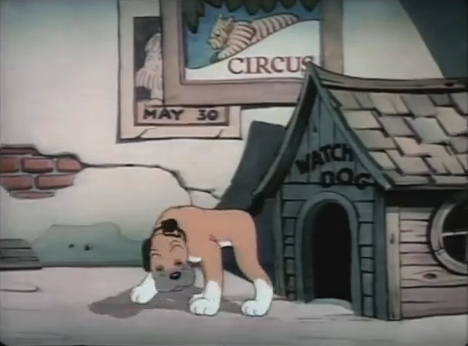
The curious puppy is seen hiding inside a dustbin after the take from the powerhouse being turned on. The puppy steps out of the dustbin, and we pan towards a kennel which reads 'Watch dog'. With no humans sighted at the amusement park: we find the sleepy watchdog stepping out of his kennel, awakened and disturbed. Some great personality animation of the dog stretching himself to keep awake.

Meanwhile, the curious puppy is seen at a 'Giant Swing' display watching the giant swing move sideways. In a close-up shot, the puppy watches the giant swing with his pupils, which swing sideways. A rather Disney-esque animated shot, which isn't particularly special, but its cute.

As the curious puppy is watching the giant swing; the camera pans to the watchdog who makes a turning point and watches the curious puppy who has trespassed inside the amusement park and turned on all the lights and displays into motion. The watchdog growls at the puppy. The curious puppy follows inside a typical display in amusement parks: the 'House of Mirrors', and the watchdog follows on.

The watchdog rushes inside the House of Mirrors, looking out for for the curious puppy. Chuck also attempts to make his animation look rich with the floor animation animated in perspective. Despite how it's described outside: 'amazing, baffling, etc.'. Unfortunately here, it's nothing spectacular.

The 'House of Mirrors' sequence turns into a lengthy, syrupy-paced sequence where the watchdog ends up watching his own reflection in the mirror. Evidently, the dog has never seen a mirror in his own life; he can't help but look at his own reflection.

Just like what you'd expect in a Disney cartoon featuring Pluto, except twice as slow as the pacing of Pluto and Pluto would probably not look at a mirror with such curiosity. As the watchdog continues to walk around in the House of Mirrors; a particular reflection (not a mirror).

The curious puppy on the other side copying the exact same motion in this sequence. Be prepared, folks, for a Disney-esque that Pluto would laugh at. With some pretty pointless Pluto thinking animation; the dog sticks his head out a few times, and then copy their movements with really goofy facial features which really lacks form with Chuck's conservative drawing style of this period. Afterwards; the dog watches the puppy use his own movement (without the watchdog moving). Knowing, he is caught--the puppy then rushes outside the Houses of Mirrors and the watchdog still chases after him.


After the sequence at the Houses of Mirrors, it appears to be that the curious puppy is climbing some sort of novelty staircase. The watchdog also climbs the stairs, but due to his weight, and the lack of weight on those stairs-it collapses. The puppy also slides down, next to the watchdog.

There's a great close-up by McKimson, and character poses, no doubt, by Jones--where the watchdog glares at the puppy. The puppy smiles sheepishly and timidly but dashes out of the scene. The watchdog runs inside a photograph shop where you can pose in front of dummy cardboard figures.

The puppy is seen posing as a beautiful woman holding an umbrella. Unfunny, although Chuck intended it to be cute. The watchdog walks around, but finds the puppy standing up on top of the figure. He jumps towards him, and the puppy flies out of the window. The force of the puppy being thrown out of the water, isn't very believable and lacks gravity. The puppy ends up dumped inside an automatic popcorn machine.

The puppy's head pops out of popcorn lying inside the machine. The puppy makes a sniff of the popcorn. There is a very expressive and charming which is definitely a Chuck Jones pose. The puppy smiles with glee as there is food inside the machine. This clearly indicates, how Chuck may have been ahead of his other rivalling directors, but just wasn't as good a cartoon director before he found that route.

Though this is a slow-paced sequence; the animation and facial expressions on the puppy are priceless. The timing on the puppy slowly chewing up the popcorn is very solid, as it gives a great feel of fear. After gulping a large amount of popcorn in his mouth.

The puppy attempts to dig his way out of the popcorn machine. The watchdog, turns curious of the popcorn machine. He finds an on-and-off switch button on the machine. He then switches it to 'on'. There is a technically-well animated scene where the machinery picks up the puppy inside the popcorn machine and places him inside a popcorn bag. A machinery is carrying a saltshaker and shakes salt at the puppy's behind. The other hand then shakes the bag so the salt can mix. Then the hand then butters the popcorn and the bag exits the machinery.

The dog then carries off the popcorn bag with him as he plans on kicking the puppy out of the amusement park. However, the bag then rips open and the puppy wonders off. The dog hears the puppy bark off-screen at a stall with novelty kittens set out in display. The puppy then makes sure if the puppy is in the bag by even ripping the whole bag open and through his head.

Knowing he is gone, he pulls the bag out of his head and runs towards the puppy. The puppy turns and watches the watchdog chasing after him. The chase then leads to inside a really tall sculpture.

The puppy looks down, and has a fear of heights, as it turns out he is about to slide down a very steep slide. The watchdog bumps into the puppy and they both slide down the slide and land into a pool.

The watchdog slides under the water, and ends up swimming out of the lake with the puppy. The puppy is seen sitting on top of the watchdog's back as the watchdog steps out of the pool, exhausted from the slide (great personality animation, once again). The puppy then slides down the watchdog's spine. They both look at one another, and then the puppy makes a rush out of the scene away from the watchdog.

The watchdog runs, and makes another turning point, but ends up being tricked by the puppy again. He comes across a box where there are toy puppies. However, it turns out by complete coincidence, that the toy puppies on display just happen to look just as identically as the curious puppy.

The watchdog, knowing he is being tricked, then barks at the puppy to see if the curious puppy whinces or makes any movement. After the watchdog growls, nothing happens.

So, he ends up jumping on top of the box with toy puppies for sale and it all breaks. The curious puppy watches the watchdog, in which the watchdog jumps on top of him and there is a cloud of puff that covers up the violence. As the violence is happening, the curious puppy makes a bark off-screen. The watchdog listens to the puppy and we pan to find the curious puppy is already outside the gates. Then the watchdog's anger starts to rise and burn. At the peak of his anger, he just breaks down sobbing. Why? I guess because he really wants to beat the crap out of that pup.

Overall comments: Another of the very 'many' cartoons where Chuck was just seeking out for some Disney-esque sequences as well as having the entire cartoon performed through pantomime. For the umpteenth time, Chuck Jones was a complete master of animated pantomime. Look at his Road Runner cartoons, Frisky Puppy shorts or even his Ralph Wolf and Sam Sheepdog cartoons for Warner Bros. Just to clarify this is still early days for Chuck, he obviously had the thought of animated cartoons performed silently from the very beginning, but still needed much more practice at the concept. Despite his earliest attempts, the Two Curious Dogs--are a pain to watch. The fact that the sequences just run on longer than they should be, and that the cartoon has no gags. More or less, the curious dogs were just Chuck's take on 'Pluto' except he'd just add two of them and make them twice as slow as Pluto. I'll admit I quite like the fact that literally not one person has noticed the bright lights of an amusement park or even approached to it, since compared to the dark city (where everyone would be asleep); it wouldn't be hard to notice. I will say that Chuck Jones' facial expressions on this cartoon are a great example as to much potential he had as a cartoon director, although his expressions were only the tip of the iceberg into being a exceptional director. Throughout the cartoon score: Carl Stalling uses Oh Where, Oh Where Has My Little Dog Gone? which would be a typical Stalling cue, but it works cleverly since the watchdog is on the hunt for the puppy.

On a side note, the entire 1930s library have now been reviewed and watched in chronological order. From watching the very first cartoons in 1930...and all the way to the last cartoons of 1939. You could say they're pretty bad and mediocre cartoons. But in-between those years: the WB cartoons have years of progressive improvement. All the pre-1935 are almost unworthy to watch. For me, the Harman-Ising era are only worth watching for me prior 1932...the 1930-31 shorts. Almost every cartoon they made afterwards (I find) is just about as bland and as terrible as the 'Buddy' era where the cartoons were incredibly below-standard, due to less creativity freedom they had, with the popular songs that had to be sung in the cartoons.

It's hard to imagine how the WB cartoons started off as mere ripoffs to the early Silly Symhponies or the early Mickey Mouse cartoons by Disney, and yet by 1939: they already had a special style of humour to themself. There is no doubt, Tex Avery definitely helped reform the humour and appeal which the Warner cartoon would eventually had, but the popular song system really still stayed on with some of the cartoon directors, and in some aspects, has never died away. You can even see in some 40s and 50s cartoons, but just in the wacky, hilarious Warner style. The end of the 30s have already brought to us memorable characters like Porky; who has dominated that decade. He had a great streak from 1937 to the end of 1938; though he is seen as 'tired' by the directors by the end of the 1930s. Moving on to the 1940s, better changes are made at everything: the directors, Tex's departure in 1941, as well the entire humour and timing which everyone has come to admire. After 44 cartoons of almost-painful reviews of the 1939 cartoons, I now am relieved to see the great side of the 1940s.