Saturday, 7 July 2012

175. Get Rick Quick Porky (1937)

Warner cartoon no. 174.
Release date: August 28, 1937.
Series: Looney Tunes.
Supervision: Bob Clampett.
Producer: Leon Schlesinger.
Starring: Mel Blanc (Porky Pig), Earle Hodgins (Honest John Gusher) and Cal Howard (Gabby Goat).
Animation: Chuck Jones.
Musical Direction: Carl W. Stalling.
Sound: Treg Brown (uncredited).
Synopsis: Porky and Gabby try to get rich quick by striking oil which was initially a scam trick by a hustler.


I think that it is Cal Howard that voices Gabby in this cartoon as his voice sounds a little different but I'm  not sure. At this point; after 'Porky's Badtime Story' Clampett and his peers were writing their own stories for the Porky Pig cartoons. This cartoon is also the final appearance of Gabby Goat.
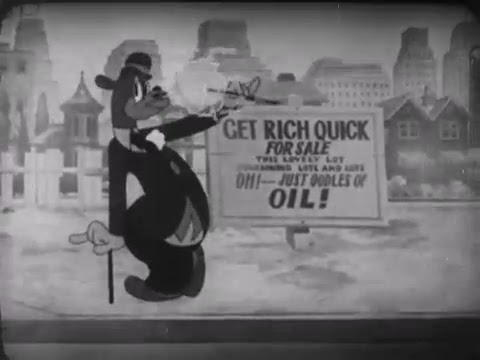
The cartoon begins as we find the backgrounds for the title cards done in silhouette. The silhouette then fades away in which we find that there are city backgrounds but a sign in a ditch that reads: GET RICH QUICK - FOR SALE THIS LOVELY LOT CONTAINING LOTS AND LOTS OH! ~ JUST OODLES OF OIL! The word "oil" then starts to drip down as we find an oil land hustler standing next to the sign dressing rather dandy, rather rich and uses a cigarette holder to smoke.

A car full of oil then starts to drive past as the driver asks the hustler, "Hey chief, where do I deliver this oil?" The hustler then replies, "Right along here my good friend" as he points with his stick to the direction of where the oil needs to go at. I'm not sure if the oil hustler is meant to be a reference to someone but the fast toned voice sounds like as though it could be referencing a celebrity of the time but maybe it's just a voice of what a hustler would just sound like. The oil hustler then grabs out a hose in which he places the hose for the oil to go inside the sprinkler system which is a way to cheat his way of getting rich quick. 

As the oil hustler turns on the hose; his way of getting rich quick being a cheat then happens as oil squirts from the grounds for where oil is delivered. The oil hustler rubs his hands gleefully and speaks, "Now for a couple of suckers, speaking I should make prospects - someone with a little money to invest". The hustler then looks over to his opposite in which he glances at the bank.

We find that Porky and Gabby are walking to the bank as Porky is holding a bag of their money. Gabby then starts to yell at Porky on why taking money to the bank and not buy a new car or travel to Europe. Porky replies, "No, I'm going to stock my dough and get 2%". As they walk up the steps to the bank; they are stopped by the oil hustler who introduces himself to both of them. Gabby sounds much more different than he did in Porky and Gabby or Porky's Badtime Story as he was voiced by Blanc in those cartoons but here I don't think he is voiced by Blanc here but I think it was probably by story man Cal Howard but I'm not too sure - does anyone have evidence on this? Keith Scott? Anyone?

The oil hustler who speaks very quickly with is voice still introduces him as he convinces Porky and Gabby that he's "just the man you want to see". He then shows out his card just like any any hustler or manager would do to introduce people by shouting "My card" in which he quickly shows it to them and tosses it back. Some nice quick timing of the card being shown. The hustler introduces himself as Honest John Gusher who convinces them to dig for oil.

Honest John Gusher as he's been identified speaks too fast like 24/7. Honest John Gusher then convinces Porky and Gabby as he pushes them away from the bank and over to the ditch where he convinces them to dig for oil in which they'll get rich quick. Honest John Gusher then goes to say they don't have to take his word but I can't tell exactly so I'm not going to go through everything he says but I get the gist of what is being said. Honest John Gusher then proves to Porky and Gabby as he prods his walking stick to the ground as a small fountain of oil flows out to show the soil has enough for them to get rich quick.
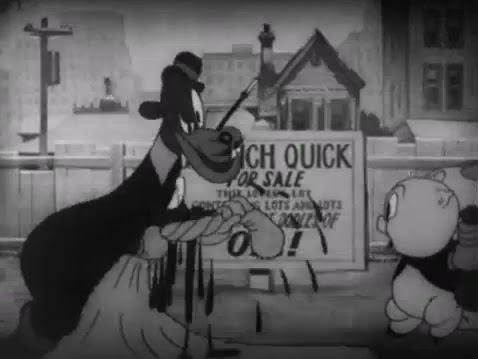
Honest John Gusher continues to convince Porky and Gabby with his fast talking mode that the oil grounds are exaggerated with oil that you would "ring it out with your fingers". He grabs hold of the soil and rings it like doing so with a towel and oil is squirted out. At least Clampett is presenting it as it keeps the audience interesting as you see him ringing the soil with his fingers which is rather cartoony.

The hustler then hand over the deed to Porky and Gabby for them to sign the deal to get rich quick. Porky is a little unnerved about signing the contract but Gabby convinces Porky to sign it stating, "We'll never get a chance like this". The hustler then points to where it ought to be signed. Porky Pig then makes a mark on the deed which is an 'X' mark which is a rather funny gag that probably suggests they can't write or too lazy to write their full name as he would just write a simple 'X' symbol. After the deal has been made; it meant that the hustler took their bag of money in order to strike oil in which would supposedly be a cunning trick to scam their money to strike oil - what a bastard!! Porky and Gabby are rather excited to start with the job as they grab out digging tools in order for a huge oil strike.

Gabby Goat then starts to begin the goal to strike oil in which he drills to the ground. He continues to drill deeply to the ground but then tugs out something from the ground and shows a tank that has the word oil labelled inside it; Gabby shouts "Hey Porky look,  oil". Personally I find that the way Cal Howard (or whoever) voices Gabby a bit degrading.

Meanwhile as they are starting to dig for oil, a dog then walks into the area where they are still digging rather curious as to what is being seen. As the digging still continues; Porky is digging the soil off-screen but you find once he's digging that a bone pops out which eagers the dog. There is some pretty solid character animation of the dog watching what is being dog as you feel he has got the personality of a dog; like Pluto in the Disney cartoons. The dog then starts to walk off with the bone and then does what all dogs would do - bury their bone. So the dog then buries the bone underground for safe keeping.
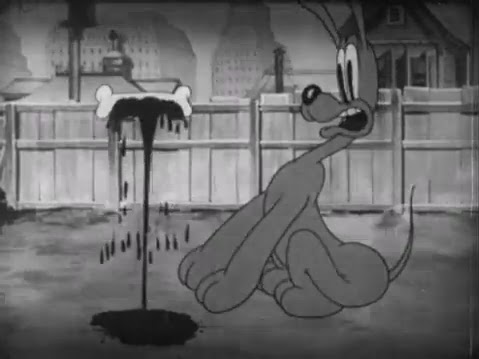
After the dog has the bone underground and scrapes it under the soil but finds that he bone then starts to squirt from oil which scares the dog. Then the bone starts to move from the flowing oil up in the air and then hits the dog on top of the head. The dog then starts to bury the soil under the oil but then the oil ends up squirting the dog in the face in a different position. There are then action scenes following on the dog being squirted by oil even including on his head which makes the cartoon action fun to watch.

There are multiple tiny oil squirts that happen in which the dog tries to stop the oil in which the dog starts to go into these interesting swirls which makes the pacing and comic timing much more fun to watch as Clampett is making his cartoons fun to watch and you can tell he's committed to animation even when he first started directing. After the dog believes that he has solves the problem by standing on each oil flow with arms and legs; the dog starts to pant happily. The oil is so intense that it starts to squirt and the dog is standing on air with the dog having a bit of a worried face wanting to get back down.

In the next sequence following after the bone sequence; Gabby Goat is standing on a drill that would drill to the ground. Gabby Goat then shouts over to Porky Pig but finds that he drills to the ground rather deeply that the timing is rather funny. Gabby Goat continues to dig even deeper believing me knows how to dig and Porky Pig walks over to the scene to see what has happened. Porky looks under the hole looking for Gabby and stutters, "Gabby, where are you?"

Some very funny animation pops up as the drill then drills it's way out of the soil from the other side and floats on air as the drill is in control of Gabby and the 'Merry-Go-Round Broke Down' is heard in the background. The drill then stops drilling once it touches the ground again in which he starts to shout at the drill to Porky. The drill continues again as Gabby continues to dig deeper to the ground burying the soil. Porky then starts to worry about Gabby underground asking, "Are you alright?" Gabby is underground as he replies; "What do you think?" which is of course a direct "no".

After that bit of fun with Gabby and the drill; we return to the dog again who is seen in the ditch slouching rather bored. The dog is sitting down fiddling with the bone with his hand. That is some very solid character animation of the dog moving the bone - good to study if you're learning to be an animator or studying animation.

Meanwhile a gopher from underground then starts to whistle to the dog and hides underground to get the dog's attention. The dog then starts to stand up rather happy there is a hole buried to place the bone as the dog couldn't find any area to bury the bone safely. The dog then drops the bone to the ground but the bone throws itself up. The dog throws the bone back into the ground but then the dog starts to move weirdly (and that animation is rather enjoyable). The dog covers the bone to the ground so that the gopher wouldn't have luck in throwing the bone back to the surface. The dog looks over to check but the gopher whacks the dog in the nose.

After being whacked on the nose the dog then starts to pant happily as the gopher pops back with the bone. The gopher decides to perform some magic tricks with the bone. The gopher then starts to push the bone down so that it disappears. The dog is rather curious of the tricks and finds that the bone has disappeared from the gopher's hand. The gopher then grabs out the bone out of the dog's ear as the trick has been finished.

Although that magic is rather typical; but the animation of that was rather appealing. The music for the magic scene in the background is of course; She Was an Acrobat's Daughter. The dog is rather surprised as to find the bone inside the gopher's ear. The gopher then buries the bone under a small pile; the dog points to himself whether he can pick up the bone and the gopher nods. The dog digs to the ground to grab his bone but is conned by the gopher as some oil squirts straight to the dog's face. After the dog's face is covered in oil; the gopher then opens the dog's mouth and takes the bone out. The dog has been tricked once again. The dog is annoyed again for being tricked by the gopher and ends up breaking down into tears. All the clever things that gopher does.

After that rather length sequence that went on for roughly a minute - Porky is seen digging to the ground and ends up striking a bit of oil. Porky Pig starts to fill up some of the oil in a bucket gleefully shouting "Oh boy". As Porky has managed to dig up quite a lot of oil. Honest John Gusher; the sneak has turned off the sprinkler system in which the amount of oil then starts to flow down which disappoints Porky. No wonder he's probably rich - just ripping off people's money.

Porky Pig continues to dig for more in which suddenly finds that he has bit a bar in which oil is squirted at his eye. Honest John Gusher then walks over to Porky Pig trying to act as though he knows nothing of the problem

Honest John Gusher: What's the matter, sonny boy? You aren't discouraged, are you?
Porky Pig: You're just a crook and I want my money back!
Honest John Gusher: Well, if that's the way you feel about you just give me back the deed.

Porky Pig has already realized of the hustler's crooked scheme which was to rip off his money as a trick to get rich quick.

Honest John Gusher continues on as he offers a dollar note to Porky, "...and I'll give you this crispy one dollar bill". What a ripoff; no wonder this character is such a weasel which is a good portray of  the hustler. We continue to go under ground where there is a good amount of oil. The words then scream "OIL" which is also a small Clampett trademark but he only uses that sometimes in this cartoon to make the climaxes exciting.

Underground we find that Gabby Goat has got the drill and is very close to struck the amount of oil. Porky Pig is just about to return the deed to the hustler which is another part of the crooked scene; as he's only given a dollar. I like how Clampett has organized the shots and climaxes for this part: Gabby is very close to be striking oil and Porky is very going to be giving away the deed. Once the hustler just touched the deed in return - UREKA! Oil strikes. There is a huge amount of oil shooting straight up to the sky even reaching as tall as the city buildings. They're rich now. You can hear a little bit of 'We're in the Money' in the background with the shot of oil striking.

Porky and the hustler are standing on oil but both are still holding onto the deed. Now there is a fight that goes on which means Porky has to try and fight the deeed back as he immediately changes his mind. Porky shouts "I'm a billonaire" still holding onto the deed. They then try to snatch the contact from each other fighting over it.

As the fighting still continues; Gabby is still being controlled by that powerful drill in which he ends up moving at weird and funny positions. The drill then moves inside. Honest John Gusher is in pain as he screams from the drill that is hitting his rear end. Porky and Gabby are trying to stay on top of the oil but are about to slip and slide down which would be rather dangerous. They end up slipping from the oil as they land and hit the ground. Porky thinks he is holding the deed as he shouts, "Look I got it, I got it!" but instead Porky is holding a bone by mistake. Porky continues to point but ends up pointing slowly realizing that he's holding a dog's bone and not the deed which is also good character animation.

Porky and Gabby are now in a little shock as they can't find the deed so they have evidence on where they could sign the oil. Immediately after that shock there is a dig under the ground that features the same gopher that performs magic tricks. The gopher then pushes the bone down but forms it back to form the deed. Porky is about to take the deed, but the gopher hides it back asking, "Partner?" Porky accepts in which the gopher then rips up the deed so they get their share. The gopher then ends the cartoon looking at the audience - and that's the cartoon, folks.


Overall comments: With a cartoon that has good solid character animation, as well as funny gags and good personalities I find that this makes a good cartoon and this certainly adds to that effect on that cartoon. Bob Clampett was only 23 or 24 years old but he has certainly made some appealing cartoons in the first year he started directing - 1937. While there were quite a lot of bland designs in the cartoon (but that's my opinion) - the Clampett cartoons shown here have a distinctive feel to it through Chuck Jones' character layouts on the early Clampett cartoons which makes the cartoons fun to watch.

The dog however in my opinion is another ripoff to Pluto but at least the dog has character personality which is interesting to watch; and that watching the dog getting conned by the gopher makes the sequence also interesting. I wonder if the gopher was created to try and appeal to an audience; like the way it happened to Daffy Duck in Porky's Duck Hunt - I may be wrong but just a theory. This is the final appearance of Gabby in this cartoon; and I feel that it would be enough we would've seen of Gabby Goat as he may have an annoying voice but was rather funny being grouchy but I feel that 3 cartoons starring would be enough and of course Porky Pig would continue to be a star for many years - but I feel so far in the 1930s Clampett has made the best Porkies but that doesn't mean I'm an immediate Clampett fanboy just because of that. Each director has got their own unique style back then which I do appreciate in some ways.

Friday, 6 July 2012

174. A Sunbonnet Blue (1937)

Warner cartoon no. 173.
Release date: August 21, 1937.
Series: Merrie Melodies.
Supervision: Tex Avery.
Producer: Leon Schlesinger.
Starring: Mel Blanc (Various Mice), Billy Bletcher (Villain Mouse) and Berneice Hansell (Girl Mouse).
Animation: Sid Sutherland and Virgil Ross.
Musical Direction: Carl W. Stalling.
Sound: Treg Brown (uncredited).
Synopsis: A lovestruck mice couple entertain the hat shop infested with mice.


The cartoon begins outside the shop of a hat store at night reading Snobby hatte Shoppe which is closed for the night. We then start to view inside the dark hall where the hats are sold. There are some interesting overlays of inside the shop to make the effect more realistic such as watching the shelves with the hatstands. Could be funnier if Avery could add a gag into it.

A mouse then peeps his head out of the mouse hole to check if the coast is clear to step outside or not. The mouse then starts to tiptoe quietly out of the mousehole in case the mouse might get spotted or something. The mouse continues to tiptoe through the shopping hall to check if anybody is around and then bursts out roaring, "IS ANYBODY HERE?!" and then dashes back into the mousehole in case of a guard or a cat lurking around. That was a slightly funny scene considering that it was not expected during a sneaky tiptoe scene. The mouse then steps outside to find that the coast is clear and that nobody is about. The mouse walks over to the elevator next door to his home and catches a lift going upwards. The mouse then reaches to a piece of wood that reaches to the last part of the elevator.

The mouse presses a button to take him to his next step but the buttons he press bash him off the top and he lands on top of a top hat. Now that is a clever and fun way to try and get to contact the other mice even though it may hurt. The little boy mouse then warns the other mice "There's nobody here. Come on!" The top hat then grows back to normal size pushing the little boy mouse out of the way.

All of the other mice then rush out of the hole so they can have fun. The little boy mouse then quickly nibbles at the hole in which it forms into a loveheart as he takes his sweetheart out. I wouldn't call that a gag as I'd say it's rather sweet. The little boy mouse then shows his sweetheart at the loveheart shape he created as she comments, "Aw George, you're so cute" and she giggles. As the couple run out of the scene holding each other's hands; the villain of this picture turns up laughing evilly who is up to no good and acting as a stalker on the couple. The villain with that stereotyped  moustache and black cloak then steps out of the love-heart shaped hole to spy  on them.

Meanwhile the two mice then walk over to the hats as the female mouse picks up a blue bonnet to wear. The male mice then grabs out a boater to place on top of him so he can match with his girlfriend holding the blue bonnet. The animation of the mice holding the hats is rather realistic looking and looks as though it was taken good care. The villain then stand by his hat which is black and to represent how evil he is then starts to laugh evilly.

There are a group of mice that then push buttons in which they are trying to create dance lights to make the mood and atmosphere more colorful; and even in animation, too. The two mice then walk into the spotlight as they are holding the hats. They place the hats down and start to dance by moving their hands to the song A Sunbonnet Blue (and a Yellow Straw Hat) that was composed by Sammy Fain. They are a singing duet together as they and of course even Berneice Hansell provides the singing voices for the two mice (at least of the girl mouse) but I'm not sure if Berneice is singing the voice of the boy mouse whilst they sing.

Meanwhile as the singing mice couple perform 'A Sunbonnet Blue'; the boater hat then starts to comes to life as so does the blue bonnet. They have now got legs and arms. Okay but am I being taken back in time to the Friz Freleng 'Merrie Melodies' era? This cartoon so far really doesn't feel very much like the work of Tex Avery and feels soppy to be his work so far.

The boater and the blue bonnet then walk over to a priest hat that weds them. The boater has got shakey legs which is good timing on the shaking legs. We then move back to the mice couple still singing their song and then a point of view shot shows a hat couple sitting down like a married couple with babies sitting in the lounge near them. Okay, but I don't particularly understand the appeal of hats in this particular cartoon - is it because hats were popular back then and they decided to make a cartoon out of it?

As the mice couple still continue to sing their song; the mice changing the colors of atmosphere in the spotlight grabs out a coloured hat with a cap in which it changes color to a yellowed atmosphere. Watching the dance scenes; I'm not sure but these dance scenes of the mice might be done by Virgil Ross as he animates dance scenes but I'm not so sure.

The colors of the spotlight changes color to demonstrate mood and I find it much more interesting than the dancing mice couple as the song and dancing routine is starting to become monotonous. After they have sung the song; the finale then finishes as it includes the boy mouse scatting at the music which includes. The scatting at the end is more fun to listen to and makes the rhythm more appealing in my opinion than the overall song which was a bit of a bore for me, but that's my opinion though. All of the mice applaud at the music they have enjoyed it but I imagine that the song was enjoyable of the time.

After the group of mice have finished clapping to the song; the next sequence that is added includes a dunce hat which appears to be sold in these stores maybe for teachers to purchase as school supplies. There is fighting going on inside and the caption underwards reads The Three Ratz Brothers which is of course a reference to The Ritz Brothers who were a popular comedy team of the 1920s even spanning up to the late 1960s.

The three "ratz" brothers then rip up the dunce hats that they sing the song I Haven't Got a Hat which of course you'll be familiar with. The animation of the ratz brothers is animation by Irv Spence who definitely gives it some loose movement and I like how that he makes the rats look rather goofy looking and gives the scenes much more appeal. It appears to be that Spence loved to draw open-mouths wide even in these drawings. As soon as the spotlight changes to green; the Ratz brothers then got on a dramatic version of the song they were singing which is rather entertaining. I like how that this cartoon is focusing on hats but it looks like Avery is desperate to try and make a gag featuring hats which is why they sing "I Haven't Got a Hat".

After the green spotlight fades to normal; one of the Ratz brothers then starts to quote Ted Lewis "Is everybody happy?" As the other two brothers shout "No!" and the spotlight changes atmosphere. They conclude the song singing the last verses repeatedly "I haven't got a hat...". They then start to change song to; Put On Your Old Grey Bonnet which is another hat song. Looks like this cartoon has made it clear that Avery was trying to use songs about hats to put in this cartoon for it's plot; but it's interesting that there were a lot of songs about it in the 1930s.

The Ratz Brothers appear to go into a medley that they switch chorus on different verses which appears to go off quite clever but probably dated in today's standards as they go off singing 'The Lady in Red'. They then conclude their performance in which the mice also applaud. Well that was some rather entertainment - at least with the medleys which I wonder if that was meant to be a gag pulled off by changing songs from verses to be pulled off cleverly even though it may be dated. Irv Spence animates all the scenes of the Ratz Brothers who managed to make the sequence a fine performance, I'd say. Although I'm not saying that just because I like his animation but because I find it more interesting than the other animators in this cartoon..

The boy and girl mouse were also amused at the performance. After some entertainment at roughly 2 minutes of just singing and dancing the villain then steps back into the cartoon. The villain then starts to tiptoe inside his hat to come up with a plan. As the little girl is still amused by the performance, the villain then captures the girl in an escape as the little boy has to think up of a plan to rescue.

Oh great, it looks like Tex Avery has been influenced by these recycled cartoons of the villain capturing the girlfriend - not you Tex! The little boy then starts to make an alarm by whacking a spoon on an army helmet informing  the mice that his gal has been captured. All of the mice's ears then stretch and start to dash out of the scene to try and capture the villain. An army mouse then starts to make the "Reveille" call but his pants falls down at the scene. There are a group of army hats in which they start to march as they are at war with the villain who has the girl mouse. Okay but watching this I do feel like I'm being returned to the 1935 Merrie Melodies except that it's got Tex Avery's drawing style on there. Meanwhile the boy mouse then starts to look through the hats to find anyone by going through the bowler hats but there is no trace to be found so the boy mouse has to put in more effort.

After going through several hats; the boy mouse then encounters a  police officer hat in which the boy mouse warns the officer mouse about a villain who's captured his girlfriend and is on the loose. The officer barks, "Why don't somebody tell me these things?!" Okay, I can see that this is also Avery's humor except this is a reference to the Listerine commercial. The officer scenes were also Irv Spence's animation.

The police officer blows the whistle to warn the other mice about the situation in which police hats are on the run; and also firemice slide down the fireman hatstands to also help. Although I don't know why fire would have to be involved in this sequence; I don't think the villain is planning to burn the girl mouse. Even a cowboy mouse is on the run and appears to shout in what sounds like a type of reference to me. A hillbilly mouse then pops out of the straw hat and shouts "Hello bub". Then a group of cheer leading mice are on the run with their hats as another group of cheer leading mice shout for their team. So basically an entire group of hats are on the run in this store. With these action scenes going on; now I'm starting to notice some Tex Avery humor but it's not appearing an awful lot in this cartoon.

The boy mouse then starts to run around the stalls of hats whooping excitedly and you can hear Daffy Duck's whooping sounds that Mel Blanc has added in this cartoon. The boy mouse is still looking around and even looks under a George Washington hat. The boy mouse then starts to ask the George Washington mouse.

Boy mouse: Which way did he go? Which way did he go?
George Washington Mouse: I cannot tell a lie. They went that way.

The George Washington mouse points at his left direction to where the villain went in which the boy mouse starts to follow to find out. The George Washington mouse scene was also Spence animation. The boy mouse then looks under a hat with a sign reading "blind" in which a blind mouse responds to the mouse who asked, "Which way did he go?" It feels like a bit of a blind joke to me since the mouse is blind; it can still know which direction to go which doesn't make the mouse blind at all - which means Avery is showing a blind joke. I wouldn't redeem the joke as offensive as it's presented rather harmless.

The boy mouse has now caught up with the villain they step up the steps of boater hats and then descend down them. The boy mouse then steps on top of a top hat in which it flattens. The boy mouse then picks up the flattened top hat and spins it like a Frisbee and the animator on that sure has focused on the hat movement carefully. The flattened top hat then slides down on the floor and the villain slips on it releasing the girl mouse.

Afterwards; the villain then starts to slide by automatic, apparent force and gets' trapped inside the knight's helmet. The boy mouse then starts to lock up the villain for good after his crime towards his girlfriend and all the mice start to laugh at the villain's misfortune. The villain then shouts, "'T ain't funny, McGee" of course - he's referencing to the radio show Fibber McGee and Molly. The mice couple then pick each other up from the ground as they reunite together. The boy mouse then whispers to the girl mouse to extend his hand in marriage - a proposal. The girl mouse then nods enthusiastically as the boy mouse jumps with delight.

The scene then fades out but fades in as we find that it's the mice's wedding day and they are sharing the same top hat. They walk down the aisle of the ceremony as the priest then starts the speech of accepting marriage to the mice couple. The priest then asks one of the mice, "Do you?" in which he starts to blab with a "blah, blah, blah" noise as though he wants to get it over and done with. A group of mice then start to deliver in a wedding present in which is delights the girl mouse now married who gleefully shouts, "Ohh, a wedding present". The girl mouse then unties the ribbon and opens up the box to find what's inside the box. The girl mouse chuckles delightedly and snuggles up to the boy mouse lovingly. Now that is some nice character animation of the snuggling up part. The boy mouse looks inside the box which comes to his surprise. This is definitely an Avery idea added in which shows a photograph of a bonnet featuring baby mittens that suggests they're having a baby.


Overall comments: I find that the overall cartoon to watch from beginning to end is rather interesting in many ways to explain. To begin with; I find that much of the beginning of the cartoon starts off and feels like watching a Merry Melody cartoon made around 1934-1935 when Friz Freleng was directing the cartoon as it was a Freleng feel to it. Avery appears to have returned to the singing and dancing routine in this cartoon as it was roughly 2 minutes long and must've felt desperate to try and add gags to it. I wonder if this cartoon was backlogged when Avery was still having to make cartoons and forced to add songs to it; but if he did then it would've been very early on for Irv Spence to animate on this cartoon.

Nothing in this cartoon starts getting into action after the villain captures the girlfriend when Avery appears to be following that old routine that's even old enough to be featured in very early Disney cartoons. After the capture sequence, I feel that's when the gags typical of Avery start coming in in which it makes the cartoon not bad after all. It feels rather off to me as to why Avery wanted to make an animated short about mice wearing hats which seems like a crazy idea for a plot but I guess Avery was just experimenting and finding ideas to go along.

Thursday, 5 July 2012

173. Porky's Railroad (1937)

Warner cartoon no. 172.
Release date: August 7, 1937.
Series: Looney Tunes.
Supervision: Frank Tashlin.
Producer: Leon Schlesinger.
Starring: Mel Blanc (Porky Pig) and Billy Bletcher (Silver Fish engineer).
Animation: Joe D'Igalo and Robert Bentley.
Musical Direction: Carl W. Stalling.
Sound: Treg Brown (uncredited).
Synopsis: Porky Pig is in threat of a streamlined train which is planning to take over him.

The cartoon begins as we find an animated locomotive in perspective moving while the title cards still appear. The animation of the locomotive driving down is done in an animation cycle which I feel is suitable and it's done in a point of view shot. The train has the number '515' printed on it as it is steaming through the railroad. There are some interesting camera angles done by Tashlin such as watching the bell ring.

While the steam train rides into the camera with perspective animation; the title card reads in modern writing: The 30th Century Limited the Railroad's Crack Train. The music played at the opening of this cartoon is called California, Here I Come which is a popular Stalling cue when you hear trains or travelling. You can hear the lengthy version in 'Porky the Wrestler' which is heard two-minutes in the cartoon non-stop. There are some pretty interesting Tashlin timing here as well as camera angles that shows how modern the steam train looks describing it as "30th century" and picturing the speed of it.

In the next shot after watching the 30th century updated, faster steamtrain we find an interesting comparison towards Porky Pig's steam train that he engineers. The title card for that reads: The 15th Century Unlimited - also a crack train. A little jokey part is added in describing the steam train and Porky, too -  everything cracked - including the engineer. The animation of the steam train completely puffed out, lacking energy has got some good personality animation.

Porky Pig is then about to ride on top of a hill called 'Piper's Peak' which is shown in Porky's point of view chosen by one of Frank Tashlin's interesting camera techniques even including the shot of what is supposed to be the train going up the hill and instead; it's the camera moving up the hill. Porky is ascending up a hill but is moving up there very slowly. The funny part that is that the train is moving so slowly that a snail moving up the hill is even going at a faster pace which is funny pacing and gag. As the train continues to try and move up the hill; the train then suddenly halts and doesn't make anymore movement.

Porky Pig already finds that there is a problem with a steamtrain but finds an idea to solve that problem. Inside a box where Porky appears to keep his tools; Porky grabs out a pepper-shaker and shakes the pepper on the candle where the engine is. The train starts to sneeze and ends up doing so which starts to make a slight move up the hill. A clever gag idea; and even amusing as Porky blesses the sneezing train, "Gazuntite" (bless you in German).

Everytime when Porky's steamtrain - called Toots starts sneezing; it makes slight movements up the hill. The timing of the steamtrain sneezing starts to get faster as it starts to reach to the top of the hill and then lowers down the hill. Then it comes back with some point of view shows of the steamtrain descending down the hill and then moving forward as the background shows us there's no hill ahead which is why I love those obscure camera angles that Frank Tashlin was experimenting with as he was more of a live-action man. The steamtrain then enters through a tunnel but finds that it's out about two seconds later; and sorry Tash but the pacing of that was a little too quick.

In the next scene you find that some very obscure animation is seen as well as obscure layouts in a bird's-eye view shot of Porky's train "Toots" driving through the train tracks from the looks of it it just looks like a bunch of blocks driving through the train tracks. You make it look more stunning and eye-grabbing attention; Porky's train from the bird's eye shot then goes through very complicating railroads that are all over the place in which the trains split apart in different sections before reattaching together.

Meanwhile as Porky is still driving his train; we find that the '515' train is steaming straight past as it's much more updated than Porky's train. The animated shot of the train steaming past is reused animation of earlier on in the cartoon. Porky Pig notices that the incoming 515 train is coming straight ahead moving incredibly fast. Porky Pig notices that he is in trouble with the incoming, fast locomotive as Porky then starts to make a move on the other side of the railroad so he will be dodge. However there is already one caboose that isn't part of the tracks where Porky is and is likely to get crushed by the incoming train. Porky Pig then starts to pull the last caboose in on the last second just as the incoming train drives past. Now that animated scene would've been just difficult to animate in terms of timing and movement.

Porky then starts to sweat, "Phew" which was a close one after the caboose was almost strucked by the train. Porky Pig can still continue to ride on his train but however faces some trouble as there is a cow sitting in the middle of the railroad. The point of view shot of the cow chewing on the railroad gets closer to attempt to show the halt of a railroad but that camera effect doesn't feel very effective to me.

The concept of this gag of a cow chewing on the railroad has been seen in early Disney cartoons like 'Plane Crazy' or the very Harman-Isings and Tashlin pulls it off here; but it's not the exact same sequence; but just built up differently in this cartoon. Porky Pig then steps out of the railroad and tries to speak to the cow to move although stutters: "Excu..., excu..., Pardon me Mrs. Cow, will you kindly get off the track?" The cow moves her head very slowly making no posture or even an answer to Porky's request but instead just gives a stubborn feeling of not moving. Porky then starts to get more assertive towards the cow, "Come on, come on, get going! Time's a wastin'!" The cow still stays still in which Porky starts to try and push her off but the cow then starts to move along. Huh? Considering that Porky calls her Mrs. Cow - where's her udder?

Porky Pig finally has the "cow" taken off the track in which he walks back on his old steamtrain "Toots" rather annoyed commenting, "It's cows like that, that give milk a bad name. I bet she can't give sweet milk with a sour puss like that". Okay Porky, but don't bother crying about a cow. Porky Pig then steps back onto his steamtrain.

Meanwhile as Porky would be about to get going on the track; a bull walks into the scene. The bull looks very cartoonie; but very tough and bold. I like the nose pierce and appears to have a missing tooth inside his mouth. The bull walks at the end of the railroad but Porky notices that the bull's tail is sticking out of the railroad refusing to walk any further. Porky Pig steps out of his steamtrain and tugs at the bull's tail, "So you won't walk, eh? I'll show you, you four-legged piece of hamburger". Mmm, is it me or does the line "So you won't walk, eh?" sound like a bit of dialogue that a Billy Bletcher character would've voiced. The bull then starts to turn aggressive towards Porky as Porky is making the bull angrier. Porky makes a take from the angry bull and dashes back inside the steamtrain. The steamtrain then dashes away very quickly through those curvy tracks until only you find a speck of dust. The timing of that is done very well and I imagine this was difficult for the animator; likely to be AC Gamer.

After some sequences featuring Porky and his railroad troubles. We find some montage scenes of a hand (influenced from live-action camera angles) tapping on a wireless operator. The operator then comes out with a printed message reading Stop Porky's Train. There are more of these obscure shots of a hand pulling the lead in which the traffic orders the train for Porky's steamtrain to halt.

Porky Pig then stops the train at a local station as a telegram is delivered to Porky through a type of washing line and Porky grabs out the telegram and reads the message: ENGINEER PORKY PIG, ROLL UP YOUR TRACKS AND GO HOME - THE STREAMLINE TRAIN IS HERE TO STAY - I. FULLER CINDERS P.S. PLEASE RETURN SPIKES. I'm not too sure what the "Spikes" reference is meant to mean but the telegram shows that Porky's career as an engineer is in jeopardy as a streamlined train is about to take over Porky Pig. I love that eye shot of how the words "streamline train" is highlighted which is bad news for Porky Pig.

Yes, and a streamlined train is driving through the tracks in which it is called 'The Silver Fish'. The movement of the Silver Fish then starts to zoom in closer (done with arcing and perspective) as the driver of the streamlined train certainly looks evil and a threat to Porky. In the meantime; Porky Pig then starts to sob as his job being an engineer is over. Porky stutters on saying "au revoir" (means "goodbye" in French" but then stutters, "goodbye Toots old gal". Porky then quotes Romeo & Juliet, "Parting is such sweet sorrow".

I love how that in early Porky Pig cartoons that Porky definitely shows personality in his stutter; he tries hard to say complicating words or speaking foreign as he did now but stutters and just thinks of a simpler word on the spot; I appear to notice that an awful lot in these early 1930s cartoons. The "parting is such sweet sorrow" line used in this cartoon is rather funny to use it considering that Porky has used that steamtrain for such a long time.

The Silver Fish streamlined train then arrives at the scene of Porky sobbing of his steamtrain "Toots". Porky walks up to the Silver Fish engineer and stutters, "I wish you lots of luck, Mr. Silver Fish". Mr Silver Fish then grabs out his hand to shake Porky's hand rather violently that Porky is off the ground and goes into these weird poses without inbetweens.

Mr Silver Fish then points at his old steamtrain rather rudely, "Say, what is that? A perculator on a roller skate?" Mr Silver Fish then starts to laugh at "Toots" the steamline which starts to flatten like a burst balloon. Porky then starts to break the forth wall speaking to his audience:

Porky Pig: I bet my Tootsie can beat his old Silver Fish.
(Mr. Silver Fish picks up Porky) Mr Silver Fish: Oh yeah? It's a bet. We'll have a race and see.

Mr. Silver Fish prods and pokes Porky's eyes just to bully him for him as an inferior. Evidently the villain of the cartoon is voiced by Billy Bletcher who is popular all over the studios.

The next scene then fades into the dace. Porky's old steamtrain is next to Mr. Silver Fish ready to begin their race. The referee is holding a stopwatch and is holding a gun in the air as though their race has been made official. The referee then fires with his gun as the streamlined dashes off in a millisecond leaving a speck of dust that blows off revealing Porky's "Toots" all tied up like a pretzel. From what we are seeing - it would be impossible at this point to see him win.

I like the timing here by Tashlin and that Porky's train is tied into a knot after a speck of dust. At least it wasn't so challenging for an animator to have to draw it. The Silver Fish then starts to zoom past winning the race; and drives through the wood pile. The wood pile then starts to fly out of the way revealing what appears to look like a Negro boy or a monkey; and I can't really tell the difference but it's likely to be stereotyped as a Negro. The steam train is already zooming by so fast that whilst going through a tunnel; the tunnel ends up going inside out - with the comic timing of that great. As the race continues; the streamlined train then stops at a bridge to cross a river as a tugboat is sailing past. There is a Mae West fish that pops up from under the water that comments, "Oh boy, what a man". I imagine that was a funny at the time because it's an impression of Mae West but I just find it really random, though. The steamtrain then starts to cross the bridge once it's formed.

Porky Pig  is now steaming ahead trying to catch up with Mr. Silver Fish. Okay, but HOW did Porky end up out of the tangled steamtrain - makes no sense to me and it was never even though. Oh well about that; let's get on with the cartoon. Porky is catching up on the speed so fast that he even crashes open a bridge as a ship is sailing past.

Afterwards Porky turns to find that there is a sailor on a lifeboat rowing singing Don't Give Up the Ship which is a rather funny gag. The name of the ship the sailor works for is called S.S. Leon which is of course; a reference to Leon Schlesinger. Leon even used to own a boat at the time and would even take his crew aboard his boat for events sometimes. There is also a lifebelt on top of the front part of Porky's train "Toots". I'm not so sure on who the voice of the singing sailor in this part could be. Meanwhile as Porky's train is still steaming past still competing to win; the bull from earlier on in the cartoon is on top of the top and spots Porky's train. The bull speaks in an angry voice, "He can't get away with a thing like that, I'll show him". There is a thought bubble that pops up near the bull remembering about what had happened which was Porky tugging at the bull's tail.

The bull then makes a dash down the hill onto the tracks. The bull then starts to make a very loud roaring sound that it slightly shakes the telephone poles. The bull then starts to run straight towards Porky's old steamtrain at full speed ahead. As the bull continues to steam upwards; Porky's train (from the bull's point of view) gets closer and closer. The bull then starts to wreck the cabooses on Porky's steamtrain in which only the front part (where Porky rides the train) is bounced off because it is made of metal and it makes a huge jump. Porky's "Toots" starts to jump high so fast that the train even overtakes the Silver Fish and wins at the finishing line as the scene fades out.

We iris in to find that Porky Pig has taken over the "Silver Fish" train although the last shot makes me wonder since when was the deal made of Porky winning the streamlined train? The camera then pans to where we find that Porky's old steamtrain "Toots" is wrecked and ready for disposal with the sign reading, "Headin' for the Last Roundhouse". Now I thought that Porky loved that engineer and yet he gets rid of it to take over the Silver Fish which I thought he said "I bet my Tootsie can beat his old Silver Fish". Now that is a rather lame way to end the cartoon in my opinion.

Overall comments: You can really find a lot of Tashlin's techniques in this cartoon as it's all over. The obscure camera angles and Tashlin really focused on point-of-view shots of the steamtrain driving past as Tashlin had to get the idea of what it would look like being on a steamtrain when climbing up a hill and such. The effects animation pretty much dominates the whole cartoon and I consider it to be an achievement of this cartoon although I don't know if Gamer would be the only effects animator animating the steamtrains as maybe one of Tashlin's animators had to challenge it. The montage shots were particularly decent as this shows Tashlin being influenced from film reels.

I find however that cartoon is oddly paced in some ways. I notice how that the first 3 minutes of this cartoon doesn't appear to go anywhere as it focuses on Porky's old fashioned steamtrain; then trying to get rid of a cow and bull. It then focuses on the race which feels like it could go on longer but it only lasts roughly 2 minutes. The story in my opinion isn't too great because I find that it waffles through this cartoon but the direction by Tashlin is very good. I just find it confusing as to how did Porky managed to untangle the knot on his train during the race and that the ending feels a bit cold as to Porky decides to take over the streamlined which I thought he didn't want at the beginning.

Sunday, 1 July 2012

Directorial Debut

Alright; here is a special post or "review" of an animated sequence in the Joe E. Brown film When's Your Birthday.

The film stars Joe E. Brown, Marian Marsh, Fred Keating and Edgar Kennedy as the main stars. It was directed by Harry Beaumont, produced by Robert Harris and David L. Leow and distributed by RKO Radio Pictures. The reason why I've decided to review the animated sequence of this black-and-white film is because it's meant to be a follow up to Clampett's first directed cartoon. I was reminded that the animated sequence in this film was in fact the first animated sequence that Clampett supervised or directed; and I had completely forgot about that.

At that time, Clampett was already animating for Tex Avery and he desperately wanted the chance to direct. Wanting to direct; Leon Schlesinger was initially contracted by RKO Radio Pictures to create an animated Technicolor sequence in 'When's Your Birthday' and Leon gave Clampett a trial to direct that sequence in order to qualify him as a cartoon director to work on the Porky cartoons. The plot of this animated sequence talks about the origins of the zodiac chart. This was really Bob Clampett's first directorial work. This sequence was filmed in Technicolor, however despite being so rare over the years and being hard to find; most of the prints of this sequence is in fact filmed in black-and-white and it's  not known if the Technicolor prints still exist today.

What confuses me is that this film was released to theaters in February 19, 1937 but in 'Hollywood Cartoons' Clampett was promoted to a director, according to the book and that's when he made cartoons at the Iwerks studio. Although I imagine this would've occurred at around Fall 1936 when he was given a trial to direct the animated sequence of the film before released to theatres; and as the film was released to theatres - Clampett and Jones would've  been at the Iwerks studio where Clampett would've heard his trial was successful and given the director's chair on the spot. I don't know if this is true but that's my theory. It's a shame that Clampett didn't get any screen credit for his work in the film but screen credits were scarce back then; and animation artists wouldn't be credited on distributing pictures with animated dream sequences.

The animated sequence occurs at the beginning of the film after the screen credits. The title card begins to read; and this was definitely Clampett's idea to use: The events and characters depicted in this photoplay are fictitious. Any similarity to actual persons, either living or dead, is purely co-incidental. Those descriptions of course were in feature films back then.

The narrator then starts to read out the zodiac chart as the zodiacs show their resemblances such as "Cancer" resembles a crab, "Leo" a lion, etc. A professor then begins the sequence as an animated hand drawn realistically points with a stick explaining the Astrological chart. The professor appears to be speaking in an Irish accent but I think this is voiced by Joe E. Brown and cracking up some dated jokes, by mentioning the Chicago World's Fair once. The camera then views some of the animals like Aries which is a ram, Sagittarius resembles a centaur, Taurus is a bull, and that's all that is pointed out. The hand holding the stick then spins the chart; as we go straight into the universe.


After the spin of the astrological chart; the chart then dissolves into one of the planets or meteors of the universe as we view to a astrological heaven. The effects animation of the planets moving is pretty decent effects animation of it's time which is probably by Ace Gamer and the gold letters reading astrological heaven.

Inside the heaven we find the zodiac figures inside as this paradise for them. There is a bull puffing on a cigar sitting on top of the clouds; with a half naked girl sitting next to the bull which is meant to represent Virgo. The moon and bull wink at each other as the narrator explains the story. The bull then walks down to find a crab (represents 'Cancer') is rather frightened of the bull and dives under the cloud. The bull then charges forward as the 'Taurus' is supposed to be superior with all the other zodiacs prancing on the floor obeying the Taurus. The Taurus then walks up to the Sagittarius that is also obeying. The Taurus then turns to find that there is a lack of moonshine  as the moon has a happy face once the clouds fade in.

After the moon has faded away and appears to have faith on the Taurus. The Taurus then has it's foot caught on the hole of the cloud as the professor mentions, "Taurus is very unhappy". The Sagittarius then helps the bull up and fixes it up before pushing the bull.

The rest of the animated sequence then focuses on the bull in which the Sagittarius beats it up and it ends with the bull knocked down with the moonshine watching what is being seen; and it concludes with the bull knocked out. After being knocked out you find that the knocked-out Taurus' pose fades to live action of a knocked-out boxer; and that's the end of the animated segment. You can find that much of this sequence shows Chuck Jones' character layouts and animation, but I believe that Bob Clampett did parts of the animation too. Bob Clampett mentioned that the model of Sagittarius is in fact Bobe Cannon who was animating for Tex Avery and also went to join Bob Clampett as Bob Clampett mentioned so in a Michael Barrier interview describing that Cannon had a "heroic figure".

The animated sequence isn't particularly special and it's very unmemorable but it was very important for Bob Clampett and it was enough to impress Leon to be given the directorial chair; so without this animated segment - it wouldn't have been possible for Clampett to begin directing. It's a shame that there aren't any known color prints available to the public unless private collectors might own some. The story, well I couldn't quite understand the narration in the copy I was watching but it appeared to be poking fun of the Sagittarius and the Taurus; but believe me I know very little of zodiac charts (except I'm a Leo) and I don't believe in astrology so I don't know much of the meaning of this animated sequence; except the plot focuses on Joe E. Brown's character who believes in astrology which is why it fits into the sequence. At least the good part of this animated segment is that Clampett would go on to direct some very funny cartoons for Warner Bros. which include some of my favourite Daffy Duck cartoons.

Here you can watch the whole sequence that is available on YouTube thanks to Cartoon Brew who written a post about it a couple of years ago. It's also available on DVD in the US.

P.S. I have 'Porky's Railroad' ready for Wednesday - with screenshots prepared but it won't be published until Wednesday as it's my school leaving day.

Saturday, 30 June 2012

172. Plenty of Money and You (1937)

Warner cartoon no. 171.
Release date: July 31, 1937.
Series: Merrie Melodies.
Supervision: Friz Freleng.
Producer: Leon Schlesinger.
Starring: Mel Blanc (Weasel).
Animation: Cal Dalton and Phil Monroe.
Musical Direction: Carl W. Stalling.
Sound: Treg Brown (uncredited).
Synopsis: A curious baby ostrich is born by mistake and experiences misadventures in the back yard.

This is the first known cartoon to use the 'Eat at Joe's' gag reference that would be used even through the years as it was a fictional name for restaurants.


The cartoon begins with a henhouse and there are hens standing outside plucking the ground at some corn. Inside the henhouse shoes a hen sitting on top of her nest waiting for her eggs to hatch. The hen turns to the pinup calendar hung against the wall and places a cross on "July 14" sighs as though the eggs might not be ready on time after hatching all the time.

While the hen is still hatching waiting for the eggs to be born; they happen to be born just on the spot as the hen is getting impatient. The hen jumps after one egg cracks making a "plop" sound effect with the first chick born. Then a couple of other eggs are hatched with more chicks born in the nest. After most of the eggs have been hatched; there is just one more egg that needs hatching; and it turns out the hen grows because it turns out she has apparently laid an ostrich egg and a baby ostrich has been born. This leaves me rather confused and so many questions: Why is there an ostrich egg inside the henhouse? How did an ostrich egg even end up in the henhouse? How can a hen hatch an ostrich egg when not being an ostrich? Wouldn't an ostrich egg be much larger from what is being hatched? I could continue asking these questions but here are the main ones.

The hen then flies away in perspective and clucks outside to warn the other hens and chickens that there is a baby ostrich being born. The hen just clucks "Look what I did". The chicks look at the baby ostrich afraid as they dash off but dash back in again to look at the size compared to theirs before dashing off.

All the other hens then dash into the henhouses to look at the baby ostrich as though it must be the most unusual poultry they've ever seen not knowing what an ostrich is or what it looks like. They look at the baby ostrich with amazement; but the ostrich tries to stand up but slips inside the nest not keeping itself in balance. The ostrich uses it's long neck to help pull itself upwards to stand. All of the other chickens and hens are amazed at what they are seeing; the ostrich then leans it's neck towards them and blows a silly face towards them. The chickens have a stunned look afterwards as they gossip towards each other on what they are seeing. Personally; I really dislike ostriches; I'm really scared of them in real life - no joke. However I find this cartoon ostrich rather cute here so I don't have a problem (although I swear I've already told this before in a review that I hated ostriches).

After the baby ostrich has been born in the poultry farm; the chickens just accept the ostrich as though it's a part of their poultry farm or even one of their chicks. In the next scene; we find the mother hen walking in the farm with the other chicks; until we pan to the baby ostrich who has a weird walk compared to the other chicks which I love because it shows the characteristics of a baby ostrich.

Meanwhile the ostrich peeps its head through the hole of the fence with curiosity as to what is seen. The baby ostrich then finds a pond in which there is a small fish swimming across it. The baby ostrich believes that it is food in which it gobbles the mouth with its beak and tries to swallow it. The fish is still seen swimming inside and alive as it is swimming inside the ostrich's beak and the ostrich can't keep control. The ostrich from the rear is caught on the fence as the mother hen walks into the scene to try and pull the ostrich out of the fence and uses its weight to drag it off. As the ostriches' head is being pulled off the fish is pushed out of the ostrich's mouth and back into the pond. The mother hen then starts to tell off the ostrich for not following orders even though the ostrich doesn't particularly understand. Boy; if that was me trying to tell off that ostrich I wouldn't dare because I'd rather cry my eyes out or faint before being pecked or beaten up.

After that shot of the curious ostrich and that fence incident - the mother hen continues to walk on with her chicks as they do what they told. The hens appear to treat the ostrich as (well, I'm not trying to refer the ostrich as a dog but ) a type of 'mongrel' if it's okay to put it that way. The mother hen then walks past a basement door as the other clicks walk besides it. The baby ostrich however looks at the basement door that leads to it also in curiosity. The ostrich then steps down it by accident (and I like the fluid movement of the ostrich falling).

The ostrich then trips and falls down the stairs that leads to the basement. The baby ostrich has already crashed inside the basement with a few items lying over the place. The baby ostrich does not realize what is in there or any danger and starts to eat some of the tools in which it is mistaken for food. The ostrich has already swallowed a type of vice in which it starts to hiccup (hiccups were done by Mel Blanc) in which the neck starts to extend as it forms into a type of funny gag. The ostrich's neck then ends up with parts of the vice sticking out.

Meanwhile back up in the surface; the mother hen is finding some food for the chicks to meat as she is standing by a grinder. She picks up some of the soil in the earth and places it onto the grinder to grind it. The mother hen then calls up for the chicks to turn up as it's being grinded. After being grinded; the worms fall out of the soil as the chicks scatter to eat the worms; which I guess was sensible since we didn't want to see the worms get eaten up, I guess.

Back inside the basement door; the ostrich peeps up from the top as the baby ostrich probably heard the mother hen calling for worms and probably went up to see what the clucking noise was for. The baby ostrich then finds one of the worms sliding out of the way and past the ostrich trying to escape the chick. The baby ostrich takes an interest in eating the bird and chases after it. Well, the worm would definitely be in peril considering that ostriches run extremely fast and the ostrich could get it easily.

The baby ostrich then steps out of the basement; and it already appears now that the ostrich has some personality which is trying to eat other living creatures as foods as the baby ostrich sneakily creeps up on the worm sliding past. The baby ostrich then turns around making an innocent facial look by whistling as though the baby ostrich isn't after any worm. I noticed how that the baby ostrich turning around acting innocent almost has a type of smear to it - I wonder if there was a specific animator for Friz who did that back then?

The worm then starts to stand on two legs; and considering that this is definitely a cartoonie worm since it has arms and legs. The ostrich turns around to chase after the worm as it's turning away. There is a little chase sequence that follows on with the baby ostrich is trying to snap at the worm for food. The worm then escapes under a small hole in which the baby ostrich takes the wrong direction but turns with it's neck which is some interesting animation movement. The neck turning movement is repeated a few times each time the worm jumps down the hole and that the ostrich is still going to follow after the worm.

The worm then starts to slide near a hosepipe in which the ostrich follows. The baby ostrich looks through one of the holes attached to the hosepipe looking out for the worm. The sprinkler machine then hoses on the baby ostrich's face which would've been one of the worm's tricks. In this scene the baby ostrich is being mimicked by the hosepipe where they go eye-to-eye with one another copying each movement of their necks moving up and down.

The ostrich looks closely at the holes of the hosepipe but the ostrich gets soaked in the eye from the hose. With one eye open; the ostrich gets squirted in the eye from the hosepipe. The ostrich then opens up the other eye but gets squirted with water again. With both eyes opened the hosepipe squirts both eyes as the ostrich is moved out of the way. Now the baby ostrich is running away from the hosepipe; although I do wonder if it's being controlled by the worm because it wouldn't make sense if it wasn't. The ostrich then starts to dunk it's head in the sand; which is a make belief of what ostriches do which makes the gag work but fact is ostriches do NOT bury their heads when frightened as it's just made up.

The hosepipe which I think is being controlled by the worm then squirts the ostrich in the rear end as the ostrich pops its head out of the hole and into the air being squirted from the water. The baby ostrich then starts to try and attack the hosepipe like it's a type of snake; and during the fight action scenes you can notice some type of minor smears of the ostrich and the hosepipe.

The ostrich then starts to chew up the hosepipe into it's mouth but as the baby ostrich walks on; the handle for the hosepipe is let go as the ostrich is sprayed backwards because of that effect which makes it a decent gag. The ostrich runs off rather frightened after the hosepipe sequence that went on for a bit (and by this point I'm surprised that the chicks or the mother hen haven't noticed anything so far). After the ostrich buries it's head under the hole; the ostrich is encountered by a weasel who plans to eat it. The words "The Weasel" (The Rat!) pops up for the audience to know who the character is of the cartoon. Of course; those words popping up is a little Avery influence unless by that point there were story artists working for Freleng and Avery, too. The ostrich from the outside of the hole then gets dragged in by the weasel and the mother hen looks under to discover and ends up in state of panic; as NOW she's noticed.

The ostrich is seen inside a box trapped so it wouldn't be able to escape. We PAN across as we are inside the weasel's kitchen room as he's going to cook some ostrich meat and reading through the cook book. The weasel is singing the title song but it's sung in substitute lyrics called Plenty of Gravy On You.

 The weasel here I don't know if it's voiced by Mel Blanc or not as I swear it's the same voice actor in I'm a Big Shot Now or He Was Her Man but I don't know who the voice actor for that would be [01/07/2012 update: I stand corrected that the weasel is in fact Mel Blanc]. The weasel continues to work on his recipe by shaking the salt of the vegetables and also peeling the potato skins to add into it. As the ostrich is inside the cage still curious; there is a lamp hanging from the ceiling in which the ostrich gobbles it inside his joke with curiosity but the weasel finds it's rather dark. The weasel walks over to the ostrich and pulls the lightbulb out of the ostrich's mouth. The weasel then walks back to the cooking table to continue the recipe after sorting out the baby ostrich.

The weasel is back with the recipe as he grabs out a bottle of olives on the casserole dish to add to his ostrich stew still singing the song he sung whilst cooking. Meanwhile the ostrich still trapped then finds a box full of fireworks. The ostrich then starts to swallow the fireworks not aware of the dangers and effects towards it but only believes it's a type of food. The weasel then finishes the song he was sung and takes the ostrich out of the cage.

The ostrich is being placed inside the pot as the poor baby ostrich is going to be cooked alive. The weasel then places the baby ostrich inside the casserole dish and then inside the oven. The weasel then walks over to the stove carrying the casserole dish and closes the door inside. All the weasel will have to do is wait for the ostrich to be cooked as he sits down waiting for the baby ostrich. Well that is just cruel to cook them away; especially from weasels who just want to eat them which will just kill them. The weasel is sitting on the chair humming waiting for his dinner to be ready.

The ostrich is sitting inside the casserole dish and is extremely hot as the stove is cooking. The ostrich is slightly starting to burn; with it's face turning red from the heat and starts panting. Since the ostrich had eaten the firecrackers just before he was taken; this leads to the climax of the cartoon as the heat reacts to the fireworks inside the ostrich's body and it will cause the stove to turn crazy and then does so.

The weasel makes a 'take' at the stove starting to react badly with exploding fireworks and the stove continues to jump. The ostrich then falls out of the stove reacting to the amount of fireworks but stops after being driven out of the stove rather dazed. I do like the animation of the ostrich being stirred up by the fireworks and I imagine that the firework effects were done by Ace Gamer. The weasel walks over to the ostrich rather gobsmacked as to what had happened. The weasel opens the baby ostrich's mouth but more fireworks then start to react. Even the weasel is starting to shake badly as though there is an earthquake going on underground.

The fireworks then start to fire out of the front bottom part of the tree as it's rather reactive. The mother hen then starts to feel an eruption that is going on underground as though there is an earthquake going on. The mother hen and her chicks then hold onto the crops tightly so that they'll be alright. The fireworks then start to shoot out from the tree with that stunning fireworks effects animation by Ace Gamer. After some eruption; the weasel then drags out the baby ostrich with a lot of anger in his face. The baby ostrich is placed backwards to return to the mother hen as it shows the weasel has given up. The mother hen and the ostrich then reunite together; but the ostrich's stomach then starts to erupt again with one firework blasting high up in the sky also animated by Gamer; and it explodes with the letters reading Eat At Sloppy Joe's which would be the first 'Eat at Joe's' reference in a Warner Bros. cartoon.

Overall comments: Personally I find that this cartoon feels it has a Disney's Silly Symphony-ish feel to it; at least story-wise as it focuses on a curious born baby ostrich born at the wrong place and encounters a weasel. I like how that the ostrich in this carton has personality of a new-born animal and they're going to be curious once they encounter new things they've never seen before and are unaware of it's dangers which is exactly what the personality of the baby ostrich here is. We got to see which I believe is the first 'Eat at Joe's' reference in a Warner Bros. cartoon as it's the earliest I could actually find. There are still many questions I have for that cartoon which I don't particularly understand and I'll probably never know the answer to which involves why did an ostrich egg end up in a poultry farm and as to why the hosepipe is moving inanimately. Of course; Friz would just be experimenting with his cartoons trying to have fun but the moving hosepipe (if the worm really is controlling it) feels really realistic and desperate for a gag which I feel fails for a bit and makes the sequence too slow-paced for the overall cartoon but that's just my opinion. Freleng got better with comic timing here for sure at least with the firework reaction scenes from the baby ostrich.