Friday, 8 July 2016

403. Greetings Bait (1943)

Warner cartoon no. 402.
Release date: May 15, 1943.
Series: Merrie Melodies.
Supervision: Friz Freleng.
Producer: Leon Schlesinger.
Starring: Mel Blanc (Jerry Colonna worm + Colonna fisherman, Dumb fish, Lusty fish).
Story: Tedd Pierce.
Animation: Manuel Perez.
Musical Direction: Carl W. Stalling.
Sound: Treg Brown (uncredited).
Synopsis: A worm caricatured as Jerry Colonna, travels underwater to lure fish with his many guises - until he is confronted by a crab.

Greetings, gate. Let's observate!

Jerry Colonna's popularity as a radio figure and sidekick of Bob Hope soared around the time the Schlesinger studio started to hit their stride. He became an important source of inspiration from that era; with some referenced that maintain a timeless quality. While Colonna has become largely obscure in today's generation, some of his gags and catchphrases were forever immortalised in the classic Warner Bros. cartoons.

Some Colonna caricatures and references surfaced from other studios, but never as frequent as Warners. So much so, that the studio have devoted two cartoons on him. The first was already reviewed two years earlier on Friz Freleng's The Wacky Worm.
The caricature on the worm was portrayed well, but it wasn't enough to carry out an entire cartoon. The short warranted a sequel (which is today's review); by using the same character design. The title of the short, of course, being a parody on Colonna's popular catchphrase: "Greetings Gate!". Unlike Wacky Worm, this cartoon doesn't take advantage of the parody and caricature much at all.

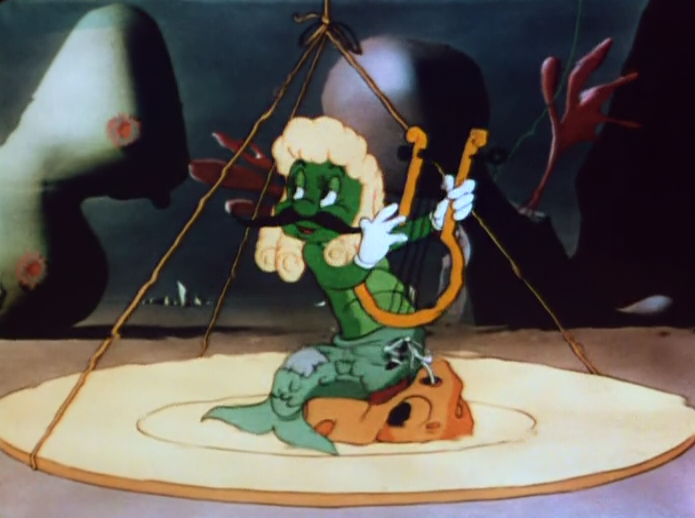
It's a largely cliched cartoon formula (e.g. Disney's Goofy and Wilbur) of a bait worm going through different guises through a string of gags until he meets a threatening opponent. One of the few moments where the caricature is taken advantage of is in a sequence of the Colonna worm disguised as a mermaid. He sings Trade Winds while playing the harp in a bid to entice the fish to lure towards him. At one point, the worm stretches out a syllable to a certain length - a characteristic trait of the radio star. The parody works fine as the gag on the aroused fish pays off.

The first half of the cartoon is mainly just exposition and routine. The worm is lowered under the lake by a fishing rod - and prepares his guises and baits. Three sequences depict how the Colonna worm lures each fish based on their individual personalities. The first sequence is more straightforward as he makes a sandwich to deceive a curious fish as bait.

There's some decent subtleties in animation and timing as the Colonna worm quickly replaces the smaller fish with a larger fish sitting next to the hook. The following sequence deals with the antics of the Colonna worm attempting to lure a dim-witted fish, and creating an obstacle in the process.

The last sequence is most likely an idea conceived by Ted Pierce, as the worm uses a mermaid disguise to seduce a lusty fish. Then, as the worm is about to rise up to the surface with the lusty fish trapped - he is encountered with a more threatening and less vulnerable specie: a crab.

The Colonna worm responds to the presence of the crab in a double-take; taking the cartoon's narrative focus into a different direction. Ted Pierce primarily splits the plot structure into two elements: the first half represents a string of gags, while the second half is all action-packed. The result becomes a pretty bland structure.

The first half is overall tedious viewing, although the sequence of the Colonna worm attempting to lure the dimwitted fish is more resourceful and creative in its approach to humour. To start with, the dimwitted fish fails to respond to the worm's whistle and hint of a chase. The Colonna worm observes the personality and plots, "I shall have to resort to an ingenious ruse."


The ruse, of course, is a circus show for the dim-witted fish. The worm performs an acrobatic act as he grips his teeth onto the hook and spins in motion. Gerry Chiniquy animation on the manoeuvre is very graceful; especially for the purpose of the gag.

He pulls off the stunt divinely and deceives the dim-witted fish into giving it a try - "Don't be so reluctant...Dragon!" encourages the worm in a possible Disney reference to the 1941 film and adaptation: The Reluctant Dragon. And so, the bashful fish meets his own end.

The sequence is a clever piece of written satire in taking advantage of easily impressed dimwits. On another note; the distortion underwater scenes are a delightful effect to carry some extra quality into the cartoon. While it might be an economical effect; it's enough to create the illusion of being underwater.

A piece of character animation
very reminiscent to a Bugs Bunny
scene in The Heckling Hare.
The opening sequence, which although establishes the Jerry Colonna worm - is a little sluggish in pacing...even for a Freleng cartoon. The short opened with a yet-unidentified fisherman lowering his fishing rod into the lake. Standing on top of the hook - is the Jerry Colonna worm.

 The character animation of the worm placing the swimming cap on top of his head and warming himself up for ascending underwater feels delayed and unwanted.

With problems asides, Mel Blanc delivers some amusing voice effects for a shivering worm dipping his toe into cold water - and captures the charm of Jerry Colonna's characteristics but it's the sluggish pacing that drags the opening scene down. The Eat at Joe's in-joke which appear as neon signs underwater is a nutty addition.

Nevertheless, Freleng's area of expertise is put too good use in individual scenes and sequences. Exceptions include the chase sequence around the surface of the water. The gag seems to be borrowed from the Avery short The Heckling Hare. The effects of the bubbles travelling around the lake are timed well to Freleng's action and Stalling's music cliches. The timing is paid off with a vibrant effect as the crab strikes a rock.


His genius use of timing is showcased better in the scene of the Colonna worm disguising himself in the proportions as a seahorse and joins the procession by copying their characteristic moves to avoid unwanted attention from the crab.

Freleng and Stalling keep the music rhythm aligned with the procession action which is beautifully timed to the Light Calvary Overture. It's a meticulous piece of animation with strong accents to support the rhythm of the timing.

As far as dynamics and "mise en scene" goes, Friz Freleng conceives some innovative and unprecedented POV shots. A striking example occurs in the treasure chest sequence. The crab stretches both his eyes on both sides of the chest - to corner the Colonna worm. The following shot reaveals a split-screen point-of-view shot of the crab watching the worm run at opposite angles.


And so, the quick-witted Colonna worm devises a quick plan by frantically tying both his long eyes into a single knot gripped around the treasure chest. The following scene features another visionary point-of-view shot of the crab in and the layout in an unclear perspective.

Freleng also uses the point-of-view crab shots for gag purposes - like the staggering effect after he struck a rock; or as a scope set-up when the crab is attempting to target the worm. The POV shots are incredibly effective and yet unexplored as far as filmmaking goes. It's a perfect example that showcases Freleng's overlooked abilities at composition and dynamics, and how he's fearless when it comes to experimenting with such a feat. This shows the true working of a genius laid bare.


For the cartoon's finale - Ted Pierce and Friz Freleng conceive a clever depiction of an unseen final showdown.

The Colonna worm skids to a halt during a chase and protests to the crab, "You wouldn't be so brave, knave  if you weren't wearing that shell to protect you." In preparation for the final battle; Ted Pierce pokes fun over Hollywood censorship that the worm announces:


"Ladies and a'gentlemen! The following scenes will be so brutal and a-horrifying, that for the benefit of those with a-faint hearts, weak stomachs and 4-F ratings; we will return you to the surface". The 4-F ratings crack must've been guaranteed a laugh upon its release (or offence).

The camera pans vertically upwards to the surface where the violent is interpreted from the splash effects and the vigorous thrusts from the fishing line. It's an entertaining alternative to make the unseen fight more suspenseful and unpredictable. After the fight, the hook rises to the surface and the fisherman's hands open the tureen to reveal the injured worm.

The worm remarks "I could be wrong, y'know" in response to his promise to defeat the crab. The camera pans vertically upwards to reveal the fisherman is Jerry Colonna, himself who delivers the final punchline: "Ah yes! Embarrassing, isn't it?".

In conclusion, the cartoon still sits in the "hit and miss" category. In some sequences, the timing and gags are enhanced further than compared to The Wacky Worm. Both cartoons are relatively flawed in its own areas, although the Colonna caricature is used much better in the former short. What both shorts have proven is a short devoted entirely to a Jerry Colonna caricature works less effectively and comedically than the occasional reference in a cartoon...otherwise, it'll date the cartoon fast. Overall, it's a pretty stale output from Freleng - except for moments of a genius at work. Freleng's excellent use of experimentation in composition and layout reveals a director who is more than just a "master of comedic timing". The short's narrative is relatively thin and formula-driven, although Ted Pierce has his moments of funny dialogue.

Ratings: 2.5/5.

Thursday, 7 July 2016

402. The Wise Quacking Duck (1943)

Warner cartoon no. 401.
Release date: May 1, 1943.
Series: Looney Tunes.
Supervision: Bob Clampett.
Producer: Leon Schlesinger.
Starring: Mel Blanc (Daffy Duck), Darrall Payne (Mr. Meek). (Thanks to Keith Scott)
Story: Warren Foster.
Animation: Phil Monroe.
Musical Direction: Carl W. Stalling.
Sound: Treg Brown (uncredited).
Synopsis: Daffy Duck finds a new target to harass: a henpecked husband who's forced to butcher Daffy for dinner.

Daffy Duck lived up to his name since his first appearance; but the zaniness in the late 30s was tamer compared to a couple of years later. Tex Avery had interpreted Daffy with a more impish personality compared to Bob Clampett. Once Clampett found his own style - he took the "looney" in Daffy to a whole new level.


By 1943, the pace and style of the Warner Bros. cartoons had changed a great deal compared to 1938. Not only had WW2 partly helped enhance comic timing and humour standards but also by character personalities.

In the case of Wise Quacking Duck, Clampett magnifies Daffy's wacky personality to the point where no other directors would dare approach that standard. While directors like Chuck Jones and Friz Freleng gave more depth and insight into Daffy's personality; Clampett stays faithful to the character's origins and exploits the persona so broadly and potently.

As a result of Daffy's refined 'daffy' personality - Mr. Meek becomes the perfect candidate to Daffy's torment and heckling. Warren Foster's narrative is kept simple and to the point: a meek farmer attempts to slaughter Daffy Duck for dinner. Mr. Meek's introduction is only brief but it uses exposition wisely. A visual gag in Mr. Meek's mailbox with his house number read as "1313" sums up the character almost completely.

Mr. Meek is seen carrying a large axe as he tiptoes through his farm. Warren Foster, whose many talents includes bringing subtlety into hysterical dialogue: reveals a remorseful Mr. Meek who cries, "Oh, I hate to do this, folks. But my wife, Sweetiepuss, says if I don't roast a duck for dinner, she'll cook my goose!", a pun Foster uses so subtly and in excellent taste.
It's worth noting the voice work for Meek is top-notch delivery from the unfortunately anonymous Darrall Payne.

From information provided by Keith Scott in Facebook: It's worthy to mention that Mr. Meek was based on a character of the same name from a 1940s radio character from New York centered on a henpecked man. However, the dialogue spoken by Mr. Meek the cartoon is based on the henpecked Wallace Wimple, of the then-popular radio hit: Fibber McGee and Molly - whom Darrall Payne is impersonating.

Animation by Virgil Ross
Clampett also takes recurring themes from Daffy Duck cartoons into new heights. For example, an early common gag would feature the victim breaking the forth wall, remarking "What a crazy duck" or "That duck's screwy" with Daffy butting in at the statement, sometimes declaring: "That is correct. 100% correct"

In this case, Mr. Meek says, "Say, that's that Daffy Duck". Daffy slides in the scene spinning a pie on the tip of his finger. He boisterously yells in a vibrant tone: "You ain't just whistlin' Dixie!" and slams the pie across Mr. Meek's face. Clampett enhances the gag with unprecedented energy and broad animation - that his wackiness feels somewhat human.


Daffy's sheer insanity is also better showcased in the hysterical Jerry Colonna caricature. Mr. Meek responds to a vibrant knocking on the door, with Daffy Duck disguised as a fortune teller. As far as gags go, Warren Foster appears to be reliant on slapstick violence...a common trait of his. Daffy's behaviour gets ruthless when Daffy attempts to "read the bumps" on Meek's head, and creates some by hitting his head with a hammer. A slightly sadistic gag, although it's still in fine taste and spirit of Daffy's "looney-tooney" persona. Foster goes to town on some corny yet harmless puns, like Daffy literally painting Mr. Meeks' arm red as he says: "Perhaps you'd like your calm 'red'. Very well."

Clampett enhances his direction and pacing further in this cartoon; and is never afraid to go edgy on his material. Daffy's introduction scene showcases Clampett's professionalism as a director wonderfully. The peaceful atmosphere of Daffy singing and eating seeds is captured appropriately in music and timing.

Clampett also builds some great suspense as Meek in silhouette is about to anticipate a striking action. The pacing from a slow, quiet mood changes within the blink of an eye as Daffy yells, "Watch it, bub!" in a threatening pose - masterfully animated by Bob McKimson.

Daffy warns Meek, "Listen, you're liable to hurt somebody with that thing!", and so heckles Mr. Meek as he flicks his bill at Mr. Meek's face - resulting in a vibrating gag, topped with a Sold American jingle effect. The mood and energy builds up fiercely once the heckling begins. From Clampett's timing and Milt Franklyn's arrangements - the transition in pace and mood is masterfully effective.

Clampett as an instigator is primarily shown in the haystack sequence which follows. Daffy jumps into a haystack and plays along with a fierce Meek. Clampett's timing is fun as Mr. Meek franctically chops the stack violently multiple times, before ending it with one big strike. The animation shows very strong accents to make the violence tense, and yet comical.

Animation by Art Babbitt.
Then, Daffy screams in agony behind the haystack - masquerading that he's been murdered. He rips off some of his feathers and tosses some ketchup to create a bloody effect in deceiving Meek. He also channels a little of the "Mean Wittle Kid" from the  Red Skelton Show as he yells: "You've crushed my wittle head!".

Mel Blanc's passion for delivery and energy into his performance is unbelievable. Blanc's voice contrasts each other for Daffy's boisterous and calmer dialogue - and yet never loses the character's focus.

"Gruesome, isn't it?"
The edginess kicks in as Daffy presses his head underneath his neck to create a decapitated look, as seen in a close-up surrealistically animated by Art Babbitt. He jumps out of the haystack and runs around frantically in agony. Despite the blood effect being ketchup, it's no doubt a gutsy move from Clampett as far as censorship goes.

Rod Scribner's animation superbly captures a supposedly traumatic, disturbing scene with very strong poses and excellent graphic clarity. Daffy goes as far to ham it up in a dramatic, dying pose as he clutches onto his hold. He staggers and crashes onto a piece of fence. He stands behind it as he anticipates a dying pose. Daffy's pranks has succeeded in deceiving a now remorseful Meek in killing him.

The breakfast sequence is one of the few tamer, soothing scenes in the cartoon. It's a perfect casting choice for Bob McKimson to specialise in cartoon acting. A saddened Mr. Meek walks into his kitchen where the camera pans to a relaxed, unharmed Daffy Duck sitting on the kitchen table pouring himself "a swig of swamp water".

A casual Daffy continues to deceive Meek into thinking Daffy is still dead, as Meek cries: "I killed a poor, defenceless little duck." The Schlesinger staff's admiration for the Dick Tracy comic strip is evident when Daffy calls Meek "B.B. Eyes".

Warren Foster's use of forced puns works well as Daffy asks: "How many lumps does your wife usually give ya?". Meek responds, "Well, this morning, Sweetpiepuss only gave me one lump." He takes off his hat to reveal the "lump" on his head. Not only is the pun amusing, but it also gives us information on Meek's married life. Daffy responds by giving him "another lump" as he smashes his head with a sugar bowl and pours cream on his head in the process. Although the sequence is heavy on character animation acting; it's a good bracer for the more rowdy energy Clampett has in offer.

After a string of gags pulled on Mr. Meek - Daffy reaches his peak in an energetic sequence involving war-related references. Daffy jumps upwards and dives in the style of an aircraft. The use of colour in the shots of Daffy diving is very cleverly used - it deceives the audiences from thinking he's flying from the clouds - whereas the next shot reveals a similar colour from the wallpaper.

Daffy drops an egg on Mr. Meek which he regards as a "secret bomb site". Clampett's interpretation of "wackiness" in Daffy Duck goes unsurpassed as he goes into a frenzy of loud crashing noises while smashing household items to interpret a crash effect.

It gets so broad that Daffy Duck himself, almost loses energy and triggers as he pants: "Say, I'm pooped!"...until he starts again. Clampett and Foster take pleasure in making Daffy an incredibly obnoxious foe for Mr. Meek that his rowdyism and heckling gets to the point where he gets too big for his britches. Mr. Meek's anger is beautifully executed in a gag where his head literally burns to the point where the egg fries. This leads to Daffy very meekly and timidly surrender his fun as his life's at stake again.

Warren Foster's ability in gag development and plot structure work brilliantly in a supposedly dead-end climax. Daffy is cornered by Mr. Meek at gun point, and is vulnerable at this moment. In what appears to be an act of surrender, he remarks: "Well, it looks like Sweetiepuss gets duck for dinner, after all! Don't it?".

A dynamic point-of-view shot
of Mr. Meek's pinnacle moment.
With chance - he gracefully pushes the gun away and performs his striptease as he seductively unveils his skin - once again, fooling Meek. The sequence itself is a throwback to the striptease gags Tex Avery had conceived for some of his spot-gag cartoons...with Carl Stalling playing the same song: It Had to Be You. Another funny moment for Daffy Duck, the sequence feels very sophisticated and poised compared to anything Clampett's done in the short--which can be attributed by its animation.

It's famously known amongst historians and animation enthusiasts the sequence was animated by Art Babbitt during his very brief tenure at the Schlesinger studio (which I wrote four years ago).

Babbitt is perhaps best known for his work (and later, union activities) at Disney and during its pinnacle era of the 1930s and early 40s; animating on Pinocchio, Fantasia, and of course: his contributions to Goofy. While Babbitt denied using live-action reference on this sequence in Michael Barrier's 1986 interview; his animation on Daffy Duck still had a sincere Disney-like quality look to it - in contrast to the broader, looser animation from Bob McKimson or Rod Scribner.

As far as Clampett endings go: this short is no exception. Daffy has found himself at gunpoint, again, which he complains: "No, no, not twice in the same picture!". Mr. Meek shoots his feathers off - revealing a naked Daffy. He throws Daffy in the oven and prepares to roast him at the short's nail-biting moment.

Disturbed by Daffy's agonising screams; Mr. Meek frantically opens the oven to let Daffy live. Daffy remarks, "Say, now you're cooking with gas" which leads to perhaps the most disturbing scene in the entire cartoon: Daffy pouring himself in gravy while laughing hysterically.

As nutty as the ending is, it's slightly discomforting in watching a naked Daffy Duck bathing himself in gravy and clearly enjoying it too much. But, what do you expect from Clampett?

Bob Clampett has directed a handful of zany Daffy Duck cartoons like Draftee Daffy and The Great Piggy Bank Robbery, but in this short: Daffy's personality is far more broader. I'd personally consider it the nuttiest Daffy Duck short the director made. Clampett takes complete liberty in pushing the boundaries of the character with unparalleled insanity and innovative comic timing which is carried almost entirely in the cartoon. Warren Foster also had his share in enhancing Daffy's zany persona with outlandish, hysterical gags and spontaneously conceived situations. For a cartoon with a relatively shorter length; the timing couldn't have been more flown nicely. The short contains a lot of material with its accelerated pace that took its toll.

Rating: 5/5.

Tuesday, 7 June 2016

401. The Unbearable Bear (1943)

Warner cartoon no. 400.
Release date: April 17, 1943.
Series: Merrie Melodies.
Supervision: Chuck Jones.
Producer: Leon Schlesinger.
Starring: Marjorie Tarlton (Sniffles), Mel Blanc (Fox Burglar / Husband Bear), June Foray (Wife Bear) (Kudos to Keith Scott).
Story: Michael Maltese.
Animation: Bobe Cannon.
Musical Direction: Carl W. Stalling.
Sound: Treg Brown (uncredited).
Synopsis: Sniffles' loud, fast-talking causes mayhem amongst a fox burglar and a drunken bear who attempts to discreetly sneak past his sleepwalking wife.

Once Chuck Jones had reformed into a talented, comedic animation director - it seems he attempted to take his own characters into that comedy angle...especially on Sniffles who was known previously for having mawkish, Disney-ish qualities and facing vulnerable situations.

"Little Blabbermouse (1940)"
Instead, he is given a different persona which is a throwback to the late 30s shorts of cute, inquisitive characters who are compulsive talkers that are a nuisance to those around him.

The persona is a throwback to the late 30s characters Tex Avery had conceived in shorts like I Wanna Be a Sailor, and of course: Friz Freleng's short-lived Little Blabbermouse character. It wasn't a funny or engaging personality back in 1940; but by the time the Warner directors were hitting their stride in 1943 - the characterisation was put into better use depending on what narrative was told. In the opening sequence of this short where a Cockney fox burglar attempts to steal money - the compulsive talking personality works.

To some extent Sniffles' fast-talking becomes an important dilemma as far as story goes. In the opening sequences; a fox burglar's attempts at raiding a house unnoticed goes foiled when he encounters Sniffles as he attempts to open a safe lock.

Caught, the fox burglar spontaneously tricks Sniffles into thinking he's Robin Hood, providing an cover-up motive: "As robs rich blokes for the benefit of the poor, I am." For what it's worth, Cockey accents are very rarely performed by Mel Blanc - who as usual excels in the dialect and stereotype. Sniffles agrees to watch out for the fox and protect him: "I'll stand guard. If anybody comes I'll warn you, like this!". He grabs out a spoon and bowl and produces unwanted noises out of it. His naiveness would prove an essential role as far as story arcing goes - distracting the fox from his principal goal.

And so - Mike Maltese's story becomes even more episodic when the drunken husband bear returns home. Once he changes into his nightwear - he opens the box to bid an intoxicated "good night" to the fox hiding inside. Had the fox not been inside the box - it's a hilarious notion of the bear's drunken behaviour by bidding farewell to a box.

In a double-take; the bear zips back and points his pistol at the fox's mouth. As though the story doesn't get more episodic - the suspenseful scene is interrupted by a sleepwalking wife bear.

The police bear warns the fox: "Hold still, ya little runt! If we wake the missus now, we're a couple of dead ducks!". This is backed up in an earlier sequence that is complete exposition - explaining the husband's fear of his henpecking wife.

The wife bear was fast asleep in her bed with a rolling pin on her bedside, murmuring in her sleep: "Wait till I get my hands on that brood, I'll teach him to stay out all night - gallivanting around."

Meanwhile Sniffles misinterprets the sleepwalking wife as an enemy of the fox (who still believes he's as Robin Hood) and attempts to finish her with his small bow and arrow. The fox and the bear grab Sniffles and silence him while the sleepwalking mother is in their presence.

For an animated short, it's a rather complex storyline: a fox burglar has to avoid getting caught by tricking a suspecting Sniffles into thinking he's Robin Hood; while attempting to avoid himself from the hands of the police bear, whose avoiding his sleepwalking wife out of fear of waking her up. For a talented writer like Michael Maltese - he takes advantage at such a feat by conceiving potentially funny gags out of it.

As usual; the innovative "avant-garde" styling of the cartoon is expert work amongst John McGrew and Gene Fleury. McGrew's layouts for the opening sequence feel like cardboard props on a theatre stage; such as the trees outside - and the advantages of the interior scenes is it doesn't have too much background interference. It's Fleury's colour styling which makes a marvellous addition to McGrew's layout styling.


An ambitious animated close-up
of the key about to unlock the doorknob.
Just the right suspenseful effect anywhere. 
Scenes like the fox casually smoking his cigarette outside while waiting for the household lights to switch off - is beautifully and intricately staged in order to give the fox a more sinister appearance. The animation effects of the cigarette reflection is the perfect finishing touch. It shows two artistic masterminds laid bare.

The sequence of the drunken police bear staggering back to his home is another example of excellence graphic clarity. The action is entirely in silhouette; and the poses read well. Not only is the staging exceptional; but the lighting and tone blends in wonderfully - capturing that dark, vague feeling of being intoxicated in a dark room. It's another homage paid to the low-key lighting of motion picture filmmaking - as evident in the darkness of the windows. The darkness of the sky is kept to a blue shade so the colour contrasts of the silhouette action is kept subtle.

Chuck, who excelled in the pace of Warners, was never afraid to challenge himself as far as timing goes - as evident in the radio switching sequence. After his encounter with Sniffles; he attempts to carry out his plan by working out the code for the safe lock. Sniffles attempts to cooperate by switching on the radio - which he mistakes for another safe lock.


Alarmed by the infamous Frat Stalling cliche - the fox streaks into the scene by wrapping the radio with a pillow, and tying up Sniffles with bandages - to prevent such further disturbance. It's an appealing, intricate piece of drybrush work with a rapid appearance of 20 frames, and all on 'ones'.
Chuck Jones' experimentation for outlandish expressions are always key to not only giving his characters some extra personality - but also for striking effects. The double-take of the drunken bear ascending the stairs is an example; but the most valiant would be the fox's take to Sniffles' banging noises on the bowl. The fox reacts with a triggering effect that nails the essence of unwanted disturbance and the fear of getting caught beautifully.

For the sleepwalking scenes - Mike Maltese and Chuck Jones work together in formulating some gags to reflect the wife's daily chores routine. In one scene, the wife unknowingly carries the fox hiding from the box and takes him outside to get scrubbed - mistook as a piece of laundry. The hysterical facial expression on the fox as he's being carried away speaks for itself.

The posing on the fox has some nice subtleties as he squirms while being hanged on a washing line.


Another great gag is centred on the wife bear carrying her husband after his long fall from the basement. She sleepwalks towards the fireplace and dumps him there on the floor. The husband raises his mouth to appear in the form of the bear rug - resulting in a funny visual gag from Mike Maltese's taste for irony.

For a climatic sequence; the sleepwalking starts to take its toll and threat towards the husband. Once the bear sobers up and makes direct eye contact with the fox - this builds up to a chase sequence around the house. In an attempt to rid him; the bear grabs an axe hanging on the wall - and hides behind the wall to inconspicuously finish him.

Maltese conceives some great delivery for some suspense-build up as the sleepwalking wife walks into the fray - causing the husband to almost strike his wife with an axe.

Meanwhile, Sniffles enters into the scene again - as he once again: mistakes the bear's actions as an enemy of "Robin Hood". He fires his arrow which targets the bear's rear end - causing him to hit his head on the wall-mounted shelf and leaving pieces of china floating in mid-air, awaiting its destruction. Incoherency and cartoon physics takes its toll when the bear and the objects abruptly halt in mid-air - as the sleepwalking wife walks past the scene. The bear motions again to collect the shelve pieces still standing in air.

After a series of chases with the fox - the husband bear is about to meet his fate as he accidentally strikes his sleepwalking wife with an umbrella (which the fox is clinging onto). At the summit of the wife's wrath - she observes the fox around her shoulders, which she mistakes as a sincere present from her husband.


The scene of the wife building up her wrath which only sinks down into happiness and affection is a brilliant team effort, from not only the animation but Stalling's musical score, too.

At first perplexed, the husband bear decides to play along as he turns back coyly while his wife admires the "fox fur" present. He goes so far along with it to the point he knocks on the fox's head, leaving him out-cold, for the sake of his wife's satisfaction.

The ending scene however, are another throwback to the Little Blabbermouse shorts where the compulsive talker will get justice from irritated characters who'd put up with him throughout the short. In this instance, the husband bear places his police hat on top of Sniffles. Despite an inventive approach of the compulsive talker in keeping up with the brisker pace of Warners - the ending itself feels somewhat uninspired and limp.

For a narrative which is very episodic - Mike Maltese masterfully paces and blends the story together whilst still making room for funny gags. Chuck continues to do an ambitious albeit successful job at directing and yet it appears he isn't yet ready to let go of his own characters like Sniffles or Inki - who slowed him down and gave him limitations artistically. While the compulsive talking personality works fine in this cartoon, the short also take much advantage of Sniffles' screen time - and appropriately limits his role in the cartoon...as the comedic values centred on the bear couple and the fox were too valuable. Admittedly, had Sniffles not appeared in this short - it's doubtful the short would suffer much at all.

Rating: 3.5/5.