Tuesday, 3 April 2012

142. At Your Service Madame (1936)

Warner cartoon no. 141.
Release date: August 29, 1936.
Series: Merrie Melodies.
Supervision: Friz Freleng.
Producer: Leon Schlesinger.
Starring: Ted Pierce (W.C. Squeals) and Martha Wentworth (Mrs. Hamhock).
Musical Score: Norman Spencer.
Animation: Don Williams and Cal Dalton.
Sound: Treg Brown (uncredited).
Synopsis: 

 The last cartoon to be scored by Norman Spencer (who probably went into early retirement) and NO people - he didn't pass away in 1936 just as Blanc made it up in an interview. This is also believed to be the first cartoon for Warner Bros. ink & painter Martha Sigall to work on this cartoon as she said so in her book. Apparently this cartoon was an attempt for Friz Freleng to create recurring characters of the Hamhock family but it never went any further. This probably sounds like a very unreliable fact but does anyone have proof to support that?

Our cartoon begins with the darkness of the sky but the sun rises as it's morning time. There is a small, crowded house on top of the hill where a pig mother and her piglets live. The rooster is giving out the morning call off-screen. Quite a neat shining effect shown of the window reflection here.

Inside the house are a group of piglet children in there single beds snoozing as the sun reflections reach through the window. The piglets are snoring and snorting. The mother pig named Mrs. Hamhock is preparing porridge for her piglets to have for breakfast. Mrs. Hamhock walks up to the bottom of the stairs ringing the bell calling for the children that are sleeping upstairs, "Wake up children; breakfast's ready". She is a widow as she is of-course left with the children. The Mother Pig continues to ring the bell until the children are awakened.

The children upstairs then hear the sounds of the bell as they stretch to wake themselves up. Piggy (not to be confused with Porky Pig); the other piglet appears to be sleeping in a single bed-room or just at the end side of the bedroom where all of the other piglets are as he is near the door.

Piggy dashes to the bathroom down the hallway to rinse his face; then back down but runs back to the bathroom he washes his toothbrush to pretend as though he's brushed his teeth before dashing downstairs to have breakfast. Piggy dashes downstairs quickly with his cutlery up with his hands ready for breakfast. If this was Avery or even Frank Tashlin working on this cartoon; they could take the timing of the dashing Piggy even faster. The mother is surprised to see Piggy made it at such speed. All of the other piglet children start to run through the hallway to go down the stairs; including a slow piglet jogging but gets stampeded by an incoming piglet with his pants flap down. Another piglet sibling who is considerate helps out the piglet and sorts the pants flap back up and even sorting out the pig tail. At least this shows the piglets having different personalities.

Piggy is still sitting down at the breakfast but is already helping himself scoffing up the porridge. Mrs. Hamhock is disgruntled by Piggy's manners as she bitterly tells him off, "Piggy, now you wait for the others!" Notice how the pig's breakfast meals are being served in small pig troughs - ha; at least it shows us realism since pigs eat from troughs. The rest of the piglets then arrive at the breakfast table.
 
 Mrs. Hamhock then begins her demonstrations on how to have good manners on the table while having porridge; by counting on "fours"; in which the first three numbers counted they angle themselves with positions of holding the spoon, dipping it, etc. and on the "four" count they slurp the porridge. The children are seen copying her actions as they seem to he not bad; but they hold their spoons tightly and not lightly with their pinkie sticking out like Mrs. Hamhock.

During the table pan scene - we pan to Piggy who is not on track and just slurping the soup and each slurp  is each count from his mother. The mother grabs out a stick off-screen to whack Piggy on the head as Mrs. Hammock gives him a telling off; "Now how many times must I talk to you? Can't you ever try to behave like the others? My, my - I don't know what I'm gonna do with you" Some pretty solid character animation of Piggy drumming his fingers on the trough sulking while the mother is grilling his ass. Piggy shows the character personality of a "greedy piggy" since pigs are portrayed as greedy and used as examples for someone being greedy with food; and Piggy is the odd one out here since he can't behave and would rather eat.

In the next scene takes place in a city street where a entrepreneur pig who is walking down that is a caricature of Hollywood celebrity of the time; W.C. Fields but in this cartoon his name is parodied after W.C. and is called W.C. Squeals. While Squeals is down the side of the pavement; he notices a cigar on the other side of the street (such splendid eyesight) and he crosses the road but dodges incoming honking cars to help his way through.


W.C. Squeals then picks up the cigar as he walking around strolling in his characteristic walk with the cigar in his mouth. While walking past the Hamhock family - the name of the street is called 13 Pine Street. W.C. Squeals picks up the morning newspaper "Daily Bulge"  as he reads what appears to be the front headlines: WIDOW INHERITS FORTUNE and W.C. Squeals is reading the paper murmuring the words in the paper.

W.C. Squeals then looks out of his window to see what is outside and finds the exact house he read on the newspaper article by coincidence. As W.C. Squeals steps on the porch and before ringing the doorbell; he peeps through the window to see.

W.C. Squeals has his snout caught on the window as he attempts to push himself away from the window but his snout is still glued to the window. The comic timing isn't very exaggerated at all and too slow or my taste but at least when the snout plops  out of the window is good humour. W.C. Squeals then uses his cane to ring the doorbell like a snooker club. He picks up some posies that are on Mrs. Hamhock's front porch while he has prepared for her. Remember kiddies; he's only doing this for money. 


W.C. then greets Mrs. Hamhock with some posies.

W.C. Squeals: Good mornin; my little chickadee. Pretty flowers for ma pretty lady.

I think W.C. Fields said the "my little chickadee" line somewhere in a film but I'm not too sure.

Mrs. Hamhock then smells the posies he was given as she giggles as she is flattered, "Oh thank you. Won't you sit down?" W.C. Squeals sits himself down  on the chair with Mrs. Hamhock as he holds her hand faking compliments on her "What a beautiful hand you have!". He grabs out a microscope to take a closer look of the silver ring she is wearing but instead gets a squirt of her ring. Now that is a funny gag since he didn't see that comin', eh? I'm surprised that she's already being flattered by W.C.  Squeals who is a stranger to her; and yet she seems unaware of strangers. Of course; you'll back this up saying "but she is inheriting fortune so she would've known" but she  doesn't seem to know he's after money.

W.C. Squeals continues to faking compliments which he doesn't mean as he unenthusiastically says "What a lovely house you have in here, yeah, yeah, etc. This is very nice; Mrs. Hamhock. Quite homie". There is a point-of-view shot of W.C. Squeals scanning around the looking room looking for the vault as he finds the vault where the money is located. Removing the vault door  as visionary; the money is located in there.

W.C. Squeals: You play piano, Miss Hammy - y'know I sing a little.
Mrs. Hamhock: Oooh (giggles) certainly.

Mrs. Hamhock stands up out of her sofa to go over to the piano to play some tunes for W.C. Squeals being totally conned by his nasty trick not doing about the money he's after. Mrs. Hamhock then starts to play the title song in the piano; In Your Service Madame with W.C. Squeals (Ted Pierce) doing the singing.

While he is singing the song; Piggy is seen upstairs probably because of the piano playing and stranger singing that caught his attention. W.C. Squeals is still singing but gets annoyed when he sees little Piggy walk into the scene which shows he won't be able to steal the cold-hard cash.

W.C. Squeals then tries to scoot little Piggy away; "roll away son; you're bothering me". He quickly unwinds the lock to get access to the safe (which Piggy saw with his eyes) as he attempts to scoot Piggy out of the way, "That's all son, that's all". He continues to try and scoot Piggy away while still singing At Your Service Madame shouting "Scram, lad, scram" and gets to the point of kicking Piggy out of the way. Piggy rolls away as he hits a table with a fishbowl falling on top of his head as a goldfish swims around his head. Piggy plops his head out of the fishbowl as he vows to get revenge on Squeals. Piggy finds that he has eaten the goldfish which gave me a shocked chuckle since I also didn't see that comin'.

Piggy continues to look at what Squeals is doing; which he is unwinding the lock for the safe. Piggy catches him opening the safe as he plans to stop him to save his mother. W.C. Squeals is stealing the money and placing them in his jacket without Mrs. Hamhock noticing since she's too busy playing the piano. Every time Mrs. Hamhock turns; W.C. quickly turns back acting all innocent.

Piggy has attracted a group of his sibling that are watching his shenanigans as Piggy whispers a plan to outsmart W.C. Squeals to get their mother's money back.W.C. continues to steal the money from the safe in which Piggy walks in as he's got an electric socket to place in his tail. Another piglet then turns on the lamp switch by the armchair which causes W.C. Squeals to be electrocuted as he turns to Piggy with a dirty look. Mrs. Hamhock gets the wrong idea as she tells off Piggy; "Piggy! Aren't you ashamed of yourself? You had better bringing up than that. Now you march right off to your bed! I haven't been so embarrassed in all my life!" Really, woman?

While Mrs. Hamhock is busy telling off Piggy as usual; the other piglets have set up the trap on W.C. Squeals. There are a group on top of a banister of the stairs with a hook attached to wire while the other group of kids in a different area of the lounge have the rope attached all the way to a laundry mangle.

The hook is being lowered as it's caught W.C. Squeals as he is high in the air. There is a brief bit of action going on as W.C. Squeals is being scraped by the stairs which follows him down the stairs and under the carpet as he spins around hitting the poles, and hitting all kinds of crazy shit. W.C. Squeals is already found himself in a good position already since he is caught on a lamp attached to the ceiling. There are piglets sliding down the rails of the stairs with a moose's head as they jab the moose on W.C. Squeals as he's sent flying.

W.C. Squeals has his snout caught on the wall as he is still attached to the rope. There is a little sequence going on where it shows the piglets are standing on top of a cupboard with dishes stored as they push W.C Squeals forward with W.C. Squeal's snout smacking the wall while the force of the rope pushes him backwards. This routine is repeated a few times.

I noticed how there was a little bit of perspective animation of the pig zooming towards the camera but it reminds me of a 3/4 angle shot - but not quite. W.C. Squeals then reaches for the window with the rope but is almost suffocated as a piglet closes the window to trap his neck. Blimey; now this is turning into physical violence where he could be choking? Doesn't that seem to be too much of a stretch there?

W.C. Squeals is still suffocating as he shouts "Say, what's the big idea?" and the piglets then grab out a type of machine that shakes with a slingshot that shakes; as they do that to W.C. Squeals' body and money falls out of his pocket so Mrs. Hamhock would finally know about his plan.

The shaking still continues until Squeals falls out as the window crashes. Mrs. Hamhock looks out the window as she pecks her piglets for getting rid of the fraud. W.C. Squeals walks off very shaky as he farewells her (although I don't fully understand it since it sounds like he's shaking in his speech. He then starts to walk down the path away from them - and I'd imagine the joke at the end was that he still thinks he has the money in his pockets which was part of the plan but he doesn't know that. Some pretty good animation of the shaking W.C. Squeals here.

When I listen to the 'That's All, Folks' ending in a Norman Spencer cartoon. He seems to have a trait where he would repeat a finale ending to the music over and over again in his cartoons.

Overall comments: Friz Freleng has performed a good cartoon here with character personality. Even the W.C. Squeaks character was a good take of W.C. Fields who was voiced by story man womaniser Ted Pierce; who in my opinion is pretty underrated when it comes to voices. Piggy showed some good personality of a "greedy piggy" but is of course the hero of the cartoon at the end. The cartoon consisted of character animation (mostly on the W.C. Fields character) as this was a pretty good try there; and it did the job. It's interesting to hear that Martha Sigall; an admired ink-and-painter veteran worked on this short where she would work and ink on all the Schlesinger cartoons until his retirement (if I'm not mistaken). This short was later followed by the sequel Pigs is Pigs which is an improvement to the cartoon; although the Hamhock family probably wouldn't be a great idea for recurring characters of the Warner Bros.cartoon franchise - but at least they were in good cartoons in their brief time.

Monday, 2 April 2012

141. Porky's Poultry Plant (1936)

Warner cartoon no. 140.
Release date: August 22, 1936.
Series: Looney Tunes.
Supervision: Frank Tashlin.
Producer: Leon Schlesinger.
Starring: Joe Dougherty (Porky Pig) and Ted Pierce (Rooster Commentator).
Musical Score: Carl W. Stalling.
Animation: Don Williams and Volney White.
Sound: Treg Brown (uncredited).
Synopsis: Porky owns a poultry farm but the problem is a group of hawks always capture his chickens; which turns into a battle.

This is the first cartoon to be directed by pioneering Warner Bros. animation director Frank Tashlin who was only 23 when this cartoon was made and Frank had the gift with experimenting his animation like the use of camera angles, techniques, animation designs, and speed, the list goes on. He would leave in 1938 and return briefly in 1943 continuing up to 1946 before going into the motion picture business. This is his second tenure at Warners  - his first being an animator and his second tenure being his first career as a director.

 Another important fact about this cartoon as it's the first cartoon to be composed by famous cartoon composer Carl Stalling who is another pioneer in the humour of the Looney Tunes as he would compose great music until his retirement in 1958 in more than 600 cartoons. Stalling around make musical score for cartoons very funny and would adapt music from the Warner Bros. music library and make them broad in his cartoons. His most definite trait is those "cliches" of what movement the character is performing.


The cartoon begins as we pan from the woods as we reach to Porky's poultry farm as the sun is rising high. The flag (of course) tells us that this is Porky's Poultry Plant (the title cartoon) and I like how Tashlin used his design skills with just one huge "P" letter with the other words matching it.

There's a very good camera pan (a Tashlin trait) of the camera pan down but the pan has the backgrounds (like the buildings) animated. A rooster steps out as the new day has begun. The rooster stands on the chicken box (uses it as a conducting box) with the chicken performing a "Revielle" the morning call. A whole group of ducks, birds, chickens, etc. then step out of their hutches for the morning. There's a good pan shown here like all of the birds stepping out where it's a pretty long background (no background animation shown here).

Porky Pig steps out of his house (in the early Porky cartoons around 1936-37) Tashlin tend to make Porky larger and older while Avery tend to make him child looking. Porky is standing at his porch enthusiastically stuttering; "Oh day; what a day" and he bangs his chest for breath or the Tarzan beat but Porky coughs from the banging on his chest that probably shows he's physically weak.

Porky then grabs out a bucket in which he pulls down the robe of a machine in which corn comes out for him to feed his chickens as he flicks them with his hand. He shouts and calls "Here, chick, chick, etc." to call for the chickens. I love that curve movement of Porky swinging the bucket of corn.

All of the chickens then rush out of their hutches as they run out to go and get some corn. There is a tiny chick that is left out of the crowd that would be worth a giggle and a "bless". All of the chickens and geese run up to catch some corn leaving the tiny helpless chick trying to catch up with tiny legs.

You can hear some of Carl Stalling's early cliches here like the footsteps of the chick running; listen carefully and there it is. Of course at the time; Carl Stalling hadn't really adapted his music the way he liked to; and it probably sounds a little like Norman Spencer or Bernard Brown but you can hear it here in this sequence which is pretty cool. I do wonder what had happened to Norman Spencer. I recall Carl Stalling saying in an interview that when he arrived at Leon Schlesinger he had to clear away the "whisky bottles" in his new office from the old cartoon composer [evidently; it's Spencer]. Some sources say he died; while Stalling said he needed to be replaced - does anyone know the real story?

A whole group of Porky's chickens and duck are crowded together nibbling at the corn on the ground. Porky grabs out another handful of corn and tosses them into another area where the whole group of birds run down to catch some corn. Porky repeats that routine but in different areas as the birds will follow him.

There are geese in there that belong to Porky that also run into the scene to grab some corn; but truth is; why would geese want corn? I thought they preferred bread just like what they get in a pond in a park - chickens would eat those.

There is a little sequence going on here where the little chick is trying to grab some of the corn here but all of the chickens then start to rush after the corn once it's dropped the ground as the chick was just about to get started. This is a good example of Tashlin's experiment with timing even though the timing is rather slow; but if this was made ten years later then it would've got the corn in a millisecond.

This causes real confusion for the chick as the chick walks off when the corn is just dropping right next to her but gets stampeded by greedy chickens and geese. Porky feels pity for the chick who isn't getting anything to eat but comes up with a plan to give the chick some corn. He grabs out a handful in which the chickens and geese turn to him. Still gripped with the corn in his hands; he pretends to toss them out of the way for the chickens and geese to scatter as he gives them all to the chick as it quickly scoffs it up turning fat. Now that was a pretty moment there by Tashlin (or a writer) where he pretends to throw the food a way since birds aren't very cunning - or to an extent "birdbrained" ;-).

 Meanwhile there is a goose that is trimming off corn in a line like moving a lawn in a single line; which shows some amusement as it is a gag relating to it's beak. A VERY GOOD EXAMPLE of a "Tashlin technique" is shown here in terms of animation techniques. Porky is throwing corn to the geese and throws the corn to the camera creating perspective animation while the next shot the corn (from the camera) falls to the ground and I think that's called arc animation. The next part goes some good comic timing where the geese scram to each other to grab the corn but crash into each other leaving some smoke lying out but after the smoke drifts away; they're all tied up together with their necks.


Here is the good example of perspective animation used as Tashlin was experimenting with that technique; watch it in full motion to get the idea.

There are a group of chicks running after worms as they scatter off. The animation shows some realism with the chicks tripping which shows us that chicks are helpless birds with some good weight. The worms then dive back into their holes as the chicks start to scrape the holes with the claws on their feet.

The next stage is funny and good cartoon humour where Porky already comes up with a plan as he grabs out a funnel where he starts to use it to play "snake charm" music since worms are the shape of snakes (but are like miniature versions) they step out dancing out of their holes. The chicks then start to move very carefully (look at that movement of the birds creeping up; this is brilliant timing) and then the chicks eat up the birds. Gruesome, isn't it?

After some fun from Porky Pig and the chicks; we move onto a little bit of drama where only the backgrounds and layouts are presenting the drama. Despite Porky enjoying his farm with lots of chickens and ducks; he's had problems in the recent months.

He once had a chicken named "Olga" that was stolen by a hawk on April 6, 1936. "Dorothy" was "Hawknapped" same meaning as stolen but on April 28 only three weeks later.  We ZOOM back to Porky who is looking at the other chickens named "Petunia", "Gertie", and "Rebecca" who are her hens - and they've all been either captured by a hawk or gone missing. Huh, Petunia eh? Interesting; I imagine Frank Tashlin  reused that name for Porky's girlfriend in 'Porky's Romance' who would later become famous in Looney Tunes comics. Porky is weeping at the missing hens he had as he weeps (and stutters) "Poor Petunia, and poor Gertie, my poor little chickens". Porky is leaning against the wall crying. Now that would be sad since they're very likely dead as hawks have deadly claws to catch birds. Porky turns as we PAN to the right of a poster reading PUBLIC CHICKEN ENEMY No. 1 as it shows a hawk who stole Porky's chickens. Porky points at it stuttering and yelling; "I'll get you, you old buzzard!" Notice how Porky's tail goes straight and back to curly numerous times. There are some pretty good camera shots here like the posters of the missing chickens and we zoom back to Porky; thanks to Tashlin.

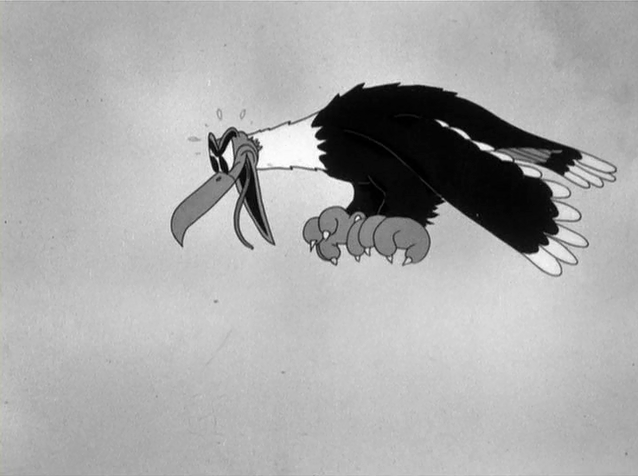
From that poster view shot of an illustration of a hawk flying; we fade in to the next scene of a deadly hawk flying in the same position as the hawk in the poster which would requite strong staging. The hawk's expressions show greediness as he looks down for more poultry farms. A pretty good point of view shot of the hawk flying as we see the farms and fields underground. I do remember seeing a type of camera shot technique like that in an earlier WB cartoon but my mind is clearly erased as to what cartoon that was - it might've been a Buddy cartoon.
The hawk then notices the same poultry farm that it must've encountered before as it starts the signal as it flies around the farm surrounding it. All of the chickens start to react with fear as though murder is on the loose. A hen is pecking on the ground with her chicks but makes a frightful take as she notices the shadow of hawk and grabs her chicks. The hawk notices the hen afraid as it starts to make a dive bomb with a good camera angle P.O.V. shot of the hawk flying down. 

Porky starts to stutter but yell "The hawk! The hawk!" as he starts to make the hawk alarm call with the sounds of sirens displaying the message. A good use of speed is shown here as the chickens dash off with the hawk zipping past with very little frames shown (I can't get this in slow motion but I figured it's roughly 8 frames).

There is a strange drawing style drawn of the chickens here who seem to have very feathery breasts with so much detail; like that shot of the hen with her chicks dashing inside the hut for safety before the hawk dives in after them. Just look at that brush effects  of the hawk zooming down fast to chase after the chickens; it sort of reminds me of the car chase sequence in 'Gold Diggers of '49' but probably not as quick and strong use of speed here but Tashlin found a way of making characters run in such speed when you see the early cartoons directed by Friz Freleng and Jack King they would have the characters run as the way a human would jog with no exaggeration or re  alism. Although the first cartoon to use proper speed is (probably) Disney's 'Tortoise and the Hare'. But Tex or Tashlin would be the first to use good speed with little drawings for the Warner Bros. cartoons. Some of the running scenes of the chickens to me though; look like there was little inbetweening done - and it's still experimenting here that's why there's the use of volume changing here.

There are ducks in a pond that also "duck" [no pun intended] underwater from an incoming kestrel. More problems arrive as a chicken runs off to hide inside a teapot and grabs a chick with her arms to protect it. Another chick is cornered by two walls not knowing what to do which is pretty serious since it's very young and helpless.

Porky grabs out his shotgun to shoot any buzzards flying past. He starts to shoot constantly but keeps on flying backwards as they slides back a pond and crashes into a tree; which is what I call a funny gun reaction but I guess years later it would be funnier if it was shot and there were no inbetweens with the next frame it would hit a tree although in the 1930's it hadn't quite been achieved right. After the gunshot sounds are finished; the chickens and ducks pop their eyes out to check and so does the hen and her chickens then step out thinking the coast is clear but counts how many chicks she has but goes into a panic attack when one of the chicks is stolen by one of the hawks - a whole tiny chick for a big hawk to eat? - puny.

The hen then dashes up to Porky who is sitting by the tree after the reaction of pulling the trigger. The hen dashes up telling Porky about her misfortune clucking; "Porky! The hawk stole my baby! Oh Porky, look, look, look, look, look!"

Porky dashes off as he reaches inside the barn (done in very few frames as it's shown). Porky the hen starts to bring out his small jetplane with a gun inside it. The plane takes off in perspective animation before ascending. In fact; some good
 perspective animation of the plane flying here. It's amazing to see that Frank Tashlin was only roughly 23 years old at the time he was directing this cartoon and it's much better than what Friz Freleng (still improving) and Jack King from what they've turned out. If this is a competition between Tashlin and Avery; Avery would be leading as he's got the humour adapted to Looney Tunes; and the use of speed. Tashlin is improving it's animation quality here; and the timing to make it funnier - to it's a tight competition.

The hawk is still flying away with the chick in it's limbs but turns around with a scared reaction as Porky is on the plane with a machine gun aiming right at the  hawk. There is then a chase sequence going on between the buzzard and Porky.

Porky (so far) has only managed  to shoot the buzzard's feathers at the rear end. The buzzard cries or help which shows a whole group of hawks defending the main hawk as they form each other like an airplane and take off at the edge of the cliff. They form each other V-shaped (Gee; they're not flying south for winter - heh heh). The group of hawks decide to play nasty on Porky as they grab him off the plane (and it's still flying - who's controlling the plane?!) as they pull his pig's  tail making a spring sound with a hawk holding tight on his suspenders before Porky lands back on his plane again.

Perspective animation pops up again with the buzzards dropping giant eggs down at Porky as it splats on his head. The hawks laugh in which Porky's plane flies straight at them as they go through inside a cloud as it's opaque. The fight ends with Porky fleeing but the buzzards have the machine gun as they fire directly at Porky.

The propellers have been shot to fragments until Porky starts to fall straight down with a crash prepared. The chickens watch him fall as the hawks are just laughing. A good use of a few frames in single-shots. Porky then starts to crash in a wind turbine as he manages to grab the propellers for it to continue flying on the plane. The buzzards continue to laugh until they  notice Porky has the ability to continue flying as they need to go into a plan.

An off-screen commentator (voiced by Ted Pierce) then reports "They go into a huddle" as the group of hawks huddle together as they gone up with a plan. They routine themselves to race after Porky.

Meanwhile a rooster is doing the commentary of the action scenes on top as though he's the guy doing the commentary on sports. Now that is funny since Tashlin is adapting his humour into this cartoon. The commentator reports "The ball is snapped. He's running back. It's a trick play, etc, etc.". It turns out that the "ball" is the chick that the hawks caught and Porky is trying to catch it; and this fighting sequence is a spoof of an American football game. Porky has to go through many manoeuvres to try and catch the chick. The commentator continues reporting; "He's up, he's down..." This would've been a challenge to animate since I doubt Warner Bros. directors attempted this before coming up with manoeuvres. The commentator then ends the reports "...and he fumbles!" as he missed the baby chick who is about to fall for his death (I'm surprised the chick hasn't died of shock). Good point of view camera shots - once again.

The hen is worrying about the chick about to fall and crash to the ground. Porky sees the chick flying all the way down as he has to do his best to grab him safely.

The hen crouches down covering her eyes with the "I can't bare to look" attitude. In a long-shot that we see - the chick is only a mere spot falling but Porky's plane performs a slide movement as it's managed to grab the chick safely and punctually. The hen is gobsmacked as the chick is safe that she faints with relief. As Porky has managed to grab the chicken in time. The buzzards start to fly after him since they're not over. Porky starts to spread smoke out of the back end with the hawks starting to fall down to hit the ground. The chickens approach the scene to dig the ground quickly so they can fall down properly. The buzzards fall down the dug hole as the chickens bury them.

I do really like that "Death March" part (Carl Stalling's contribution) with the rooster placing the flower on top of the buried patch. Porky starts to land back on his poultry farm safely and securely. She hands the chick to the hen "Here's your baby, Henrietta. All safe and sound". Henrietta the hen grabs the baby chick with her relieved clucking "My little baby" acting motherly. The mother then starts to scream as she thinks she sees a shadow figure of a hawk from the sky.

Porky grabs out his gun as he thinks he sees the hawk but stops to find that the "visual gag" shown here turns out to be the shadow of a weathervane with a bird on top that would look like a hawk figure. Porky looks at the weathervane as he laughs at the trick as though "jokes on him"; and to the chickens.

Overall comments: This is Frank Tashlin's second tenure here at the Studio - the first being briefly in 1933 animating on 'Buddy's Beer Garden' and the other earliest cartoons produced by Leon. This is also his first tenure at the studio of being a director; although some claim he directed those cartoons in 1934 that are credited to Bernard Brown. This is a pretty damn good cartoon for 1936 in my opinion. Warner Bros. cartoons needed to boost up their skills, humour in order to compete with other studios and Frank Tashlin is one of those pioneers with Avery as well as many others. He has shown some complete visual ideas here as well as an abundance of amazing animation techniques like perspective shots, background animated shots; as well as camera shots of the character's point of view. He is very talented.

Porky Pig is portrayed as an adult in this short since this is Tashlin's adaptation (although Tashlin made Porky a child in some cartoons) but Avery made him younger looking while Tashlin altered it. They are both fine in some ways but just treated differently. I love the animation in the short; this is definitely an improvement to the cartoons and even to Avery's cartoons. Some loose; fluid animation is presented here as well as a great use of good timing and speed with little drawings needed. This would've been an unusual job for a Warner animator back then since they were used to slow timing and the boring way of timing speed. This is also Carl Stalling's first cartoon and there's a definite improvement on the musical scores here while Norman Spencer tended to tell the stories of his shorts while Stalling uses some of his famous music "cliches" which he was known for. Tashlin has used some good gags even with good comic timing. Well; this was a pretty good cartoon and even a good start for Frank Tashlin's tenures at Warners directing many great cartoons.

Sunday, 1 April 2012

140. Sunday Go to Meetin' Time (1936)

Warner cartoon no. 139.
Release date: August 8, 1936.
Series: Merrie Melodies.
Supervision: Friz Freleng.
Producer: Leon Schlesinger.
Cast unknown.
Musical Score: Norman Spencer.
Animation: Bob McKimson and Paul Smith.
Sound: Treg Brown (uncredited).
Synopsis: Nicodemus refuses to go to Sunday church; and truants it. While trying to kill a chicken; he turns unconscious after being hit by a fence until in his dream he is being sorted out by the Devil.


This is the 2nd cartoon I'll be reviewing that's on the infamous "Censored 11" list created by Ted Turner. The last time we saw one was 'Hittin' the Tail' and it's been five years so we'll see what happens on this short.

Our cartoon begins with a street outside where there are chickens wondering around pecking on the ground there are sounds of Church bells going on where all the blacks would have to go to Church as it's Sunday. The black preacher is singing the song 'De Lawd's Day' as he welcomes everyone entering the church as he greets them "Good morning, brother" or "Good morning, sister" which is sort of stereotyping what blacks would say to people; but I wouldn't call it harmful but it shouldn't be considered that.

I do quite like that song the preacher sings at the beginning of the cartoon as well as when the bell rings.

Inside the church is a black old man who is pulling the rope down to make the church bell call. The gag shows that he jumps up and down with his trousers unattached as he reaches high in the sky and is wearing trousers when he reaches the bottom. Oh come on; this is a type of gag that Harman-Ising would use or in 1934 Merrie Melodies; I thought Friz was better than that by then.

Another stereotypical gag shows a black person sleeping on a rocking chair as it rocks; his head hits the bell to show his head is the clapper of the bell. It appears to be stereotyping as it's showing us how his head doesn't seem to be positioned in a right angle and changes as he hits the hell. It seems a little harsh to show them working hard on bells which could lead to injuries although that is just me; and I guess everyone used it back then for entertainment.

There is a black couple walking down a street (I like how the animation fences and paths move as they walk down); and they are looking good in their outfits going to Sunday black church as they stroll down singing the title song Sunday Go to Meetin' Time. The dancing that they do is pretty good animation.

A black man walking to church that that sloppy looking walk with his head down and a rather loose lip is for sure stereotyping African-Americans in this short; and I notice how that there are no whites in this short although they probably live in an area where they all live together considering that back then blacks had no civil rights towards white people like that's why they would have separate bars, separate churches (as shown here) or separate parks, etc. The couple then finish off the title song they were singing and then they go off to church.

Meanwhile a housemaid is inside cleaning up children's faces with a cloth that shows her with a Aunt Jemima look to it - with the bandana and the earrings. There is a black cleaner who also wipes the children's heads and one of them steps out with a very shiny bald head which would be an offensive gag since they have no hair and makes it a shade lighter.

A black mother walks her twins to church in a wooden-type pram (probably can't afford it and is made out of wood) walks out of her front yawn but steps back inside when she picks up her bra and places them on her two children's heads forming a type of baby hats that they would wear to keep their heads worn. But I'm just thinking isn't that part where she places the bra on the twin's heads just wrong??

The church bells ring again; and this time a mother living in a shack steps outside calling for her son (I believe) called Nicodemus - Nicodemus was a man who (in religious beliefs) did favors for Jesus and I wonder if that's why he was called that. He walks down the street calling for Nicodemus, "Oh Nicodemus, Nicodemus" she yells.

The mother then spots Nicodemus' hands as he's seen playing dice gambling with the others. Although to me; it suggests as though black people back then liked to gamble with the pair o'dice they had in teeth; or whatnot - I don't understand it all since I'm too young to know it all I guess. The mother then shoves Nicodemus about having to go to church (and saying it in a type of black church) but Nicodemus with a black stereotyped voice shouts "But I don't wanna go to church". The mother keeps on pushing Nicodemus to go to Sunday church or worse could happen to him "You good for nothing! Get yourself to that Church! The Devil's gonna get you as sure as you're born!"

The mother continues to drag Nicodemus in the ear as they enter the black church; and of course black churches are more spiritual with their hymms - gospel music.

Nicodemus then starts to sneak out of church as he escapes and runs off. Nicodemus then skids as he's ran off far enough. Nicodemus has stopped by a farm where there are chickens that live there. This is a bother to Nicodemus' conscience as he grabs out a club as he threatens to kill one of the chickens to eat. Now that is some pretty sadistic stuff that tells us Nicodemus is mad to kill chickens; although it doesn't matter what race this is stereotyped but no-one should try to do that - unless he's supposed to be a troublemaker.

After Nicodemus opens the gate to enter the poultry farm; there is a chicken pecking the ground minding its own business until Nicodemus turns up and tries to wriggle his finger to come forward but the chicken refuses. Nicodemus keep on bringing his hand out to try and encourage the chicken to come closer but the chicken keeps on shaking its head.

Nicodemus (stereotyped as a minstrel show and coon song) then attempts to whack the chicken with the cub until a chase sequence begins and starts to chase the chicken around as it squawks with fear. Nicodemus then reaches the end of a gate but a plank falls on him leaving him unconscious in which this all dissolves into a dream sequence. Notice how that Nicodemus is standing by a poster of a judge reading Vote for Judge Jailem for Court of Justice. It turns out that the poster used was used in Nicodemus' dream as he has ended up in hell in the Hades Court of Justice.

The devil is laughing evily at Nicodemus in hell; and even the devil IS stereotyped as an African-American with the voice. Is it me or is this short just set in a dimension of where blacks live. The court then tells him he'll open the book to "reveal his past" on the bad things he's done - I'm not trying to take offense but it just appears to be that way in this cartoon.

The devil opens the pages to read what he done; the list shows us he's been "Shooting craps" in a simple form gambling with dices; "Stealing chickens" as he tried to kill one earlier, "Missing Church", "Raisin' Dickens" and "Stealing Watermelons". The devil then laughs as he pulls the switch in which Nicodemus falls down a trap door as he is falling down the scary parts of Hell where there is a lot of fire. Nicodemus then lands on an edge of a cliff but dangles while holding onto the edge. He tries to climb back up but Hell proves to be his emotions as the grass rips off while trying to climb back up but ends up falling again.

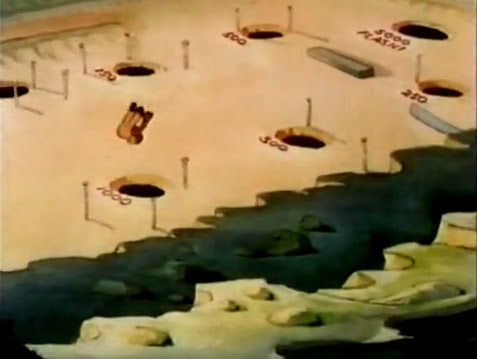
Nicodemus then starts to land in a type of pinball game where he is prodded by the sticks from the pinball machine as he moves. This is pretty good animation but I imagine it was hard to get Nicodemus move like a pinball ball here. Nicodemus then falls into a type of trap but zaps him out as he lands in a hole into another part of Hell.

A group of little devils then start to grab Nicodemus in the arms and legs as they capture him; but Nicodemus tries to break free from the group of small devil creatures. The animation of Nicodemus trying to break free isn't very good as he seems to stretch quite a lot and it doesn't look good on cartoons like this where the characters were rather stiff.


The group of little devils then dump him on the ground after grabbing him as they all go into some type of coon song about going to dispose Nicodemus - even the devil does so. The close-up of the devil singing to Nicodemus is pretty expressive animation.

The devil then starts to poke Nicodemus in the eyes numerous times with those funny springy sound effects heard. The little devils are the chorus singers while the devil is singing in gospel music. There is sort of a fire dance performed by the little creatures where they walk up and down shouting "Yeah" almost going into perspective animation. The devil keeps on reminding Nicodemus "You gotta, you gotta, you gotta give the devil his due". The devil has finished the song as he shouts; "Okay boys - give him the works" as the group of little devils start to yank him with their pitchforks which causes Nicodemus to scream.

We fade back into the real world where Nicodemus is being pecked by a group of chickens which gave us the feeling of being hit by pitchforks. Nicodemus then wakes up scaring all of the chickens out of his way. Nicodemus hears the sounds of church bells again and from the nightmare he had; he decides to be a good Christian in which he dashes all the way to church running up and down the fences just to travel to church. He continues to run all over the place as he dashes into church and we see him in a silhouette singing a hymm; and on the stained glass window is an angel where he's standing which probably suggests that he's a good person now; going to heaven - I guess.

Overall comments: This cartoon certainly has African-Americans stereotyped here with their charactertistic walks, and the strong of use caricature adds it up. It's sort of an entire black cast here in the world they're from. Censored 11 cartoons are hard for me to review since I try to be careful with what to say and if I'm getting my information right. I wouldn't consider it a racist cartoon even though the character Nicodemus has a religious name and acts like someone from a minstrel show and coon song stereotypes - even though this is information I got but I'm a little too young to understand the actual meaning but I have a feeling what they mean - minstrel shows being white actors performing blackface and coon songs are songs about racial slurs towards blacks. I know "coon" is an offensive word to blacks that describe him as lazy - but I'm unsure if this would describe Nicodemus but he does like to gamble which seems to be a black stereotype of the time. This cartoon would've probably been good if it was about a normal boy who skips Church and does naughty things (sounding like Disney) but just putting it with black characters makes it subtle for me to review. I didn't hate the cartoon at all but I just don't find it comfortable mentioning religion and discussing about it.