Wednesday, 11 January 2012

87. Buddy the Detective (1934)

Warner cartoon no. 86.
Release date: September 15, 1934.
Series: Merrie Melodies.
Supervision: Jack King.
Producer: Leon Schlesinger.
Cast: Billy Bletcher (Mad Musician), Jack Carr (Buddy) and (Cookie) Bernice Hansen?
Animation: Paul Smith and Don Williams.
Musical Score: Bernard Brown.

 The cartoon begins at a haunted house in the middle of nowhere, and in this area there is a storm outside, a storm that tells us this house is bad news. We truck inside the house (I'm scared) and we see a mad musician  playing some haunted tunes on the piano. We then see these branches pop through the window and they are also playing the piano - which looks even spookier. But the branch is playing a lively tune called Shake Your Powder Puff that the mad man despises, and almost rips his hair "Bah! Get out!", the mad musician feels that he's not writing good music and shouts "I need inspiration!", and laughs evilly.

Well kiddies, do you think this guy is REALLY frightening and scary??
- Duh?! I've been scarier like that demon in 'Paranormal Activity' or the 'Blair Witch Project'.
Yeah, I guess you're right. :L

The mad musician then walks to his small table and grabs out a bottle and cup. He pours the bottle in the cup which has a frog that falls into it. He grabs out the frog into his hands, and uses his hands to hypnotize the frog and declares that the frog will now play some haunted music for him. He throws the frog onto the piano - but then the frog picks himself up and do we hear evil music? Well, instead the frog happily plays Amaryllis on the piano which drives the mad musician mad. The frog then jumps onto a picture frame of a pond that splashes - you know, magic?

The frustrated mad musician then walks around to other portraits such as one that features Napoleon, and hypnotizes him to come to life and "play" some tragic music. Instead he plays some jolly tunes again - which angers the mad musician and his fiddle is destroyed. I must say that there is some wonderful character personality of the Mad Musician here - at least Jack King has made a bit of effort.

Meanwhile, the mad musician starts to think of an idea. But then we see a cut to Cookie's house where she is reading a newspaper article that says "Mad Musician Escapes" - what did he escape from an asylum or something? Back to the evil house, the Mad Musician then goes through a telephone directory and blocks his eyes with his hands on who he will choose to hypnotize by random. The Mad Musician finds the name he's chosen and that's "Cookie" of 00 1/2 Cornbread Ave. In the directory; you can find two Schlesinger employees here which is Bob Clampett and Ben Clopton, I believe Manny Corral is another one who was a cameraman at the studio.

Cookie runs to the window and closes it thinking there will be a storm. The telephone rings, and she picks up the phone and answers it. The mad man then uses his fingers to hypnotize Cookie by signalling it, he declares "Come to me my little Cookie". Cookie asks him to "stop it", but the hypnotizing still goes on. The mad musician then breaks the forth wall and admits, "She's a tough customer, I'll have to give her words!" Afterwards, she feels rather weary and then walks out the house like a zombie.

Bozo, Cookie's dog (as apparently that's his actual name in later cartoons), then starts to sniff the phone in which he turns almost hypnotized. He barks at the telephone and then hides under the cushions in the sofa. The dog then reaches to the telephone and blows a raspberry at it, then out of the house. The dog starts to run through the streets and then to Buddy's house who was sitting down in his armchair leisurely looking at his picture of Cookie. Bozo runs into his house and runs over his chair, and has a fishbowl stuck onto his head. The dog starts to bark but then breaks the fishbowl to try and signal Buddy what is going on by what's happened and even in the picture of Cookie. Buddy realizes that Cookie's "in trouble". He then puts on his jacket and hat and is off to inspect. How about we say that Buddy is Sherlock Holmes and Bozo is Watson; heh-heh - no!

Meanwhile, Cookie is inside the mad musician's house and she is being ordered by the mad musician to play some haunted and cold music on the piano. In the meantime, she then plays some jolly tunes on the piano that causes the mad musician to scream. He then uses his hands to order her to play tragic music again. Buddy and Bozo are then detecting as Bozo leads to where Cookie's whereabouts could be - which is in that haunted house. Buddy can't seem to open the front door, but instead thinks of a better idea. Instead he uses a torch on his magnifying glass to open up a patch on that door that he crawls through. So far, Buddy has seen some scary encounters (a spider lands on his magnifying glass), but as he uses his torch there appears to be these type of scary ghosts that appear out of nowhere. Does Buddy seem good enough for a detective - well; he is pretty much an every man.

Buddy then starts to run in the hallway, and notices a skeleton walking out of a door and he secretly follows it to see what the skeleton is doing. The skeleton is drinking some water from a water machine. Buddy watches the skeleton's activities in which it's just getting out a broken umbrella to go out for a walk (considering that there are other skeletons behind him) will this be explained or what?! Oh that's great - we see Bozo's howling as he is chasing after a skeleton and he bites off one of the skeleton's legs. The skeleton chases his leg back but instead Bozo is then climbing up the stairs (that appear to be broken) and the skeleton has no chance of chasing him. The skeleton then falls down the basement in which it breaks into pieces, Bozo's tail is caught on one of the blinds and starts to run out with the blinds stuck on his tail, Buddy is skidded on top of it as Bozo runs. Okay, but I thought they were on the hunt for Cookie but instead they're mucking around with skeletons and other stuff.

Buddy then finds Cookie upstairs, and he tries to climb up the banister of the stairs, but the pendulum on the grandfather clock then kicks Buddy up there. Buddy tries to open the door, but gets slapped by the mad musician. Buddy already used his torch beam to melt the patch on the door with his magnifying glass - why couldn't he just to the same here. Buddy then moves another door through the same wall on the door next to it. Buddy notices the mad musician standing at the door but instead he kicks his bottom, but his fat bum bounces off and smacks Buddy. They both then start to fight (Okay, I've got one vote for Buddy, going once; going twice - eh, I like to do these things).

Buddy then crawls behind the mad musician, grabs his robe and swings him around and around until he hits the wall - and appears to be week and defeated. There is a stool on top of him, Buddy swings it up to the ceiling so it blocks the mad musician from going anywhere. Cookie steps out of the piano by surprise. To give the mad musician some more torture they play some jolly tunes to make up for it, while it drives the mad musician nuts - and that's all folks.

This cartoon was not a bad cartoon - and it seems that Jack King has fallen into the influence as what Friz Freleng or Ben Hardaway did when it was those incoherent cartoons. I liked parts of the cartoon such as the personality of the mad musician, and yet Billy Bletcher's cartoons are always great to listen to. The music here is not so bad - but I can never see Buddy just acting like Sherlock. We just pretty much saw the first 3 minutes of this cartoon without Buddy - and only showing the mad guy trying to get people to get inspiration to get evil music, all really works. Then the cartoon gets to the point where it's weak since Buddy is detecting and just wasting time with skeletons that we didn't bother having to see.

Sunday, 8 January 2012

86. The Miller's Daughter (1934)

Warner cartoon no. 85.
Release date: September 8, 1934.
Series: Merrie Melodies.
Supervision: Friz Freleng.
Producer: Leon Schlesinger.
Cast unknown.
Animation: Rollin Hamilton and Charles M. "Chuck" Jones.
Musical Score: Norman Spencer.

This is Chuck Jones' first ever animation credit as an animator, by 1938 he would later become a director, and soon would become one of the greatest animation directors of all time.

Our cartoon begins with these two ceramic figurines that are standing on a table, we then ZOOM back and see a view of the lounge in the room. There is a canary bird who is sitting in it's bird cage chirping happily. After some peaceful music, we see a bit of edgy music when the cat enters the scene (good set-up) and the cat plans to eat the poor canary. The cat jumps at the arm of the armchair; then leaps to the cage but falls off and lands on the table destroying the female figurine and knocking the lamp over to the side. Clumsy cat.

The housemaid enters the scene and is rather annoyed with the mess the cat's made. She places the lamp back into position and then picks up the pieces of the female figurine with her apron and takes it upstairs. The shepherd figurine who is still alive then weeps, probably thinking "There goes my gal". The housemaid then walks up to the attic and dumps the broken pieces of the female figurine into a box and then walks downstairs. Well, at least the design of the housemaid is appropriate while in other cartoons such as Disney's Three Orphan Kittens and the Tom and Jerry cartoons; it's stereotyped - but it makes the cartoons more interesting while the housemaid looks very bland.

 The shepherd figurine must've heard that noise from upstairs and then starts to slide down the lamp, but the sheep is still on the table not knowing how to get out. The sheep "bahs" with tinidness but the boy then brings out a cushion for a "happy landing" - not quite a happy landing. The figurine and the sheep then walk to the staircase but they hide by the wall since the housemaid walks down the stairs to do her other jobs. They both hop upstairs and finally they reach the dark, scary, boring attic.

The young lad then walks around trying to find his gal (or shall we say that he's a shepherd figurine why not say she's a shepherdess). The male figurine then hears the noises of the shepherdess calling for him, and he notices to find her in broken pieces, "Look, I'm all broken up" she says. Of course, he's standing right next to "glue" he remarks "That's alright, I'll fix it!" He then starts to glue the pieces back but there's a lamb in a picture portrait with the sheep figurine walking into the scene baaing at it but jumps at the portrait but rips it. Now that I think is a gag that works - finally something worth looking at by Friz Freleng so far.

Finally all the pieces of the broken shepherdess figurine is all fixed and she is able to walk again. The male figurine forgets another piece (which means there's a huge hole in her behind) and he glues the last piece. They both dance around together dancing and prancing happily. There is then a spider at the attic (Girl scream: AHHHHHH!) that plays the piano with it's legs but is still attached to a web. There are then these type of "See No/Speak No/Hear No Evil monkey figurines but they're caricatures of the Three Stooges, and they go off singing the title song, The Miller's Daughter.

Another gag that we see is which rather weird but it works well I guess is that there are these pair of old shows with their tongues saying and making rather annoying sounds - and their tongues are actual human tongues which is part of the gag. The Three Stooges as monkey figurines then go back into a song, but they interrupt briefly by punching one another. Then they go back into song.

We then see this lamp that's up in the attic that shows these silhouetted figures dancing, but one of the figured "clay man" turns on the light and we see them dancing as skeletons and they go around the lamp which moves. After the shepherd and shepherdess figurine applaud after their song. We see these type of kettles that start to dance to a Latin-American tune (IMDB confirms it as Cuban Carabet), and the shepherdess dances to the music by shaking her booty with a cloth, as they enjoy a bit of dancing. The shepherd figurine then jumps to a box with a room full of clocks. He starts to conduct the clocks which plays the Blue Danube tune by Johann Strauss II. The cuckoo clock then joins in to the music, too.

Michael Barrier wrote in his book Hollywood Cartoons that this cartoons resembled one of the Disney cartoons with its animation and rotoscoping. In a way, he is actually quite right since this cartoon has got some pretty stunning animation in there so far which was done carefully - most particularly the object animation. The attic sequence really has only got rich looking animation.

We then see a picture frame of a couple there are almost in silhouette and they have a dance (there is a tree near them in that frame). They have a type of waltz dance, and the dance part goes on for a while - but it is actually very well animated, but it is of course - rotoscoped. You might think that it was filmed in live-action and placed in silhouette (similar to what was in Two Silhouettes in Make Mine Music). There already has been some great animation, but I've always heard about Chuck Jones being a great draftsman - I wonder if he was involved anywhere in the skilled animation. Since the Schlesinger budgets back then only cost 7K, and yet they probably couldn't afford that much for that part to be rotoscoped by hiring live-action actors - unless this dance was probably burrowed from a Warner Bros. film. The girl then claps at the shepherd figurine.

There is then a type of lion figurine that is huge, and the lamb looks at it curiously. The sheep figurine then looks at it and shouts "Hey big boy", the lion roars fiercely at the sheep in which he goes in a surprised take and runs off. Instead of the usual "villain chases girlfriend" sequence that we always have - instead it shows a lion figurine chasing after the sheep figurine, since the shorts back then always had to have a climax. I really like that look of the lion in the first shot we see him, he moves very realistically and you can feel it. I love the shines on that lion as it makes it a lot more realistic. The boy and the girl figurine then scream to see their sheep being chased by that grizzly lion, and they are trying to help him out.

The poor sheep then climbs over a pipe and as he reaches out of the pipe he is covered in soot. He reaches a cornered part of the attic and cannot do anything to stop that lion, as the lion has more power. The boy and girl figurine then walk into the scene - the boy uses a cupid model and borrows it's bow & arrow. The boy shoots at the lion's bottom in which it jumps and roars. The sheep runs out of the scene, as do the boy and girl ceramics. They then run out of the attic, but the boy closes the door in which the ceramic lion crashes the door but breaks into pieces - which works so perfectly and really well done.

The boy, the girl and the sheep slide down the railings, and they fly back onto their table but knocks down the lamp on the floor that breaks. The figurines then notice the housemaid entering the scene and both go back into their positions. The housemaid enters the scene to find out what has happened. The cat walks into the scene minding it's own business, but gets framed for knocking down that vase. Now that isn't so fair to set it up - the cat didn't do nothing and us audience can't do anything about it to stop the maid. The ceramic figurines then look out the window where the housemaid is still chasing after the cat, trying to whack it with a broom - and that's all folks.

Friz Freleng was put in charge to direct all of the Merrie Melodies throughout 1934, all of 1935 and most of  1936. It was his job to only direct them as the others would be off directing the Looney Tunes. I must say that this is probably Friz's good picture that he's directed so far while the earlier ones he's worked on were pretty awful. True, there's still blandness in the animation but parts of the animation in the attic sequence looks so realistic and rich. The animation is not a close resemblance to the Disney cartoons, as their quality was higher - but this short has probably got highest animation quality since the Harman-Ising era. Of course, it was mostly rotoscoped but it makes the cartoon look better viewing. The cartoon was more coherent than the other pictures, and let's hope that Friz Freleng will make a turning point - or unless that was just his picture of luck - at that time.

Saturday, 7 January 2012

85. Buddy's Circus (1934)

Warner cartoon no. 84.
Release date: August 25, 1934.
Series: Looney Tunes.
Supervision: Jack King.
Producer: Leon Schlesinger.
Cast: Jack Carr (Buddy).
Animation: Bob McKimson and Ben Clopton.
Musical Score: Norman Spencer.

Our cartoon begins with Buddy and a couple of animals up in a hot-air balloon with the banner reading Buddy's Circus in big letters. The animation of the hot-air balloon looks very inflatable. Buddy brings out a telescope. He looks through a sign in a close-up position that reads Buddy's Circus Will Arrive at 2.00 PM. Buddy then takes a look at his watch and watches that the time is seconds from 2.00. As it is 2.00; Buddy pulls out some pegs from the hot-air balloon and throws them to the ground where they're bundled up neatly - it's rather too late to be making a tent right now - there'd be audiences walking by saying "Where's the circus tents?!". There is then an octopus that slides down and clamps the pegs down with a hammer doing the job of a roustabout.

The hot-air balloon lands at the top of the pegs and then it immediately forms into a circus tent. There are some folks setting up some props outside and then one of the circus barkers calls them into the circus where crowds of folks dash inside. I must say that Jack King really does have some imagination for his cartoons - and Chuck Jones said that he had no imagination; although I guess that he received support for the cartoons he directed.

The circus show has already begun and Buddy is already in his ringmaster outfit performing a show. He appears to be performing some type of "instruments" by playing around with elephants. He uses xylophone sticks to play the xylophone by using elephant tusks. You can see the sign for yourself that says Professor Buddy and His Musical Elephants. The next part he does in his "20 tons of tunes" is that he pulls the elephant's tails in which their trunks play some type of musical woodwind sounds coming out - and the tune there is pretty good, and the gags are entertaining itself.

Buddy steps right up on stage and announces to his audience: "Hi, Hi howdy folks. Step right this way. First, the Ubangi boys are going to dance this way." Buddy brings the show over to the Ubangi twins that belong in the "Darkest Africa" and one of them does a type of dance, while the other twin plays the drums on his head and the xylophone around his type of skirt - ending the performance with a tap on the twin's teeth from the drumstick. The next act that Buddy introduces is: Oscar the Ubangi phone "He Plays a Mouthful". Oscar then opens up his huge mouth in which he places a record in his mouth and uses his tongue as a gramophone. Is it me or is it that this act meant to be a "black-stereotyping show"?

Buddy presents another act in which it the performer's name is Elastiko - the India-Rubber Man. He moves very rubbery and moves really well. The timing is done extremely well - and it's a safe guess maybe Bob McKimson had some involvement in the  timing of that scene. The designs of the "India-Rubber Man" doesn't even look very Indian to me at all - and instead looks more like a black stereotype - but I guess that the director wanted to keep things simple, and not too stereotypical or complex. This act was re-used from an earlier Harman-Ising short I Love a Parade. The next act to be shown is Asbesto - the Human Stove who cracks two eggs inside his mouth. He then walks to the X-Ray and we see inside there is a pan sizzling with two scrambled eggs being cooked. Mmm eggs. His heart is ticking slightly, and as he steps out of the X-Ray - he rumbles slightly and then burps. That's the end of the acts feating stereotypes.

Buddy then acts as a host who gets people to step into a act, and appears to be very popular to the crowd. The arena is getting crowded with people sitting with benches. Buddy is the bandleader of this arena - with a kangaroo standing behind him playing the trombone and a baby joey pops out of the patch playing the trumpet. There are tricks being played so far such as a clown lying down facing the ceiling of the tent smoking a cigar - and the smoke forms into rings that the lions jump over. At least that is a clever gag than just looking at the "usual" rings, and instead it's rings created from cigars.

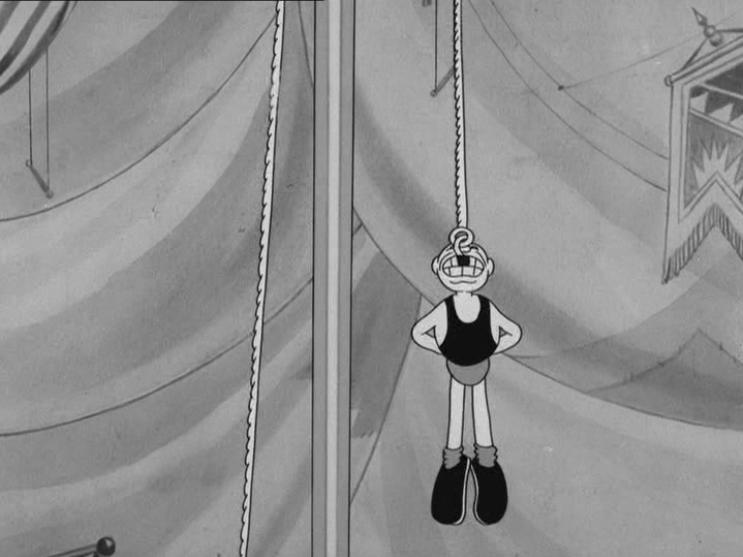
Another act that is being performed shows an aerobic who has a gap between his teeth and he places a hook between it. There is a man standing behind the pole that pulls the rope upwards as the aerobic is being lifted. It must be very painful for that to happen and it seems to be "impossible" - or is it?! The man who is still being lifted is really tired out, and then his whole false teeth fall out of his mouth and he falls down. Yep, even an animated cartoon has proven that it is physically difficult.

Meanwhile, there is a baby who is sitting at the audience who appears to be eating a packet of Cracker Jacks (popular for the circuses back then). The baby accidentally drops the packet, and starts to climb down the whole seat stool. As the baby is down on the ground - it starts to look for the popcorn, which is lying down in the elephants section. The Cracker Jacks is then sucked up by an elephant's trunk just like a hoover sucking it by force. The elephant's trunk also sucks up the baby, in which the elephants bounces the baby for fun.

There is an act that is still going on where it involves aerobics - swinging around - with the crowds looking from left to right - one of them licks the person's ice cream as part of the gag; plus the cone itself and then his thumb. Okay, but the gag really had to go that far? It was only funny when he licked the ice-cream, we didn't have to see anymore. There is then a line of elephants walking into the arena where the baby is holding onto an elephant's ear. The elephants perform a dance sequence and the baby copies the same movements as the elephants do - rather cunning for a baby.

A trapeze swinger who is still performing some movements accidentally causes the rings to break and fall down, in which the child is sitting on a see-saw but as soon as the trapeze artists lands on it - the child catapults - and then lands onto the trapeze artist's legs. It starts to make the whole performance go worrying for the child and for the performers. As there's these folks balancing on a wire, they form a tower - but they get knocked out by one of the artists. One of the aerobic folks lands on a trombone, and gets reaction movements from the ticklish vibrations. The mother in the audience of the child then notices the child in the audience, and shouts "Junior", Mmm - no name, eh? How can we tell if this is a boy or a girl, or not?!

One of the aerobic performers then crashes onto a drum, in which to Buddy's surprise sees that the whole trapeze act is going awry. Buddy then climbs on top of the pole to try and stop the disaster going on, the mother follows him to rescue her child. Buddy grabs out a rope and grabs the baby tight, but then bounces from the hammock and then Buddy, the mother & her child are holding onto the trapeze artist (who is covered in dots since his costume was pulled down). Buddy and the mother then land on a bike by balancing on wire and all the gags are too complex to explain whilst they're trying to rescue the child.

Buddy, the mother and the baby then fly out of the tent - in which they cause to rip the roof of it. They slide down the giraffe's neck and as they slide down all the spots on the giraffe's neck falls off it's skin. Now that is a very funny gag, and it even works very well too. It reminds me of what Tex Avery probably would've done in his earlier cartoons. See, Jack King certainly is slowly improving the cartoons - by showing slightly better gags - but there's still blandness in the characters and animation, though. The mother still screams "Junior, junior - where are you?" still not revealing the name. Buddy goes around trying to look for her child, but the mother goes off weeping with tears thinking the baby is missing. Buddy tries to comfort the mother, and encourages her to blow her nose which makes a horn-honking sound - hah.

A hippo that lives in his cage then pops out and opens his mouth and there's where the baby child is found. The mother is therefore all happy and amazed to see her baby is still alive, and gladly receives it back. Buddy, the mother and the baby then hold each other's hands around in a circle - and they hop around happily - and that's all folks.

Good thing that this cartoon is fully restored and remastered (that's included in the Looney Tunes Golden Collection Volume 6. which I have - I've got all 6 volumes) and I wish to see more Buddy cartoons to be restored - so that I don't have to review them in horrible TV quality, or VHS tapes that have blurs all over it or even an annoying, baby timer in the middle of it - I'm glad at least one 1934 cartoon here has been restored, and I've finally gotten to understand it well. This was Jack King's 2nd cartoon he was credited as a director, and again - he's done a pretty fine job here. 1934 seems to be slightly better since King has arrived, but no further changes come to Freleng, unfortunately - not for another few years. There were some good gags in here (the giraffe one in particular) characters and stories still rather bland, but this worked worked as a whole pretty well. The reuse sequence of the Indian rubber man didn't bother me too much which was from I Love a Parade as I almost forgotten that cartoon. I guess that Tex Avery wasn't the director who just improved the gags - since Jack King did contribute, but not at the level of Tex Avery, of course. 

Friday, 6 January 2012

84. Why Do I Dream Those Dreams (1934)

Title card courtesy of Big Cartoon Database.

Warner cartoon no. 83.
Release date: June 30, 1934.
Series: Merrie Melodies.
Supervision: Friz Freleng.
Producer: Leon Schlesinger.
Cast unknown.
Animation: Rollin Hamilton and Bob McKimson.
Musical Score: Norman Spencer.

The cartoon begins very early in the morning, in a quiet town. We hear some nice smooth music in the background as it's quiet in the village. We then see a house with chickens outside pecking their corn. Nice and peaceful --- until I hear the sounds of crashing in the house (Yikes!). There is a rather lanky looking guy who is running out of the house because of all the fighting. We then see this lady coming out nagging at him, but she is speaking in a very gibberish voice and so fat that no-one can really understand what she's saying. Unless her mouth is very inappropriate to the younger audiences that it's sped up - or just a voice speeded up as a gag. Hang on a minute - is that lady meant to be the wife??

Well the husband doesn't seem to have a clue what she was on about and is about to turn away, but gets a pot thrown at her head. It turns out that the sign at their front lawn reads "Mrs. and Mr. Rip Van Winkle" - well duh, that explains everything. The man grabs out a paintbrush out of nowhere and he puts a "cross" through the "Mr." words and then walks off. The animation movement here is actually pretty good for 1934 back then, and I wonder if it was either Bob McKimson or Rollin Hamilton doing those scenes (don't think it would be the uncredited animators) since both animators were pretty skilled at animating and it's either one of them. Well, it's clear that this story is based on Rip Van Winkle now.

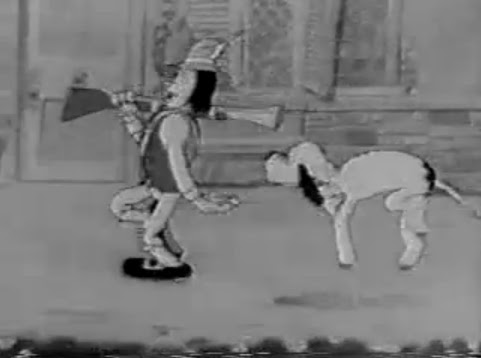
Rip Van Winkle then walks down the street holding onto his shotgun and his pet dog following him. Meanwhile, his pet dog then turns around and runs back to the house. The wife opens the door with the dog blowing a razzie at her - aww, an old Harman-Ising characteristic annoyed emotion. It appears to be that Rip is singing a song about how nothing is worrying him (Don't ask me what the song is - I'm sure someone will raise it). There are then children skipping along merrily with the tune as well, and chickens. There is a weird gag of a chicken skipping, but then lays an egg, hatches it and then a chick is born to follow the music? Huh? Winkle's still singing the song about how he has no worries, and has no regret of leaving his wife (but were is he gonna live)? As he walks up the hill - he waves goodbye to the children that also wave to him.

Rip Van Winkle then arrives at a quite spot by the lake, and sits behind the tree. There are birds chirping on the branch of the tree and it's wonderful. He brings out a fishing rod, and uses a mousetrap as a bait. He sits down and fishes. There is then a fish underwater who looks at the cheese in the mousetrap and is rather interested in it (No, don't do it!). Instead the fish uses the stick to poke the trap (rather cunning, I'd say). The fish eats the cheese and pulls the hook as a trick to think Rip has caught the fish - which to his surprise, he hasn't. I must say that this is even a fine Friz Freleng cartoon so far. Rip Van Winkle then goes to sleep until....

It appears to be that this is 700 years later where we see these type of gnomes dancing and prancing around the woods, singing some songs. The gnomes are singing the title song, Why Do I Dream Those Dreams? They appear to enjoy drinking beer and alcohol. Therer are then these weird gags that show these gnomes getting beer bellies from drinking barrels as they line up for some booze.

We then get this caricature of Rudy Vallee who sings with his cone hat (Oh man, I thought I'd never hear of him again!) The gnomes continue to sing the title song by doing this dance routine. But the dance routine shows some where they stand on their beards - I guess that's something new. Blimey, that dance routine is really long than I imagined it would be.

These gnomes then appear at Rip Van Winkle who is still sleeping and they go through his pockets and appear to be laughing at his newspapers because they're so bloomin' old (about 700 years). One of the gnomes then reaches out a pocket watch and it ticks! One of the gnomes then climbs aboard the shotgun that Rip had with him. They then fire the gun, and Rip wakes up - blimey he doesn't even look 700 years! In fact, he hasn't even aged! As Rip wakes up - all the gnomes dash off and hide.

Rip then stands up and walks to these trees (and somehow everything looks bigger to him - and the barrels). Rip then rips up a barrell and drinks it (which is about the size of a mug for him). After that bit of drink - he suddenly shrinks. Just explain!!!

Just as Rip Van Winkle has shrunk into a small size - his pet dog sniffs through the forest and is of course, much bigger than Rip. The dog then notices it and starts to bark, then lick poor Rip. He then starts to try and walk away behind the dog that is continuously barking at him, but instead he gets away by riding a grasshopper - eh, is it meant to be like riding a horse? In fact, he actually rides it like a horse - well more like a bull, really. Rip then falls off the grasshopper that "bucks" him off.

Poor Rip then falls off the cliff and lands onto a spider web. The spider then jumps off the limb and rolls down, and then tries to attack poor Rip.

Rip Van Winkle wakes up and actually IS 700 years later. So it turns out that he doesn't in that dream sequence. What an unexplained story. He has cob webs covered all over him. He then sees his dog who is 700 years old?? How can dogs live so long in human years -I know that Rip does the same since it's a tale. But considering he had pups at that age is juts beyond me. I really don't like that ending on how he does turn out to be very old at the end -not the way I like it. And that's all folks.

This cartoon wasn't too bad I guess, overall. I didn't mind the beginning, with the gnomes but it's a shame that he just had to leave his wife after the fight - which generally isn't funny. Some of the animation at the beginning was quite fine to look at (either Hamilton or McKimson did it). The ending just really bothers me with that aged dog, and it turns out that Rip really is aged 700 years -well I guess that's what was explained in the book (even though I haven't read it but know of it). I guess I should say that I don't like looking at aged dogs, because it reminds me as though they'll be "put to sleep" soon.

Wednesday, 4 January 2012

83. Buddy's Bearcats (1934)

Warner cartoon no. 82.
Release date: June 23, 1934.
Series: Looney Tunes.
Supervision: Jack King.
Producer: Leon Schlesinger.
Cast: Jack Carr (Buddy), (Cookie) (?) Bernice Hansen? and Billy Bletcher (Mustached baseball player).
Animation: Ben Clopton.
Music: Norman Spencer.

Jack King's first cartoon where he directed - or supervised. Somehow in the title card only Ben Clopton's name appears, since the main title "Buddy's Bearcats" hogs up a lot of the screen credits. Anyhow, with watching all these Friz Freleng cartoons and Ben Hardaway's cartoons, let's see what Jack King brings here...

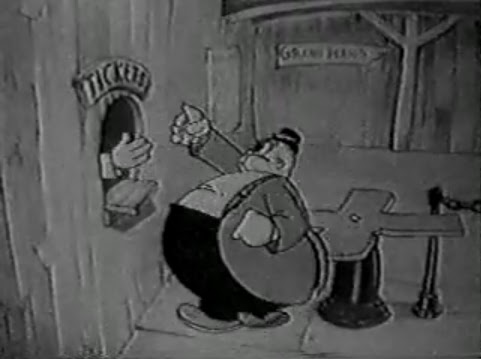
 Our cartoon begins with a poster that reads Baseball Today - Buddy's Bearcats vs. Battling Bruisers which is of course some pretty good names (I prefer the latter, though). It is in fact a flag as we zoom out, and we see a view of the baseball stadium as there are quite a number of people attending at Ball Park Stadium. All of the fans are waiting at the ticket box-office ready to pay for their ticket for the big game. One the ticket is bought, they go through the turnstile. There is a fat man who buys a ticket, the hand of the ticket-man then extends (I love the camera angle of that hand extending).

The ticket man then wants to measure him because of his weight for admission. The ticket man then declares "Two seats" that he needs, so the fat man pays for another ticket and then he walks through the turnstile moderated. There are then these two type of two gentlemen that have beards, and as they are about to reach the turnstile they both shrink to they go under it, and then they go back to their normal height so they don't have to pay their ticket. Surprising no-one has noticed really, they were quite visible to notice when they walked under.

We then see a young teenager who is peeping through a hole in the gate looking through the stadium and turns to us audience "It's Buddy!", we then see Buddy who appears to be the pitcher and is rubbing his baseball about to get ready for the game. The young teenager who is wiggling his bottom both sideways (with a dachshund walking into the scene) with the young teen wiping his bum on that dog - which is a pretty corny gag, but works. There are these two tough-looking lads who are peeping through these holes, with the other tough guy slipping the one that's two guy down to his height. But the other hole goes right at the top, and then they have a non-physical fight about it, by changing it's positions - one-by-one.

There is a guy who helps extend's the dachshund's body by using his tail. The young teenager manages to get through the stadium gates, and thanks the guy out for helping him. We then see these Scottish music players are are parading the streets outside the stadium with their bagpipes. The bagpipe then forms into a type of balloon, and ties it to the drum which forms into a hot-air balloon and they also manage to raid into the stadium without a ticket - amazing how they got away with it back then.

Inside the stadium we see these group of audiences who are all swinging side-to-side happily, and the girl at the audience woos at Buddy "Yoo-hoo, Buddy". Wait a minute? Is that Cookie? No, it can't be - let's keep watching this cartoon, and find the real Cookie. Buddy then replies "Hello, Cookie". Oh my god, that really IS Cookie, look in the later screen-grabs she has a completely new design - instead of the black hair she had and that she really looked like a young adult (a bit), instead the new design makes her look like a 8 year old - Urgh. Buddy goes into some rhythm pattern in which he bounces the baseball onto the bats that like a xylophone sound.

Meanwhile there is some hot dogs being sold by hungry customers and fans, and there appears to be some Italian speaking chef that sings a little song about how to make hot-dogs. Okay, I can totally see a style coming from Jack King - where it shows the Chef has some character. Then we see a drink vendor who is walking down the steps who is singing about his drinks. Mmm, looks like we have some whimsical songs coming.

Of course, there is "more" singing coming from the announcer who is standing in the middle of the pitch with his microphone and chants: "Ladies and gentlemen, (whatever he's seen, then points to the team), the Battling Bruisers." The Battling Bruisers are of course, the rival team and they show off. He then turns to his right, and declared "On my left, the greatest team I've ever seen - Buddy's Bearcats." In which they do a rather dancing pose as well to their fans.

We then see the commentator who I assume is meant to be a caricature of Joe E. Brown who did baseball commentaries back then. Buddy is the pitcher for the team against the rivals, and he throws a sing with the ball but the batter misses, which is a "Strike One" to him. The ball accidentally lands on the commentator's mouth and he swallows it. Hah, now THAT is a funny gag. He says "Shucks! It's a ball. I'm all balled up!" Now that is even a funny gag and pun. Jack King has so far made a short really worth watching from the horrors I've been watching over the past few shorts.

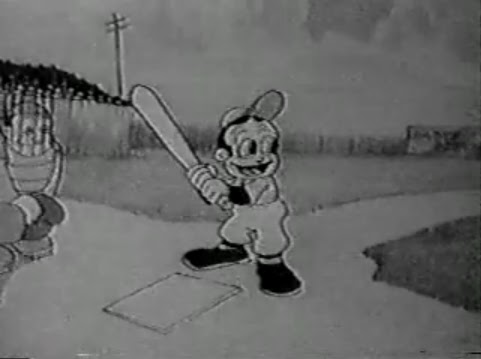
It seems that immediately, it's the "Bearcats" turn to bat, with Buddy being the first to bat. He wipes some of the dirt in his hands and onto the bat because (is that what baseball players do? I don't know baseball very well as it' not so big where I live in the UK). The pitcher then squirts oil in his armpits (an old fashioned way of deodrant??). He seems to be rather nasty looking. We see the backstop player who has a bird-cage on his helmet - which is a gag since their helmets have types of cages on them. The pitcher then does a loop-de-loop swing with the ball, but Buddy manages to smack the ball, in which he runs at the first base, but the ball is already caught before he could make out - with an embarrassed laugh. Buddy is out of the game, and appears to be a celebration for the fans of the Battling Bruisers.

It is the evil batsman's teams turn to bat, in which the mustached batsman laughs evily as though he's got a trick up his sleeve (I believe that's Billy Bletcher's laughter being heard). Buddy also has another trick as he is pitching, he seems to lock the ball with the key. As he throws the ball off his hand, and the ball goes all over the place. The batsman tries to whack the ball, but the ball goes in funny directions. He accidentally hits the backstop player by mistake, and he brings out a type of gas pumper and sprays it at the ball, in which it stops moving. He picks up the ball and whacks it. Okay, but that is some cheating going on there from that villain (and I admit, a little bit from Buddy).

One of the players fielding then sees the ball that's about to go through the audience (which would've meant a "home run"), but his arm extends, and manages to catch the ball in time. We see this really great, but bizarre camera shot of the commentator who shouts "OUT", and we got right inside to see his tonsils, and then another shot slides into the screen with him in his desk - a great shot but probably hard to film. The commentator announces the score which is "49" to Bruisers and "47" to Bearcats, and Buddy's team are down by one point.

All of the audience are chanting for "Buddy" to come back on them as they want him. Buddy is standing outside the "players" door, who was out of the game and is begging praying with his knees down to enter back into the game. Cookie opens the door and enters, she says to him that there is in encore for Buddy to come back in. Buddy enters the pitch, and is chosen as batsman, and blushes slightly. Well, I have to admit that Cookie's redesign does make her look cute, but also really makes her look really young - and I can't decide if it's a good design for her or not. Although I do prefer the original design first.

Buddy then shoots the ball high in the sky, from a swing by the evil batsman. We see a great shot of the baseball flying straight at the camera. Everyone is all cheering on Buddy, and Cookie is standing right at the last base, and he makes it. Buddy has completed a home-run. Everyone throws their hats with delight for Buddy and his girlfriend Cookie. They are then covered in hats. They both pop out, cuddle each other - and that's all folks.

Jack King's first cartoon he fully supervised, and already it looks pretty impressive compared to what we've seen in the early 1934 cartoons. Of course, Jack King was an underrated director and often his pictures weren't anything special - but this is something special to look at. He includes a caricatured commentator and a good gag of when he swallows that ball. There are some great camera shots too, and when the animation does zoom right into the camera, something that the directors like Earl Duvall, Tom Palmer or Friz Freleng didn't achieve. Of course, I'm not too settled with the redesign of Cookie because the audience just won't recognize it, but I think this is in fact a pretty decent cartoon. This is probably the best that I have seen so far in 1934. Of course, Jack King isn't really influencing the other directors, but he's done quite good - however; nothing shakes the studio until Golddiggers of 49.

Monday, 2 January 2012

Lloyd Vaughan obituary and info...

Today I would like to post something a bit different, instead of a review - an obituary. 103 years ago, Lloyd Vaughan was born, and he died on May 19, 1988, aged 79, and he will be the topic of this post......

"Why a post about Lloyd Vaughan?"
"Aren't you supposed to be doing this Buddy review?".
"What really is so important about Lloyd to you..."
Well, since Lloyd Vaughan was born on January 2...
"Well why didn't you do the others on the other dates?! You left out Chuck Jones in September!"

ALRIGHT! Listen up, not only is it his birthdate back in 1909, but I actually want to show out an obituary that I have from him that Joe Campana has sent me through e-mail:


Click on the obituary.
I suggest you read the obituary first before the following text I will write:

This here is the Lloyd Vaughan obituary that I have which was sent from Joe Campana through his research and files. It's a really interesting read his obituary. It seems that from his wife's view that he loved to draw Bugs Bunny a lot, (even though he had an interesting animation style for Bugs - and other characters).

His original dream was that he wanted to work for Walt Disney (which was probably's everyone's dream back then) but unfortunately he never went to Art College or studied Art but brought his portfolio, and the guys felt his style wasn't the Disney style - and the fact they thought he was too old - being 26. That was a bit bizarre for me to hear that - since Disney did in fact hire quite a bunch of old guys who were even older like Eric Larson, Grim Natwick, Jack Campbell, Bill Roberts, Dick Huemer, etc. No there's no question.

Who knew before that Lloyd Vaughan was apparently blind with one eye - even  before he started his animation career - and was tenacious. Interesting how he used to work at a tobacco shop.

Click on the picture of Lloyd.
Taken in the late 40's in the Jones unit.
First, a bit of history (Information mostly by Joe Campana). Lloyd Lincoln Vaughan was born on January 2, 1909 (as we know) in Portland, Oregon. He was raised by his parents: Thomas Henderson Vaughan (9/8/1873-4/10/1942), and mother Flora Anita Reimann (11/3/1884-7/17/1968). He mostly lived in Oregon up to his early years as an adult. He had a twin brother named Boyd Bertram Vaughan who died on 3/7/1984, and an older sibling named Evelyn M. Vaughan - and it is unknown of his death.

Lloyd Vaughan was married or in a civil partnership with a lady named Livinne L. Whitman back in 1927 when Lloyd was only 18!! Livinne was two years older than Lloyd. The couple is believed to have split up around 1930 after only three years. Lloyd later remarried in 1936 with his new wife Glaya M. Dewey (Vaughan) (born 12/24/1913-1/22/2007) and they were married until Lloyd's death, around the time they were married - Lloyd would've been living in California by then. Lloyd had one son who was born on 7/4/1937 named Lloyd Lincoln II. He spent his early years working in a tobacco shop, shipping clerk or ticket agents at bus lines.

After Lloyd's failure to enter the Disney Studios, he then tried Schlesinger where he got a job there in 1935 working as an inbetweener for $6 a week, and a month later his salary was doubled. He then stayed as an inbetweener/assistant for almost a decade (mostly in Chuck Jones' unit). He was finally promoted to a  fully-fledged animator around late 1944 or 1945. He was animating in the Chuck Jones unit. I haven't been able to call many Lloyd Vaughan scenes in the shorts but I know a few of his trademarks: he had a style of drawing one eye taller than the other, he drew Bugs's two front teeth with one tooth taller than the other. From what others have told me - his animation was rather off-model and a bit ugly, when actually I noticed that his characters look a bit crude but it always worked well in the scenes.

Some notable scenes that Lloyd Vaughan worked on the shorts that I know include:

Bugs' ride through space in Haredevil Hare.
Sylvester sleeping outside house (bed outside window): Scaredy Cat.
The crazy chase sequence/Bugs and Eskimo trapped on huge icicle in Frigid Hare.
The card playing game sequence: Mississippi Hare (also Ken Harris).
Pa flying up very high in the sky that he descends the following day: Bear Feat.
The whole "Rabbit/Duck" season argument when Daffy is shot several times in Rabbit Fire.
Daffy entering the saloon removes his chaps "Seems awfully breezy in here"/Entrance to Nasty Canasta: Drip-Along Daffy.
Daffy as the flower-bizarre monster in Duck Amuck..

and there's many more.

I've heard some other stories about Lloyd when he worked as an animator (Greg Duffell told me this but Thad Komorowski has brought this up before) that around the early 50s Chuck Jones was going to have to fire Lloyd because his work was not at all up to scratch. Ken Harris suggested, in order to keep his job; that Lloyd would share the same room as Ken Harris for a while and see if he has any progressed. Lloyd ended up staying in the same room with Ken for about a year. Another interesting fact that which I didn't know before was that Lloyd was an "Arrow" shirt model that was featured in magazines at that time.

Chuck Jones' unit must've been very busy in 1952/1953 since he had a huge unit with not only Ben Washam, Ken Harris and Lloyd Vaughan - but also Abe Levitow and Richard Thompson became fully fledged animators. Chuck was sort of busy experimenting with casting the animators since Ken Harris single-handily animated the entire short "No Barking", Ben Washam did "Rabbit Rampage", Abe Levitow and Richard Thompson both worked on "Stop! Look and Hasten!", "Sheep Ahoy", and "Feline Frame-Up".  Lloyd Vaughan got to animate most of the cartoon "The Cat's Bah" along with Ben Washam, as they both were co-animators.

Lloyd stayed with Warner Bros. Animation Studio until it's closure in 1953, and after it reopened about four months later - Lloyd didn't return and worked at Storyboard, Inc. for a few years. Lloyd seemed to take a  break from animating but returned in the 1960's where he worked as an effects animator on the live-action film Jack the Giant Killer. He reunited with Chuck Jones in 1966 where he worked as an animator on projects such as How the Grinch Stole Christmas, The Phantom Toolbooth, etc. He also worked at Hanna-Barbera in 1969 working on the first series of Scooby-Doo, Where Are You? until it was cancelled. He's been around at different studios throughout the 1970's and appeared to be busy, he worked for Ralph Bakshi's film Heavy Traffic and on a couple of Chuck Jones projects in the 1970s such as Carnival of the Animals or the Rudyard Kipling adaptation Rikki-Tikki-Tavi which was originally a short story featured in Kipling's book The Jungle Book.

Lloyd spent much of the 1980's working on many Bugs Bunny/Looney Tunes specials with various directors and Raggedy Ann movies in the 1970's. Lloyd was very busy animating and appeared to still be enjoying work. One of his last pieces of animation was working on a few Garfield animated projects in the late 1980s. Lloyd Vaughan appears as himself briefly in the 1991 documentary Chuck Amuck: The Movie where he talks about one of his Road Runner scenes.

Click on the gravestone picture.
Lloyd Vaughan died on May 19, 1988 in Burbank, California, aged 79, of liver cancer. His body was buried at the Forest Lawn Cemetery in the Hollywood Hills - according to the obituary. He was survived by a wife, his son and two grandchildren.

I hope you have enjoyed reading this article I wrote about Lloyd - if it wasn't for Joe Campana or Greg Duffell, or anybody who brought this information and made this article - I'd like to extend my thinks to them. I have a few more articles on some guys (info by Campana) on fellas like Phil Monroe, Rod Scribner, AC Gamer, Tom Palmer and Irv Spence and if anyone would want to choose a particular person who want me to write - please inform me.

Sunday, 1 January 2012

82. How Do I Know It's Sunday (1934)

Warner cartoon no. 81.
Release date: June 9, 1934.
Series: Merrie Melodies.
Supervision: Friz Freleng.
Producer: Leon Schlesinger.
Cast unknown.
Animation: Frank Tipper and Don Williams.
Music: Bernard Brown.

Our cartoon begins on a Sunday morning with the sounds of church bells playing from the church as there are Christians entering the church in which they go to worship just like normal ones on a Sunday. The general store is closed on a Sunday (as most shops do), and it's one of them shops that are not open on Sundays. Anyway, the shop is rather empty and quiet. Inside this glass counter we see a packet of  anchor sardines that open and we see these sardines that are singing the title song, How Do I Know It's Sunday with a stuffed pig's head singing in a low tone.

We get these very dull scenes of these fish in a barrel that says "Pickled Herring". Even these ladies in the entertainment part also enjoy the song with the advertisement of the company called PINK RIBBON MALT with the motto America's Greatest Seller. We then get to see a gag, which I guess is pretty funny in which there is a lady potato singing, but is crying while she is standing next to an onion, but one question is - why does that potato have so many eyes, in fact - why do they even have eyes? We see a stereotypical gag with a box called Aunt Eliza (a reference to Aunt Jemina) singing a verse. Alright, I'm already getting sick of all these annoying songs that every Merrie Melodies had to have in the mid 1930's. I sure can't wait to surpass them.

All the other food and market items cheer on the song, and now these sausages inside a box called "Mexican Tamales", all stand up with one of them using a pitchfork as a guitar and they go into a melody (they don't sound much Mexican to me), but instead we see these oysters that clap with their mouths for rhythm. Then we see this annoying cartoony lobster dance. The legs and arms look very much like a balloon where it shines and really bubbly. Well, don't think you'll see him again because he is gonna be around a while in these 1934-1935 pictures. There is then a dance routine by these maids that came from a can called "Old Maid Cleanser", and they look rather Dutch with their clogs and all. We see a gag used with a "Searchlight" can that has a lighthouse with the light being placed on the maids dancing which is their spotlight.

We then hear these funny carnival sounds in which there are champagne bottles in which the corks fly out. We see the items from the market (like on illustrated cans) sitting on top of the fan. Then we see another can that has a waterfall in it, but then there is a little girl in a can holding an umbrella in which it stops the rain (and  somehow the waterfall turns into rain??). Man this cartoon doesn't make any sense to me. Then we see an Eskimo inside a can who is ice fishing inside a can that has ice cubes in it I presume. The fish that he caught then lands onto a cup of tea, and swims. One of the men illustrations from a cracker box runs to the girls inside a separate can each - enter inside and they sing the title song themselves. I guess I should say that the girls in there look cute, right?

The Eskimo then steps out of the product that resides, and goes on a bit of a journey where he uses toilet paper to slide down and runs to a house box that reads "Toyland Cookies" in which a gingerbread girl steps outside. They both go outside on some type of "date" together by skipping through the counter with other boxes, packages, up in display. Meanwhile there is a type of fly that looks at a type of meat, he then gets all the other flies to come by and they eat all the meat leaving the bones.

They fly around and then they nibble on a loaf of bread with a sticker that reads, "Russian Rye" the gag then turns into these flies dancing the Trepak (Russian dance). Well - is that meant to be the gag? Just that bit of Russian dance - it certainly isn't a funny enough gag just because it said "Russian" on it, but does that assume that after eating it they just suddenly start Russian dancing?

The gingerbread lady and the Eskimo are riding each other on a knife (using it as a seesaw), then the flies notice each other. One of the flies then shouts "Hey" as in (look at her), they can fly to capture the girlfriend - and I guess they count as the villain, so they fly after her and capture her.

This time I'm showing a complete attitude as though I really can't be bothered - although I should've added an "s" in villain since the antagonists are the flies. Anyway the flies then capture the girl, which means the Eskimo then tries to stop her. The eskimo then runs up these cans of sardines (formed like a mountain) and as he reaches the top, he bangs his chest and does a Tarzan impression which is the exact same as what Buddy did in Buddy of the Apes. WHAT WAS THAT I HEARD??? Friz Freleng actually USED IT TOO? Holy hell!

The Eskimo then grabs onto a piece of rope in which he flies onto one side in which he kicks all of the flies off the gingerbread girl that hold her hand, and then the Eskimo swings backwards and kicks off the other flies, in which it sends the gingerbread girl falling. They both get back up but run away from the incoming flies.

Then these flies start to try and attack the whole marketing characters, by using these type of safety pins and toothpicks, and firing at them like using a bow and arrow. One of the flies is then attacked by another package in which his head is struck by a mallet. The flies then start to light match and surround the entire market in which they threaten to burn the place, and they do. We see these items that then use champagne bottles to put the fire out which is a peanut that does that. Okay, truth to tell you I have no idea what to call these characters, because they're just characters from commercial art - and making them come to life just doesn't, doesn't even make it at all clear to me - I wish Friz Freleng will stop this "Harman-Ising" crap.

One of the characters then sucks up some syrup and squirts them at the flies with a squirt gun, and all the syrup lands on the flies and they all turn very sticky. Popcorn is then fired at the flies covered in syrup and they appear to be turned into one big popcorn. They then land into one of the boxes that reads "Popcorn Balls" very gently.

The Eskimo then shouts out "Hey" at the flies, but all the flies then turn to face him and they chase after him. He then jumps and hides into a mixer, but then pops out and traps them inside the mixer. He turns the machine on and all the flies shoot out and land inside a glass bottle. The Eskimo puts a cork into into the bottle, saves the shop and the commercial art characters - and that's all folks.

What a dreadful, dull, unoriginal cartoon. In fact this was the years when the directors had no coherence in their cartoons at all. It's such a shame that this has to be a part of history to us. It's been very hard to review this cartoon for me, and once this review is published and made available - I will forget this cartoon almost immediately. At best I'm ambivalent to some Friz Freleng cartoons in that era (and other shorts too like Jack King's) but most of them I actively dislike. For no other reason than their poorly drawn animation, recycled stories or bad pacing; or their irritating voice overs, songs, and overall shorts. If all you sentimental people think I'm joking - I'm not. Well, this was a pretty bad start to 2012, but I know that this will be a better year because we will eventually reach to the good stuff once Avery comes.