Friday, 9 December 2011

67. Buddy's Day Out (1933)

[REVISED VERSION: May 2nd, 2017].

Warner cartoon no. 66.
Release date: September 9, 1933.
Series: Looney Tunes.
Supervision: Tom Palmer.
Producer: Leon Schlesinger.
Cast unknown.
Animation: Bill Mason.
Musical Score: Norman Spencer, Bernard Brown.
Sound: Bernard Brown (uncredited).
Synopsis: Our new hero, Buddy takes his girlfriend Cookie for an outing; along with his younger brother Elmer and pet dog, Happy. Little does he realise trouble is ahead.


Courtesy of Tralfaz.
Throughout the first part of 1933; Leon Schlesinger was in turmoil. His creative team of artists under the leadership of Hugh Harman and Rudy Ising walked out on Leon's contract in the hopes of producing more ambitious cartoons. They hoped to work with budgets larger than what Warner Bros. were willing to provide - attributed by the studio's shaky financial grounds in the early thirties.

Rubber-hosed Bobby Bumps?
Harman-Ising took Bosko with them, leaving Leon Schlesinger with only the titles. Determined to fulfil his contract, Schlesinger set up his own studio on the Warners lot at Sunset Boulevard. Searching for artists to produce new cartoons; Leon raided talent from other studios - namely Disney, and some of Harman-Ising's people.

By June 10, 1933, it was announced on Film Daily that Schlesinger had completed his staff, and had conceived a new character: Buddy - a blander replacement of Bosko, who bears a Boy Scout persona. Although his staff might've far from perfect - Schlesinger's own formation of a cartoon studio was probably his greatest achievement in hindsight. Although it got off to a slow start, its immortal legacy was unthinkable in the eyes of Leon.

Here is the Film Daily advertisement as announced on that date:

Hollywood—Leon Schlesinger has completed his staff and started production of the "Looney Tunes" and "Merrie Melodies" cartoons for Vitaphone's 1933-34 program. Thomas A. Palmer is production managers; J. Patton King, head animator; Norman Spencer, head of music department; Bernard Brown, sound department; Earl Hurd, chief of layouts. Forty animators are at work. Schlesinger has obtained copyright on the characters "Buddy," "Cookie," "Elmer," and "Happy," the dog, for "Looney Tunes." Mythical characters will be used in "Merrie Melodies." 


Caricature of Tom Palmer at Disney
by Jack King, c.1931.
Both Tom Palmer and Jack King were undoubtedly the most experienced animators Schlesinger raided from Disney. Other Disney artists Schlesinger hired like Bill Mason or Paul Fennell were only junior animators at the studio, working under Ben Sharpsteen's supervision. Despite the experience, both animators weren't as highly reputable in comparison to Norm Ferguson or Les Clark.

Today, Palmer is remembered and universally criticised for his lack of creativity and humour on his only two directed cartoons at Schlesinger. The quality of both shorts were in severe condition that extensive changes were called for in order for Warner Bros. to finally accept it. No doubt, the extra reworks cost the cartoons extra dollars - a bad deal in the eyes of Leon Schlesinger; and a possible attribution to Palmer's firing.

Buddy, introduced by Tom Palmer, was already established in the same vein of a Mickey Mouse persona. Like Mickey, Buddy had a recognisably human girlfriend, Cookie - whom, in her earlier appearances bore a resemblance to a flapper girl. However, according to Bob Clampett, it was Earl Duvall who created the character.

Again, like Mickey, Buddy was to have a pet companion, a dog named Happy, whom appears to have been replaced with another dog in later Buddy shorts. But unlike Mickey, Buddy had a baby brother, named Elmer - in his one time appearance only.

All the characters are introduced individually in the opening scenes with their names and identities printed on them. These scenes pay homage to movie trailers (and occasionally opening credits) of that time era, that featured individual shots of stars featured. While the effect worked to establish the scenario of the picture - here, the opening is riddled with awkward character animation, like Buddy looking at his audience weirdly.

For the most part; Buddy's Day Out suffers from extremely thin gags spread across the cartoon. Most of the gags were poorly conceived due to incoherency and amateurishness. The opening scenes of Cookie bathing Elmer, but spanking him back to the tub to stop him from leaning over to grab a sponge is an example of weak imagination. Perhaps Tex Avery didn't arrive soon enough.

One of the more illogical, preposterous gags occurs later in the cartoon's climax. Elmer and Happy had carjacked Buddy's vehicle as they ride through rail tracks - unaware of a locomotive heading straight towards their path.

What should be a satisfying resolution; it's implausibly resolved by Buddy and Cookie, who use a ladder to route the train off its tracks and through a shack. And in the following shot, the train is somehow routed back to the rail tracks.

Preposterous gags suitable for animated cartoons? Without question, as long as it's reasonably executed - which the short fails to do. Not only is the train gag sluggishly pulled off - but it's a lazy, unsatisfying closure to a locomotive climax.

A lot of the cartoon's gags remain unfunny and inconsistent in tone. The only gag featured in the short that feels justified, is featured in a scene of Buddy's vehicle animatedly shaking off water in the mannerisms of a dog. Gags like those are in the spirit of surreal animated gags, popularised by many animation studios in the early thirties. It's a pity the cartoon didn't wind down that path.

Although incoherency played a huge part in weak gag development, some of them is also hampered by weak characterisation - which is showcased with Buddy. The introduction scenes of "our hero", Buddy already establishes the character with such blandness and mediocrity.

He is portrayed with a "boy scout" persona, which greatly limits audience appeal for Buddy. Gag-wise, he is very constraint. In one sequence, Buddy calls out to his girlfriend across the neighbourhood and shouts, "I'll be right over, Cookie."

He starts the engine of his vehicle, but begins to malfunction. Buddy's car drives backwards; crashing into his neighbours' yards. His car is accompanied with a quarrelling cat and dog, but once the vehicle crashes through a greenhouse - it's garnished with flowers as it stops by Cookie's front porch.

Elaborate gags like this could potentially have entertainment value, but it depends largely on how strong characterisation is. Since Buddy has little personality; the gag comes across as generic and forced, in a desperate attempt to make Buddy seem charming with the accidental decorum of flowers.

It appears Tom Palmer wasn't confident on building a personality for "our hero" Buddy. For his cartoon debut, he is in the foreground a lot of the time - especially in the picnic sequence. In that scene, the audience experience an awkward romantic moment between Buddy and Cookie on the hammock.

Buddy asks, "Woojie, woojie, woojie?" to Cookie - in which she declines, by responding: "No, woojie woojie woojie" nonsensically. Judging by the context of the Pre-Code era - I'm curious whether it's an implied innuendo.

Character designs are reminiscent
to some of Disney's early
Silly Symphonies - namely
BUGS IN LOVE (1932).
The scene cuts to a series of individual shots of courting bugs and bullfrogs, repeating Buddy's cringeworthy "woojie" dialogue. None of the individual shots are taken advantage of by gags - which is virtually absent. The shot of the bullfrog couple comes close to one (the scene itself feels premature Clampett-esque), but it has no payoff or coherency. The female frog denies his request for "woojies" by simply slapping him off a log, and beating him with a cattail.

The shot of the critters feel too sidetracked compared to the rest of the cartoon and there's no reason to include it - as it's just a pointless piece of filler. It indicates Palmer's lack of creativity and imagination for sequences centred around his cast of characters. Was Buddy's "woojie" dialogue so funny, that an encore of critters repeating it was called for? Bernard Brown recalled Palmer at story meetings in Michael Barrier's interview, where Palmer said, "And now we do a funny piece of business", without explaining what the gag was. The sequence is a prime example of that.

Although a lack of screen time for Buddy might be beneficial; it must be supported with stronger entertainment values - especially amongst side characters. Even in blander Mickey Mouse cartoons featuring Donald or Pluto, their sequences work standalone.

One sequence in this cartoon is devoted to Happy and Elmer. The concept of a dog and a baby playing off each other could show some merits - but here, the action is very generic and underwhelming.

Although the behaviour of both characters craving for food is believable enough - it's another showcase of not featuring any cartoonish gags. Elmer, at one point tosses a cake that completely covers Happy's head. Happy runs around, barking wildly across a field.

The action is dull, predictable, and the 'gag' doesn't escalate to make the animation more compelling. It only pays off when Elmer's bumps into a small stump, causing the cake to fly and land on Elmer's head - setting him up for mischievous, messy behaviour.

One of the most jarring elements of Buddy's Day Out; are the cartoon sound effects by Bernard Brown. The most misplaced use of it are featured in anticipation gags. In one scene, Cookie is drying Elmer with a bath towel. She lightly tosses him in the air, as Elmer lands safely on the towel - with a bell ring sound applied to it.


The sound is used several times in this short, but for that scene it ruins not only a forced bit of delivery - but also the illusion of cartoon fantasy. Another poor sound effect applied is heard in a scene of Elmer pestering Buddy on their way to the picnic. Elmer strikes Buddy's head with his bottle - with a sound similar to rocks being smashed.

As mentioned, the cartoon sound effects are very weak. Brown isn't creative with sound ideas to enhance the atmosphere of an animated world. I express no disrespect to Bernard Brown by all means, considering the fact he's contributed sound to numerous live-action films, as well as Oscar nominations to his name - (Brown would win an Academy Award for Best Sound in 1939 for When Tomorrow Comes).

Whether poor direction or working under a very tight schedule was a factor in this short; I'm not sure. Brown specialised in many different areas of sound, so cartoon shorts were only a small portion to his schedule. As Bob Clampett recalled in Barrier's interview, he could "just ooze in any hole that needed filling." He might not have been innovative with cartoon sounds, like Treg Brown; but for the most part, his sound work was competent and in style throughout the later Buddy cartoons.

After Cookie criticises' Elmer's mischievous behaviour at the picnic, he dejectedly walks to Buddy's vehicle - but knowingly starts the car's engine by stomping on the pedal. Soon, this follows into a climatic sequence of Elmer carelessly riding the vehicle - with Buddy and Cookie pursuing him.

The sequence is pretty unremarkable, as far as direction and staging is concerned. None of the action is embellished with any fast cutting or creative dynamics to create the illusion of danger - which remains absent.

A scene featuring a layout of the vehicle driving along a curved road is kept very straightforward and basic - without making the action more daring and spontaneous for a supposedly frantic scenario.

Gags are supported throughout the action sequence; but they're very standard and somewhat predictable (like Elmer and Happy crashing through a haystack, but come out sporting a beard made of straw).

Seeing animation pioneer Earl Hurd's name on the Film Daily ad is something of a surprise. I'm not sure how long he stayed at Schlesinger's, or if he stayed long enough to work on this cartoon. Either way, the layout work remains generic and unambitious as far as dynamics go. Very occasionally are the layouts creative in visual style - like the three-quarter down shot of Buddy and Cookie looking down at the rail tracks (whilst riding a pram, complete with a rotary washing line spinning like a helicopter - !!). The ending goes quite simply: Buddy and Cookie implausibly change the route of the train - resulting a happy reunion with the characters.

After revisiting the cartoon, I'd almost forgotten how difficult reviewing poor animated shorts are - especially to avoid saying "that's not funny" repeatedly. It's clear that some of the artists at the newly formed Schlesinger studio were starting to get their feet wet - and how much there was to learn and discover. Today, Buddy's Day Out remains a mess that's below the standards of most animated cartoons produced during that era. At Disney, Tom Palmer was a competent animator - but as a director he doesn't have a strong point of view. Gags are very vague in their interpretation - a problem attributed by Palmer's indecisiveness. Sometimes, the cartoon shows striking resemblance to an Ub Iwerks cartoon - like the usage of spark lines. Otherwise, Palmer hasn't developed a coherent or interesting style for his shorts. How much of the cartoon was actually reworked remains a mystery, but it's clear it didn't do justice to an overall unfunny short. Apart from the cartoon's significance it holds in Warners' history, there really isn't much to recommend in this cartoon.

[March 28, 2018 update - info on animator Bill Mason]: born as William Henry Mason in Manchester, England in 1910 to parents Herbert Mason and Isabella Ferber. Had two brothers, Arthur and Harold. The latter, known as Hal Mason, was also an animator at Walter Lantz in the early-to-mid 1940s, and later creating characters for commercials, such as Mr Clean. Bill begun his animation career in 1931, working as a junior animator at the Hyperion Disney studios. Soon afterwards, Bill left to work for Ted Esbaugh on independent cartoons like The Snowman and The Wizard of Oz alongside ex-Disneyite, Frank Tipper - another native of England.

Once Leon Schlesinger opened up his own studio after the Harman-Ising fiasco, Mason landed a job there during Leon's major head-hunt. Despite his only WB animation credit on this cartoon, it's unknown how long he remained on the Schlesinger payroll. Once Bill left Schlesinger's, he found employment as an animator for Walter Lantz in 1934/1935. Bill married Miriam Ellen Lewis, daughter of Disney musician Bert Lewis, on November 25, 1936. Mason remained employed at Walter Lantz, until his tragic death on July 21, 1937 of a heart ailment. His younger brother, Hal, would follow his brother's footsteps - by working for Lantz in the early 1940s, and remaining active in the animation industry until his death in 1986.

If anyone reading this has any further information on Bill Mason, please feel free to leave a comment or drop me an e-mail].

Rating: 0/5.

Sunday, 4 December 2011

66. Bosko's Picture Show (1933)

We now reach the "final" Harman-Ising as well as the last Bosko cartoon - but it isn't the last as he did make more appearances later on at MGM in the Happy Harmonies series.

Warner cartoon no. 65.
Release date: August 26, 1933.
Series: Looney Tunes.
Director: Hugh Harman, Friz Freleng.
Producers: Hugh Harman, Rudolf Ising, and Leon Schlesinger.
Starring: Johnny Murray (Bosko).
Animation: Isadore "Friz" Freleng and Carmen "Max" Maxwell.
Musical Score: Frank Marsales.

The cartoon begins, outside the theater and we see that Bosko's name is in lights that does read Bosko's Picture Show. Inside the theater we see the stage, in which the Asbestos curtain opens, followed by a tatty curtain, and then a gate that opens separately, and we see the screen. A piece of paper enters the screen that reads, Presenting BOSKO at the Console of the mighty FURTILIZER Organ. The centre light approaches, and then Bosko rises at the stage through a door that lifts up to the floor where everybody can see him, he shouts to his audiences, "Howdy folks!".

He then chants to his audience "Let's sing", so Bosko begins by playing on his organ to the song Were in the Money and as he is singing (it doesn't sound like Murray to me, but I think it was someone else). He sings his verse of that song, and then he encourages his audience to have their turn. The audience then sing the song, and the lyrics are even printed onto the screen, and even shows the words being highlighted for every word they sang in timing. I do wonder if there had been some enthusiastic people singing to the song when it first aired? Bosko even finishes with him pulling firmly onto some chains, and even a type of "chain" that has the sound of a toilet flushing.

Bosko then releases the curtain in which the screen is now showing a newsreel. The newsreel is called Out-of-Tone News with the motto at the bottom Sees all - hears all - smells all. We see the logo with a person flying on his plane around the planet Earth. One of the main news in this newsreel is in Geneva, Switzerland - and it's about "World figures gather at peace conference", and it turns out that in this conference they are having some physical conflict in there from the country leaders, which is meant to be part of the joke.

Another newsreel takes place in Malibu, California with the headline "Sunkist Bathing Beauties enjoy California sunshine". The gag is that the reel shows a snowy beach in California, and there is a lanky woman dressed in a bathing suit, and she runs away from a huge tide that comes along, and it almost swamps up the entire beach, but the tides then come back, she returns to dip her foot inside a puddle before almost being run over by a wave.

Another newsreel shows the headline that says, Jack Dumpsey is training for his come-back at boxing, and as you can see - he is a retired boxer, who looks very frail and crooked. While he is training, he already is holding onto a walking stick, and there is an audience of animals all cheering on him.

Another reel takes place in Epsom Salts, England - where there is a dog "race classic". Epsom Salts? The joke is that they are using the town Epsom, as a spoof for "Epsom salts" which is actually "magnesium sulfate". But, Epsom do races there - especially famous for horse racing. We see the shot of all the other dogs running on the track, and behind the dogs is a dog (that looks like Bruno) that is sniffing. The Bruno-like dog then runs off from what he sees behind - the Marx Brothers are running on the track with their nets and they are dog catchers.

The next newsreel shows a "famous screen lover" on vacation in Germany. The "famous screen lover" term is of course, a famous movie star. It turns out that it is Jimmy Durante who is being chased by Adolf Hitler and Hitler is chasing him with a meat cleaver, and Durante is running away shouting "Am I mortified?" Of course, this would've been a very funny joke at the time - and I understand the gag. This short was released in August 1933, and back on January 30, (about seven months earlier) Hitler had been elected as Chancellor of Germany - and of course from the beginning, a lot of people knew about his hatred on the Jews. So, Hitler is assuming that Durante is Jewish (because of the big nose) and starts to chase him, when actually Durante was a Roman Catholic. Of course, this would be extremely politically incorrect today - but it's not making Harman-Ising or even Freleng anti-Semetic at all! The newsreel ends, with a shot (meant to be live-action) of a camera man rolling the film with a meat grinder and holding onto a sausage. The ending motto reads, "It squeaks for itself". Overall, the "Out-of-Tone" news was a spoof of Fox's Movietone News that also used the actual slogans, while the slogans were spoofed in this cartoon.

After the audience clap, Bosko announces, "This is only the beginning folks, only the beginning" and that was a Ted Lewis quote. Bosko then waves his hand, to show the next film to be shown, and good news is that it's a Laurel and Hardy short called "Spite of Everything". The short begins as we see Laurel and Hardy skipping through minding their own business, and they see somebody's back window with a fresh baked pie lying on the windowsill. Laurel points if he should, and Hardy nods. Laurel then grabs the pie, but Hardy snatches the pie off Laurel. They both start snatching it off each other, as an argument. Laurel then grabs the pie and drops it on top of Hardy's head, as he is now covered with pie. Laurel acts all innocent, and then Hardy gets his comeback by hitting him on the head with a pot, with the short ending with Laurel whining.

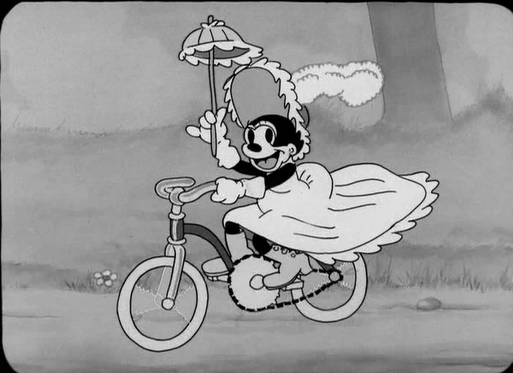
The audience all clap at the Laurel and Hardy short film, with Bosko's claim, "Is everybody happy?" another Ted Lewis quote. Bosko then starts to roll the film, as we now reach a feature film, that is brought to you by TNT pictures. The spoof shows the distributor (TNT) is an obvious reference to the MGM company, even with the trademark that shows the lion, who was the mascot for the Metro-Goldwyn-Mayer company. The TNT lion then tries to roar at the audience, but covers' its mouth before even trying - which I find a good way to spoof a classic MGM trademark. The name of the feature is called, He Done Her Dirt (and How!), and we see a shot of Honey (who is the lead actress) riding on her bike, with the Marx Brothers behind her singing the song Daisy Bell. Bosko who is playing the sweet, says "Ain't she sweet?"

Then, we see a title card that comes up reading "Dirty Dalton (The Cur!)", and we see a shot of Dirty Dalton who is creeping up on Honey. Bosko turns to the audience, and here it is folks: he says the lines that we all know, "The dirty fuck!". Of course, in my copy from the Golden Collection, Volume 6 the line was cleaned up and it sounded like Bosko says "That dirty fox!", and originally (or in the uncut version) Bosko definitely says "The dirty fuck!" Wow, this is something that cartoons would never dare use, and this is definitely Pre-Code. Some say, that Harman-Ising deliberately used that line as a farewell to Leon Schlesinger, and his associates at Warner Bros. as they had a budget dispute. But seriously, they really thought they were going to get away with that??

Dirty Dalton who is on his bicycle (that creeps secretly and sneakily) and Dalton sings the verse, "and you'll be sweet, upon the seat...", and then hides behind a very narrow tree. As Honey is cycling along, she is captured by Dirty Dalton behind the tree. She then cries for help, but Dirty Dalton ends up with Honey and jumps on one of the boxcars. It leaves Honey in double trouble, as Dalton is trying to grab her, and the boxcar is riding out of nowhere (oddly enough, for no reason). She shouts if there is a boy scout in the audience, but Bosko then shouts out "I'll save you!" Seriously Bosko, this is only a film! Bosko runs to the stage, where he sees Dirty Dalton, and he shouts "Stop! You cur!", and he jumps onto the screen through Dalton's face. Bosko pops out of the screen, and both him and Honey smile with glee - and that's all folks. It's all folks, for Bosko.

Well, folks - this is the end for Bosko; and that's all for the Harman-Ising cartoons. This cartoon (I felt) was a good way to end the era, as we saw some entertaining reels from Bosko, and it was a nice change that we didn't get to see Bosko very much, as he probably would've bored us with his singing and dancing. This cartoon deserves to be a triumphant in it's way, but I thought it was quite controversial - including the "dirty fuck" part, and also the Hitler chasing Jimmy Durante part.

I've got to say, that since I've not reviewed all of the entire Harman-Ising cartoons - I've certainly learned a lot from them, and even analyzed on what I've seen. The 1930 Bosko cartoons meant nothing, and it was just only "singing and dancing", but by 1931, there were some story that was reaching for the Bosko cartoons (but all of the singing and dancing routines still had to be shown). The singing-and-dancing routines were toned down in Bosko cartoons, when the Merrie Melodies series was launched, and they were going to do the singing-and-dancing shorts anyway, and it would've given Harman-Ising a more creative mind with just doing the one-shots.

The Bosko cartoons in 1932 (in my opinion) were at a very good streak (as well as some Merrie Melodies cartoons), and even some 1933s were doing well. Although, I think that most of their productions were just the same for me. I reviewed them all, and always gave them the same views on them, which was "mediocre at best", since their synopsis were mostly the same. I also learnt that in 1931, that they started to re-use some gags in there from their earlier productions in the 1930-1931 season. By, 1932 it was clear that just about almost every single cartoon they created featured re-used animation (with only some not reused). But I learnt that it wasn't their fault because they were subcontractors, and they couldn't go over-budget, and they were forced to reuse materials in order to keep the budgets low. 

I noticed a lot of better character development in Bosko by mid-1931, and he certainly improved onto 1932, and 1933, before that in 1930 - he was just nothing but a singer. The animation quality had certainly changed, as I noticed in 1933, that the production budgets seemed to go higher, with higher quality animation. I guess that Harman-Ising wanted their cartoons to go into colour, and was the result of why they left, because they were sick of those musicals they were creating. They had to use a lot of falsetto singing in which I found extremely annoying (especially in 1932) but I didn't hear much falsetto in 1933 - from the Merrie Melodies. I personally found that Harman-Ising did copy some of their work. If you don't believe me, then look at Congo Jazz - the shot of Bosko's body completely loose is just similar to what was seen in Steamboat Willie. The skeeleton dance in Hittin' the Trail for Hallelujah Land is just like Disney's The Skeleton Dance, as well as Bosko's falsetto voice is a comparison to Mickey Mouse's voice. Basically, the cartoons were just like the early Disney cartoons (from 1928-1932), until they improved a lot, but nothing much ever changed in the Harman-Ising productions.

Well, as it is now - a farewell to Bosko, but I know that we are coming onto a new start - Buddy, and Leon Schlesinger Productions, so: bye-bye Bosko.

Bring on - Buddy.

Saturday, 3 December 2011

65. Were in the Money (1933)

The last Merry Melody cartoon by Harman-Ising...

Warner cartoon no. 64.
Release date: August 26, 1933.
Series: Merrie Melodies.
Directed by: Rudolf Ising.
Producers: Hugh Harman, Rudolf Ising and Leon Schlesinger.
Cast unknown.
Animation: Isadore "Friz" Freleng and Larry Martin.
Musical Score: Frank Marsales.

The cartoon begins inside a department store, and it is already closed for the night. The night watchman walks up the stairs, and stops. He spits at a spittoon in which it is a bit further away from where he is. He then walks on, and turns off the light switches. After switching the lights off, he then places a lock pad on the doorknob, and pulls down the curtain reading "CLOSED". The night watchman walks away, and then all of the toys comes to life watching him, as soon as the coast is clear.

After a toy soldier watches the watchman leaves, he shouts "Whoopee!", and then rushes along in the shelve full of toys. He jumps onto a block of building bricks (all ascended), and he reaches at the top of a violin - he asks his peers "Come on, fellas". The soldier then slides down the violin string, and lands on a toy accordion, and then lands on a drum.
All of the other toys start to follow, and then there is this strange toy that jumps on the squeaker of a toy dog, and he follows so by bouncing on the squeaker. All these group of dolls start to move their way to a piano, and they hold hands. A soldier (on the floor) runs to the nearest violin he sees (beside the piano where the dolls are sitting). More soldiers start to join (including another one to hold onto the bow), and then a clown jumps up a piano seat where he will play the saxophone. The toy soldier then starts to conduct the music, in which all the toys are playing music, and the soldier starts off by playing the rhythm to the title song Were in the Money - which was a famous song at its time in the hit 1933 musical Golddiggers of 1933. We see some bizarre gags of toys playing the instrument, like these different dolls helping to play the accordion.

The singing finally begins (after a variety of bizarre of instrument playing), and the doll starts off singing the song. She even sings in a lower tone, by placing her mouth inside a tuba which comes out with a very low bass voice. The song is very good to listen to (and I'm meaning it as a fact, but just in the story), but anyway all these inanimate objects are coming to life, such as shoes with laces loosed and using it as a "skip-rope" game for the socks to jump.

A very entertaining gag/pun comes up when the soldier is standing on top of the counter of a cash register, and he jumps onto one of the counters, and these coins are singing a verse We Are the Money  - of course, the gag is that they ARE money, and it explains it all. All these inanimate clothing such as gloves, socks, etc. start clapping after the song - and to be honest; so far watching this cartoon it's extremely weird in my opinion.

The doll (who was clapping) then walks and does her bit of entertainment business, such as she sees some rings hooked, and beeds and she pulls them off. She grabs out a large don hat, and walks on doing an impression of Mae West. Is it me or is it that Mae West is caricatured in these cartoons because of her huge breasts - she did compliment Disney in 1935 for a great and (I guess suitable) caricature of her in Who Killed Cock Robin? The Mae West doll then walks up to a male's head dummy and proposes "Why don't you come up some time?" which is a quote that West used to say. All of those inanimate figures were entertained by the impression and they all applaud, even though the impression isn't very good.

More entertainment is coming on such as this "ball type figure" is playing Were in the Money on the xylophone and is very good at it. There are even toys that are spinning around each holding onto a straps from a girdle and they swing.

The music is very jolly, that even a mannequin from upstairs is dancing to it. Oh, wait a minute! It's the mannequin from A Great Big Bunch of You - so it seems that Merrie Melodies did show one-shot characters more than once, then. The mannequin is then dancing and even pats a female mannequin's behind. The mannequin then moves his stilts as they are sliding down the banister of the stairs. After sliding down the stairs, the mannequin lands and bounces off an armchair, and then the mannequin takes over the stage dancing.


The audiences then clap at the mannequin's entertaining dance he does, and he has more. Yes, the mannequin stays on this picture until the very end, and all we see him do is just dancing - and all that lot. He then steps by a three-panel window, and is singing Were in the Money and his reflections copy his movements (even if it involves moving their legs out of the mirror and tapping the spittoon with their stilts).

More dancing is going on, and there are these inanimate long johns that are moving and dancing, and they reach these boxes of hats, and they play it like the drums with their rear flaps. More dancing from the mannequin then comes back, and he even does these swirls, and the animation movement of that is just wonderful to look at. You can see these very early "speed lines" shown, and then very early stages of smears, but not even quite. The Dover Boys (Jones - 1942) was recorded as the earliest cartoon at Warner Bros. to use smears.


The mannequin then moves along to a piano where he is playing the title song. His seat moves him along to different pianos, and then he bonks three dummy heads like some type of drums. The mannequin also hits the dummy heads of Laurel and Hardy, where they do "boop-boop-da-boop-boop" sounds. The mannequin continues to spin, as he grabs hold of a trumpet and plays some music - with dummy heads singing the verse of the title song. The mannequin continues to play the trumpet, until it crashes into a cupboard full of boxes, that collapses on him. He pops out playing the final note - and that's all folks.
The music in this cartoon was very good, and especially the song - Were in the Money. Frank Marsales' score was fun to listen to, but I thought the synopsis and the story was very boring. It was the same old routine that Harman-Ising kept on using, and that was the singing and dancing stuff. Although, mind you; it's not their fault because overall (with the Harman-Ising Merrie Melodies completed), they were sub-contractors and they had to make cartoons that involves singing songs - it was the early stages of music videos, you can say. Although, in the Bosko cartoons, they didn't have to do much singing in those cartoons - but one verse of singing was probably forced to be used, but there have been some cartoons with Bosko that didn't have any singing, right? Well - with that cartoon completed, I have only one cartoon left by Harman-Ising to review, and it's bye-bye Boskos - hello Buddy :/.

Friday, 2 December 2011

64. Bosko the Musketeer (1933)

Warner cartoon no. 63.
Release date: August 12, 1933.
Series: Looney Tunes.
Directed by: Hugh Harman.
Producers: Hugh Harman, Rudolf Ising and Leon Schlesinger.
Starring: Johnny Murray (Bosko).
Animation: Rollin Hamilton and Robert Stokes.
Musical Score: Frank Marsales.

Our story begins with Bosko picking up posies in a field, and is having sentimental thought of his girlfriend, Honey - and is singing the verse "she loves me, she loves me not". Bruno follows Bosko on, and runs around a small tree (randomly) and then follows Bosko who continues to pull out petals off the flowers he is holding. Meanwhile, Honey is sweeping at down doing some dusting - and she is also humming to some sentimental music. As she sees a picture frame of Bosko, and immediately changes into an impression of Mae West, and says "You can be had!" Of course, the impression somehow seemed strange to me - but I wonder if Robert Stokes animated this part, as he animates Honey and Bosko skipping - which is similar to what he did animate in Bosko in Person.

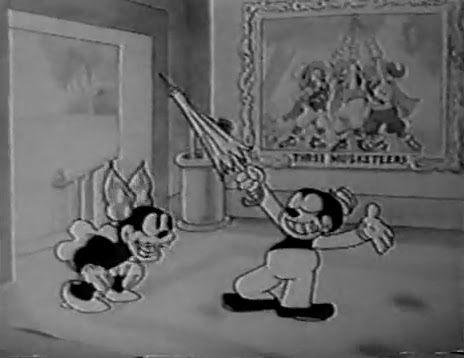
Bosko enters Honey's house full of spirits and energy, as he is delighted to see her. Honey was sweeping a portrait of the 3 Musketeers that is on her Wall. She asks Bosko if the Musketeers "are grand"? Bosko chuckles and thinks that "it's nothing", and he pulls out an umbrella and he pretends that he is doing a sword fight with the umbrella, while Honey is singing in the background about Bosko being a brave musketeer. The background then fades from Bosko mimicking a sword fight with an umbrella into Bosko actually fighting the villains. Bosko then reaches a cornered point, and then he jabs his sword into the barrel of beer, and SWOOSHES the villains away. Bosko then enters a bar, and shouts "Howdy ho, etc.", we then see a title card that reads The Three Musketeers.

There is then a shot of the 3 Musketeers in the pub and they are all singing. Bosko runs along, and climbs onto a table, and he introduces to us who the musketeers are. They are: Athos, Amos and Andy - and obviously they were referring to Amos n' Andy which was a popular radio show at the time. Athos, was a character out of the 3 Musketeers (I think), but I find it extremely pointless that Harman-Ising only use one character out of the 3 musketeers, and name the other two "Amos and Andy", and it completely pointless, because there isn't a connection towards the other two names in the book, and the fictional character names themselves - but never mind let's pres son.

Bosko then raises his word and says the famous Musketeers line, "All for One and One for All", and the musketeers sing a song about it. Bosko then draws out his sword, and tries to break a table leg, but instead the blade gets twisted on the leg. Bosko pulls the sword out, and it looks like a cork opener, and he uses it to unscrew the cork of a champagne bottle. The bottle says "New Deal - 3.2%" (which according to TZ says that it was part of a deal that President Franklin Roosevelt as part of his promise for policies, and it happened at the end of the "prohibition". Bosko then brings along a glass of beer, and guzzles down the beer in one of the first musketeer's mouth (Athos), the 2nd musketeer (Amos) then lips his lips as if there is some type of assembly in this. The last musketeer (Andy) then does a "swallow" intimidation, and it is a fine gag - but I've seen it somewhere before in one of their cartoons. Wouldn't it be funnier if one of them burped? Anyway, their entertainment business managed to entertain the audience, and we see some bizarre Harman-Ising gags used as part of an applause like a man that honks his chicken like a horn??

We then see a shot of a thug (who is the main antagonist - I'm pressuming?) and he grabs hold of his nose, and shouts "Bah!", as if he didn't care about that bit of entertainment performance from the Musketeers and Bosko. He then starts to eat off parts of a chicken, and starts off with eating a turkey leg. He then puts the whole thing in his mouth, and then pulls the bones out showing that he ate the entire chicken in one bite. He appears to be so tough, and that he's the big man around here, that he uses a person's teeth (next to him) to unload the cork off the screw.

A door opens, and the crowd of people in the pub see Honey approach (and she's wearing modern clothing on?). Anyway, she shouts to her audience "Here I am you lucky people?" - Lucky, huh? How lucky? All of her audiene enjoy her tap-dancing performance that she performs (although it doesn't seem very exciting to look at) - and I think Bob McKimson did that scene, comparing to what his Honey looked like in Bosko in Person. Bosko is all "awe" about Honey's dancing and even asks the guy next to him, "Boy, ain't she keen?", and pats him on the back with his false teeth coming out - Ha ha, now that was something amusing.

The dancing movements seems to impress the villain who was eating the turkey from earlier. He comes up with a sneaky plan, and he rubs his hands to do so. He grabs Honey while she is dancing, and causes her to shout for help, and shouts "Bosko, help!" - is it me or is it that every fantasy land that's made up, she always seems to know Bosko? Anyway, I don't care - she knows him anyway in this story! So, the villain has captured Honey, and yet again here comes another comes another "villain plotting to capture girlfriend" sequence (Seen that before!).

Bosko runs into the scene and stops that from happening, and shouts at the villain, "Hey! You piper!", and then he draws out his sword, and they start a sword fight. But before they begin, the blades from both sword turn into hands and they shake each others'. They both perform a sword fight on each other, the villain then tries through Bosko's hat, and the plume is actually a chicken wrapped in feathers that clucks, but you notice immediately that there is another one after wards. The villain's sword is then badly damaged, and he calls a caddy to come and give him a spare and fresh sword, and he uses the caddy's beard to sand it. Bosko's sword is also damaged (as they clashed their sword into each other), so Bosko uses a pencil sharpener to give his blunt sword a sharp look again.

The villain then throws a dagger at Bosko by using it like a bow-and-arrow, but misses as Bosko manages to duck. Instead, the dagger ends up ripping off a lady's skirt and it is revealed that there is chickens and chicks in there, (which seems very wrong and very humorous). The sword fighting still continues, until Bosko ends up at a fireplace, (where he could burn himself), and he uses his foot to catapult some coal that lands on the villain's pants. The agony causes the villain to scream, and runs out of the pub never to be seen from Bosko again, and he won the duel.

Bosko then raises his sword with courage, and Honey runs up to admire him - and we cut back to a different background, with Bosko's usual outfit on, and the sword fades into an umbrella. Honey says, "Aw, Bosko - I don't believe that?" with Bosko's reply "Was you dere, Charlie?" and it is a dated reference from a radio character played by Jack Pearl - and that's all folks.

 Overall, this cartoon was very boring and it was basically a singing and dancing routine. In fact, the villain was very close to have captured Honey, but all we got instead was a very tedious sword fight sequence, which was just as bad as seeing the villain trying to ruin the picture. It seemed very low-budget in my opinion, and it reminded me of a reused story version of Bosko's Knight Mare but done differently. Well, with this Bosko cartoon now reviewed, we only have one more Bosko cartoon to review in this challenge, and also two more in the Harman-Ising era! Stay tuned and keep commenting!