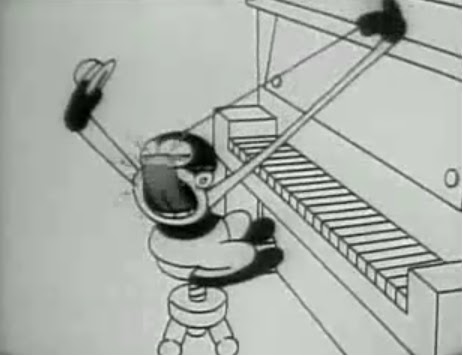
Release date: 19 April 1930.
Directors: Hugh Harman, Rudolf Ising.
Produced by: Hugh Harman, Rudolf Ising and Leon Schlesinger (associate).
Starring: Max Maxwell (Bosko) and Rochelle Hudson (Honey).
Animation: Friz Freleng.
Musical Score: Frank Marsales.
Synopsis: Bosko, in a fancy free mood, takes his girlfriend Honey for a car ride - not knowing what's ahead of them.
[REVISED VERSION 26/04/2017: To any regular readers who might be startled; this is a revised version of my review, which I intend to do throughout Warners' 1930s cartoon output. Looking back at my old cartoon reviews, I felt I had an incredibly limited frame of reference, which I attribute to my very young age upon creating this blog. I understood very little about historical/social context of the period when these cartoons were made. I've decided to add some more insight, by revising my reviews on these cartoons - to hopefully make up for my unfair interpretations of the Harman-Ising cartoons. This will gradually happen over a period of time; alongside my current reviews, of course. Instead of going back chronologically - I'll be selecting reviews to re-work, or re-arrange.]
 |
| Courtesy of the Tralfaz blog. |
History hasn't been entirely fair on Hugh Harman and Rudy Ising. Amongst animation fans, they're probably best remembered for spending a lot of their animation career as competitors towards Disney. This was primarily evident during their MGM years; were they not only turned out shorts that screamed lavish production values - but were close competitions to the more lavish Disney shorts produced during the 1930s. Most of their cartoons, however were riddled with warmth and cuteness that eventually became out of fashion by the time Bill Hanna, Joe Barbera and Tex Avery were producing wilder material at MGM.
Both men begun their animation career working for Walt Disney, as animators on the Alice Comedies and Oswald the Lucky Rabbit series. They also unknowingly created strong animation legacies, such as the establishment of Looney Tunes and Merrie Melodies series. Although, this was originally an alternate series to the Silly Symphonies, except their original purpose was to promote popular songs through animated cartoons. It's a pity they missed out on the series gradually becoming one of the greatest of animated shorts during the Golden Age of Animation. While they might have had missed opportunities along the way, there's no denying they helped set the standards of animation - making them animation pioneers in their own right.
 Bosko, the series' first animated star, is perhaps remembered today for being considered a Mickey Mouse ripoff - which isn't exactly the case. Bosko's design appears to predate Disney's mouse, as based on drawings by Hugh Harman which was registered at a copyright office on January 3, 1928 and identified as "Negro Boy".
 Bosko's first appearance in this cartoon certainly indicates an African-American stereotype, not only in design, but by Max Maxwell's voice. Shortly after the cartoon, Bosko's stereotype wore out, and he was given a Mickey Mouse-like falsetto voice. Although his design might've predated Mickey, his personality was an imitation for the most part.
 |
| STEAMBOAT WILLIE (1928) |
In 1928, a cartoon was released about a mouse who could make sound happen by playing Turkey in the Straw with pots and pans. Do I really need to say the name of the cartoon? Animation studios across America soon adapted to the change, by applying synchronised sound into their short subjects.
Not only did it help enhance the quality of their products - but it helped create endless possibilities of what's achievable in the animation medium. Meanwhile, once Harman and Ising were working on their first Bosko cartoon under contract with Leon Schlesinger, Disney was slowly trying to break away from the barnyard humour evident in his early Mickey Mouse cartoons. Other studios attempted to duplicate Disney's successes with Mickey clones - and Bosko, being one of them.
Harman and Ising's contract were to produce animated cartoons to help promote popular songs of the era. The first being Singing in the Bathtub - a song written in 1929, by Ned Washington, Herb Magidson and composed by Michael H. Cleary. Washington would later on work on the songs for Disney's earliest features, Pinocchio and Dumbo. The song was without doubt, iconic of its time. Carl Stalling even used it enough times as music cues.
Harman and Ising's contract were to produce animated cartoons to help promote popular songs of the era. The first being Singing in the Bathtub - a song written in 1929, by Ned Washington, Herb Magidson and composed by Michael H. Cleary. Washington would later on work on the songs for Disney's earliest features, Pinocchio and Dumbo. The song was without doubt, iconic of its time. Carl Stalling even used it enough times as music cues.
 Although the studios' attempts to recreate the environment in the early sound Mickey cartoons might've been evident - they're entertainment values were just as good. The opening scene of this short is a great showcase of representing Bosko in a nutshell. He whistles to Singing in the Bathtub, whilst plucking his toes and rubbery nose like a string.
 Soon, he begins to violate the laws of physics, as he plucks the showering water like a harp - and later on, bends the water to a 90 degree angle out the window.In between Bosko's activities; an inanimate bathtub bounces to life as he dances across the bathroom, tossing away toilet paper like a small ticker tape parade.
 Rubber-hose animation was still fairly new towards audiences; so it's clear they would've enjoyed watching animated surrealism of inanimate objects coming to life. This would've been considered the norm of animation entertainment standards; an escape from reality.
The opening scenes served as a swell introduction to the promises Harman and Ising show as cartoon directors. Not only are the visual sight gags creative enough to enhance an audience's interest; but it sets the mood for a time period audience to be entertained.
 The Bosko cartoons are a prime source for its early use of toilet humour. The gags themselves are subtle and charming; whereas overtime toilet humour has become tasteless. Examples of this includes a scene of Bosko whistling for his car, which steps out of a privy and pulls his gears up to cover its rear end.
 Other scenes features Honey's introduction, who is seen bathing through an open window. From her perspective, the audience are watching her. She immediately shuts the blinds and pulls the washing line towards her - complete with her blouse nested by two singing birds, and bra.
 Other revealing gags occurs later in the short. While taking Honey out for a car-ride; Bosko's path is blocked by the presence of a chewing cow. Bosko impatiently tries to signal the cow to go away, but to no avail. The cow responds by spitting on Bosko's car, damaging the front part.
Although the early sound Disney cartoons enjoyed its fair share of toilet gags, there's no denying they were received favourably by audiences. Rudy Ising once recalled in an interview of the scene of the cow's huge udders flipping backwards, "you never heard a reaction in the theatre - they howled at it." Both Walt Disney and Harman-Ising came from Mid-Western backgrounds, and gross-out gags has often been attributed to their rural upbringing. It's possible that both Harman and Ising shared Disney's sense of rural humour.
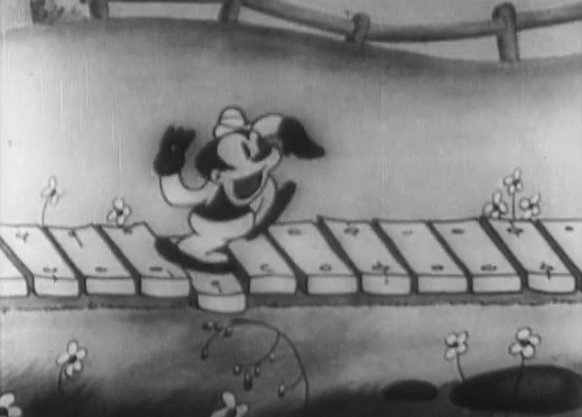 Despite such similarities to the concepts of both Disney's shorts and Harman-Ising's - the latter were blessed with the ability to also execute creative dance numbers - by taking advantage of the impossible into rubber-hose animation.
 |
| Animation by Friz Freleng. |

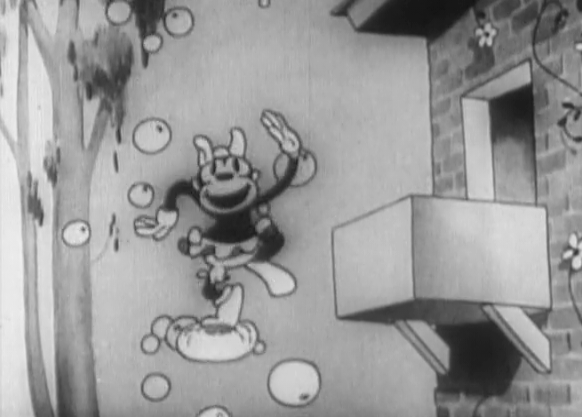
Disturbed by Bosko's sax performance on the balcony, Honey drowns Bosko's saxophone with bath water from her tub. And so, bubbles float alove Bosko's instrument when he switches the song to I'm Forever Blowing Bubbles.
For one of Harman-Ising's earliest cartoons to time their cartoons to synchronised music - they do a wonderful task on the scene of Honey dancing on the bubbles in rhythm of the song. Animating dance is difficult enough, but Friz Freleng's rubber-hose animation of Honey is nicely fluid in movement. The suggestive nudity of Honey is evident which follows after her bubble dance. As she dances broadly, her body jumps out of her skirt when she dances, which years later, would be frowned upon by the Production Code endorsement four years later.

 Attempting to hold on tight to the car's exhaust pipe; Bosko encounters a bumpy journey. He crashes on a couple of small rocks, until his groin slides through some passing-by trees, and then a series of larger rocks. The gags themselves are creative enough and fulfilled through squash-and-stretch animation.
 |
| TROLLEY TROUBLES (1927) |
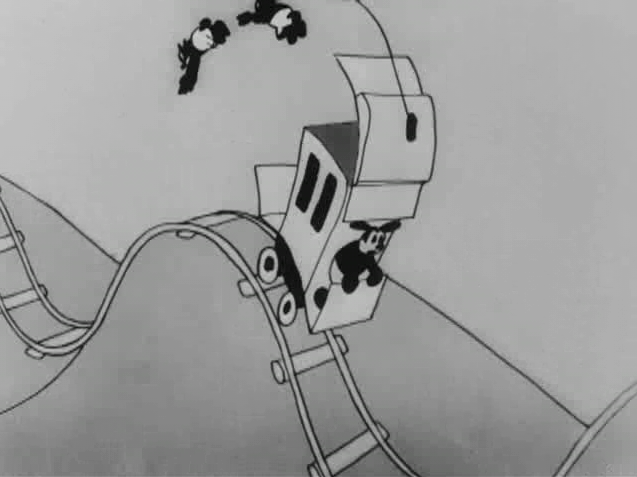
 A part of myself questions whether chase sequences like these were inspired by Buster Keaton's comedic action scenes of his locomotive in his comedy The General (1926). The lack of dynamics in the cartoon's action is most possibly attributed to the studio's tight budget. A lot of the ambitious perspective animation makes up for it, however.
At one point in the chase; Bosko and Honey lose their car - and ride a bathtub instead. Their near-calamity ends when they leap off a cliff. Honey lands safely in a pond, whilst Bosko's pants are hanging onto a root branch. Nature reunites Bosko with Honey, as a hand formed from water drags Bosko off the branch. The cartoon ends appropriately with Bosko playfully performing the cartoon's popular song a la xylophone.
Sinkin' in the Bathtub is an important cartoon as far as legacy goes. It began with a procession of milestones that would later lead the path of some of the most hilariously executed cartoons of all-time. The cartoon itself, however, isn't entirely significant as far as production/entertainment values go. Although most of the gags and sequences are imitations from their former boss' earlier cartoons; the cartoon itself is still enjoyable for the most part. It serves as a great premise of establishing the Looney Tunes series - to promote popular cartoons in animated fantasy. The confidence of Harman-Ising is evident in the cartoon, and it's small wonder the cartoon itself was enjoyed by audiences. The earliest Bosko cartoons remain the most entertaining from Harman-Ising, until the formula got repetitive and unambitious (with small exceptions being Bosko in Person).