Showing posts with label Porky. Show all posts

Saturday, 19 May 2018

423. Tom Turk and Daffy (1944)

featuring PORKY PIG
Warner cartoon no. 422.
Release date: February 12, 1944.
Series: Looney Tunes.
Supervision: Chuck Jones.
Producer: Leon Schlesinger.
Starring: Mel Blanc (Porky Pig, Daffy Duck), Billy Bletcher (Turkey).
Story: The Staff.
Animation: Ken Harris.
Musical Direction: Carl W. Stalling.
Sound: Treg Brown (uncredited).
Synopsis: Daffy Duck protects a turkey from becoming a Thanksgiving dinner, hunted by Porky Pig. Soon, he turns into a "stool pigeon" by betraying the turkey's trust.

Before I commence with the review; I'm not going to theorise too much on the story credit for this cartoon. The context of "The Staff" credit has been forgotten overtime; much to the chagrin of some cartoon fans. Don't take my guess for granted; but I believe it was simply a joke by the Schlesinger crew. After all, would 1944 audiences really care on who wrote the cartoon?


If I had to pinpoint a writer, I'd say Mike Maltese, or maybe Ted Pierce. Then again, Leon Schlesinger also employed gagmen in his service. Hubie Karp worked as a gagman for Michael Maltese, although he wasn't hired until late 1944. Any idea who might've worked alongside Mike around the time of the cartoon's production?

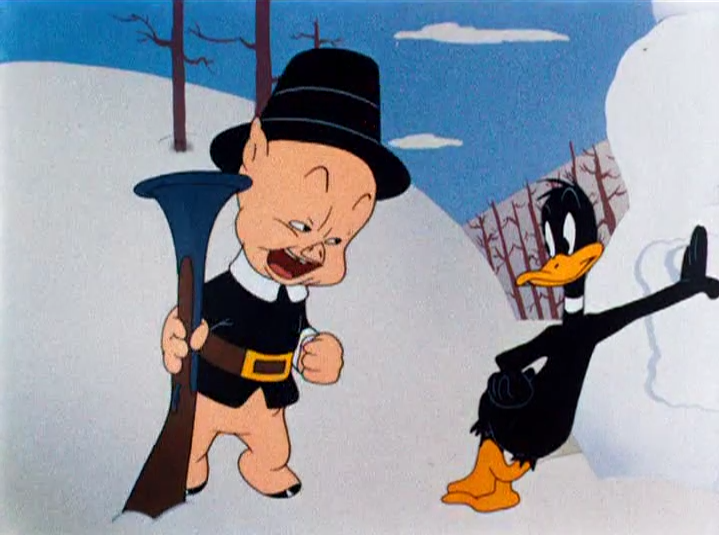
Onto the review: Porky and Daffy continued to be a successful duo in animated cartoons, that a hatful of story opportunities were open to them. For this cartoon, the locale is centered during the Colonial era. Porky assumes the role of a pilgrim, hunting for a turkey to feast for his Thanksgiving dinner, but Daffy intervenes by hiding the turkey from harm.

The opening sequence serves as exposition for the entire cartoon. In a wintery scenario, Daffy is contentedly building a snowman. Daffy reacts to the off-screen gunshots in a vigorous manner, as broadly depicted in the frame grab. Daffy encounters a desperate turkey, vulnerable from the shooting.


Some wonderful character animation from Bobe Cannon who depicts despair and cowardice in a comical fashion. The turkey cries, "Don't let 'em kill me! I'm too young to die! I've got my whole life before me: love, travel, good books!", and proceeds to climb on top of Daffy, whose weight burdens him, yelling and sobbing "HIDE ME!".


Daffy's nonplussed expression as he sinks slowly in the snow is priceless. It's a beautiful presentation of how one might respond awkwardly to such a plea.

Billy Bletcher clearly has a blast with his vocal performance for the turkey's plea - and wonderfully versatile in vocalising comedy. It's more refreshing from the standard, villainous voice; for which he was typically typecast in cartoons.

Animation by Ken Harris.
Ken Harris' animation beautifully portrays Daffy as ignoramus by showing that the character has no consideration for the turkey's well-being, by physically forcing him down potential hiding places; to no avail. First, he attempts to hide the turkey under a lump of snow and in another attempt down a rabbit hole.

Daffy's characterisation is portrayed in a hilarious fashion, as he jabs the turkey with a pole down the hole, until he reconsiders: "Nah, even more obvious-er."
Daffy's ideas for hiding places become even more hysterically ridiculous as he tries to stuff the turkey inside a narrow tree. Whilst Porky is seen from the distance, Daffy chooses the final hiding spot; and hides the turkey inside a snowman.


Once Porky arrives and meets Daffy, he guards the snowman and attempts to stall Porky. To begin with, Daffy appears to be resilient and defensive; by declaring: "My lips are sealed." In a close-up; Daffy's "loyalty" is featured as a visual metaphor, with a dissolve of padlocks and a vice; supposedly closing his bill tight.

The opening scenes have already established the premise in a precise manner. Daffy hides a turkey, and defends him from hunter Porky. This paves the way for some comedy opportunities based on these characters. Daffy is clearly portrayed as careless and ignorant - so it begins to transcend that.

Porky walks away with disappointment, complaining: "I had everything ready for a nice, big turkey dinner." The following close-up exquisitely illustrates temptation and battling good vs. evil. Daffy is enticed by Porky's remarks about a roast dinner, so much so, that he desires it. Without being wholly corrupted; he forms like an angel, declaring: "I'm no stool pigeon." But, his halo disappears and devil horns appear at the thought of cranberry sauce!


Background colour play a pivotal part in Daffy's torn emotions. He's literally "torn" to the point when the colours are divided to coincide with the staging of the scene. A celestial blue colour depicts his willingness to do good; whilst a more vibrant purple colour suggests a sinister nature consuming him.

Chuck Jones' posing are broad and nutty in a sense, but Daffy's emotions feel very human in his hopeless attempt in fighting temptation; and his corruption. The point-of-view shot of Porky walking away is crisply inter-cut to evoke Daffy's increasing impulse.


Alongside mashed potatoes, chestnut dressings and greened peas; a favourite of Daffy's, candied yams, was also prepared for Porky's dinner. So, Daffy breaks down crying as he bellows: "The yams did it! The yams did it!". He impersonates a stool pigeon and begins to coo (squeal), indicating that Daffy is perfectly willing to reveal the turkey's whereabouts.

Daffy's breakdown serves as an unforgettable scene throughout his entire legacy. Succumbing to temptation and attempting to divert the blame correlates with the human mindset, and yet his betrayal is impeccably funny; right down to the animation and Mel Blanc's voice work.

Of course, like a Chuck Jones cartoon, Daffy directs the turkey's location to Porky with numerous signs, as though his desire isn't escalating any further. Dissolve inside the snowman, the turkey refers to Daffy as: "quisling".


The cartoon takes a different direction with the turkey plotting retribution for Daffy's treachery. The turkey steps in as a plot device to turn the conflict towards Porky and Daffy, rather than what the opening exposition established.

The turkey trails under a pile of snow and hides behind a remorseful crying Daffy. He sacrifices his own feathers to plant them on Daffy's rear end (without his knowledge), and gobbles to attract Porky's attention.

With the exception of Bugs Bunny, the Schlesinger cartoon writers knew fully well that their characters were dumb and unsophisticated. Despite just meeting Daffy a moment ago, Porky completely overlooks this and takes Daffy for a turkey. Daffy's denial isn't enough for the obtuse Porky; which puts him in a vulnerable spot.

Several gags during the chase sequence feel like a throwback to early Chuck Jones cartoons, which involved inanimate objects personified to challenge the character. This is evident in the scene of Porky getting attacked by Daffy's snowballs. Snowballs strike Porky from different directions, including two from opposite sides. Porky comes face-to-face with a large snowball, who mimics every  movement of his. Daffy arises and strikes him with a mallet.


Although Chuck had explored these gags several times in his earlier years (i.e. Elmer attempting to blow the candle out in Good Night, Elmer), the timing is advanced and the gag is kept spontaneous; with Daffy merging from the large snowball.


Further gags take advantage of the winter locale in the cartoon. Daffy fills up a bucket from a lake and tosses the water out of it. The running water solidifies into a piece of ice, and strikes Porky - with forceful timing to illustrate pain.

Daffy showcases his zany ability as he loiters by a tree and pours a glass of water over him, forming into ice. Porky's attempt to crack the ice with his gun creates a comical staggering effect from Ken Harris' animation.

Chuck Jones' innovative use of funny expressions are uniquely showcased in a scene of Porky that's remarkably broad. Porky has been fooled by Daffy from the "toll bridge" gag. He skids from the snow and has a moment of thought. After a series of visual gags highlighting Porky's stupidity, he completely boils up. Porky slams his gun in the ground and is all-out exploding with rage. He anticipates a huge sprint, as he digs up a lot of heavy snow before he exits the scene - animated sublimely by Bobe Cannon.

During the buildup, Porky goes through several angry expressions which are very far-fetched for a character whose relatively tamer compared to Daffy, or even Bugs. It's a unique form of outrageous posing that has seldom been seen in Porky or since. It's a pity that Cannon reportedly despised animating broad and wild, despite how well he excelled in it.

The wildness doesn't end, as during the chase, Porky's rage and speed are executed in a perilous and yet exaggerated sense. To begin with, he transforms into a war tank; symbolising force and danger. Such a gag easily rivals the more outlandish gags Tex Avery would conceive. The great use of energy in Porky's wrath causes a snowy hill to break open into a chasm. The cutting and timing of the chase scenes are a contender for Clampett's more flamboyant energy.


The final scenes of the cartoon are represented as a bookend to the entire cartoon. The turkey is contentedly building a snowman, but is ambushed by a cowardly Daffy. It perfectly matches the opening scene, to demonstrate the changes made through the course of the cartoon - and the heavy emphasis on the characterisations reverse.

The turkey gets the last laugh, as he deliberately re-enacts Daffy's careless attempts to hide the turkey. Soon, his "attempts" to hide Daffy turns ruthless as the turkey kicks Daffy up a tree; and cuts the tree down with an axe, causing it to land on his body.

The fast-cutting becomes very slick and abrupt to showcase the turkey taking pleasure in fulfilling retribution on Daffy. For the final scene, the cartoon ends very appropriately on the turkey continuously beating up Daffy Duck into the night - long after Porky Pig is out of the picture.

So far, Tom Turk and Daffy has become one of Chuck Jones' fastest paced cartoons; and definitely worthy of rivalling Frank Tashlin or Bob Clampett. The writing and structure is sublime and true to the animated cartoon spirit, and the conflict is executed hilariously from a writing standpoint between the three characters; that it keeps the whole viewing experience engaging and spontaneous. I can't emphasise enough on how overly entertaining this cartoon is; all down to its impeccable wit and execution.

Rating: 5/5.

Sunday, 30 April 2017

413. A Corny Concerto (1943)

Warner cartoon no. 412.
Release date: September 25, 1943.
Series: Merrie Melodies.
Supervision: Bob Clampett.
Producer: Leon Schlesinger.
Starring: Arthur Q. Bryan (Elmer Fudd), Bob Clampett (Vocal effects). (Thanks Keith Scott).
Story: Frank Tashlin.
Animation: Bob McKimson.
Musical Direction: Carl W. Stalling.
Sound: Treg Brown (uncredited).
Synopsis: Parodying Fantasia, Bugs Bunny and Porky Pig perform ballet; followed by a musical story about an ugly duckling.

Disney's Fantasia became controversial since it first opened at New York in November 1940. Critics were polarised by the film. Some praised Walt Disney for making "motion picture history", while others critics associated with classical musical roots, openly criticised it. Soon enough, Fantasia proved a disappointment at the box office. It was without a doubt, Disney's most ambitious feature at the time, while some argue it was Walt at his most pretentious. Ambitious or pretentious (I personally love it), it held quite an impact amongst the Schlesinger staff - so much so that they went on to parody the film - using two infamous pieces of music by Johann Strauss - Tales from the Vienna Woods and Blue Danube.

It so happens that Frank Tashlin is credited for story work in this cartoon. Tashlin spent some years at the Disney Studios during the late 30s, but left in 1941 after a quarrel with Walt. He returned to the Schlesinger Studio in September 1942 in the story department, before taking over Norm McCabe's unit. A part of myself suspects whether or not Tashlin wrote the cartoon as a snide towards Disney?

While Tashlin may have blueprinted the cartoon, the feat had to be met by a director with a great understanding of classical music, and how to combine it within animation. One would suspect Friz Freleng would be equal to the task, which I don't doubt, but instead the short fell into the hands of Bob Clampett.

"Fantasia" - except in Clampett style.
Clampett has directed several cartoons beforehand which were heavily themed on music - like his success with Coal Black. According to Bob Clampett in Michael Barrier's 1973 interview with Wilfred Jackson, Bob attended the Carthay Circle Theatre premiere of Fantasia, and vividly recalled the audience's reactions to the use of Fantasound: "the whole audience [at the Carthay Circle] kind of gasped, or oohed and ahhed."

While other Schlesinger employees may have attended the Fantasia roadshows - it appears Bob Clampett was the right candidate to take on the parody.

For the most part; Clampett's parody of the Disney masterpiece is well executed right down to the frame. Clampett's excellent use of parody couldn't have been more perfectly fulfilled by casting Elmer Fudd as Deems Taylor. Not only is Elmer the perfect option as far as speech-impediment exploitation goes, but both he and Taylor have similar looks - with a five o'clock shadow and glasses for the right touches. Fudd could easily pass as Deems Taylor's animated counterpart.

The scene begins with an establishing shot of a sound stage orchestra - with colour styling and staging almost comparable to Fantasia. Clampett applies a great gag of a large shadow walking up to the podium - suggesting a well-built person is about to make an appearance. Then, the shadow reveals to be meek Elmer Fudd. It's a great gag that contrasts size and personality comedically.

Clampett applies some charming touches to Elmer's awkward personality. Elmer announces to the audience of an orchestration of Johann Strauss' Tales from the Vienna Woods - but at the same time, Elmer has difficulty of keeping control of his tuxedo shirt, which constantly springs out from his tucked in suit.

Elmer's tuxedo shirt becomes a great annoyance of Elmer; that he tears it apart. Later on, when Elmer introduces the Blue Danube - Elmer finds new difficulty with his pants - which drops at its own accord. Both Bob McKimson and Rod Scribner were assigned the animation of Elmer's scenes - and both excel in capturing the timing and humanistic approach of Elmer's embarrassment.

Arthur Q. Bryan's vocal delivery is sublime, especially his use of awkward laughter, and the classic line, (quoting the popular song The Music Goes Round and Round): "Wisten to the wippwing whythm of the woodwinds, as it wolls awound and awound, and it comes out here...". Personally, I wish the cartoon ended, after the Blue Danube segment with another payoff of Elmer struggling with his starched tuxedo. So much potential for so little time.

Clampett's unit also come close to matching the beautiful artwork and colour styling that embellished Fantasia. A lot of it appears throughout the cartoon; but its most revealing for the introduction shots of each musical score. The opening pan shot of Vienna Woods, featuring a stylised woodlands background holds as a reflection to the elaborate Multiplane camera shots in the feature.

Despite budget constraints from a studio that couldn't afford to build a camera as elaborate as Multiplane, or let alone, shoot entire pencil tests; Johnny Burton's camera department achieved the effect by using an overlay which was moved by the cameraman differently from the background.

One of the more subtle references to Fantasia appears during the title card of the Blue Danube. The titles are followed by a falling flower landing in water - creating a beautiful ripple effect. The scene itself is lifted from The Nutcracker Suite segment in Fantasia; so it's nice to see Clampett subtly insert a reference without a forced gag in sight. It's a rare privilege to see how artistic and lavish how the Schlesinger studio could be - evident of the meticulous ink and paint work on the flower. The colour styling, probably by Mike Sasanoff, is also comparable to the Disney feature - as Sasanoff's work expresses a carefree quality, too.

Excluding Elmer Fudd's scenes; the remainder of the cartoon is dialogue-free - save from the occasional vocal effects provided by Bob Clampett. This is already established in the opening scenes of Porky Pig as a hunter in the Vienna Woods segment. The premise is a throwback to the early Bugs Bunny cartoons, that followed a hunter pursuing rabbits. While Elmer Fudd might've been more suitable for the role; Porky Pig is cast instead.

Visual pantomime plays a key role within the cartoon; but sometimes Clampett would cleverly insert sign gags, like Porky Pig holding a sign, reading: "I'm hunting that (explicit) rabbit."

Not only does pantomime allow other forms of communications, but it works as a funny parody; mocking the sophisticated Fantasia, by being unsophisticated - such as suggested blasphemy on the sign.

Deliberately, Clampett creates a clash between fantasy and reality; as he doesn't hesitate to include cultural references, such as an Emily Post etiquette book. Porky's hunting dog points towards Bugs Bunny's rabbit hole; but Bugs opens the book to a certain page which bears the pun: "It ain't polite to point!".

For the most part, Clampett articulately takes advantage of animated action to the classical music - tenderly and comedically. Clampett's skill is evident at the opening segment of the Blue Danube. The waltz has been parodied several times in animated cartoons, and it certainly never lost its popularity overtime. In popular culture it's widely recognisable today for its usage in Stanley Kubrick's 2001: A Space Odyssey.

The staging might seem a little jarring in
this frame grab, but thankfully, the scene
flows without being too noticeable for
the average viewer. 
Like the previous segment, the premise is also kept facile: an ugly duckling tale - featuring a black duck, who closely resembles a baby Daffy Duck. The opening scene features a mother swan and her baby cygnets; swimming in a lagoon, as well as quacking in synchronisation to the music's most memorable motif.

The layout staging of this scene is a tad sloppy and not well coordinated (at several points, the swans appear to swim through a tree or a piece of grass). However, the beautiful timing of the swans moving in tempo to the music as well as the charming use of quack sound effects makes up for it.

Clampett's sense of creativity and timing is used to its fullest advantage of baby Daffy, following the flock underwater. Bubbles arise at the surface, popping in synchronisation to Strauss' elaborate piece. It's also ambitious to pull off the timing by relying on effects animation, and Treg Brown's sound effects. The gag is topped in some hysterically loose animation by Rod Scribner of the mother reacting to the bubbles arising underneath her.

Animation by Bob McKimson.
Despite the challenges of finding an appropriate story that could be taken advantage of by classical music; extra elements are added to the Blue Danube segment like developed characters, to make the action more compelling. Daffy Duck as an ugly duckling is established enough as an outcast; making it more beneficial for gags.

In a scene of the vulture kidnapping the cygnets one by one; Daffy arrives last from the flock - only to be thrown away by the vulture. Clampett provides added character to the scenario as a 4F rating is plunged on Daffy's rear end.

Daffy's relationship with the mother swan expresses some humanistic qualities; such as the mother's disapproval of an outcast joining the family. Early on in several closeups; the mother glares at Daffy disapprovingly until she strikes the duckling out of her sight.

The mother's neglect of the Daffy duckling is briefly but hilariously executed in one energetic sequence. Leading to the segment's crisis; the mother swan has discovered her cygnets are missing. She reacts in a panic-stricken state; with unparalleled energy made justice through smear animation.

At one point, she picks up a big rock, and finds the Daffy duckling sitting underneath it - only to slam the rock on top of him again until she faints. Not only is the delivery nailed right down to the timing and vast energy, but also based on how subtle it is. Their share of eye contact is very brief, adding extra personality to the judgemental mother.

Applying sound effects would've be an obvious violation to Fantasia - with only two exceptions heard in the Dance of the Hours segment. Nevertheless, it never went as broad as Treg Brown's marvellous effects.

Brown sporadically is given the feat of applying sound effects in synchronisation of both of Strauss' pieces. For one scene in the Vienna Woods segment, Bugs Bunny is heard munching carrots until he places his foot on the pedal of a rubbish bin, and disposing the finished carrot.

Other places, applying cartoon sound effects is almost logical. In one scene, the vulture's hand lurks behind a rock; kidnapping the cygnets - with a "whish" anticipation effect applied in rhythm to the Blue Danube. One of them is even propelled an outboard motor, indicating slack.

While sound effects are applied to deliberately parody the artistically demanding Fantasia, Clampett and Tashlin are faithful enough to its source material that dialogue isn't exchanged at all during the segments.

Instead, Clampett cheats a little by applying his own voice effects (based on Keith Scott's research) on some comedic scenes. In a scene of Bugs Bunny supposedly dead; Porky's dog is heard bawling as he brings out his first aid bag. In one scene of the Blue Danube segment; the vulture shakes pepper on each individual cygnet. One cygnet is about to anticipate a large sneeze fit, but the vulture's finger holds her nose momentarily. Afterwards, the cygnet sneezes very lightly. Rod Scribner's tour-de-force character animation blends well of a seemingly huge build-up of a sneeze, that's ends deliberately anti-climatic.

To pull off a Fantasia parody convincingly; one must observe the film and divert what goes with it. So, applying cartoon sounds into classical music creates a funny juxtaposition - whilst still maintaining an artistic quality.

Although Bob Clampett pulls off music timing, for the most part, at times he doesn't take advantage of it completely. Had Friz Freleng directed the cartoon, he'd meticulously find methods to incorporate animated action to fit with classical music, without any minor exceptions that may feel less tangible.

Only Clampett could pull off a dangerously
flexible gun gag; and yet the anticipation
feels real!
At times, Clampett appears to struggle to fulfil that completely - especially in elements of the Vienna Woods segment. In one scene, (animated by Virgil Ross) Bugs Bunny has some fun with Porky's dog, by tying its tail to a tree as he runs off. The music is played in a fast-paced fashion, but the movement doesn't blend as solidly as other parts of the piece.


Later on in the segment, an angry squirrel fires his gun towards Bugs, Porky and the hound. This is followed by a melodramatic, hammy performance of Porky, Bugs and dog supposedly reacting to a gunshot wound.

Porky and his hound discover they're wound free - whilst Bugs Bunny supposedly discovers his own wound and collapses - with his "corpse" looking like squeezed toothpaste.

Although Rod Scribner never fails to pull off a funny acting performance; again, the music feels out of place compared to the cartoon action - with an exception being Bugs pirouetting next to the dog. The atmosphere feels wrong, unless Clampett deliberately depicted it that way - but either way his intentions aren't fully realised. Conceiving gags to fit with piece music is difficult enough so direction-wise, you've got to give Clampett credit for trying.

To some extent, at times Clampett gets a little carried away, not only in consistency, but also in taste. At the end of the Vienna Woods segment, Porky attempts to undo the fingers around a mortally wounded Bugs' chest. He pulls them apart, to reveal an exposed bra - riddled with Clampett's risque humour of Bugs shrieking horrifically as sexual harassment is implied.


Bugs finds himself in ballerina forms, slaps Porky and ties his bra on Porky and his hound's head, before he pirouettes away into the distance - and collapses as the finale draws to a finish.

A favourite amongst Clampett fans for its shock value, the gag is too crude and juvenile for my liking. Bob was much funnier when he was subtle in his approach - at least for me, anyway.

For the climax during the Blue Danube segment; Clampett goes a tad too far in a sequence of the Daffy Duck duckling pursuing the vulture kidnapper. While wartime references such as Daffy momentarily morphing into a P-40 Warhawk fighter work; the chase scenes feels too much like a farce that feels like its sidetracking from the musical piece.

In Clampett fashion, the vulture falls from a cloud after Daffy provides him a barrel of TNT; which results in his demise and ascendent to heaven. The overall cartoon finishes with the baby Daffy Duck finally accepted into the mother's family - as they quack away happily to Blue Danube.

For what it's worth, A Corny Concerto is a milestone in Warner's history. For the first time, several star characters appear within the same cartoon - Bugs, Porky, Elmer and arguably Daffy. The studio, by that point, had established their stars to popularity and recognition. A parody of a feature as grand as Fantasia welcomed the opportunity to use their main stars altogether. This trend would appear several more times in later shorts like The Scarlet Pumpernickel or Beanstalk Bunny. Bob Clampett showcases his versatility not only for his energetic timing, but also his ability to time musical classic into animation - which he executes well. While Clampett uses the opportunity to recreate the artistic spirit of the Disney film; he never overlooks entertainment values which are all put to great use. Clampett might not be as skilled at timing music compared to Friz Freleng, but he approaches the challenge well, making it a fine effort for what it is.

 Rating: 3.5/5.