Showing posts with label Chuck Jones. Show all posts

Sunday, 26 August 2018

424. Bugs Bunny and the Three Bears (1944)

Warner cartoon no. 423.
Release date: February 26, 1944.
Series: Merrie Melodies.
Supervision: Chuck Jones.
Producer: Leon Schlesinger.
Starring: Mel Blanc (Henry, Bugs Bunny), Kent Rogers (Junior Bear), Bea Benaderet (Ma Bear).
Story: Ted Pierce.
Animation: Robert Cannon.
Musical Direction: Carl W. Stalling.
Sound: Treg Brown (uncredited).
Synopsis: The three bears attempt to lure Goldilocks with carrot soup, but only Bugs Bunny arrives at the household.

If Disney mastered in evoking fairy-tale fantasy for his features and Silly Symphonies; then Warners certainly mastered in satirising them. Several adaptations had been done on Goldilocks and the Three Bears in animated cartoons, particularly Ub Iwerks and Terrytoons. Tex Avery directed a "semi-epic" version, in The Bear's Tale.

For this cartoon, it's an unwholesome take on the more endearing tale. The three bears are portrayed as a dysfunctional family, each having a distinctive personality and defect. Papa Bear (or Henry) is depicted as the smallest sized of the clan, who bears (no pun intended) a Napoleon complex. Junior Bear is simply an overgrown, differently-abled child (a la Lennie Small), whilst Ma Bear is the long-suffering, passive wife, burdened with a deadpan expression.

The family portrayal is more cynical than the "ideal American family" image audiences might expect to see in a Andy Hardy picture. In this case, the three bears are the kind of family one might find in a rough and disreputable neighbourhood. One could say it's a prototype to the dysfunctional family comedy, long before Matt Groening popularised it in The Simpsons.

Animation by Bobe Cannon.
The opening scene introducing the three bears living in poverty is pure exposition. Their situation is already established based on their expressions: frustrated and hopeless. This is clarified through held poses for each characters; save Pa Bear drumming his fingers. Carl Stalling's wholesome rendition of In an 18th Century Drawing Room  nicely contradicts the sour atmosphere of the household.


Junior breaks the ice as he wails, "Dad, I'm hungry"; retaliating the abusive Henry to clobbering him on the head, yelling: "Shuddup, Junior! Can't ya see I'm thinkin'?" Already, the audience are aware of how run-down the family are.

Truck in on Henry as he ponders and thinks - (wouldn't it have been easier and less confusing to omit the mouth movement, since dialogue isn't called for?) And so, he pitches his new plot to his family: "Remember the story of the Three Bears? Well, why can't we do the same thing? But when Goldilocks goes upstairs to sleep...WHAM!"

But, Ma informs Henry that there isn't porridge for "Goldilocks" and only a handful of old carrots - a nice piece of foreshadowing on Bugs' part. Infuriated, Pa is forced to compromise: "Well then, make carrot soup!"

This scene, and like so many in this cartoon, suffers from poor assistant and cleanup work. Bobe Cannon's work in this sequence isn't met with justice and it's evident that his work needed a more skilled assistant. For example, the animation of Pa Bear on the table lacks weight and has a floating feel.

The following sequence explores the personalities further, based on how the three bears interpret their line readings during their reenactment of them having carrot soup. In the line: "My soup's too hot"; Ma delivers it in a scatterbrained manner, whereas Henry half-asses his line unenthusiastically. Junior Bear, however, slurps his soup sloppily and delivers the wrong line: "Somebody's been sleeping in my bed."


The timing of Pa hitting Junior with a spoon works to a tee, and the abusive comedy opens for some gag opportunities; which were used several more times throughout the short.

And so, Ma Bear awkwardly delivers her lines, "Now, let's all go for a...walk. And when we return, the--porridge will be--just right." Hysterically, the bears stroll out and back in the house; even putting on a performance that they're a healthy and functioning family. They end the masquerade once they hide behind a curtain under the stairs.

The scent of carrot soup soon lures Bugs Bunny inside the cottage and he starts to guzzle the soups on the table - forcing the bears to disguise themselves as bear rugs. It's a relatively slow-paced sequence on Bugs' part whose calibre isn't fulfilled. The only source of humour appears when Bugs calls for ketchup, and Junior unconsciously walks over to a nearby shelf and passes the ketchup to Bugs. In this case, the humour is coming from Junior, and not so much Bugs.

Ironically, as the cartoon's title suggests, Bugs is downplayed considerably in this cartoon, who functions like a prop. One questions whether Chuck Jones or Ted Pierce wanted to fully explore comical possibilities on the three bears more, but were saddled with Bugs based on the number of cartoons required to make on the studio's most popular star.

This cartoon is notable for its unusual use of long continuous shots - only ten cuts occur through the duration of this short. Was Chuck Jones experimenting artistically or was this an economical practice? After all, his previous cartoon Tom Turk and Daffy is bombarded with fast cuts that possibly ate up its budget.

A fine example of Chuck's long continuous shots is the bedroom sequence, starting with Bugs walking to the room wearing a nightgown, and singing King For a Day. It's a remarkably long piece of character animation tailor-made for Ken Harris, who usually assigned the hardest scenes for Chuck. The scene is 123 feet long, and its all a continuous performance. Surviving animation drawings reveal that this scene was animated in separate levels. Imagine the workload that had to be finished at a set time! And here's the breakdown of the rather long scene:

After Bugs' exit, the bears bump into the door and Pa yells, "Now don't forget your lines!" - followed by another of Junior's comic foils. Like the soup eating sequence, the bears reenact the story up to its point. The bears find Bugs Bunny sleeping in Junior's bed and they pounce on top of him for a beating.

A camera pan, however reveals Bugs to be unharmed. Ma Bear finds Bugs and confronts him, but he bluffs by expressing fake admiration and kisses her - in standard Bugs fashion. It's also the only moment in the cartoon when Bugs contributes something substantial and

Personally, I feel the long continuous action marred the cartoon's pacing in earlier scenes, but it's used effectively and busily for this sequence. It's a stellar performance from Ken Harris, whose work is the cartoon's one saving grace from its somewhat sub-standard animation.

Animation by Ben Washam.
It's clear by the time of this cartoon's production that Bugs Bunny already evolved fast as a character. To resolve the cartoon in a less predictable manner, his wits get the better of him. Bugs' fake flattery to Ma Bear consumes her to blinded affection. She protects Bugs from Pa and Junior, and hopelessly attempts to seduce him: "Tell me more about my eyes?".

And so, Bugs awkwardly tries to back away form Ma's seductive moves towards him. He attempts to turn her down gently, "Now take it easy, you've got me wrong! Just a passing fancy, etc." Blanc takes Bugs into an emotional arc during his dialogue, as Bugs finally has enough and yells: "Stop it! People are looking at us! Compose yourself! Stop!".

It's nicely written dialogue, performed to a fine standard by Mel Blanc, but unfortunately ruined by awkward character animation. The timing of Bugs cringing at Ma's advances towards him, in particular, is executed sloppily and the animation acting lacks clarity. Washam's timing and posing of Ma Bear is frankly not strong, and at times, confusing. Ma Bear comes across as lifeless from her expressions and the surplus of spastic, unrelated movement over Bugs' animation is rather distracting.

The cartoon's ending has the standard pacing and energy of a classic Warner Bros. short as Bugs attempts to escape from the nymphomaniac Ma. Door to door, he finds Ma posing in seductive, saucy outfits. The scene is timed well and Bugs' penetration through the wall is nicely executed.


Bugs escapes safely inside his rabbit hole until Ma's off-screen voice reveals she's hiding inside, once again saying: "Tell me more about my eyes" and kissing him. Mel Blanc delivers some wonderful, hilarious hysteria as Bugs leaps from his hole and runs into the horizon - screaming and panicking.

As entertaining as the sequence is alone, it feels out of place compared to the more uneventful and sluggish sequences seen earlier in the cartoon. Based on Pierce's philandering reputation, it's possible that the ending is a scenario of life imitating art.

Bugs Bunny and the Three Bears is a cartoon I want to appreciate more for its dysfunctional take on the three bears, that definitely had the potential for comedy gold, but it wasn't fully realised in this cartoon. The satire is there, but only marginally. The sluggish pacing throughout this cartoon proved to be a missed opportunity with the concept. The short isn't clear on whether Bugs or the Three Bears should be the focus; when you take into account on how relatively underplayed Bugs is. A healthy portion of the cartoon's gags evolves around the Three Bears, who by far, are the cartoon's scene-stealers. Despite the cartoon's flaws, the comedic opportunities for the three bears wouldn't be missed, when Chuck Jones (and Mike Maltese) would later return to the characters and turn out master-works (i.e. A Bear for Punishment, Bear Feat).
Rating: 2.5/5.

Saturday, 19 May 2018

423. Tom Turk and Daffy (1944)

featuring PORKY PIG
Warner cartoon no. 422.
Release date: February 12, 1944.
Series: Looney Tunes.
Supervision: Chuck Jones.
Producer: Leon Schlesinger.
Starring: Mel Blanc (Porky Pig, Daffy Duck), Billy Bletcher (Turkey).
Story: The Staff.
Animation: Ken Harris.
Musical Direction: Carl W. Stalling.
Sound: Treg Brown (uncredited).
Synopsis: Daffy Duck protects a turkey from becoming a Thanksgiving dinner, hunted by Porky Pig. Soon, he turns into a "stool pigeon" by betraying the turkey's trust.

Before I commence with the review; I'm not going to theorise too much on the story credit for this cartoon. The context of "The Staff" credit has been forgotten overtime; much to the chagrin of some cartoon fans. Don't take my guess for granted; but I believe it was simply a joke by the Schlesinger crew. After all, would 1944 audiences really care on who wrote the cartoon?


If I had to pinpoint a writer, I'd say Mike Maltese, or maybe Ted Pierce. Then again, Leon Schlesinger also employed gagmen in his service. Hubie Karp worked as a gagman for Michael Maltese, although he wasn't hired until late 1944. Any idea who might've worked alongside Mike around the time of the cartoon's production?

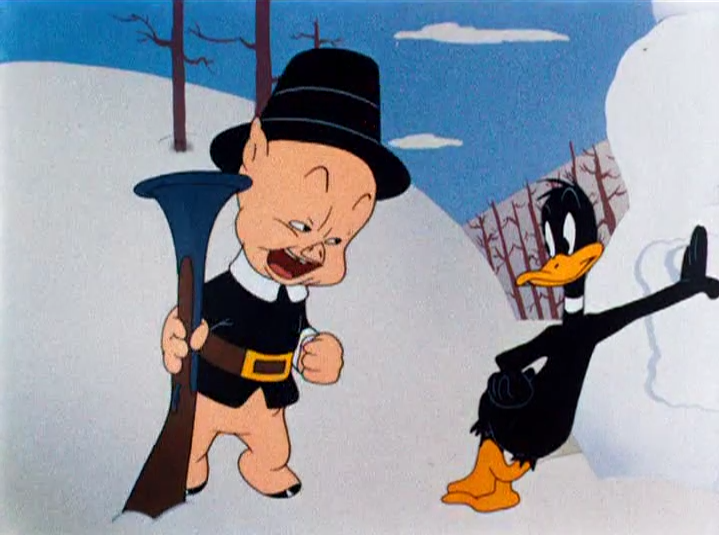
Onto the review: Porky and Daffy continued to be a successful duo in animated cartoons, that a hatful of story opportunities were open to them. For this cartoon, the locale is centered during the Colonial era. Porky assumes the role of a pilgrim, hunting for a turkey to feast for his Thanksgiving dinner, but Daffy intervenes by hiding the turkey from harm.

The opening sequence serves as exposition for the entire cartoon. In a wintery scenario, Daffy is contentedly building a snowman. Daffy reacts to the off-screen gunshots in a vigorous manner, as broadly depicted in the frame grab. Daffy encounters a desperate turkey, vulnerable from the shooting.


Some wonderful character animation from Bobe Cannon who depicts despair and cowardice in a comical fashion. The turkey cries, "Don't let 'em kill me! I'm too young to die! I've got my whole life before me: love, travel, good books!", and proceeds to climb on top of Daffy, whose weight burdens him, yelling and sobbing "HIDE ME!".


Daffy's nonplussed expression as he sinks slowly in the snow is priceless. It's a beautiful presentation of how one might respond awkwardly to such a plea.

Billy Bletcher clearly has a blast with his vocal performance for the turkey's plea - and wonderfully versatile in vocalising comedy. It's more refreshing from the standard, villainous voice; for which he was typically typecast in cartoons.

Animation by Ken Harris.
Ken Harris' animation beautifully portrays Daffy as ignoramus by showing that the character has no consideration for the turkey's well-being, by physically forcing him down potential hiding places; to no avail. First, he attempts to hide the turkey under a lump of snow and in another attempt down a rabbit hole.

Daffy's characterisation is portrayed in a hilarious fashion, as he jabs the turkey with a pole down the hole, until he reconsiders: "Nah, even more obvious-er."

Daffy's ideas for hiding places become even more hysterically ridiculous as he tries to stuff the turkey inside a narrow tree. Whilst Porky is seen from the distance, Daffy chooses the final hiding spot; and hides the turkey inside a snowman.


Once Porky arrives and meets Daffy, he guards the snowman and attempts to stall Porky. To begin with, Daffy appears to be resilient and defensive; by declaring: "My lips are sealed." In a close-up; Daffy's "loyalty" is featured as a visual metaphor, with a dissolve of padlocks and a vice; supposedly closing his bill tight.

The opening scenes have already established the premise in a precise manner. Daffy hides a turkey, and defends him from hunter Porky. This paves the way for some comedy opportunities based on these characters. Daffy is clearly portrayed as careless and ignorant - so it begins to transcend that.

Porky walks away with disappointment, complaining: "I had everything ready for a nice, big turkey dinner." The following close-up exquisitely illustrates temptation and battling good vs. evil. Daffy is enticed by Porky's remarks about a roast dinner, so much so, that he desires it. Without being wholly corrupted; he forms like an angel, declaring: "I'm no stool pigeon." But, his halo disappears and devil horns appear at the thought of cranberry sauce!


Background colour play a pivotal part in Daffy's torn emotions. He's literally "torn" to the point when the colours are divided to coincide with the staging of the scene. A celestial blue colour depicts his willingness to do good; whilst a more vibrant purple colour suggests a sinister nature consuming him.

Chuck Jones' posing are broad and nutty in a sense, but Daffy's emotions feel very human in his hopeless attempt in fighting temptation; and his corruption. The point-of-view shot of Porky walking away is crisply inter-cut to evoke Daffy's increasing impulse.


Alongside mashed potatoes, chestnut dressings and greened peas; a favourite of Daffy's, candied yams, was also prepared for Porky's dinner. So, Daffy breaks down crying as he bellows: "The yams did it! The yams did it!". He impersonates a stool pigeon and begins to coo (squeal), indicating that Daffy is perfectly willing to reveal the turkey's whereabouts.

Daffy's breakdown serves as an unforgettable scene throughout his entire legacy. Succumbing to temptation and attempting to divert the blame correlates with the human mindset, and yet his betrayal is impeccably funny; right down to the animation and Mel Blanc's voice work.

Of course, like a Chuck Jones cartoon, Daffy directs the turkey's location to Porky with numerous signs, as though his desire isn't escalating any further. Dissolve inside the snowman, the turkey refers to Daffy as: "quisling".


The cartoon takes a different direction with the turkey plotting retribution for Daffy's treachery. The turkey steps in as a plot device to turn the conflict towards Porky and Daffy, rather than what the opening exposition established.

The turkey trails under a pile of snow and hides behind a remorseful crying Daffy. He sacrifices his own feathers to plant them on Daffy's rear end (without his knowledge), and gobbles to attract Porky's attention.

With the exception of Bugs Bunny, the Schlesinger cartoon writers knew fully well that their characters were dumb and unsophisticated. Despite just meeting Daffy a moment ago, Porky completely overlooks this and takes Daffy for a turkey. Daffy's denial isn't enough for the obtuse Porky; which puts him in a vulnerable spot.

Several gags during the chase sequence feel like a throwback to early Chuck Jones cartoons, which involved inanimate objects personified to challenge the character. This is evident in the scene of Porky getting attacked by Daffy's snowballs. Snowballs strike Porky from different directions, including two from opposite sides. Porky comes face-to-face with a large snowball, who mimics every  movement of his. Daffy arises and strikes him with a mallet.


Although Chuck had explored these gags several times in his earlier years (i.e. Elmer attempting to blow the candle out in Good Night, Elmer), the timing is advanced and the gag is kept spontaneous; with Daffy merging from the large snowball.


Further gags take advantage of the winter locale in the cartoon. Daffy fills up a bucket from a lake and tosses the water out of it. The running water solidifies into a piece of ice, and strikes Porky - with forceful timing to illustrate pain.

Daffy showcases his zany ability as he loiters by a tree and pours a glass of water over him, forming into ice. Porky's attempt to crack the ice with his gun creates a comical staggering effect from Ken Harris' animation.

Chuck Jones' innovative use of funny expressions are uniquely showcased in a scene of Porky that's remarkably broad. Porky has been fooled by Daffy from the "toll bridge" gag. He skids from the snow and has a moment of thought. After a series of visual gags highlighting Porky's stupidity, he completely boils up. Porky slams his gun in the ground and is all-out exploding with rage. He anticipates a huge sprint, as he digs up a lot of heavy snow before he exits the scene - animated sublimely by Bobe Cannon.

During the buildup, Porky goes through several angry expressions which are very far-fetched for a character whose relatively tamer compared to Daffy, or even Bugs. It's a unique form of outrageous posing that has seldom been seen in Porky or since. It's a pity that Cannon reportedly despised animating broad and wild, despite how well he excelled in it.

The wildness doesn't end, as during the chase, Porky's rage and speed are executed in a perilous and yet exaggerated sense. To begin with, he transforms into a war tank; symbolising force and danger. Such a gag easily rivals the more outlandish gags Tex Avery would conceive. The great use of energy in Porky's wrath causes a snowy hill to break open into a chasm. The cutting and timing of the chase scenes are a contender for Clampett's more flamboyant energy.


The final scenes of the cartoon are represented as a bookend to the entire cartoon. The turkey is contentedly building a snowman, but is ambushed by a cowardly Daffy. It perfectly matches the opening scene, to demonstrate the changes made through the course of the cartoon - and the heavy emphasis on the characterisations reverse.

The turkey gets the last laugh, as he deliberately re-enacts Daffy's careless attempts to hide the turkey. Soon, his "attempts" to hide Daffy turns ruthless as the turkey kicks Daffy up a tree; and cuts the tree down with an axe, causing it to land on his body.

The fast-cutting becomes very slick and abrupt to showcase the turkey taking pleasure in fulfilling retribution on Daffy. For the final scene, the cartoon ends very appropriately on the turkey continuously beating up Daffy Duck into the night - long after Porky Pig is out of the picture.

So far, Tom Turk and Daffy has become one of Chuck Jones' fastest paced cartoons; and definitely worthy of rivalling Frank Tashlin or Bob Clampett. The writing and structure is sublime and true to the animated cartoon spirit, and the conflict is executed hilariously from a writing standpoint between the three characters; that it keeps the whole viewing experience engaging and spontaneous. I can't emphasise enough on how overly entertaining this cartoon is; all down to its impeccable wit and execution.

Rating: 5/5.

Tuesday, 20 June 2017

416. Inki and the Minah Bird (1943)

Warner cartoon no. 415.
Release date: November 13, 1943.
Series: Merrie Melodies.
Supervision: Chuck Jones.
Producer: Leon Schlesinger.
Story: ?
Animation: ?
Musical Direction: Carl W. Stalling.
Sound: Treg Brown (uncredited).
Synopsis: Inki runs into a hungry lion whilst hunting with a spear. However, the lion has difficulty when he encounters the mynah bird who challenges him.


Courtesy of Heritage Auctions.
By the time Chuck Jones was achieving better comedy for his animated cartoons; he still hadn't quite withdrawn from his Disney-esque characters which held back his true talents during his first few years as a director. He previously attempted to broaden Sniffles in The Unbearable Bear, which worked fine by underplaying his position and altering his cutesy persona.

Chuck Jones' Inki cartoons remained firmly consistent during his reform - with the exception of his broader timing. Jones would continue to sporadically make Inki cartoons until 1950 - at a time when he was reaching the pinnacle of his powers. Inki is probably the least diverse character from Chuck Jones regarding formula. While the Coyote & Road Runner cartoons feature a great variety of hysterical gags within the same premise - the Inki shorts are restraint from that. The premise is almost entirely centred on Inki hunting a mynah bird whilst endangered by a hungry lion. Only occasionally does the locale change, especially in later cartoons like Inki at the Circus and Caveman Inki. For such differences is for the review to uncover.

The animation is far broader in Inki than Chuck Jones wouldn't dare to do in his earlier cartoons centered on the character. In the opening scene Inki attempts to stab a worm with his spear, but narrowly misses. The spear vibrates vigorously that once Inki grips his hands onto the handle - he begins to shake violently.


In a following close-up; Inki's shaking action is matched by some wild smear animation. By the time the spear relaxes; Inki's hair bun is unloosened with wild long hair falling over his face. For a character we're used to seeing in slower paced cartoons - it's a pretty farfetched gag.


Shortly after, Chuck Jones appears to channel the likes of Tex Avery in a scene of Inki attempting to hunt the mynah bird. Inki's hair bun appears above the water, signalling the bird's location. Upon finding it Inki's hair bun travels its way through soil and digs up the surface. Inki grabs out his spear lying by the ground and proceeds to follow the bird.

The gag itself has been used several times in Avery's cartoons like The Crackpot Quail and The Heckling Hare. It was also used similarly in the Donald Duck cartoon, The Hockey Champ.

The gag standalone might be a throwback to earlier animated shorts, but the action of Inki digging through soil goes up a notch. Inki's hair bun creating wild subtle twists enhances some charm to Jones' timing.

Carl Stalling's music typically requires a lot of direction from Chuck Jones for his Inki shorts. Most evident is the infamous motif for the mynah bird's hopping action synchronised to Mendelssohn's Fingal's Cave. Although Stalling took credit for the accompanying motif in an interview; he added, "it went over so well that we had to use it every time." While it's one of the few remaining identities surrounding the character - it magnifies the bird's vague nature.


Other uses of music timing blended into animation is utilised well in the cartoon's opening scene. A green worm hops rhythmically to Stalling's beats - including the worm's wriggling action. The hopping action continues until the worm has a close call to Inki's spear slammed to the ground.

It's a great showcase of how Stalling and Jones were both creative when it came to timing animated action through tempo. The scene itself has great staging and layout work - most likely by Art Heinemann. Keeping the worm the main focus until a spear shoots ahead of him is a nice case of unexpected delivery. The absence of Inki in the shot makes the spear all the more threatening. While the opening operates as a formula to previous Inki shorts - Chuck's pacing and use of dynamics had advanced to that point.

The sequence of Inki and the lion fighting inside a barrel showcases some of Chuck's experimentation with timing. Inki frantically hides inside a barrel after a close encounter with a hungry lion who antagonises Inki throughout the cartoon. The lion lifts the barrel upwards licking his chops, indicating he ate Inki - without realising he's now hiding on top.


This follows by a frenzy attack inside the barrel. The action is interpreted as frantic and wild as indicated by the barrel exaggeratedly twisting and changing volume, pulled off by Chuck's fun timing and the clarity of the cartoony animation.

A very intriguing piece of timing follows immediately afterwards. The mynah bird suddenly hops out of the barrel and zips out of scene - leaving a cloud of dust. Then, Inki and the lion leave their clouds of dust as they zip out of shot.

But, the dust unveils to reveal the trio standing in their same positions - except this time the lion is ready to eat up Inki. The timing is wonderfully innovative in its presentation of speed. Very few directors like Chuck Jones could time a gag that requires so much subtlety surrounding the mystery of the mynah bird.

In previous Inki shorts, a hungry lion played an antagonist role. As a personality the lion was always intended to be fearsome and dangerous - likely a past attempt to make audiences take the lion seriously. For this cartoon, the lion is portrayed with a foolish characterisation; much in vein to the rest of the Warner Bros. product.


In one scene, the lion skids broadly to a halt upon seeing a juicy steak Inki holds. However, the mynah bird swallows the steak whilst hiding inside the jaws of the lion's mouth. Upon realisation that his steak is gone; the lion ends up bawling his eyes out, banging on the ground like a child.

Chuck Jones adds a hilarious touch by having the lion eyeing towards the audience - and quickly returns to his fearsome image - which is already tarnished. The gag works fine in creating an obvious contrast between size and behaviour.

Such characterisation remembered fondly by animator Shamus Culhane - a veteran animator who briefly worked at Schlesinger during this time. He recalls in his autobiography: "I especially working on the lion because he was a dumb, raggedy coot who didn't remember that he was supposed to be the king of beasts." Culhane's descriptions perfectly matches with the scene. Culhane also wrote that the majority of the animation was split between himself and Bobe Cannon. Cannon's animation adorns this cartoon but whatever animated scenes Culhane worked on, I'm not certain.

In several sequences; Chuck Jones' character layouts come to advantage - notably when Inki first encounters the lion. Animating pantomime is challenging enough in terms of capturing clarity, but in the hands of Chuck Jones it's put to good use. Chuck's posing works effectively during Inki's double-take when he glares directly into the lion's eyes.

Beautiful touches are added when the lion drums his fingers which delays Inki's take comedically. Inki's hair bun forming a question mark wonderfully communicates through pantomime. As the lion roars menacingly at Inki; he zips out of the shot - causing the lion to bump his head on the ground - adding character to his clumsy persona.

In a later sequence, the lion pounds furiously at a palm tree with child-like behaviour after failing to eat both Inki and the mynah bird. Coconuts drop from the tree but one drops in the lion's hands which morphs back to Inki's proportions.

Inki looks at the lion bashfully by which the lion responds with an even goofier grin. Inki leaves the scene - leaving the lion's hands empty. Chuck's expressions are fitting towards the lion's inept personality.

The mystery of the mynah bird typically becomes repetitive when the character sporadically hops into scene with the same Mendelssohn music and bringing curiosity towards Inki and the lion. In some cases; the mystery of the mynah bird actually becomes intriguing and ambiguous.


In one scene; the mynah bird hops inside a clump of hay whilst the lion anticipates a pouncing action towards it. As the lion follows the bird - the straw gradually reduces in size until it completely vanishes into thin air.

Later on, the lion encounters a single piece of straw hopping into scene, but gradually grows larger and larger until the mynah bird reemerges. It's an intriguing piece of ambiguity surrounding the character - indicating a supernatural force in a cartoon environment. Jones' cartoons never reveals the mynah bird's true nature - perhaps a deliberate suggestion that the mynah bird is an unknown power towards mankind that can't be understood. The greater the mystery the more illuminating.

The mynah bird soon plays a more active part at the cartoon's climax when the bird challenges the lion. Earlier cartoons never featured the mynah bird's actions when defeating a lion; as it took place entirely off-screen. In this occasion, we are blessed to see the mynah bird engage in an effortless fight with the lion.

He picks up the jungle giant by the tail and whirls him around until the lion falls inside a lump of hay - which dwindles until it vanishes out of sight. Soon afterwards; the lion reappears when the mynah bird gives Inki a few pieces of straws.

The cartoon's ending commences once the mynah bird takes down the lion again - but this only, interpreted by some elaborate drybrush work and Treg Brown's use of comical sound effects. Inki quietly exits the scene during the brawl.

Once the drybrush whirlpool wears off; the lion discovers his jaws are missing from his mouth. He turns his eyes towards the mynah bird furiously - who then reveals to be wearing the lion's teeth inside its mouth.

I don't consider myself a fan of the Inki cartoons, primarily based on its stale, repetitive formula. The cartoon's title itself doesn't strike me as anything different in comparison to The Little Lion Hunter or Inki and the Lion as those cartoons have a primarily similar structure. Although this cartoon might be another replica, it's much more engaging than the previous instalments. Chuck Jones' pacing and innovative use of timing makes the short a more intriguing viewing. It's evident that Chuck was attempting to utilise comedy for the Inki shorts; and to some extent it worked well for the lion characterisation. The minah bird's role in this cartoon adds some depth to the mysterious nature, and he's a lot more active than beforehand. This short doesn't represent the very best of Chuck Jones by all means, but it's certainly a step up from Jones' painfully slower cartoons.

Rating: 2.5/5.