Showing posts with label Don Christensen. Show all posts

Wednesday, 15 February 2017

411. Scrap Happy Daffy (1943)

Warner cartoon no. 410.
Release date: August 21, 1943.
Series: Looney Tunes.
Supervision: Frank Tashlin.
Producer: Leon Schlesinger.
Starring: Mel Blanc (Daffy Duck / Hitler / Lincoln), Dorothy Lloyd (Whistle). Thanks to Keith Scott.
Story: Don Christensen.
Animation: Art Davis.
Musical Direction: Carl W. Stalling.
Sound: Treg Brown (uncredited).
Synopsis: Daffy Duck confronts a billy goat, whom was sent by the Nazis to demolish his scrap pile.

Although the cartoon is showered with propaganda tendencies - the premise operates like a standard Warner Bros. cartoon. Daffy Duck is devoting his time collecting scraps for the war effort; but Hitler attempts to thwart his plans by sending a billy goat to destroy his scrap pile.

For a concept relatively straightforward, Frank Tashlin never shies away from his innovative direction and artistic abilities. Like Porky Pig's Feat, he attempts to give the cartoon a cinematic scope, without losing the entertainment value - a feat he excels at.

The opening sequence is a prime example of Tashlin's attempt to combine entertainment and patriotism fluidly. Daffy's purpose is to encourage audiences in cooperating with the war effort. By doing so, he sings the popular wartime song We're in to Win, and lists out numerous items to be used as scraps.

The sequence is largely informative; and Tashlin compensates this by adding visualised gags - like having Daffy climb the scrap pile, like a mountain. Frank ic bathing suit; acknowledged by Daffy's wolf-whistle.

To enlighten wartime audiences, the Warner staff don't hesitate to ridicule their enemies. Tashlin inserts a visual pun of Daffy's mirror reflections morphing into the Axis leaders: Hitler, Mussolini, and Tojo; as they each yell "Freedom's foe" with their stereotyped accents--causing the mirror to shatter.

Tashlin also applies a hilarious cross dissolve effect to mock Hitler; that is perfectly clarified visually. Once, Daffy finishes his song, he remarks bitterly: "Well, how d'you like that? Schicklgruber?"--the name being a reference to Hitler's father's original surname. The camera pans to the rear end of a mule facing sideways. The scenes changes through a match dissolves to Adolf Hitler reading a newspaper.


Frank Tashlin's cinematic style is perhaps best highlighted during the montage sequence of Hitler and his comrades ordering the destruction of Daffy Duck's scrap pile. The scene begins with Hitler reacting offensively to Daffy's witty headline on the scrap pile, reading: "Mussolini in scrap heap - now let's junk Hitler!".


Hitler rants in the German tongue, which is comically translated as "Non aryan duck". Hitler's anger goes so far, he ends up shredding his carpet like an animal! And so, he orders for the scrap pile to be destroyed.

"Destroy that scrap pile!"
This follows into an elaborate montage sequence, of Hitler's officers forwarding the orders: "Destroy that scrap pile!". Tashlin's innovative use of dynamics fits wonderfully. He applies silhouette and closeups of officer's hands; which enhances the suspense. The choices of composition are almost on par with master filmmakers, like Alfred Hitchcock or Leni Riefenstahl.

A standout example of Tashlin's use of dynamics is evident in a shot of the submarine captain. He commands the same order, "Destroy that scrap pile", but the camera pans right across the officer as he points with his finger, to indicate a command. It's a remarkably complex layout; but the animator's use of mechanics produce great results.

Asides from his cinematic techniques; Tashlin's cartoons had strong art direction a lot of the time. The layouts of the cartoon, possibly by Dave Hilberman, follow a graphic, avant-garde approach which the animation industry wouldn't fully endorse until the formation of UPA. Tashlin, and Chuck Jones are notable exceptions in this era. The scrap pile is an innovative design that suggests a constructed look to it.

The background work is very experimental and somewhat underestimated in this cartoon. A lot of the backgrounds are painted in rough form without the use of normal linework, but was applied afterwards. A similar technique wouldn't become popularised until the 1961 Disney feature, One Hundred and One Dalmatians - under the art direction of Ken Anderson and colour stylist Walt Peregoy.

Other creative uses of colour is evident in the sequence of Daffy Duck unknowingly staring at his own reflection in the dark. He mistakes his own eyes for the billy goat, and he holds up a bayonet as defence. He orders: "Put your hands up. You criminals are all alike. I can see it in your eyes. Just a stupid ignoramus. A numbskull. A nitwit. A nincom--"; Daffy strikes a match to realise he's talking to his own mirror reflection, resulting in a late delivery of "--poop".

Once the submarine fires a torpedo directed towards the scrap pile; the weapon opens to reveal a billy goat contained inside. The sequence showcases Tashlin's comic timing wonderfully; such as the action of the goat goose-stepping.

Treg Brown's sound effects are put to great use; like when the goat eats up the scrap pile, in the action of a typewriter. Once the goat swallows a handful of junk, his stomach struggles to fully digest, and he begins to hiccup; which Brown utilises with an effective rumble sound.

Other indications of Tashlin's timing skills is seen during the mallet scene. Daffy has hidden himself inside a pair of glasses, that is portrayed so subtly in animation. The glasses were formed in the shape of Daffy, which the goat ruins by tossing them away.

Daffy's hands arise as he strikes the goat's horns with his mallet. Sheepishly grinning, the goat retaliates by shaking his head vigorously; whilst Daffy is still attached to the mallet. An interesting cross-dissolve effect fits in, where multiple uses of Daffy Duck are used to emphasise his struggle with the goat.

A trait of Frank Tashlin that's most revealing during his 1940s stint at Schlesinger's, was his ability to push poses to the extreme. The effect is applied during the fast-cutting scenes of the billy goat charging towards Daffy Duck. The timing and animation (by Art Davis?) adds a lot of character personality. The speed of the billy goat suggests a disciplined, intimidating mammal; whilst the goat's comical and clumsy skid suggests otherwise.

This is soon followed with a sequence of Daffy Duck, disguising himself as Tojo by wearing glasses and wearing the stereotyped grin: "You wouldn't hit a guy with glasses, would ya?"

Another creative piece of animation that works as a visual gag, is the scene of Daffy's neck peeking out from by the fence. His head pokes out from underneath his combat helmet, as he remarks: "Saboteurs, I betcha!". Only a gag like that could read in animated form.

While the cartoons were plagued with wartime references naturally, elements of cultural references are still blended in. Perhaps this was used to balance out the propaganda. In one sequence, Daffy Duck encounters the hiccuping goat, and attempts to help him.

In an attempt to help, Daffy produces a remedy by placing a sodium pull in a glass of water; quoting "Listen to it fizz" - a direct reference to the Alka-Seltzer advertisement popular of the time. After the goat consumes the drink, his hiccups get more violent each time - leading to Daffy's discovery that the goat serves the Nazis - as indicated from his swastika ornament.

At a moment of defeat from the billy goat; Daffy has an epiphany. He encounters the spirits of his former descendants; who are dressed as American pioneers and historical figures like Daniel Boone and Abraham Lincoln.

Admittedly, it's one of the weakest elements of the cartoon. The cartoon changes in tone and style, from the short's usual brisk pace, to an ending that's over-patriotic.

The descendants encourage Daffy by singing in the style of Yankee Doodle, about determination. Then they all sing in unison, "Americans don't give up!". The line work on the descendants are creative in style, but the sequence itself is rather forced and cliched in patriotism. The majority of the short set a brisk pace style of Daffy Duck's antics with a Nazi goat, with entertaining sequences - but the patriotic scenes of Daffy's descendants feels out of place.

The heavy of patriotism escalates only further once Daffy has an epiphany. He leaps up in the sky, and forms a superhero guise parodying Superman - "Super American". By today's standards, the sequence can be open to interpretation.

One viewer might believe the persona displays a sense of arrogance of the nation - as the scenes emphasise America's power and strength. This is especially evident in the scene of Daffy fighting off the naval officers onboard a Nazi ship; by punching the firing bullets away.

However, it could be seen as a satire on American propaganda; by overcompensating the nation's pride. Preferably, I'd like to see it as satirical. The satire is even more revealing as the scene of Super American cross-dissolves back into reality; with Daffy Duck wrestling with a pipe. Daffy Duck recovers himself after being wrenched by water, gasping: "It was all a dream". But, a camera pans up towards the scrap pile; where a Nazi submarine sits atop. The Nazis yell in unison, "Next time you dream, include us out!". It's a wonderful piece of witty writing that is either open to interpretation or plain wacky.

Scrap Happy Daffy feels more like a patriotic, propaganda cartoon and not so focused in mocking the Axis powers, as evident in cartoons like Daffy - the Commando or Herr Meets Hare. Frank Tashlin at times, uses propaganda cleverly in the short. The opening sequence of Daffy's propaganda song balances comical humour neatly, and the 'Super American' climax is a clever piece of satire on America over-compensating their power through propaganda. The sequence with Daffy Duck communicating with his spirited ancestors, however, is a bit forceful. It feels out of place compared to the satirical propaganda scenes. One could argue it was deliberately written in that patriotic style to build up the hilariously flamboyant Super-American scenes. Tashlin's expert use of applying cinematic techniques,  innovative layouts and the distinctive Warner Bros. humour more than makes up for the little flaws here.

Rating: 3/5.

Tuesday, 12 July 2016

404. Tokio Jokio (1943)

Warner cartoon no. 403.
Release date: May 15, 1943.
Series: Looney Tunes.
Supervision: CPL. Norman McCabe.
Producer: Leon Schlesinger.
Starring: Mel Blanc (All voices)
Story: Don Christensen.
Animation: Izzy Ellis.
Musical Direction: Carl W. Stalling.
Sound: Treg Brown (uncredited).
Synopsis: A U.S. propaganda short featuring a newsreel "captured from the enemy" reveals Japanese propaganda in a string of gags and stereotypes.


NORMAN McCABE
Norm McCabe's last directorial short for Warner Bros. as he went to join the army. As often said, McCabe never got the chance to leave a lasting impression for his contributions to the Warner Bros' animation legacy. While this is attributed by his short tenure as director, but so are the style of cartoons he turned out. It's a pity McCabe is mostly remembered for his war-themed cartoons that are today considered immoral in our "politically correct" generation. Perhaps the most striking example of that would be Tokio Jokio.

Not only is the cartoon incredibly dated in its references as well as extremely offensive and racist in its stereotypes; but it's a testament to how hurt America had been since it's infamous Pearl Harbour attack in 1941. Without a doubt, the short would've been successful and appropriate amongst audiences in its original release.

The short is presented in the form of a typical Warner Bros. sight-gag cartoon. The opening scene features a voice-over explaining that the short is merely a Japanese news reel that was "captured from the enemy". The theme is on "Japan-nazi" propaganda - depicting and criticising the Japanese in the lowest form of humanity as being weak, incompetent and foolish.

The caricatures have stereotypes all-over - as the Japanese are presented as skinny, wearing glasses and having giant teeth. While many cartoons considered immoral and politically incorrect today weren't intended to be harmful or racist towards stereotypes - this is the short's purpose. Since both countries were at war with each other and fighting for survival - the stereotypes themselves were intended to give audiences some sense of superiority and optimism. It is my intention to review the cartoon, not only reflecting on historical/social context - but entertainment values in 1943.

The sight-gag primarily attack the Japanese government for their poor treatment of defending their civilians and industry - which are satirised in several sequences. A striking example occurs early in the cartoon where the Japanese narrator presents the nation's "finest air-raid siren". The siren, of course, is heard from two Japanese citizens who prick each other's rear ends with a needle to create a screeching effect.


As tasteless as the gag has become over time, it symbolises Japan's poor handling of civil defense and how pathetic it's presented in comparison to the U.S.

The cooking sequence is another satire on Japan's home front; which was unorganised as the government concentrated more on their propaganda...creating many factors in the process. The sequence features General Hideki Tojo as a cook, as he demonstrates on how to make a club sandwich by using ration cards.

It's an exaggerated take on Japan's food rationing to bring the notion towards American audiences that their home front is inferior. The sequence is further exaggerated as the Tojo cook hits himself on the head with a club--portraying Tojo and the government as ignorant.

The short interprets Japan's military production as poor as indicated in a few sequences. In a scene which features the Japanese Navy at sea - a submarine enters the shot as the camera pans slowly underwater. The narrator reveals it was released "three weeks ahead of schedule". Indeed, it's still being constructed as it operates underwater. The submarine crashes off-screen with several deaths as depicted from Carl Stalling's Taps cue.

From the perspective of a 1943 audience member; it would've been a great showcase on how incompetent the Japanese were. This is also showcased in the 'victory suit' gag. The "Victory Suit" was a civilian fashion in the U.S. during WW2 as part of the war effort - lacking excess fabric and containing low quality wool...which were seen as bigger priorities for military uniforms.

Here, the fashion is parodied with a "Japanese Victory Suit". Expect this to be another gag mocking the Japanese home front and military production. A vertical camera pan downwards reveals an advertisement for the Japanese victory suit. At first, it reads "no cuffs", "no pleats" and "no lapels" which was the definition of the American suit. Then, the narrator announces: "no suit!", with the camera panning downwards to reveal an almost naked Japanese man freezing in the snow, as he tries to warm himself with a candle.

Other sequences poke fun at satirising Japanese society such as the incendiary bomb scene. The scene is presented as an educational guide on them. The text fades onto the screen on not approaching them within the first five seconds. An unsuspecting Japanese citizen walks into the scene, and counts the seconds with his watch. Then he walks over to the bomb to roast a sausage until it then detonates.


After the explosion his face is seen missing, with his glasses and hat still in the same position. The quote: "Ah! Rosing face, please! Rosing face!" is a direct pun on the Asian sociological concept of "losing face"...indicating the man has dishonoured himself - which is considered shameful in Asian culture.


Asian honour is also satirised in a scene featuring a suicide mission of a Japanese naval solider riding a Kaiten human torpedo. Honour suicide was a common attack during the war; were not only Banzai charges and Kamikaze attacks allowed Japanese soldiers to die with honour, but also used in attacking the enemy. It was also considered an atonement for any misconduct or disgrace from any civilian.

According to the narrator: "But he-a not caring, are you happy gentleman?", and asks the soldier, "Have you anything to say?". The soldier responds. "Uh, no, nothing except - LET ME OUT OF HERE!". It's a gag which was conceived to intentionally offend Japanese people by mocking their honour - and indicating that some soldiers aren't as honourable.

The spot-gag parody on Japanese propaganda wouldn't be complete without its own mockery on Japanese politicians and generals - as seen in the "Headline Poisonalities" section. The most revealing is the sequence on General Isoroku Yamamoto, who is perhaps, today best remembered for being responsible in planning the attacks on Pearl Harbour. His height is caricatured as he walks in stilts, to give him a taller appearance.


Yamamoto reveals his plans to "dictate peace term in the White House". An Editor's note title card reveals a reserved room for Yamamoto - which is revealed to be an active electric chair.

What's most intriguing about the sequence is the timing of Yamamoto's death and the cartoon's release. The general had been assassinated when his plane was shot down by an American fighter squadron in the Solomon Islands - a month before the cartoon's release. The cartoon was made while Yamamoto was still alive; even though the gag might've seemed even out of place by the time it was shown in theatres.

While the Yamamoto sequence was an approach to dark humour - the scene featuring General Masaharu Homma is more or less in the style of Warner Bros. spot-gag - with contradictory dialogue. The narrator observes the "coolness and calmness of Japanese Officer in air raid". The real scenario reveals the exact opposite as a frantic Homma frantically rushes around the forest before ducking underneath a tree log. Once he sticks his head out the log, a skunk does the same. Adding insult to injury, the skunk reappears with a gas mask on his head.

The "Flashes on the Axis" segment takes a brief break from the sustained Japanese stereotype - save for the voiceover narration. The segment focuses primarily on Japan's allies: Germany, Italy, and a caricature of William Joyce, an American-British radio broadcaster and Nazi sympathiser known as "Lord Haw Haw" by nickname - and caricatured with an ass' head named "Lord Hee Haw", hence the visual metaphor. He is the broadcaster on the segment.

Animation by Art Davis.
While the stereotypes might still be frowned upon today - admittedly, they are more forgiving and less offensive as the sequence pokes fun on the actual enemies, like Adolf Hitler and Benito Mussolini. The Hitler scene features an admittedly amusing gag of Hitler twitching his moustache like Charlie Chaplin, as he reacts to a postcard he received from Rudolf Hess, reading "Wish you were here".

The irony of Hess' message is exposed as Hitler turns the postcard over that reveals Hess held captive in a concentration camp - (whereas in reality, he was held in British custody). The kiss marks written on the letter also adds to the touch.

The Rome scene is another addition to the lame puns from the multiple Warner Bros. spot-gag cartoons. The narrator observes the infamous ancient ruins as seen in a horizontal camera pan. The camera quickly pans to reveal "ruin #1" which happens to be Mussolini. Personally, I don't think Mussolini has ever been properly caricatured in animated cartoons. The caricature is primarily focused on the chin and the lips. His forehead is treated generically, which is probably one of his more revealing facial features.

Despite the cartoon being riddled with offensive stereotypes almost everywhere - some scenes showcasing McCabe's coming timing are hard to criticise. The opening titles for the news reel is perhaps one of the more offensive gags. To begin with, the title of the reel is "Nipponews of the Week", which features a rooster (a direct parody of the Pathe news reel opening) who is anticipating a crowing noise.


As he does, he changes into a Japanese caricatured vulture, who is portrayed as scheming and evil as the Rising Sun flag appears. The stereotype is further emphasised as the vulture says: "Oh, cock-a-doodle-do, Prease!". As uncomfortable as the scene might be; McCabe's timing is pretty impressive.

The sports segment is another prime example of that. The gag and caricature of the sports commentator is in such bad taste that it's impossible to not find it in the least bit amusing. In a sudden iris out; his mouth gets stuck in the circle - that it falls off and clutters into the ground. Again, the timing and imagination of the gag doesn't fail to impress.

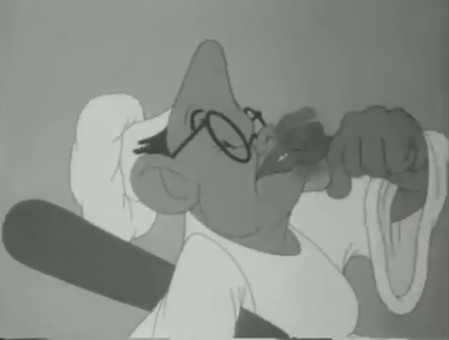
The following scene is more of a satire of Japanese sport players who are also illustrated as physically weak. The player indicated on the screen in a baseball outfit is considered to be the Japanese equivalent of Babe Ruth. Once a fly flies into the scene; the player attempts to swat it but misses and spins in a circle. While the gag might've been an arrogant in emphasising America's superiority; it turns sadistic and unnecessary when the fly responds by grabbing the swatter and whacking him with it.

With offensive stereotypes asides; the short has its share on lame, corny puns that spot-gag cartoons are heavily reliant on - as seen in the ancient ruins scene. One scene in the "civilian defense" segment reveals a listening post - which is nothing more than a pole with key holes covering it. The pun on the aircraft spotter is even more cringeworthy as the plane is literally being painted with spots.


The final segment featuring literal interpretations of marine boats is also riddled with typical visual puns, especially the "minesweeper" gag - which features two mechanical hands sweeping mines away with a broom).

When the ship accidentally explodes - a buoy is featured in the sea with a sign reading: "Regrettable Incident Please". So, the short ends which pokes fun on another Japanese stereotype where they're portrayed as being over-polite. Nevertheless the gag itself doesn't pay off with the results being lame.

It's almost impossible to give the cartoon a rating without giving consideration on historical/social context. While the humour has become outdated and offensive within today's modern society; it's still a fascinating piece of history reflecting on the attitude America had towards their enemies. Withouy a doubt, the short would've been effective on American audiences in giving the notion of hope and patriotism. It's perfectly understandable that the racism would cause uncomfortable viewing, but it can't be judged out of context - especially as history can't simply be ignored and written off. Therefore, the short would be better off viewed today purely for historical purposes, rather than for entertainment--as the stereotypes were certainly intentional. With racial problems asides, it's otherwise, an insipid cartoon, complete with gags that felt forced and stale. While McCabe shows moments of competence as a director - the short remains remotely unfunny, dated, and uncomfortable to watch.

Rating: 1.5/5.

Tuesday, 5 January 2016

393. Confusions of a Nutzy Spy (1943)

Warner cartoon no. 392.
Release date: January 23, 1943.
Series: Looney Tunes.
Supervision: Norm McCabe.
Producer: Leon Schlesinger.
Starring: Mel Blanc (Porky Pig / Missing Lynx).
Story: Don Christensen.
Animation: Izzy Ellis.
Musical Direction: Carl W. Stalling.
Sound: Treg Brown (uncredited).
Synopsis: Constable Porky and his dog, Eggbert, are on the lookout for a German spy: Missing Lynx, who aims to blow up a railway bridge.

As competent as Norm McCabe might be in presenting stylish backgrounds with some innovative staging - he never seemed to have played an influential role as far as story goes. As often, he was lumbered with cartoons with dated wartime references and heavy propaganda - much like Confusions of a Nutzy Spy (title parodied from the 1939 film - Confessions of a Nazi Spy). Occasionally, he takes the material together and turns them into a near-masterpiece like The Ducktators. As confident and professional McCabe was in giving the right personality for Daffy Duck - Porky seemed an awkward character in the hands of McCabe, much like how Clampett would interpret him in his weakest cartoons.

The opening pan shot of the interior police station ranges from hit to miss. On the hit side, it is a astonishingly complicated piece of layout of the camera panning back, forth and through the hall of assorted things like various criminal practices and exhibits. Only a strong, experienced layout artist like Dave Hilberman could've designed and coordinated such an ambitious exercise; not forgetting the craftiness of Johnny Burton's camera department.

On the miss side, the gags on the elaborate opening shot is saddled with unfunny visual puns that Tex Avery himself, even on his bad days, would mock at.

Gags like the the finger print department lack any creativity or coherence, as they are literally printed all over the wall; with no impact or pay off whatsoever. Lest not forget exhibit A of a model of the letter "A". Ho-hum. Then, there are a few display gags which is more adult oriented. In one gag, the camera pans to a jar displaying a "sure cure for criminal tendencies" with a hangman's noose attached to it. As sadistic as the gag implies, it's worth the chortle. The wanted posters exhibit has a cheeky pay-off towards it. The camera panning on generic posters, one-by-one on criminals who are wanted for arson and fraud. Then, the camera pans to a wanted poster of an attractive woman posing in a bathing suit - with a tongue-in cheek message by the U.S. Army.

Areas where McCabe could be visionary with his timing is evident in Eggbert's establishing scene. He is snoozing on a box, with the radio on. As he snores, he breathes "z's" literally in and out his mouth - a la comic strips. It's a creative, visual gag combined with graceful timing which is hardly practiced in classic Golden Age animation.

Animation by Art Davis.
Awakened by the radio; Eggbert slowly reaches his paw to turn off the radio causing the announcer to break forth-wall within the short: "Don't touch that dial!", a likely reference to the CBS radio programme, Blondie, based on the comic strip. The paw trigger effect has an effective piece of timing. Afterwards, Eggbert grabs a mallet and smashes the radio.


McCabe's visionary timing is put into good practice in a fine scene of the "Nutzy" spy: Missing Lynx - a lame parody on the description 'missing link'. The lynx, who is voiced hilariously in Mel Blanc's Germanic dialect is discreetly watching Porky and Eggbert's moves.

McCabe takes advantage on a cliched gag of a cartoon villain peeking in and out of a tree at different direction. As the spy's peeking becomes quicker - he unknowingly splits into another pair - with one and the other at a different position of the tree. The lynx double-takes at the surreal gag and both of them collide; morphing back into one figure. It's a clever piece of reverse animation that coincides with the original - which makes an oddball of a gag work effectively. The double-take and the spontaneity of the second figure makes the gag all the more merrier.

If there are weak spots as far as characterization goes - look no further than the sequences where the Missing Lynx attempts to fool Porky. While Porky and Eggbert snoop around the woodlands; Eggbert stops at a dead end of a foot blocking way - the Lynx disguised as an elderly dog.


The sequence itself would've been more passable had the lynx been under disguise the entire time - making Porky's gullibility seem more believable. As Porky inquires, "Have you seen a spy around here?". Afterwards, the spy removes his disguises and bluffs, "Does he look like this", maintaining a strikingly similar pose as seen in the poster.

Once Porky nods, in the hope of gaining information - the lynx responds: "Nope, I have not seen him" and zips out of the scene - confusing Porky. Just in time we feature a "Hitler is a stinker" gag as Eggbert pulls a Hitler mask out the spy's suitcase during investigation - until he discreetly retrieves it.

As a sequence, it's very clumsy in its own execution and handling on Porky's personality. Being gullible is one thing, but it's incredibly out of character of Porky to fall for a trick when the spy isn't making any effort to disguise himself. For a Bugs Bunny cartoon, the scenario is different in a significant way; but since the personalities in this short are undeveloped: it flaws.

Proven the previous sequence was weak in execution - the bridge sequence is hardly better. The spy reaches his destination to plot his terrorist act: a railway bridge. Just as he's about to adjust and plant the bomb; Porky has him cornered at gunpoint.

Immediately, the apparent master of disguises slips into a Porky Pig disguise. He interrogates: "Vell, I'm-a not so sure that you're Porky Pig either!" and furthermore mocks his stutter. He moves Porky away from the railway, causing him to ponder: "I'm really gettin' suspicious of that guy!"

This is most likely the weakest spot of the entire cartoon. Porky's personality is incredibly underplayed as he has nothing more to do than feel suspicious and getting interrogated by the spy. It's a completely ridiculous concept at attempting to bluff Porky Pig by disguising as his own self! So many missed opportunities run together.

On a positive note, the bridge scene has some very choice, dynamic staging as well as some rich point-of-view shots which adds to McCabe's reputation as a stylish director. In Missing Lynx's POV shot, he holds out the bomb from his suitcase; and sets the time on it accordingly. For a description of action so simple; the work on the hands is incredibly rich in detail; with an amazing use of perspective.

As far as Eggbert's role plays in this short; his role is mainly used for recurring gags and little of personality. The recurring gag is focused on Eggbert's violent sneezing habits which appear frequently. Some of the gags pay off wonderfully. During their investigation in the park, the dog almost experiences an episode - but spontaneously the spy's arm holds his nose whilst hiding in a tree. The unpredictability of the gag alone, is hilarious.


Other areas the sneezing gags build up tension and suspense; such as when Porky and Eggbert find themselves barely dangling from a root attached to the edge of a cliff. It appears story man Don Christensen intended to use the gag as a plot device; which supposedly becomes key to the flaw in Missing Lynx's terrorist plan.

The recurring gag itself hardly has much pay off at all; as his sneeze only plays a main role when his sneezes forces the spy out from the cave. Not a complete waste of a concept; it could've worked so better as well as a much better payoff which is somewhat lacking for a potential cartoon finale. Once again, another missed opportunity.


Although the action sequences might be the usual standards for a Warner Bros. short; some shots have some outlandish. The lynx's double take upon discovering the bomb-in-a-briefcase has been retrieved by Eggbert has some effective use of smear animation which captures the panic episode he is facing.


The cave sequence is in the style of McCabe's innovative sense of mise-en-scene. Capturing the complete darkness of the cave; only the eyes are seen luminously. A typical style for animated cartoons, McCabe takes the opportunity to plan the action with the panic depicted by their eyes.

Both characters believing they are safe from the bomb-in-a-briefcase; they take at the sound of a ticking noise. Porky lights the match which reveals Eggbert has followed them, retrieving the briefcase again - Porky shouts "Yipe!" creating another panic situation as the characters run frantically around the cave in complete darkness.

Despite moments of weaknesses evident in the short - Christensen finishes the cartoon with a sense of cruel irony. At the cartoon's climax, the cornered Nutzy is quivering scaredly as he awaits the moment for the bomb to detonate. As depicted in a close-up shot, the bomb distinguishes; creating no effect whatsoever.


Enraged, the spy complains: "I knew it! I knew it! Oh, this goldarn imitation ersatz ding. It never vorks!". He bangs the bomb to the ground with frustration, when at the wrong moment: it explodes.

A lot about the final shot is depicted with cruel irony. The Nutzy is dancing happily around the clouds of heaven, under the impression his plan had worked after all - and without realizing he is dead. And another thing, it seems very ironic for a terrorist spy to spend eternally in heaven. The cartoon draws to a fade as the spy salutes, "Sieg Hiel" and faints onto the clouds.

For a director who proved capable of turning out some occasionally very good cartoons; this short ranges in the 'hit-and-miss' category. McCabe seemed uncomfortable in giving further character personality on Porky Pig; which Chuck Jones achieved brilliantly in My Favourite Duck. Instead, he is given the persona of a clueless idiot who is gullible and vulnerable, which seems a no brainer to that effect. While this short is war-themed; it surprisingly holds very little wartime references; excluding the Nazi parody and the Hitler mask reference - and instead functions like a generic Porky short. Had McCabe continued to direct after the end of the war, it's almost impossible to determine whether he could've really established himself as "one of the greats".

Rating: 2.5/5.