Showing posts with label Bob Clampett. Show all posts

Tuesday, 3 October 2017

SNAFU: Booby Traps (1944)

Director: Bob Clampett.
Release date: January 1944.
Starring: Mel Blanc (Snafu),
Robert C. Bruce (Narrator).
Music: Carl W. Stalling.
Sound: Treg Brown (uncredited).
Synopsis: Private Snafu claims he's smart enough to spot
booby traps but soon finds himself inside a chamber
that consists of them.

Today's cartoon informs soldiers of the potential dangers of booby traps. As indicated by Bob Bruce's narration, some booby traps are "more alluring and ingenious than others." For entertainment and educational purposes, much of the devices and traps are exaggerated - a hint for soldiers to take no chances.

For the cartoon premise, Snafu's duty involves patrolling the North African desert. Although the base was abandoned by the Axis; a lot of traps remain intact to deceive the ignorant. Snafu however, mimics childishly: "I ain't no boob and I won't be trapped!".

Snafu's careless regard of duty is wonderfully emphasised by his carefree skip jump. To begin with, Snafu is almost deceived by a camel with a contact mine for an udder. Although Snafu realised the danger before it was too late; it serves as a foreshadow for what lies in store for him. Soon afterwards, he discovers a desert bordello, featuring multiple attractive beauties. Driven by sexual desire, Snafu lures himself inside the chambers - blinded by the potential consequences.

Animation by Rod Scribner.
Much of the traps established in this cartoon are burlesqued with sexual imagery. Snafu has already been established as a character with sexual desires - and how it corrupts his concentration. Snafu's sexual frustration becomes his undoing. It's fitting that Bob Clampett is assigned to direct this entry - who utilises his more juvenile, sneaky humour to its fullest extent.

Clampett uses the term "booby" cleverly throughout the cartoon. Earlier on, the narrator remarks: "If you are a boob, you will be trapped!" - leading to Snafu's denial of his "boob" persona. In the hands of Bob Clampett, a lot of fun can be made from the word.

Clampett later takes the "booby traps" concept literally during the harem sequence - by putting the 'booby' in booby trap. A lot of the saucy, risque humour serves as a hilarious plot device to fool Snafu.

Snafu is seated next to a barely-clad woman - increasing his arousal. He attempts to hit her on, "Hiya, toots! What cooks!". Snafu anticipates an action of slapping her rear end, but his hand gets a bad reaction from the impact - met by Rod Scribner's funny expressions, as seen in the screen grab.

In a revealing close-up; Snafu's hand moves around the curves of the buttocks to observe the texture. Unbeknownst to Snafu, the cheeks are replaced by circular bombs. He flicks the iron of the bombs - and impersonates Jerry Colonna, "Something new has been added!".

The girl's brasserie drops - also reveals her breasts to be explosive bombs! Snafu stutters with astonishment, utilised by Mel Blanc's hilarious delivery, "B-b-b-booby trap", and screams! The sequence remains hilarious as it's built entirely on visual gags, to enhance the alluring qualities of a booby trap. It still remains a fascinating insight of the liberties Clampett took, without the interference of the Production Code.

The cartoons also features one of the most recycled gags in the Warner Bros. cartoon library - Endearing Young Charms. The 1808 song, written by Irish poet Thomas Moore, has been immortalised by the WB shorts. Snafu encounters a piano, with a music sheet for the song. He attempts to play the first few notes - but hits the wrong key, which happens to be connected to a bomb device!


After hitting the wrong note several times, Snafu quickly gives up: "Ahh, the hell with it! I never could get that last note anywho!" - and moving on to the next booby trap.

Warren Foster repeated the gag several times in some of Freleng's cartoons, notably Ballot Box Bunny (1951), and Show Biz Bugs (1957). The gag might've originated in a Clampett cartoon - but overtime, the gag was refined and timed out better by Friz Freleng for comedic value.

The gag was used to enhance funnier conflict, whether it involved Yosemite Sam or Daffy Duck. In this situation, it highlights Snafu's naivety and ignorance.

The gag continues its purpose later in the cartoon, when a Hitler-esque mechanical figure chimes the correct notes of the song inside Snafu's ear. And so, Snafu rushes inside the harem; to play the correct notes - only to end with his demise! Snafu's vulnerability towards booby traps is further exaggerated in the final gag. Even in heaven, Snafu's harp is a booby trap!

Although Clampett only wound up directing two Snafu cartoons - Booby Traps showcases some of his most risque humour that serves as his pride in his work. By putting the "booby" in booby trap; some of Clampett's more juvenile tastes adds up to a charming cartoon - supported by hysterical character animation and pacing. The use of Snafu's sexual desires to multiply his danger - works wonderfully in comedic values! At the same time, the message still serves its purpose. Each soldier must be very cautious whilst patrolling the enemy's barracks - no matter how sexually frustrated or one soldier can be.

Saturday, 5 August 2017

421. What's Cookin', Doc? (1944)

featuring BUGS BUNNY
Warner cartoon no. 420.
Release date: January 8, 1944.
Series: Merrie Melodies.
Supervision: Bob Clampett.
Producer: Leon Schlesinger.
Starring: Mel Blanc (Bugs Bunny); Robert C. Bruce (Narrator).
Story: Michael Sasanoff.
Animation: Bob McKimson.
Musical Direction: Carl W. Stalling.
Sound: Treg Brown (uncredited).
Synopsis: Bugs Bunny demands a recount from the Academy voting during the Oscars ceremony.

The Oscars are a mixed bag of opinions. Some will consider it a prestigious ceremony that sets the standards by which all movies are judged. Others might see it as politically driven or biased - especially Bugs Bunny in this Bob Clampett cartoon.

The Warner Bros. cartoon studio didn't win an Oscar until 1947, for Tweetie Pie. The shorts had been nominated beforehand, but were always overthrown from the multiple Oscars won by Disney during the 1930s, and MGM's Tom and Jerry series throughout most of the 40s and 50s.

What's Cookin' Doc feels like a subtle allusion to the studio's lack of success with the Oscars; with Bugs Bunny portrayed as a symbol of disdain. I don't doubt a lot of cartoon studios felt that competition was biased - as expressed from Bugs' words; "It's sa-boh-ta-gee". For the film's premise; Bugs Bunny is competing for an Oscar awarding the Best Actor in a lead role - but angrily demands a recount after the category is awarded to Jimmie Cagney. Cagney had won an Academy Award a year prior for Yankee Doodle Dandy.

The Oscars as a subject of satire in a Warner Bros. has comedy merit - with Bob Clampett being an interesting choice for director. Unfortunately, it appears this short is a victim of Clampett's haphazard management skills. It's no secret Clampett was typically a cartoon or two behind the studio's schedule. His wartime filmography consists of both masterpieces and "cheater" shorts.

This cartoon is frustrated by its obvious use of cutting corners. New animated footage is reduced extensively - with stock live-action footage and extended clips from older cartoons compensating the cartoon's screen time - and likely its costs.


The first two minutes are made up of newspaper/magazine cuttings and live-action footage taken from establishing shots of Hollywood, featured in David Selznick's A Star is Born (1937). Technicolor footage from the film works effectively enough in its attempt to deceive audiences from the idea of stock footage.

Bob Bruce's narration serves primarily as exposition surrounding the Academy Awards presentation and hype around Hollywood. The prolonged opening feels forced in its attempt to narrow new animated footage.

Despite economic constraints hampering the cartoon - Clampett at least tries to benefit this with the occasional gag. In one scene, a wolf howls at the night sky; a deliberate misplacement from night shots of Hollywood landmarks. The narrator gets caught up in the moment: "Well, how did he get in here?"

Later in the cartoon, a clip from an early Bugs Bunny/Friz Freleng cartoon: Hiawatha's Rabbit Hunt eats up a part of the running time. The clip is meant to showcase Bugs Bunny's "best scenes"; which involves Hiawatha attempting to cook Bugs - whose crudely drawn in one of his earliest cartoons. Of all Bugs Bunny shorts prior to 1944 - is this really the best example of Bugs' funniest moments? Unless, in Clampett's case - it could be savagely ironic.

Bob Clampett portrays Bugs Bunny as arrogant and egotistical, in a similar vein to Tortoise Wins by a Hare. Both shorts showcased Bugs' frustration and delusion. Clampett experimented with different personalities and behaviours for Bugs, for the sake of his directing style - that either worked or backfired. For this short, at least Bugs' ego problem is built from strong characterisation.


Bugs Bunny is deluded to believe that the voting system is rigged - as he demands a recount to the Academy voters. Bugs' pathetic attempt in staying humble is wonderfully felt as he says: "I'll leave it up to youse intelligent people in this audience, whether I deserve the Oscar or not!".

Bugs' arrogance is displayed comically as he charades across the stage - in a desperate attempt to plead the audience. He starts off in boisterous fashion as he bangs on a drum, reading: "Let Bugs Have It"; and soon showers them with free cigars. But, the audience "give it to him" by throwing an abundance of fruit and vegetables at Bugs.

The minimal use of animation in this cartoon is blessed by Bob McKimson's top-notch draftsmanship. Like Falling Hare, McKimson's gives Bugs at the dining table humanistic qualities through his animation. Bugs' interaction with the audience is believably communicated. Beautiful little touches like Bugs acknowledging the ceremonial fanfare to the audience, is enough to give him your undivided attention.

Bugs is self-confident by the thought of winning an Oscar, "it's in da bag; I'm a cinch to win". Bugs begins mimicking iconic Hollywood stars like Katherine Hepburn, Edward G. Robinson and Jerry Colonna, not only by their mannerisms - but in caricatured form, too.

Animating caricature is difficult enough, but McKimson's ability to morph Bugs' face into movie stars, without losing its appeal, is an astounding effort! For a character that consists of familiar stock poses, it's a surrealistic, unorthodox gag only Clampett would dare to tackle, and quite possibly achieve - thanks to McKimson's draftsmanship!

McKimson's animation continues to shine in the following sequence of Bugs self-assuringly insisting the host's comments of "consitently high performances" are directed at him. The host, seen in silhouette, points out the "actor's" attributes for drama, comedy, romance and being "equally good in character roles".

Bugs' over-confident nature shines by wanting to prove he fits that profile through his zany charades. At one point, Bugs morphs and mimics the mechanical traits of Boris Karloff in Frankenstein. And so, Bugs breaks into a flabbergasted take when it's revealed that the Oscar was been awarded to James Cagney instead. Much of the attributes indeed fit with Cagney's screen persona - who had a knack for melodramatic performances, like The Public Enemy, or comedy such as The Bride Came C.O.D.

Some of Clampett's more dirtier gags goes unscathed in this cartoon. When Bugs tosses pile a film cans to "Smokey" (a nod to cameraman Smokey Garner); a "stag reel" is projected on the screen. The gag itself has aged through the years as attributed to many factors like the sexual revolution; but its context remains risque.


Bugs' defensive reaction as he yells, "HEY!" is priceless in capturing Bugs' embarrassment and pervertedness. To fool the censors; an illustration of a deer stag for the title card is a funny touch to hide its suggestive scenario.

For the final scene; Bugs is given a "boozy prize" Oscar, shaped in the form of Bugs himself. Bugs cherishes and caresses the statue; by romantically saying: "I'll even take you to bed with me every night". The statue comes to life, quoting Bert Gordon's Mad Russian, "Do ya mean it?", and puckers Bugs on the lips. Clampett's rapid firing spontaneity provides charm to that innuendo.

The newly animated sequences contains elements of Bob Clampett's eye for entertainment. Bob McKimson's animation is sublime for refining Bugs' egotistical persona. Despite some of its values, the cartoon holds up as a lacklustre in comparison to Clampett's better works. Its economical factors involving the forced use of stock footage and an old clip brings this short down in that retrospect. Clampett attempts to make up for it with some entertaining sequences of Bugs - framed in a way to make a cheater cartoon worth watching. Not a terrible short by all means, but without Bugs' appearance, there really isn't much to recommend in this cartoon. Despite what the title suggests, consider this an underwhelming short.

Rating: 2/5.

Saturday, 8 July 2017

418. An Itch in Time (1943)

Warner cartoon no. 417.
Release date: December 4, 1943.
Series: Merrie Melodies.
Supervision: Bob Clampett.
Producer: Leon Schlesinger.
Starring: Arthur Q. Bryan (Elmer Fudd), Mel Blanc (Cat / Dog), Sara Berner (A. Flea) (Thanks Keith Scott).
Story: Warren Foster.
Animation: Bob McKimson.
Musical Direction: Carl W. Stalling.
Sound: Treg Brown (uncredited).
Synopsis: A dog must resist himself from scratching; despite been tortured by a hillbilly flea.


An admirable quality of Bob Clampett is his ability to turn basic narratives into something innovative and spontaneous; which is conspicuous in An Itch in Time. The short follows a relatively straightforward scenario: a dog must resist himself from scratching, or otherwise, he'll be given a flea bath - much to the dog's heartfelt dislike.

Such a concept might be beneficial for a Disney cartoon featuring Pluto - except it'll likely be hampered by awkwardly slow-paced sequences of Pluto struggling. In the hands of Clampett, not only does he feature the dog's burden but also some insightful perspective of the flea - in wild and unconventional ways!

Of the Looney Tunes cast; Elmer Fudd takes the role of a housemaster - but he's rather underplayed throughout the cartoon. Elmer sporadically appears throughout the cartoon to keep a watchful eye on his dog. Elmer's supporting role still plays a pivotal part in the narrative's angle - as his intimidation is shown from the dog's viewpoint.

The principal character of the short, is A. Flea; whose characterisation fits perfectly with Clampett's outlandish style. The flea is portrayed and dressed like a country bumpkin and consistently sings the irritatingly catchy song, Food Around the Corner. Written by Bob Clampett himself, its intentionally unsophisticated by adding character to the unrefined flea.


Sara Berner, whose voice is sped-up for the character, provides an obnoxious performance that fits with Clampett's vision of the character. Such a personality makes the dog's heavy burden all the more hilarious in scenario.

The flea's main desire is to find food; as seen from his actions and his song. He uses the dog's skin as an opportunity to find some meat - which he discovers through a telescope by yelling "T-Bone!" in Mel Blanc's voice. Not only is Blanc's delivery sublime - but the extra touch of the flea applauding in a juvenile fashion fits with the unsophisticated persona to a tee! The memorable appearance of the flea would eventually merit a second appearance in the Bob McKimson short; A Horsefly Fleas (1947).

Rod Scribner was always a reliable choice to embellish Clampett's zaniness on the screen. His talent is utilised uniquely in several close-ups of the dog, earlier in the cartoon. For example, when the flea leaps on top of the dog's snout - his nose bounces and jiggles vigorously; unparalleled by Clampett's wild timing.

To escape from a vulnerable position; the flea softly sings a lullaby inside the dog's ear. The following close-up is a greater contrast of the wild animation seen in the previous shot. The close-up of the dog drifting off sleepily from the flea's lullaby contains much slower action.

Such subtleties would be a challenge for any skilled animator. Rod Scribner not only pulls off the slow movement convincingly - but even uses the opportunity to draw exaggerated poses of the dog yawning - featuring Scribner-esque teeth. There's also a lolw-key background colour change; as indicated from both frame grabs. The second close-up enhances the sleepy atmosphere fittingly.

Elmer going by the book! 
By the time Elmer enhances the bath caution; the dog attempts to put up with the escapades from the flea. Clampett's exploration of dynamics and struggle are priceless right down to the frame. The dog anticipates a scratching action several times, but only to be watched over by Elmer. A striking close-up of Elmer reading a Looney Tunes comic book is lavish not only in detail, but by emphasising his warning.

Animation by Phil Monroe.
In a short sequence; the dog attempts to cheat his way from scratching, by strategically kicking a domestic cat to clawing his back. Animator Phil Monroe displays sharp timing on the clawing action - as well as some very funny poses of the dog at a climax of relief. But, such luxuries aren't possible when Elmer Fudd glares down at the pets.


Bob Clampett experiments with gags of the dog's torment from scratching - that he takes an approach that's outlandish and absurd; but also bizarrely believable from that standpoint. Not only is the dog's burden beautifully captured in painstaking drawing seen in several close-ups; but also in scenes that's dependent on the ink and paint department.

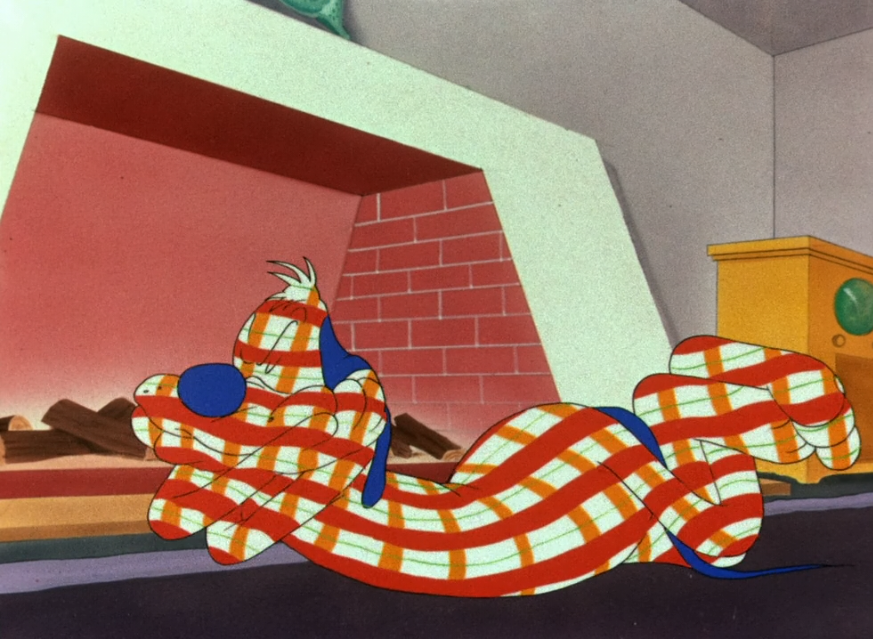
The dog's resistance from scratching becomes increasingly difficult, to the point when the dog starts to change colour. At first, the dog's body turns blue - until the colours get more absurd in the process; including a tartan look. 

The more painful it becomes for the canine; the crazier the colour choices get. The animation itself is primarily secondary in comparison to the ink and paint work. It's a very unorthodox method - but Bob Clampett enhances the pain convincingly.

Clampett's cutting style is used to an advantage as the shots of the dog struggling coincides with the flea's antics in the jungle of fur. The gags involving the flea searching for meat are hysterical in its execution. To begin with, the flea harmlessly pours ketchup and mustard on the dog's skin.


Over the course of the cartoon; the gags become more sadistic and silly - that the result is riotous. Whilst searching for more meat inside the dog's fur; the flea uses tools such as a pickaxe and a jackhammer. Whilst intercut with the dog's reactions; his struggles are much more justified.

In preparation for the cartoon's climax; the flea begins to use explosives inside the dog's fur. The gag becomes far-out when the dog scents smoke rising from his rear end. This results in a series of airbrush fireworks rocketing from his bottom - a Clampett approach of a gag indeed.

Clampett's love for edgy albeit juvenile humour goes unnoticed in a lot of his cartoons. One of his more famous dirty gags appears during the dog's frantic scratching frenzy across the living room. At one point, he halts and informs the audience, "Hey, I better cut this out. I may get to like it." Such a kinky confession is a symptom of Clampett's boyish charm.


One of Clampett's more obvious samples of juvenile humour appears early in the cartoon - during the flea's introduction. The flea pulls out a telescope to scout for potential flesh. The following shot is point-of-view from the telescope.

The flea moves across to discover a lavishly drawn rear-end of the dog. The effect of the flea double-taking and vibrantly looking back at the dog and whistling features some nice timing. An intriguing assignment I imagine for a character layout artist drawing out such lavish albeit crude detail.

Some samples of Clampett's timing blending neatly with comical action is evident during the scene of the flea escaping the dog's biting chops. The action itself is timed to Raymond Scott's Powerhouse - which was becoming a trendsetter of Carl Stalling's musical compositions.

Much later, during the dog's scratching spree - Clampett explores some fast intercutting - of an approaching Elmer Fudd. This follows into a hilariously exaggerated skid; that's so intense the dog ends up gripping its nails onto the rug.

The dog backs away as Elmer advances towards him. Once the characters are off-screen; an unseen crash is interpreted through a camera shake. Elmer walks back into the scene; with the reluctant dog attached to a door ripped off its walls.

And so; the cartoon reaches an incoherent ending. Elmer ends up scratching himself, presumably from the flea, which follows up some smear animation of Elmer scratching himself pose-to-pose.

After both characters end up slipping inside a bathtub - they are unexpectedly carried away by the flea onto a dinner plate; labelled as a blue-plate special. This leads to the flea: "They'll be no more Meatless Tuesdays", in the same rhythm of his song - delighted over not having to ration.

Such a spectacle comes as a complete surprise to the domestic cat - seen earlier in the cartoon. Losing the will to live, the cat remarks: "Well, now I've seen everything" - and commits suicide on the spot. This holds my nomination of one of the nuttiest endings in a Clampett cartoon. The gag itself has been used several times, like Horton Hatches the Egg, but ending the short abruptly during that scene - is both dark and hysterical in shock value.

For a relatively basic narrative, Bob Clampett is always full of surprises! His carefree, wild approach to cartoon filmmaking are exceeded here. His exploration of angst on the dog is a personal highlight - from both an artistic and comical perspective. The characterisation of the flea is ingenious albeit deliberately corny. The flea's uncanniness and obnoxiousness still holds up as memorable - even if Clampett's song is the prime reason. The short's ending felt a little contrived, but what Clampett does is what's given - enough to let it slide by!

Ratings: 4/5.

Sunday, 14 May 2017

415. Falling Hare (1943)

Warner cartoon no. 414.
Release date: October 30, 1943.
Series: Merrie Melodies.
Supervision: Bob Clampett.
Producer: Leon Schlesinger.
Starring: Mel Blanc (Bugs Bunny / Gremlin), Bob Clampett (Vocal effects) (Thanks Keith Scott).
Story: Warren Foster.
Animation: Rod Scribner.
Musical Direction: Carl W. Stalling.
Sound: Treg Brown (uncredited).
Synopsis: Bugs Bunny becomes tormented by a war-time gremlin who attempts to sabotage an aircraft.

How do a lot of people perceive Bugs Bunny generally? A carefree rabbit with a trickster personality. A cartoon involving Bugs Bunny becoming a victim would be entirely out of the question. In the hands of Bob Clampett, it is so the case - and how he approaches it.

Making Bugs Bunny a victim of another foil is an extremely dangerous feat; as it depends entirely on who Bugs' opponent is - based on potency and wit. Bob Clampett's choice of candidate is much more amusing and in context of his cartoon style - by having Bugs run afoul of an unseen power - a fictitious gremlin.

The origin of gremlins go back to the myths of airmen from the Royal Air Force (RAF) in the United Kingdom - the myth that gremlins are impish creatures who have the ability to sabotage aircrafts. In 1943, Welsh author Roald Dahl (best known today for a highlighted career writing children's books) was perhaps first attributed for making the myth known worldwide, by writing his first children's book for the Walt Disney Studios simply titled The Gremlins.


Roald Dahl had served in the RAF during World War II, explaining his awareness of the myth amongst airmen. For what it's worth, Dahl himself was involved in a plane crash during his post at Libya in September 1940.

Reportedly, the concept created a lot of superstition amongst many airmen. And so, it enhanced further possibilities for wartime animated cartoons. By placing Bugs Bunny in that environment, Clampett and Warren Foster don't shy away from limiting the possible consequences Bugs would face once he encounters a gremlin.

Bob Clampett must've taken a liking to the Dahl story, as well as the gremlins concept - enough so, it warranted another directed-cartoon, Russian Rhapsody which was released shortly after this cartoon.

The opening sequence has a very satisfying yet unpredictable tone. From any first-viewing experience, it's difficult to determine what Clampett has lied in store. For much of the short's first minute of running time; it's animation free - which is possibly attributed by Clampett's careless management skills.

A Clampett-esque sign gag is featured as the cartoon's establishing shot which is followed by a slow pan shot of an air base, whilst Carl Stalling plays We're in to Win in the background.

The lack of new animation is soon compensated in the following scene - which features some of the most beautiful character animation ever conceived by the studio. Bob McKimson's work of Bugs' introduction is usually hailed as a tour de force piece of animation - and rightfully so. Not only is Bugs drawn very appealingly in proportions; but he feels very human. It also serves as a welcoming opening for what's yet to appear.

Bugs is seen as his standard self - sitting on top of a blockbuster bomb, eating his carrot and reading a book which title plays on Alexander P. Seversky's book, Victory Through Air Power. Bugs chuckles over a page he's reading on gremlins - followed by a point of view shot, featuring an illustration of the creatures, along with their descriptions.


Mel Blanc adds some wonderful touches to Bugs' delivery as he reads the text, such as Bugs' misreading on "dia-boo-lickal saa-boh-tay-jee". Bugs laughs mockingly over the notions about gremlins - utilised beautifully by McKimson's acting. Bugs' mocking gesture from his line, "Oh, murder" reads beautifully.


Bugs continues to laugh skeptically about gremlins ("Gremlin! What a fairy tale! Little man. Oh brother!") - until one passes by him. And so, Bugs feels an unusual strike coming from the nose of the blockbuster bomb, causing his body to vibrate broadly. He timidly laughs until he feels another strike.

After a surprisingly calm opening sequence for Bob Clampett - the cartoon effortlessly moves forward.

So, Bugs watches the gremlin attempting to strike the nose of the bomb with his large mallet - in synchronisation to I've Been Working on the Railroad. Bugs is completely unaware of who he's conversing with. The gremlin reveals to Bugs, "The blockbuster bombs don't go off 'til you hit 'em just right!" - broadening Bugs' entranced amazement.


And so, Bugs Bunny is deceived by the gremlin into testing the blockbuster bomb, by borrowing the mallet: "Hey, Mac. Let me take a whack at it". McKimson animates Bugs with an extreme anticipation - causing Bugs to twist his body several times; until he violently halts, hollering "What am I DOING?!".


Clampett's sheer energy begins to kick in a close-up of Bugs Bunny animated by Rod Scribner. Bugs stutters and speculates, "Hey, I bet that was a -- Say, do you think that--? Hey, could that have been a...gremlin?". The gremlin, standing on top of Bugs' whiskers yells in Bugs' ears: "It ain't Wendell Willkie!".

Scribner's timing of Bugs reacting to the holler is excellent in its frantic delivery. The use of layouts and colour styling in Clampett cartoons is always intriguing. Note how in the close-up; Mike Sasanoff only uses one colour to signify suspense. It's quite a risk in changing backgrounds very drastically; but it works well effectively.

Bob Clampett conceives some of the most surrealistic gags surrounding Bugs Bunny ever turned out by the studio. Clampett's energetic gags are typically far too broad for Bugs Bunny - and yet, he experiments with it with surprisingly great results.

Once Bugs Bunny chases after the gremlin, he strikes Bugs on the head with a monkey wrench. After an assembly line of inventive smear animation by Virgil Ross, Bugs momentarily alters his persona to dim-witted Lennie from John Steinbeck's novella, Of Mice and Men.

He dimly asks the Gremlin, "Which way did we go, George?" before collapsing frontwards. Mel Blanc provides a dim-witted voice for Bugs Bunny, to enhance the absurdity of the scene. In the following close-up animated by Rod Scribner, Bugs' posing and expressions are outrageously broad and hysterical as drawings.

The Gremlin pulls open Bugs' eyelids, checking to see if he's fine. Bugs responds, quoting Lou Costello "I'm only three-and-a-half years old" (Correction: See Yowp's comment below), and then flaps his lips in a screwball fashion. Typically, such a scene like this would be completely out of character for Bugs Bunny. Bugs' typically suave disposition would normally deprive from such boundaries. Only Clampett's boyish charm and Scribner's wild animation could bring make a feat pass. The sequence still has shock value today, taking into consideration that Clampett's perilous take on Bugs Bunny hasn't been paralleled.

Clampett's broadness and dangerous experimentation don't end there. Extensive exaggeration is highlighted in a scene of a vertigo Bugs Bunny, whose heart pumps out a 4F rating. Following that, the cartoonish energy is topped as Bugs slams into the wall of the plane. His body compresses into a flat penny - and gracefully shimmers.

Animation by Phil Monroe.
Once the gremlin boards an aircraft to sabotage it; Bugs ambushes him - in a desperate plea for retribution. Bugs, unaware that the gremlin has already started the plane, looks out for the creature by deceivingly calling after him whilst holding onto a monkey wrench. The gremlin appears but kicks Bugs' rear end; whilst hiding behind the aircraft door - laughing the the first few notes of Yankee Doodle. Typical piece of added character from Clampett.

Angered, Bugs attempts to strike the gremlin with the monkey wrench - only breaking the window. This follows in a wonderfully timed, suspenseful piece of action featuring Bugs attempting to run into the aircraft doors - taking a step back farther each time, hoping for greater impact.

The action gets broader to the point where Bugs begins to violate the laws of physics. His feet start up with great anticipation, to the point were the weight of his feet causes the aircraft walls to tilt back. Phil Monroe's animation shows a great use of weight that makes a seemingly preposterous gag look believable from impact.

Carl Stalling's use of the Russian folk song, Dark Eyes fits effectively to build suspense whilst timed accordingly to Monroe's animation - which is now considered a dead art. At the right moment, the gremlin opens the aircraft door - but Bugs' impact is too great as he zips out to an open sky.


One of the short's highlights, asides from observing Bugs Bunny getting tortured, is the animation itself. Arguably some of the most inventive, outlandish pieces of animation ever cranked out by the studio. A scene worthy for analysis is seen in Virgil Ross' animation of Bugs' visual concussion from the monkey wrench that struck his head.


Smear animation dominates a large chunk of the cartoon. Some of them are more conventional, like the smear frame of Bugs, as indicated from the frame grab. Others are more far-out and brave. It's astounding how animators and assistants were able to creatively invent new kinds of smear animation - by still keeping the cartoon action maintained. At times, the stars truly have aligned when it comes to an artistic venture!

From a casual viewing experience, the smear work doesn't scream for attention - but it evidently shows the enjoyment and endless possibilities of animation.

From a cartoon standpoint, a lot of the gags conceived are fairly standard - but Clampett's animators enforce so much energy to make results more effective than what would be typically acquired. In a repeated gag of the gremlin striking Bugs with the monkey wrench on his foot - another inventive smear is thrown into the action.


The cartoon even features one of the oldest, and most cliched of slapstick gags - the banana peel. It's one of the rarest of occasions when a banana skin gag is actually inventive and hilariously executed.

Bugs Bunny zips back inside the plane after his exposure towards an open skylight. As he reenters the aircraft, he slips on several banana skins planted by the gremlin as sabotage. The action is very quick and energetic. The staging shows some strong dynamics that blends with Clampett's brisk timing. Notice how very daring the animator is on moving perspective within a a couple of frames. Both scenes provide an excellent showcase on how broad animation can improve generic gags.

For the cartoon's climax - Clampett builds up the suspense as Bugs and the gremlin race towards the earth in a diving bomber. Not only is the sequence a masterpiece in dynamics and ambitious staging - but also in comic delivery.

A speed meter that channels
Tex Avery.
The climax is kept exciting and nail-biting. Bugs Bunny has been terrorised by a gremlin throughout this short. It gets to the point where Bugs' fate becomes unpredictable based on Clampett's uncanny handling of the character.

The layout staging and fast cutting are potent in execution. The shots cut back from a diving aircraft, that's animated beautifully as its body begins to strip apart from impact. Hilarious shots cut back to a nauseating Bugs - burdened by fate and sickness.


The pacing and suspense feels like a throwback to Tex Avery's cartoon The Heckling Hare; except in Clampett's cartoon, the pacing and camera staging has far advanced.

Once the moment of impact is present - the aircraft engine sputters; causing the plane to completely halt in mid-air, barely just above the earth. The unpredictable delivery and absurdness of the punchline makes its payoff the more hysterical. In the closing shot, the gremlin reveals that the plane has run out of gas. Bugs confidently eats his carrot whilst confiding to the audience, "You know how it is with these 'A' (gasoline ration) cards" - revealing an 'A' card next to him. Although the gag itself has aged over time, there's no denying that Clampett's hilarious punchline couldn't have been outmatched.

Perhaps my favourite Clampett-directed Bugs Bunny cartoon - Falling Hare is a home run! It's wonderfully thrilling and inspiring, and yet downright hilarious. Admittedly, I'm not a fan of the savage-like persona Bob Clampett later gave Bugs in Hare Ribbin' or Buckaroo Bugs; but his experimenting on characterisation remains unparalleled. Admiration for Clampett continues to escalate by astonishingly observing the risks he took and his fearlessness. Other cartoon directors would shy away from such an ambitious experiment, but Clampett's confidence shines. As a director, he took great pride by the creative freedom he was blessed with. It remains a wonderful insight in seeing somebody outwit Bugs Bunny to terrorising levels. At the same time, Clampett remains faithful to its source material - by restoring Bugs' charisma at the cartoon's end. Overall, an excellent cartoon that holds a testament to why Warner Bros. cartoons are exciting to watch. They're original and spontaneous.

Rating: 5/5.