Showing posts with label 1930. Show all posts

Thursday, 28 July 2011

6. Box Car Blues (1930)

Hiya folks - this is another review for today - Box Car Blues which isn't really much of a dancing and singing short, it's sort of a climax short. As I will complete this review, I would've finished reviewing the 1930 cartoons - and onto the 1931 cartoons where I will review the first Merrie Melodie short in the near future.

Warner cartoon no. 5.
Release date: December 1930.
Directors: Hugh Harman and Rudolf Ising.
Producers: Hugh Harman, Rudolf Ising and Leon Schlesinger (associate).
Starring: Johnny Murray (Bosko).
Animation: Rollin Hamilton and Carmen Maxwell.
Musical Score: Frank Marsales.


The short starts off with a locomotive passenger train. It's a very cartoonie train that seems to have life and personality (not to be confused with the Disney train Casey Junior). It's a passenger train that has coaches. Inside we find Bosko and a pig friend in one of the boxcars and they appear to be migrants - or in other words: tramps. Bosko is playing with his harmonica to Cryin' for the Carolines - and the song was also a film title for the unpopular Warner series "Spooney Melodies" (title inspiration for Merrie Melodies) and Cryin' for the Carolines was known to be the surviving short.

Bosko and the tramp pig slide down the boxcar and hit the wall, (flatting Bosko like a pancake), and the long-show view shows us that the train is going uphill, at a very steep hill. There are even gags on the train going uphill and downhill. There is one, where it crosses a bridge, and the bridge is so sloppy and weak, that it wobbles when the train lands on it, and only barely carries the weight. Even another gag, where the hill is so, so steep - that the train itself crawls up like a caterpillar.

There is another gag, while the train is going uphill, and as the train crawls up - the train finds itself in a delay, with no rail tracks. So, there is a gag involved that's so extreme and crazy that I find unpleasant to watch. It involves the train pulling down the bark of the tree, with the tree's pants showing, and the tree's face pulls it back up and the train moves from the tugging from the branch's hands, and the train climbs up the rails like a ladder, and just as it's heading downhill, the last boxcar of the passage train falls off, and it's the passage train that Bosko and the tramp pig are in.

So, Bosko looks out from the roof that he's going downhill, and realizes that he's in trouble (and the pig, too), and this is the climax of the story. Bosko and the pig in danger. He is going by and calling for help, and in the meantime. A traffic lights poll is nearby, and the sign that reads "STOP" or "GO" chops Bosko's head off, and this is also another "head-cut open" gag (the first being Hold Anything).

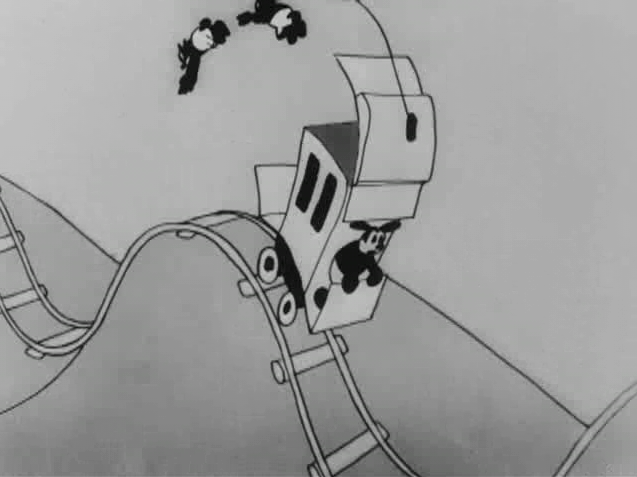
As Bosko's boxcar is going backwards, and no-one is controlling it. Bosko is going through tunnel to tunnel, and nothing major yet is happening, except that Bosko is due to get himself hurt anyhow. Whilst, he's going through a lot of tunnels - he cries "MAMMY". This short is sort of similar to Sinkin' in the Bathtub except it's boxcars - not bathtubs. This scene is sort of a reuse and even parts of the boxcar disaster scenes are reused from that short. Of course, that line what Bosko shouted for help was muted by the censors - due to racial stereotype reasons.

As Bosko, has finished going through all those dark tunnels - the railroads where the boxcar is - get so wider that Bosko's legs spread out on one half on the boxcar, and Bosko's other leg is on the other boxcar in half, which would mean he could split in half. Notice an animation error - why isn't that fat pig there on one of the boxcars - if you would say he's on at the far end side, in either one; don't give me that talk because his fat body could even be noticeable if he was animated on the boxcars.

Not only is Bosko and the fat pig at risk - but also a cattle in the middle the tracks is also at risk of being run over by the boxcar, and that's why he runs for his life. Bosko also bumps onto a lot of rocks whilst going downhill, and also telephone poles, a bunch of telephone polls. Some of those gags (I believe) had been used earlier on Sinkin' in the Bathtub. I admit, I don't like the camera angles on the scenes very much - Bosko seems to high up on the screen, that we only see a bit of his face. Although, I suppose they didn't have great technology in those days and that's could be an "early process".

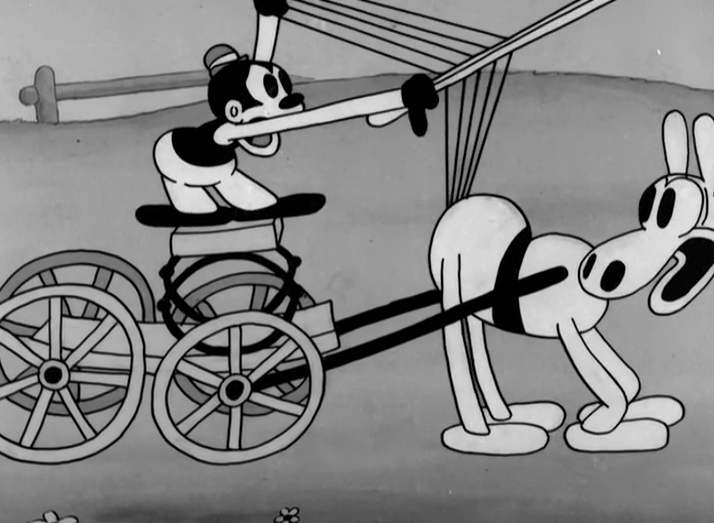
So, the boxcar crashes onto a telephone pole, and the cattle walks off safely, and Bosko and the pig make a happy landing. As they are seated, the pig holds up his umbrella to prevent him from being hurt by a rainfall of broken boxcar items. As the raindrops are clear, one falls and hits his head. So, Bosko and the pig wheel away in a cart and play the banjo, and continue being tramps.

The cartoon was a nice change from the singing and dancing, that had been produced quite often. This short is somehow reminds me of a remake of Sinkin' in the Bathtub because of the repeated gags and that there's a climax involving Bosko at peril, and the fact that Honey isn't in this cartoon. I felt the scenes with Bosko and the boxcar collision scenes just went on for too long - and we never really saw much of Bosko or the pig doing gags in this cartoon. In fact, there weren't many gags in this cartoon, except for about one or two silly ones. But, most of the boxcar scenes didn't really have gags in them at all.

That's all from my review, folks - I've now completed the 1930 cartoons and now I will be going on to the 1931 cartoons.

[2014 update: With not much to go on in this cartoon, it's a kick from watching shorts with the tendencies of just bombarding the cartoons with singing and dancing. We get a song, but we get a climax. Set in a boxcar, where Bosko and a pig character are portrayed as homeless people, with a lot of the short having scenes almost identical to the Oswald cartoon Trolley Troubles, which Hugh Harman worked on himself, especially as a lot of the climax rely on perspective animation. The climax scenes occur throughout the entire second half of the cartoon, making most of the scenes appear anti-climatic, and thus the short dragged to that effect. In all fairness, the boxcar scenes are uncanny in an entertaining way, but its a Bosko short I would skip.] 

5. The Booze Hangs High (1930)

Warner cartoon no. 4.
Release date: October 1930.
Supervision: Hugh Harman, Rudy Ising.
Producer: Hugh Harman, Rudy Ising, Leon Schlesinger (associate).
Animation: Friz Freleng and Paul Smith.
Musical Score: Frank Marsales.
Synopsis: Bosko enjoys some musical farm at a barnyard setting.


[REVISED VERSION: 19/05/2017].


Throughout Bosko's animation career, he's expressed very little characterisation. That's okay - most animated characters from 1930 didn't. A key purpose for Harman-Ising's cartoons was to lighten up the tense atmosphere surrounding the Great Depression by providing straightforward entertainment values, like dance sequences or novelty gags.

The Booze Hangs High beholds all those main elements. Bosko was merely a product of optimism and carefree spirit - a personality cherished amongst people suffering by the Depression. Previously, we've seen Bosko at a construction site or an African safari. This time the cartoon's setting is a rustic barnyard.

Although the locale in Congo Jazz suggested something adventurous - a barnyard location has a more homely atmosphere. The cartoon itself doesn't follow a conventional plot; as it's merely an experience of watching Bosko create musical melody with barnyard humour. Along with the novelty of synchronised sound and impossible gags; the entertainment values are all there. The short's title is parodied after Lewis Beach's 1924 play, The Goose Hangs High which was adapted into a Paramount film, a year later.

The short's first half is entirely centred on Bosko's antics with barnyard animals. An opening begins as a cow walking away from the camera, rear facing the audience. The influence of Disney's early sound cartoons remain strong - as the animation and staging is done in the same vein of Disney's Plane Crazy (1928).


Bosko enters the scene as he enjoys a little song and dance. The musical number is lifted from the Warner Bros. musical The Song of the Flame, whose songs were composed by George Gershwin and Oscar Hammerstein II. Their fun is spoilt once the cow's pants (?) drops; revealing a polka-dot blouse. The cow walks away after Bosko laughs.


This is soon followed with an enjoyable sequence that embellishes synchronised sound and animation. Bosko moves over to a horse and cart. He hops onto the cart, and begins to play the horse's tail hare like a fiddle.

Cartoon sound was still fairly primitive, and it feels as though the scenes of Bosko attempting to tune the horse's tail were used to entrance audience by illusion. The music is kept momentarily quiet so that a stronger emphasis of sound can be applied.

This soon follows with a musical little ride; as the horse trots in time to the music. It's a satisfying piece of character animation that's beautifully timed and fluid in motion. Despite budget constraints the Bosko cartoons were hampered with; its animation quality remains at a professional level.

Harman-Ising's barnyard humour is evident throughout the cartoon. A striking example occurs in a sequence featuring a family of ducks. The family dance merrily to Bosko's rake/banjo playing. A duckling interrupts their cue, by prodding the mother's belly - in desperate need to use the toilet.


The mother duck pulls down the duckling's bottom flap - so he can defecate away from their vicinity. The little duckling then returns, and their musical frolic continues, ending with the family landing at a lake.

It's a perfect example of how toilet humour predates a lot of modern approach to lowbrow comedy. The sequence itself is a beacon of Pre-Code cartoons, that was otherwise taboo once the Code was enforced. The gag itself today is tasteless and unsophisticated, but it reflects the rural humour which both Harman-Ising and Walt Disney favoured in their early sound cartoons.


The latter part of the cartoon is primarily centred on the antics of a pig family. Two piglets discover an alcoholic beverage inside their trough. Presumably smuggled? After all, this was still the Prohibition. Both piglets consume enough from the bottle, making them a little tipsy.


The father pig intervenes, and observes the beverage. Then, he takes a swig from the bottle and immediately becomes intoxicated. This soon follows into another musical number of the lightweight father singing nonsensically to One Little Drink.

The entire sequence itself is corny in delivery - but that's putting it nicely. The pig's "singing" is deliberately obnoxious in conveying intoxicated behaviour. It's a very charming little scene, that reflects the absurdity of intoxication. The bass voice adds to the charm, too.

The father pig accidentally throws the bottle away - shattering on top of Bosko's head. Bizarrely, Bosko also becomes drunk from the impact. He staggers towards the pig family - and briefly sings (You're the Flower of My Heart) Sweet Adeline in unison with the pig family.

A highlighted scene of the latter part of the cartoon is an out of the blue gag of the father pig accidentally regurgitating the corncob. It's a very juvenile, discomforting gag but its unexpected delivery isn't without its entertainment values.

Some nice character animation touches are applied, as the father awkwardly looks at Bosko and his piglets before opening up his stomach to place the corncob back. The cartoon ends in a finale with Bosko and the pigs dancing closer to the camera, until the iris out.

A somewhat enjoyable effort from Harman-Ising, even if it's not spectacular. The short presents a good case of entertaining its audience by watching animated images synchronised with sound. By today's standards, the enthralling experience has worn out. The Booze Hangs High is fairly standard of Harman and Ising. The cartoon does the job of entertaining its audiences with Bosko's musical talents.

An October 5, 1930 Film Daily review, reads: "Another of the cartoon creations that clicks as usual with its nutty comicalities performed to the tune of rhythmic musical accompaniment and some synchronized vocal efforts. The idea is taken from "The Goose Hangs High" and the adaptation of the lyrics from this piece to the purposes of the cartoon is quite entertaining. Activity in this instance is provided by the fantastic animals, including "Looney," engaging in the usual dancing and musical-instrument burlesquing.

Although its entertainment values might've grown old fashioned overtime; some of it still holds some merit. The scene of the pig vomiting a corncob still holds up well for its funny execution and crudeness that makes early sound cartoons enjoyable to watch.

Rating: 3/5.

Wednesday, 27 July 2011

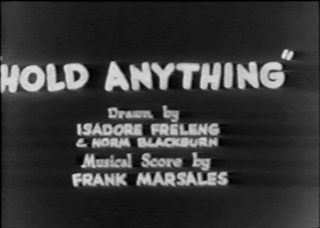
4. Hold Anything (1930)

Warner cartoon no. 3.
Release date: October 1930.
Directors: Hugh Harman and Rudolf Ising.
Producers: Hugh Harman, Rudolf Ising and Leon Schlesinger (associate).
Starring: Rochelle Hudson (Honey) and Johnny Murray (Bosko).
Animation: Isadore "Friz" Freleng and Norm Blackburn.
Musical Score: Frank Marsales.

Today's review is (of course) on Hold Anything as I'm going through this chronologically. It's the third short of the series, and it's title is a parody of an early "talkie" film called Hold Everything which is now considered a lost film. It mainly features Bosko and Honey at a construction site with singing and dancing.

The short starts off with a close up of Bosko who appears to be a worker at a construction site in a city, he appears to be drilling with his riveter and erecting beams, as part of his job. Bosko also has a couple of mice that do the job for him which is brick laying. He's playing with the tools as musical instruments - and even plunking strings of ropes, and using his riveter as a drum beat, in which it starts off the mice dancing on the bricks.

As Bosko starts off his musical beat, his group of mice workers - somehow start off dancing with their footsteps. As they step down the bricks, their feet get longer, and then as they step up the side of the bricks, their feet get shorter again. When I was watching this, I noticed that the mice are very Mickey Mouse looking - I wonder if Harman-Ising ever got sued against that, or that Walt Disney never noticed.

Just as Bosko is playing around with a saw, as one of the mouse lands in it. Unaware of safety, Bosko plays with the saw with the mouse, and it slides the mouse along with the saw sounds as the music rhythm. Until, aah - his head is cut off. That's kind of gruesome for that to appear in a cartoon, isn't it? But, I guess that's just the 1930's what else could've been done.

Just as the mouse had it's head cut off, he tries to run for his head to catch it, while Bosko is still playing with his saw, until the mouse's head finally lands back into his body. Meanwhile, as a rivet-eating goat is eating some food out of a barrell, the mouse falls off the saw, and then Happy Landing - lands into the goat's stomach. Until, the mouse opens the door and walks out.

Notice as how the goat gets annoyed that he thinks a piece of food went out of his stomach - or how did the mouse get into his belly. The mouse tips his mouse ears off to greet him. Huh, the mouse ears later became famous for Mickey Mouse ear caps.

As Bosko is high up on the beams, he demands them to load up the beam to him, and the way he does that - is that the goat's tail helps lift up the weight of the beam. The gag where the mouse turns the goat's tail around over and over, is a gag that's used very often in Harman-Ising cartoons in this era. In the next cartoons ready to be reviewed, you'll find that there are a lot of those gags that used the tail-turning gag often.

As the beam rises higher, and Bosko the riveter is going up on a different level, he spots Honey by a window in her apartment, and she's using a typewriter (I have no idea what she's using it for - writing perhaps?) and Bosko gets her attention, and then Honey writes a note to Bosko on a piece of paper, "Gee, you're swell!"

So, in the meantime - Bosko skips work for a while, and enters through Honey's window and types musical notes on Honey's typewriter - and they start to sing and boogie on Bosko's written piece. So, as Bosko is typing on Honey's typewriter as if it was a piano or keyboards. While Honey is boogieing on the sides of the windows, and shaking. There is an unappealing look on Honey's face that makes me think she looks rather ape-looking and unattractive. I know that in the 1930's, animators would get away with a lot of things, but ever since I first saw this cartoon a long time ago - it has always put me off, since then.

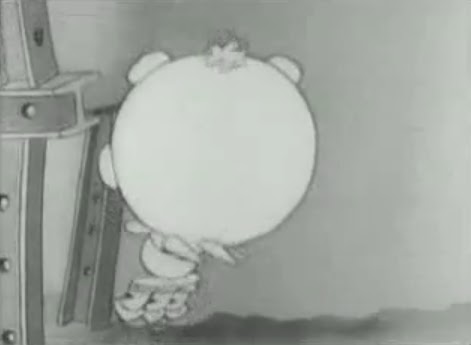
As the goat is still holding on to the beam with the ropes attached to him, he notices a tank full with hot air - and mistakes it with food, and as he walks off (the ropes come loose), and he chews parts of the whistle, mistaking it as food, he also smells the hot air, and as he bites the engine, a lot of helium is inside the goat's body and he goes up floating like a balloon. I quite like that shot, where he floats up - some very neat timing there.

Just as the goat is flying up by, Bosko notices the goat, that now looks like a hot air balloon. He steps out the window and plays with the goat like a bagpipe, that keeps Honey entertained. The gag itself doesn't work - because for one thing, the music doesn't even sound like a Scottish bagpipe at all, and it flaws in its way. Although I suppose that the directors had to stick with the music because they had to make animated shorts into musical hits.

So, as Bosko continues to play the goat as a bagpipe, he lets go all the air and helium that sends the goat to the ground as if a balloon had been popped, and as Bosko falls down, he holds the cow's utter, and milks splats on his face. Now, that is a clever gag, and quite entertaining.

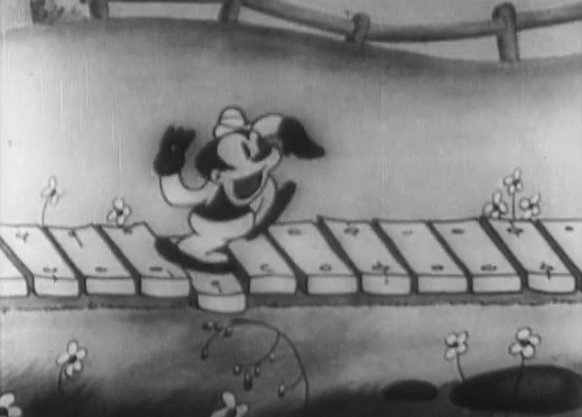
As Bosko falls down to the ground, he lands into a neat layer of bricks - ouch. As he crashes, Bosko's body multiples into smaller Boskos and he starts dancing, while the bricks are being pressed like piano keyboards. Bosko's multiples squeeze back in and that's all folks.

My own views on that cartoon? Well, I felt that the short was a hit-and-miss type. There are parts of the cartoon that work, and there are parts that don't. For example, the goat floated up as helium actually works and the udder gag, worked very well. The scenes of the goat's tail loading up the beam did work fine, but the gag does get tiring when it's used too often.

Truly, this cartoon doesn't actually have story climaxes here (even though there are some of them in other Bosko shorts), but the early Bosko shorts are just singing and dancing - and there's no major story, except the theme is on music - and the location is at a construction site. Usually, there's nothing major to brag on about it.

[2014 update: It's another music-themed Bosko cartoon where this time it takes place at a construction site. Construction played an instrumental part during the Great Depression, and it seems fitting for the time period to have the cartoon centered in the area. It's mostly consistent from the previous Bosko cartoons, but what do you expect: that's the entire purpose of the Bosko and the other Harman-Ising cartoons they made in that era, to feature in popular music and feature whatever setting or scenario pleased them, to add atmosphere to the songs.

The miniature mice soldiers at the start of the short are also parallel to the early Mickey Mouse short, When the Cat's Away, but it's kept subtle. The surrealistic gags with the goat are still comically amusing and satisfying to this day. Bosko creating musical notes from the ropes of the beam, and stepping down them like steps is beautifully bizarre and inventive. Perhaps I was tad too amateurish in expressing my views on the decapitation of the mouse's head in the saw scene. Admittedly, the scene is a little unsettling, but it has all the goods that you'd expect from animation in that era, such as the saw waving, that it makes the overall scene enjoyable, even if a little disturbing. Overall, it's a passable short for when it was made, though a little consistent when watching the Bosko cartoons together.]

Tuesday, 26 July 2011

3. Congo Jazz (1930)

I know that I've posted my Sinkin' in the Bathtub just earlier on today - but I do feel about trying to post two short reviews a day, and post as regularly as I can - on days where I'm at school - I could only post maybe once or twice during Monday and Friday - but I can't promise anything. But I'm able to post well at the moment.

Warner cartoon no. 2.
Date released: August 1930.
Directors: Rudolf Ising and Hugh Harman.
Starring: Johnny Murray (Bosko)
Produced by: Hugh Harman, Rudolf Ising and Leon Schlesinger (associate).
Animation: Carmen Maxwell and Paul Smith.
Musical Score: Frank Marsales.

This is the second ever Looney Tunes short - and it's the first time we find Paul Smith and Carmen Maxwell animating here. I've always noticed how that Bosko's voice always varies in the shorts. Johnny tends to give a Bosko a more type of falsetto voice, but there also appears to be various other unknown voice actors impersonating Bosko, too.

The first scene starts off with Bosko who appears to be a hunter in Africa hunting after wild animals that reside in the jungle and the congo area. As he's looking out for some animals, he screams with fear. It shows the audience that he is scared, and afraid that an animal would eat him. For quite a while, I've always thought that it should show some scary animals maybe popping out of the trees and to scare Bosko and that's why he would scream with fright. Not just screaming when there's nothing to be seen - otherwise it gets confusing, slightly.

As he continues to go by hunting, there is a rather peckish-looking tiger that sneaks up behind Bosko and tries to sneak up on Bosko and eat him, as Bosko noticed the tiger (by feeling his slobbery tongue licking him), he gets scared that he hides under his own trousers, and hides under there.

There's a piece of animation which I do actually quite like - and it would be later used as a popular gag - when a person is aiming the shotgun at an antagonist. Bosko pulls the trigger, and as the gun goes off - only a speck of smoke rises out from the gun, leaving a helpless bullet drop off the gun - and Bosko is helpless in that situation. So, there is a climax between Bosko and the tiger. So, the tiger has the power now.

Bosko runs away in panic from the tiger, and the tiger only manages to grab Bosko in the rear, which Bosko reacts to the pain, and squash and stretch is required for the animation, in which is body gets looser, and longer, and the tiger tries to get his claw out and rip off a part of it, but misses, and Bosko grabs the loose part of the body and tucks it back into his trousers and his normal body is revealed again. I admit, that I do actually quite like that scene. Animation could do anything back in those days, and Hugh Harman and Rudy Ising really followed that - they just did what they wanted in terms of gags and extreme ones, too. The animation of Bosko's body loose was similar animation reused from the classic Steamboat Willie.

From all the panicking and chasing going through in Bosko's mind - he somehow pulls in "imaginary" flute out of his pocket and plays with it - and discovers that the tiger doesn't fight back at all, and dances to the music and joins in with Bosko. It's a very unscientific theory, but that it is cartoons though. Bosko then mimng to the music "Here We Go Round The Mulberry Bush" that he prances around with that tiger.

Ah, moving on ever so slightly. It's shown that Bosko played the flute and sang with the tiger as a trick to get him out of his sight. As you can see Bosko dancing, there are times when the tiger interrupts and tries to kill Bosko, but gets distracted with the music, and allows Bosko to plunk the tiger's whiskers and stripy tail. He tricks the tiger by causing him to stand in front of Bosko at an edge of a cliff, and Bosko kicks the tiger out of scene, and laughs to the rhythm of the song.

Moving on slightly, Bosko discovers two small monkeys that are playing with each other. As Bosko approaches, one of them runs out of scene, and the other monkey remains. Bosko tries to pet the monkey, but the monkey doesn't appreciate it and spits in his eye. Bosko gives him corporal punishment by smacking him in the bottom, like parents used to do to their children a long time ago (some still do today). As an ape approaches in vengeance against Bosko, the ape appears to be the father of the children. Bosko, who didn't realize that their parents were nearby - and the ape is about to beat him up - and Bosko manages to find some chewing gum in his pocket, and nervously says, "Have some gum, Mr. Ape?". So, as they both share a piece of gum, another musical rhythm starts.

In this finale part of the cartoon, Bosko starts to plunk his piece of chewing gum that's grinded into his teeth, and the ape joins in, and they start to perform a piece of When the Little Red Rose Get the Blues For You in the jungle, that involves the other animals joining in and start dancing around and then a music beat enters the jungle - which turns out to be a "congo jazz". Ostriches, elephants, giraffes and EVEN kangaroos are joining into the music beat - and plants too. Huh, if this is a congo, there is a geographical problem here, what are hangaroos doing in Africa?

Like what I found weird with the bathtub coming to life in Sinkin' in the Bathtub, I find the same thing weird in this scene. Where a palm tree is dancing, and is sort of a stereotype on Hawaii dancers - with the coconuts, moving around - with the coconuts moving around like a Hawaii dancer - couldn't that be censored in that cartoon - because the coconuts sort of represent - breasts. But that is just me.

The short ends with one of the coconuts falling out and hitting Bosko on the heads, and the hyenas laugh with him, and Bosko laughs with the hyenas, which I suppose is meant to be a gag, considering they don't look close enough to a hyena - and that's all folks.

What I did think of the cartoon, Congo Jazz was that I actually preferred it to the very first short. The cartoon had that feeling where the characters did have some character there, and that we saw more of Bosko. What I liked a lot was that we saw Bosko tricking the tiger into dancing and kicking him off the edge of the cliff. The story is very simple there: it shows Bosko in the congo hunting for some dangerous animals and when he's at risk - he manages to put a stop to that by playing with musical equipments to prevent him from being killed. The short is just meant to be quite fun, and it is quite entertaining in it's ways.The animation in that cartoon was very appealing to me (particularly that very first scene of Bosko and that tiger) something I wish I could do as practice animation. The timing is wonderful - when a tiny bullet falls out.

[2014 update: With not too much to update from when I wrote the review three years ago, I do still generally agree this is an all-round entertaining cartoon. The gags were inventive, and the animation felt fresh and it was the perfect environment of a cartoon made during the Depression era. From this short onwards, the Negro stereotype of Bosko becomes less obvious, as instead he is given more of a falsetto voice, making him another addition of Mickey Mouse wannabes. The earliest Bosko cartoons, from 1930-1931, to me, are the most inventive, surreal shorts with some great imagery before they started to become more mundane]. 

2. Sinkin' in the Bathtub (1930)


Warner cartoon no. 1.
Release date: 19 April 1930.
Directors: Hugh Harman, Rudolf Ising.
Produced by: Hugh Harman, Rudolf Ising and Leon Schlesinger (associate).
Starring: Max Maxwell (Bosko) and Rochelle Hudson (Honey).
Animation: Friz Freleng.
Musical Score: Frank Marsales.
Synopsis: Bosko, in a fancy free mood, takes his girlfriend Honey for a car ride - not knowing what's ahead of them.


[REVISED VERSION 26/04/2017: To any regular readers who might be startled; this is a revised version of my review, which I intend to do throughout Warners' 1930s cartoon output. Looking back at my old cartoon reviews, I felt I had an incredibly limited frame of reference, which I attribute to my very young age upon creating this blog. I understood very little about historical/social context of the period when these cartoons were made. I've decided to add some more insight, by revising my reviews on these cartoons - to hopefully make up for my unfair interpretations of the Harman-Ising cartoons. This will gradually happen over a period of time; alongside my current reviews, of course. Instead of going back chronologically - I'll be selecting reviews to re-work, or re-arrange.]

Courtesy of the Tralfaz blog.
History hasn't been entirely fair on Hugh Harman and Rudy Ising. Amongst animation fans, they're probably best remembered for spending a lot of their animation career as competitors towards Disney. This was primarily evident during their MGM years; were they not only turned out shorts that screamed lavish production values - but were close competitions to the more lavish Disney shorts produced during the 1930s. Most of their cartoons, however were riddled with warmth and cuteness that eventually became out of fashion by the time Bill Hanna, Joe Barbera and Tex Avery were producing wilder material at MGM.

Both men begun their animation career working for Walt Disney, as animators on the Alice Comedies and Oswald the Lucky Rabbit series. They also unknowingly created strong animation legacies, such as the establishment of Looney Tunes and Merrie Melodies series. Although, this was originally an alternate series to the Silly Symphonies, except their original purpose was to promote popular songs through animated cartoons. It's a pity they missed out on the series gradually becoming one of the greatest of animated shorts during the Golden Age of Animation. While they might have had missed opportunities along the way, there's no denying they helped set the standards of animation - making them animation pioneers in their own right.

Bosko, the series' first animated star, is perhaps remembered today for being considered a Mickey Mouse ripoff - which isn't exactly the case. Bosko's design appears to predate Disney's mouse, as based on drawings by Hugh Harman which was registered at a copyright office on January 3, 1928 and identified as "Negro Boy".

Bosko's first appearance in this cartoon certainly indicates an African-American stereotype, not only in design, but by Max Maxwell's voice. Shortly after the cartoon, Bosko's stereotype wore out, and he was given a Mickey Mouse-like falsetto voice. Although his design might've predated Mickey, his personality was an imitation for the most part.

STEAMBOAT WILLIE (1928)
In 1928, a cartoon was released about a mouse who could make sound happen by playing Turkey in the Straw with pots and pans. Do I really need to say the name of the cartoon? Animation studios across America soon adapted to the change, by applying synchronised sound into their short subjects.

Not only did it help enhance the quality of their products - but it helped create endless possibilities of what's achievable in the animation medium. Meanwhile, once Harman and Ising were working on their first Bosko cartoon under contract with Leon Schlesinger, Disney was slowly trying to break away from the barnyard humour evident in his early Mickey Mouse cartoons. Other studios attempted to duplicate Disney's successes with Mickey clones - and Bosko, being one of them.

Harman and Ising's contract were to produce animated cartoons to help promote popular songs of the era. The first being Singing in the Bathtub - a song written in 1929, by Ned Washington, Herb Magidson and composed by Michael H. Cleary. Washington would later on work on the songs for Disney's earliest features, Pinocchio and Dumbo. The song was without doubt, iconic of its time. Carl Stalling even used it enough times as music cues.

Although the studios' attempts to recreate the environment in the early sound Mickey cartoons might've been evident - they're entertainment values were just as good. The opening scene of this short is a great showcase of representing Bosko in a nutshell. He whistles to Singing in the Bathtub, whilst plucking his toes and rubbery nose like a string.

Soon, he begins to violate the laws of physics, as he plucks the showering water like a harp - and later on, bends the water to a 90 degree angle out the window.In between Bosko's activities; an inanimate bathtub bounces to life as he dances across the bathroom, tossing away toilet paper like a small ticker tape parade.

Rubber-hose animation was still fairly new towards audiences; so it's clear they would've enjoyed watching animated surrealism of inanimate objects coming to life. This would've been considered the norm of animation entertainment standards; an escape from reality.

The opening scenes served as a swell introduction to the promises Harman and Ising show as cartoon directors. Not only are the visual  sight gags creative enough to enhance an audience's interest; but it sets the mood for a time period audience to be entertained.

The Bosko cartoons are a prime source for its early use of toilet humour. The gags themselves are subtle and charming; whereas overtime toilet humour has become tasteless. Examples of this includes a scene of Bosko whistling for his car, which steps out of a privy and pulls his gears up to cover its rear end.

Other scenes features Honey's introduction, who is seen bathing through an open window. From her perspective, the audience are watching her. She immediately shuts the blinds and pulls the washing line towards her - complete with her blouse nested by two singing birds, and bra.

Other revealing gags occurs later in the short. While taking Honey out for a car-ride; Bosko's path is blocked by the presence of a chewing cow. Bosko impatiently tries to signal the cow to go away, but to no avail. The cow responds by spitting on Bosko's car, damaging the front part. 

Although the early sound Disney cartoons enjoyed its fair share of toilet gags, there's no denying they were received favourably by audiences. Rudy Ising once recalled in an interview of the scene of the cow's huge udders flipping backwards, "you never heard a reaction in the theatre - they howled at it." Both Walt Disney and Harman-Ising came from Mid-Western backgrounds, and gross-out gags has often been attributed to their rural upbringing. It's possible that both Harman and Ising shared Disney's sense of rural humour.

Despite such similarities to the concepts of both Disney's shorts and Harman-Ising's - the latter were blessed with the ability to also execute creative dance numbers - by taking advantage of the impossible into rubber-hose animation.

Animation by Friz Freleng.
After an awkward moment between Bosko and a hungry billy-goat who ate his flowers for Honey - the pair engage in a brief jam session at Honey's backyard. Despite the cartoon's musical focus being the Singing the Bathtub tune; Bosko plays alternate popular songs on saxophone.


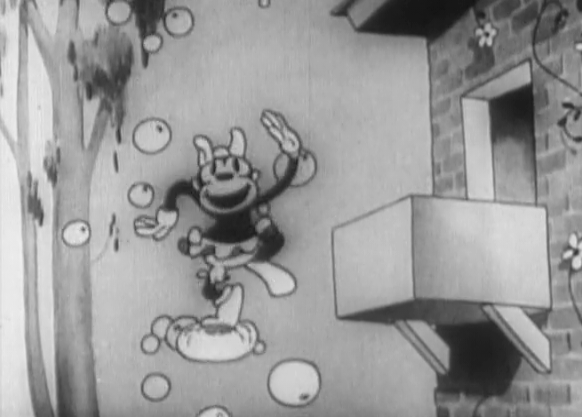
Disturbed by Bosko's sax performance on the balcony, Honey drowns Bosko's saxophone with bath water from her tub. And so, bubbles float alove Bosko's instrument when he switches the song to I'm Forever Blowing Bubbles.

For one of Harman-Ising's earliest cartoons to time their cartoons to synchronised music - they do a wonderful task on the scene of Honey dancing on the bubbles in rhythm of the song. Animating dance is difficult enough, but Friz Freleng's rubber-hose animation of Honey is nicely fluid in movement. The suggestive nudity of Honey is evident which follows after her bubble dance. As she dances broadly, her body jumps out of her skirt when she dances, which years later, would be frowned upon by the Production Code endorsement four years later.

After their encounter with the cow; Bosko's car walks them up a steep hill. Once they reach the top, they begin to descend - into a climatic action sequence. A lot of the action is reminiscent of Disney's Oswald cartoons - such as the use of perspective animation on backgrounds, and groin gags.

Attempting to hold on tight to the car's exhaust pipe; Bosko encounters a bumpy journey. He crashes on a couple of small rocks, until his groin slides through some passing-by trees, and then a series of larger rocks. The gags themselves are creative enough and fulfilled through squash-and-stretch animation.

TROLLEY TROUBLES (1927)
While Oswald cartoons like Trolley Troubles, explored different dynamics for camera angles for their action scenes; the staging in the cartoon is relatively bland. Their shots aren't quite as daring and exciting. The number of shots are relatively minimal - with an occasional close-up of a running Bosko (animated on a 12-frame cycle) impersonating Al Jolson's "Mammy" quote popularised in The Jazz Singer.

A part of myself questions whether chase sequences like these were inspired by Buster Keaton's comedic action scenes of his locomotive in his comedy The General (1926). The lack of dynamics in the cartoon's action is most possibly attributed to the studio's tight budget. A lot of the ambitious perspective animation makes up for it, however.

At one point in the chase; Bosko and Honey lose their car - and ride a bathtub instead. Their near-calamity ends when they leap off a cliff. Honey lands safely in a pond, whilst Bosko's pants are hanging onto a root branch. Nature reunites Bosko with Honey, as a hand formed from water drags Bosko off the branch. The cartoon ends appropriately with Bosko playfully performing the cartoon's popular song a la xylophone.

Sinkin' in the Bathtub is an important cartoon as far as legacy goes. It began with a procession of milestones that would later lead the path of some of the most hilariously executed cartoons of all-time. The cartoon itself, however, isn't entirely significant as far as production/entertainment values go. Although most of the gags and sequences are imitations from their former boss' earlier cartoons; the cartoon itself is still enjoyable for the most part. It serves as a great premise of establishing the Looney Tunes series - to promote popular cartoons in animated fantasy. The confidence of Harman-Ising is evident in the cartoon, and it's small wonder the cartoon itself was enjoyed by audiences. The earliest Bosko cartoons remain the most entertaining from Harman-Ising, until the formula got repetitive and unambitious (with small exceptions being Bosko in Person).

Rating: 3/5.