Friday, 22 July 2016

406. The Aristo-Cat (1943)

Warner cartoon no. 405.
Release date: June 19, 1943.
Series: Merrie Melodies.
Supervision: Chuck Jones.
Producer: Leon Schlesinger.
Starring: Mel Blanc (Cat / Madam / Meadows  / Bulldog / Hubie), Ted Pierce (Bertie).
Story: Ted Pierce.
Animation: Rudy Larriva.
Musical Direction: Carl W. Stalling.
Sound: Treg Brown (uncredited).
Synopsis: Meadows, the butler, quits his job after a series of practical jokes from the pampered, family cat - leaving him helpless and a victim of two trickster mice: Hubie and Bertie.

Animation by Ken Harris
The Aristo-Cat is a prime example of an innovative idea of cartoon storytelling, but happens to lack substance and creativity. Ted Pierce pitches a narrative that would prove to be a landmark in the short-lived Hubie & Bertie series. The concept focuses on two mice who take advantage of gullible cats by deceiving their minds.

As a formula, it writes itself, as well as a step in the right direction for potential comedy. While Pierce set the standards and characterisations within this cartoon, it's lacking gags and creativity.

Chuck Jones once mentioned in a Greg Ford and Richard Thompson interview that Pierce was, "good at structure, and it was a humorous structure---but it wasn't gags" - which is the gist of this short: a solid story premise, but the result are only moderately funny. Ted Pierce has written many wonderful cartoons that showcase his work better, but the results in this short, show several missed opportunities with the story he conceived. Michael Maltese would use the formula to a greater advantage in later shorts, like the Oscar-nominated Mouse Wreckers.

Pierce's sense of story structure is put to good use in the opening scenes. Pierce's opening is largely exposition, as it follows the perspective of the butlers' daily routines, and the burden he endures from it. One of his principal duties is to take care of a pampered, spoilt cat (an early prototype of Claude Cat) who takes pleasure in creating practical jokes on the butler, Meadows.


Ted Pierce at work: hinted profanity!
As far as Ted Pierce gags go; the practical jokes performed by the cat are more harmless and mischievous in contrast to Bugs Bunny and Daffy Duck. While it might not be savage, it shows a clear portrayal on the cat's pampered life - that sets in motion for what what is come.

These pranks include the cat squirting grapefruit juice that fires directly onto Meadows' face; or sliding a bar of soap across the bathroom hall for the butler to expectedly slip over. The results repeatedly end with the cat laughing at Meadows' misfortune.

This leads to the straw breaking the camel's back, as Meadows resigns from his position as butler and storms out the house. Struck by the recent circumstance, the cat turns vulnerable and frightened as he helplessly calls out to Meadows in a large, secluded mansion. The transition from a spoilt cat into a helpless one is beautifully portrayed with rich character animation; which makes a great satire on the pampered upper-class being unable to look after themselves and deal with independence.

Without doubt, John McGrew's avant-garde layout & colour styling is a visual tour-de-force, and the most perceptible element of the short. Since much has been analysed on the geometry and graphicness of the designs, and rightfully so; I feel the colour styling is utilised better to depict mood and tone.


This is evident in the transition of the cat's mood from indulge to panic-stricken. The scenes of the cat relaxing inside his bathtub depict the use of blue to emphasise the easy life the cat lives, with the light touch of colours to enhance the mood. The design and pattern is kept simple and consistent, like the life the cat lives.

For the fast-paced scenes of the desperate, helpless cat - the colour and layout styling shows a greater contrast in atmosphere and emotion. The heavy emphasis of red enhances the cat's predicament beautifully and effectively.

The use of pattern becomes more complex and abstract, seen as a clever portrayal of the confused cat having to face a reality that's more intricate from the easy life. Notice how the blend of red and blue colours on the shelves of books perfectly conveys the action of the scene. The cat is cornered by the shelves of books, feeling trapped and uncertain ("Good grief. I'm all alone. Who'll take care of me? Oh, I'll starve to death!"): perhaps this could be a visual metaphor that the cat is "marooned"?

Chuck Jones creates his own dynamics as far as experimentation goes. The opening sequence of Meadows entering the cat's bedroom is paced in a very cinematic style - channeling a little from Frank Tashlin. This featured a string of quick cuts of Meadows opening the door, a POV shot, opening the curtain, etc. , all complete with elaborate effects animation - like the door swinging open.

More intriguing effects occur again in the cat's panic-stricken episode. While a lot of the colour styling and layout are evident in the medium-shots, the close-ups have an alternate, compelling effect.

As the cat yells "Meadows!" in close-up; the backgrounds animate in perspective of the camera movement, which captures the mood elegantly and sharply.

While the first half of the short was all about exposition, the second half is primarily when the narrative structure goes into a different path. This leads to the cat and the cartoon's first exposure of Hubie and Bertie. Uncertain of what a mouse looks like, the cat backs away from Bertie, terrified.

Perturbed, Bertie tests the cat's vulnerability as he pathetically says, "Boo"...causing the cat to corner behind a curtain. He then calls Hubie over, where the catchphrase is first heard: ("Hey boid, come 'ere!").

Hubie performs the same actions - leading to both mice exploiting the cat's confused state and raiding the food in the house freely. As they feast in a block of cheese, the cat asks timidly: "Could you, sir--? Uh, I mean, would you--? Would you please give me a little of that cheese? I'm simply famished!". Correcting him that cats eat mice, the pair decide to deceive the cat into "locating one" of the wrong kind.

While the sequence is pivotal in setting the agenda of the remainder of the cartoon; the pacing and structure is pretty sloppy from both Chuck and Ted. Rather than take advantage of more opportune gags the mice could've pulled on the cat; their first encounter comes across as dull and repetitive in action.

The scenes of Bertie conversing with the helpless cat suffers from too much filler - especially as he repeats the same question: "You dunno what I am?" and "You dunno who I am?". Those issues could be said the same way with the opening sequences; as the exposition and build-up took up almost half of the short's plot - giving constraints for more creative gags in a limited cartoon length. An important sequence as pointed out, it's padded longer than what it needs to be. On a side note, it's interesting to see how Chuck Jones would swap coat colours on Hubie and Bertie in their later appearances.

And so, the mice trick the cat into identifying the bulldog as a mouse. Although skeptical, the cat is intimidated by its sheer size and strength; but the mice's manipulation convince him so. Despite timing constraints with the plot; the awkward encounter between the cat and the bulldog lives up to the standards of Chuck's knack for conceiving great pantomime.


The sequence is largely dominated by Chuck Jones' sense of pantomime and personality animation. Bobe Cannon's character animation show beautiful lines of action, in which both characters communicate and read clearly.

The face-to-face encounter of the two foes is a hilarious presentation of Chuck's genius in sincerity, mood and characterisation. Stalling's music creates some appropriate suspense as the cat and dog raise their jaws slowly, a turn at a time.

Intimidated by the bulldog's superior size; the cat sheepishly leaves the slices of bread on his head, and attempts to discreetly tiptoe away. The tip-toe action is a beautiful piece of character acting, as it's sincere right down to the frame. Chuck's knack for innovative, hysterical facial expressions is laid bare in that one pose. Stalling's mastery in rapidly changing music depending on mood and pace is all evident here.

After taking a savage beating from the bulldog; the cat crashes through a window and is faced upon an open book. Opening his eyes, he discovers the true identity of mice based on the book illustrations. Chuck's build on suspense is riveting as well as highly entertaining. While the cat's menacing glare at the mice is beautifully expressive, Hubie and Bertie's troubled and sudden exit is priceless.


Unfortunately, the short goes downhill again, during the chase sequence. The action as depicted makes a dull, viewing experience which doesn't live up to the fast-paced standards Chuck had finally accomplished on action scenes like Super-Rabbit.

While the cat's mistake in biting his own tail in bread slices is slightly amusing; the unseen violence of the dog pounding the cat inside the doghouse, isn't. The violence interpreted by the shakiness of the doghouse looks wooden and sloppy, timing-wise. The action dissolves into a match cut of the cat's bed reacting wildly.

The cat awakens from his bed, relieved and recovered from what was a nightmare all along ("Gosh, what a terrible dream!"). Spontaneously, Hubie & Bertie and the bulldog also arise from the cat's blanket, responding: "Yeah, wasn't it?"--ending the cartoon with a rude awakening.

From an artistic point-of-view; it's a visual masterpiece that's beautifully abstract and representing some of John McGrew's very best work. McGrew was known for producing his layouts in colour sketch; to show the background artists what he envisioned, and his use of colour styling in this short is completely carried out and utilised. It's a pity that a visual experience of a cartoon is hampered with a relatively thin story from Ted Pierce. Although the premise and concept is original, and shows promise of comedic values; it hasn't yet been properly managed - resulting in some sluggish pacing and filler. The short remains only moderately funny with Chuck Jones' true genius appearing sporadically. Despite being the first attempt at handling such a formula, Hubie and Bertie's debut wasn't a wasted opportunity at all--as Michael Maltese would enhance the characters and the formula by the late 40s.

Rating: 2.5/5.

Wednesday, 13 July 2016

405. Jack-Wabbit and the Beanstalk (1943)

with BUGS BUNNY
Warner cartoon no. 404.
Release date: June 12, 1943.
Series: Merrie Melodies.
Supervision: Friz Freleng.
Producer: Leon Schlesinger.
Starring: Mel Blanc (Bugs Bunny, Giant).
Story: Michael Maltese.
Animation: Jack Bradbury.
Musical Direction: Carl W. Stalling.
Sound: Treg Brown (uncredited).
Synopsis: Bugs Bunny is confronted with a dim-witted giant, when he attempts to invade his "victory garden".

A cartoon plot involving Bugs Bunny confronting an opponent who is immensely larger than Bugs would make a great parody on the classic Jack and the Beanstalk fairy tale. Bugs Bunny has to elude himself against a dim-witted giant--by taking complete advantage of his slow intelligence.

Michael Maltese conceives a great opponent for Bugs by having the giant with the persona of Lennie Small - and extending his opportunities for gag values and comedy. Maltese would, again, use the formula twice, in Lumber Jack-Rabbit and Beanstalk Bunny.

Although the fairy-tale parody is apparent, there's no hiding that the cartoon also contains a WW2 theme. The giant claims to be more powerful and potent than Bugs Bunny due to his size and intimidating appearance, while Bugs uses his wits to have the last laugh. The opening scene of Bugs trespassing the giant's "victory garden" is also a subtle giveaway.

The giant is an allegory on Nazi Germany and their Allies, who were also arrogant about their power - and by the time of the short's release: they were already beginning to lose the war. The giant's portrayal as dim-witted and arrogant is also a reflection on the theme, whereas Bugs Bunny lives up to the "Scientia potentia est" aphorism.

In formulating the giant's stupidity - most of it is carried out via dialogue. Michael Maltese leaps at the chance of conceiving unforced, hilarious dialogue that conveys the giant's ignorance so believably, that it's almost transcended. A lot of Maltese's lines are delivered with a subtle approach: as evident in the line "You think you're pretty C-A-T, smart, don't ya?" when the giant traps Bugs inside the glass.

Animation by Phil Monroe
Maltese's flair with dialogue is better exhibited in the scenes during the aftermath of Bugs' glass cutting act. After Bugs leaves the glass; he places a sign reading: Back in 5 minutes.

Then, the giant looks at his watch (in the form of a grandfather clock) where the hands on the clock fade to fifteen minutes later - the fade in manipulates time emphasising time passing on, and Bugs not intending to return in five minutes. The giant responds in perhaps the funniest quote in the entire short, "Wait a minute! He tried to pull a fast one on me, eh? Duhh, well he can't outsmart me, because I'm a moron!". It's a classic example of Maltese's genius in writing dialogue that deliberately contradicts the said statement. On a plus note, Mel Blanc's voice delivery on the giant feels so natural and effortless that the ignorance feels very human.

Maltese's talent in exploiting character personalities with innovative gags is laid bare in the duel sequence between Bugs and the giant - animated by Dick Bickenbach. Bugs states the rules: "You take twenty paces, toin, and fire!". Owen Fitzgerald's layouts take advantage of the gag as the giant takes huge steps as he counts with the camera pan revealing a distant giant on the horizon.


Bugs tricks the giant as he pretends to walk twenty paces - he chuckles ("So long, joiky! Send me a postcard from Alburqoique!" and comments on his own intelligence and success: "Y'know, I'm so smart, sometimes, it almost frightens me!".

Bugs is prepared to eat those words as the giant returns from the other side - indicating he has walked the entire planet in less than twenty steps. The gag is brilliantly executed with strong emphasis of the giant's size - which is proving to become a potential threat to Bugs Bunny. It's a masterful sequence not only from Maltese's genius; but also Fitzgerald's complex layout planning to achieve such a feat.

Animation by Gil Turner
Bugs' ways of exploiting the giant's intelligence or his own survival is evident in sequences like the glass cutter. The giant is momentarily victorious when he traps Bugs Bunny inside a cup glass. While the giant's scheme was more physical; Bugs' is more calculating and spontaneous. Bugs' streetwise, spontaneous scheme is spotlighted in a ruse as he entices the giant by creating a notion he's seeing a special act - an act that promises the demonstration of an astonishing glass cutter.

Bugs adds more believability to his stunt, with the help of advertisement signs complete with attention grabbing headlines that are fetching enough in taking advantage on the giant's naiveness. And so, Bugs cuts out a perfect outline of his body, and then walks freely out of the glass. The "Back in 5 minutes" sign adds the touch.


Bugs' demonstration of palm-reading to the giant also presents a good case in Bugs' quicks wits outmanoeuvring the giant's beefiness. The giant has grabbed Bugs and intends to crush him with his bare hands. Spontaneously, Bugs deceives the giant into thinking he's got an absorbing palm with hidden personality qualities of the giant.

Bugs showers the giant with compliments, like, "I'll bet you're a regular Don Juan with the ladies!" - making the giant bashful and coy. Bugs masquerades his sympathies with a flair as he whisper's into the giant's ears with some tips and advice.

The shot of the giant's ear blushing as Bugs whispers inside it is a subtle innuendo where Bugs' few pointers can be left open to interpretation.

Friz Freleng's comedic timing is put to great use for when certain gags meet. A meticulous director, Friz would add subtle little touches in whatever piece of action was given to him. For instance, the shot of the giant slamming the glass cup on Bugs Bunny is very attractive - as a gag of Bugs jiggling side to side, which is enhanced by Treg Brown's marvellous use of sound.

Animation by Gerry Chiniquy
Moreover, Freleng's comic timing is especially called for in a scene involving the giant's eardrums. Bugs Bunny notices the giant's eardrums inside his ear; and proceeds to have a "jam session" inside. It's a funny gag of Bugs producing some jazz-like rhythm; which is boosted with Freleng's direction of the giant's face aligned with the rhythm.

Gerry Chiniquy, the animator on the scene, captures the crispness of Freleng's timing, as well as the accentuation and emphasis of the beat beautifully.

Some of the dynamics in Owen Fitzgerald's layouts are elaborate in its detail - especially on the shading around the giant's face. In the scenes that follow of Bugs hiding in the giant's scalp - the size and scale give the area a world of its own. Bugs explores and goes through the giant's hair like jungle vines.

As the giant places the hat on top of his head - the atmosphere definitely has a dark vibe towards it. The war-related gags seem like an appropriate touch as Bugs walks around the dark scalp, startled: "Hey! What is this, a blackout? I didn't hear no si-reen!".

So, Bugs strikes a match inside the scalp to observe a way out. A POV shot reveals the hat size to be "107 1/2". An off-screen voice yelling: "Put out that light!" is spontaneous and charming in its delivery. Bugs reacts to the yelling and accidentally releases the match - creating a cloud of smoke underneath the giant's hat.

After a series of gags and comical situations between Bugs and the giant - it all breaks out into a climatic chase. Stalling uses Raymond Scott's Twilight in Turkey inventively along with Friz Freleng's innovative timing. It's perhaps one of the earliest uses of Scott's music (the earliest, I think, is Greetings Bait); whose music was connected and immortalised in the studio's most successful years.

Bugs finds a way out as he approaches a beanstalk complete with an elevator; which he acknowledges as "modern design". He disguises himself as a bellboy and tricks the giant from entering the elevator by ordering to: "take stairway to the left".

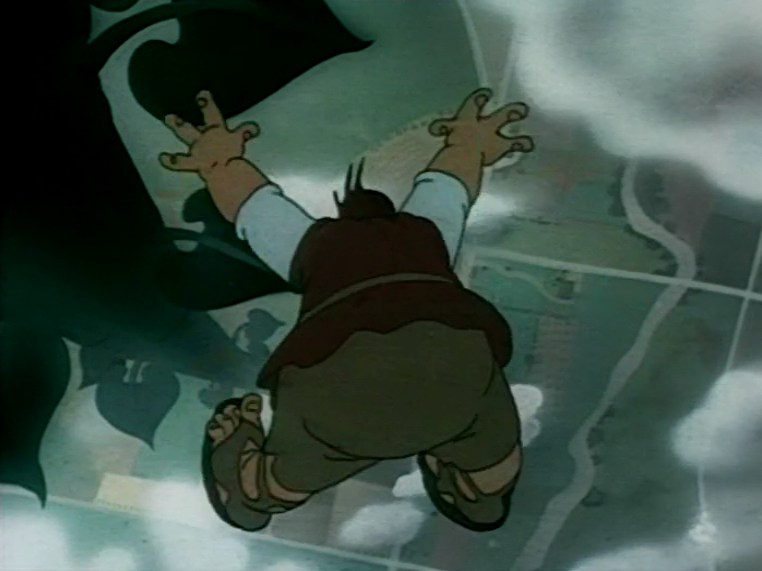
The giant's fall is a possible homage to the cinematic experience of the iconic falling sequence in Tex Avery's The Heckling Hare. While it's certainly not as long - there are several dynamic shots used to emphasise the fall.

Bugs reaches to the bottom of the beanstalk where he witnesses the giant's crash. From the outlook of Bugs' take - the crash is interpreted as somewhat horrific. The camera pan reveals the giant has created a large hole in the form of a canyon, based on the impact of his fall. He gets up and warns Bugs, "Look out for that foist step! It's a lu-lu!" - ending the cartoon with a laugh.

Jack-Wabbit and the Beanstalk is primarily an underrated Bugs Bunny entry, which is usually overlooked amongst fans. This needs to change. The short features an excellent representation of strength vs. wits turned into an enjoyable viewing experience. Although the short has war themes - it's kept really subtle, and blending it as a fairy tale parody works effectively to the point where the cartoon hasn't dated much. It also adds some insight into Bugs' character as he occasionally becomes vulnerable against the giant's strength, and his quick wits and spontaneity are portrayed believably. Michael Maltese has a strong flair for character development and gag sense which blend together wonderfully - and his take on the giant is perhaps one of the funniest characters, with a dim-witted persona, ever! Friz Freleng shines at the opportunity by utilising his knowledge of music that are put to effective use on gags like the giant's eardrums.

Rating: 5/5.

Tuesday, 12 July 2016

404. Tokio Jokio (1943)

Warner cartoon no. 403.
Release date: May 15, 1943.
Series: Looney Tunes.
Supervision: CPL. Norman McCabe.
Producer: Leon Schlesinger.
Starring: Mel Blanc (All voices)
Story: Don Christensen.
Animation: Izzy Ellis.
Musical Direction: Carl W. Stalling.
Sound: Treg Brown (uncredited).
Synopsis: A U.S. propaganda short featuring a newsreel "captured from the enemy" reveals Japanese propaganda in a string of gags and stereotypes.


NORMAN McCABE
Norm McCabe's last directorial short for Warner Bros. as he went to join the army. As often said, McCabe never got the chance to leave a lasting impression for his contributions to the Warner Bros' animation legacy. While this is attributed by his short tenure as director, but so are the style of cartoons he turned out. It's a pity McCabe is mostly remembered for his war-themed cartoons that are today considered immoral in our "politically correct" generation. Perhaps the most striking example of that would be Tokio Jokio.

Not only is the cartoon incredibly dated in its references as well as extremely offensive and racist in its stereotypes; but it's a testament to how hurt America had been since it's infamous Pearl Harbour attack in 1941. Without a doubt, the short would've been successful and appropriate amongst audiences in its original release.

The short is presented in the form of a typical Warner Bros. sight-gag cartoon. The opening scene features a voice-over explaining that the short is merely a Japanese news reel that was "captured from the enemy". The theme is on "Japan-nazi" propaganda - depicting and criticising the Japanese in the lowest form of humanity as being weak, incompetent and foolish.

The caricatures have stereotypes all-over - as the Japanese are presented as skinny, wearing glasses and having giant teeth. While many cartoons considered immoral and politically incorrect today weren't intended to be harmful or racist towards stereotypes - this is the short's purpose. Since both countries were at war with each other and fighting for survival - the stereotypes themselves were intended to give audiences some sense of superiority and optimism. It is my intention to review the cartoon, not only reflecting on historical/social context - but entertainment values in 1943.

The sight-gag primarily attack the Japanese government for their poor treatment of defending their civilians and industry - which are satirised in several sequences. A striking example occurs early in the cartoon where the Japanese narrator presents the nation's "finest air-raid siren". The siren, of course, is heard from two Japanese citizens who prick each other's rear ends with a needle to create a screeching effect.


As tasteless as the gag has become over time, it symbolises Japan's poor handling of civil defense and how pathetic it's presented in comparison to the U.S.

The cooking sequence is another satire on Japan's home front; which was unorganised as the government concentrated more on their propaganda...creating many factors in the process. The sequence features General Hideki Tojo as a cook, as he demonstrates on how to make a club sandwich by using ration cards.

It's an exaggerated take on Japan's food rationing to bring the notion towards American audiences that their home front is inferior. The sequence is further exaggerated as the Tojo cook hits himself on the head with a club--portraying Tojo and the government as ignorant.

The short interprets Japan's military production as poor as indicated in a few sequences. In a scene which features the Japanese Navy at sea - a submarine enters the shot as the camera pans slowly underwater. The narrator reveals it was released "three weeks ahead of schedule". Indeed, it's still being constructed as it operates underwater. The submarine crashes off-screen with several deaths as depicted from Carl Stalling's Taps cue.

From the perspective of a 1943 audience member; it would've been a great showcase on how incompetent the Japanese were. This is also showcased in the 'victory suit' gag. The "Victory Suit" was a civilian fashion in the U.S. during WW2 as part of the war effort - lacking excess fabric and containing low quality wool...which were seen as bigger priorities for military uniforms.

Here, the fashion is parodied with a "Japanese Victory Suit". Expect this to be another gag mocking the Japanese home front and military production. A vertical camera pan downwards reveals an advertisement for the Japanese victory suit. At first, it reads "no cuffs", "no pleats" and "no lapels" which was the definition of the American suit. Then, the narrator announces: "no suit!", with the camera panning downwards to reveal an almost naked Japanese man freezing in the snow, as he tries to warm himself with a candle.

Other sequences poke fun at satirising Japanese society such as the incendiary bomb scene. The scene is presented as an educational guide on them. The text fades onto the screen on not approaching them within the first five seconds. An unsuspecting Japanese citizen walks into the scene, and counts the seconds with his watch. Then he walks over to the bomb to roast a sausage until it then detonates.


After the explosion his face is seen missing, with his glasses and hat still in the same position. The quote: "Ah! Rosing face, please! Rosing face!" is a direct pun on the Asian sociological concept of "losing face"...indicating the man has dishonoured himself - which is considered shameful in Asian culture.


Asian honour is also satirised in a scene featuring a suicide mission of a Japanese naval solider riding a Kaiten human torpedo. Honour suicide was a common attack during the war; were not only Banzai charges and Kamikaze attacks allowed Japanese soldiers to die with honour, but also used in attacking the enemy. It was also considered an atonement for any misconduct or disgrace from any civilian.

According to the narrator: "But he-a not caring, are you happy gentleman?", and asks the soldier, "Have you anything to say?". The soldier responds. "Uh, no, nothing except - LET ME OUT OF HERE!". It's a gag which was conceived to intentionally offend Japanese people by mocking their honour - and indicating that some soldiers aren't as honourable.

The spot-gag parody on Japanese propaganda wouldn't be complete without its own mockery on Japanese politicians and generals - as seen in the "Headline Poisonalities" section. The most revealing is the sequence on General Isoroku Yamamoto, who is perhaps, today best remembered for being responsible in planning the attacks on Pearl Harbour. His height is caricatured as he walks in stilts, to give him a taller appearance.


Yamamoto reveals his plans to "dictate peace term in the White House". An Editor's note title card reveals a reserved room for Yamamoto - which is revealed to be an active electric chair.

What's most intriguing about the sequence is the timing of Yamamoto's death and the cartoon's release. The general had been assassinated when his plane was shot down by an American fighter squadron in the Solomon Islands - a month before the cartoon's release. The cartoon was made while Yamamoto was still alive; even though the gag might've seemed even out of place by the time it was shown in theatres.

While the Yamamoto sequence was an approach to dark humour - the scene featuring General Masaharu Homma is more or less in the style of Warner Bros. spot-gag - with contradictory dialogue. The narrator observes the "coolness and calmness of Japanese Officer in air raid". The real scenario reveals the exact opposite as a frantic Homma frantically rushes around the forest before ducking underneath a tree log. Once he sticks his head out the log, a skunk does the same. Adding insult to injury, the skunk reappears with a gas mask on his head.

The "Flashes on the Axis" segment takes a brief break from the sustained Japanese stereotype - save for the voiceover narration. The segment focuses primarily on Japan's allies: Germany, Italy, and a caricature of William Joyce, an American-British radio broadcaster and Nazi sympathiser known as "Lord Haw Haw" by nickname - and caricatured with an ass' head named "Lord Hee Haw", hence the visual metaphor. He is the broadcaster on the segment.

Animation by Art Davis.
While the stereotypes might still be frowned upon today - admittedly, they are more forgiving and less offensive as the sequence pokes fun on the actual enemies, like Adolf Hitler and Benito Mussolini. The Hitler scene features an admittedly amusing gag of Hitler twitching his moustache like Charlie Chaplin, as he reacts to a postcard he received from Rudolf Hess, reading "Wish you were here".

The irony of Hess' message is exposed as Hitler turns the postcard over that reveals Hess held captive in a concentration camp - (whereas in reality, he was held in British custody). The kiss marks written on the letter also adds to the touch.

The Rome scene is another addition to the lame puns from the multiple Warner Bros. spot-gag cartoons. The narrator observes the infamous ancient ruins as seen in a horizontal camera pan. The camera quickly pans to reveal "ruin #1" which happens to be Mussolini. Personally, I don't think Mussolini has ever been properly caricatured in animated cartoons. The caricature is primarily focused on the chin and the lips. His forehead is treated generically, which is probably one of his more revealing facial features.

Despite the cartoon being riddled with offensive stereotypes almost everywhere - some scenes showcasing McCabe's coming timing are hard to criticise. The opening titles for the news reel is perhaps one of the more offensive gags. To begin with, the title of the reel is "Nipponews of the Week", which features a rooster (a direct parody of the Pathe news reel opening) who is anticipating a crowing noise.


As he does, he changes into a Japanese caricatured vulture, who is portrayed as scheming and evil as the Rising Sun flag appears. The stereotype is further emphasised as the vulture says: "Oh, cock-a-doodle-do, Prease!". As uncomfortable as the scene might be; McCabe's timing is pretty impressive.

The sports segment is another prime example of that. The gag and caricature of the sports commentator is in such bad taste that it's impossible to not find it in the least bit amusing. In a sudden iris out; his mouth gets stuck in the circle - that it falls off and clutters into the ground. Again, the timing and imagination of the gag doesn't fail to impress.

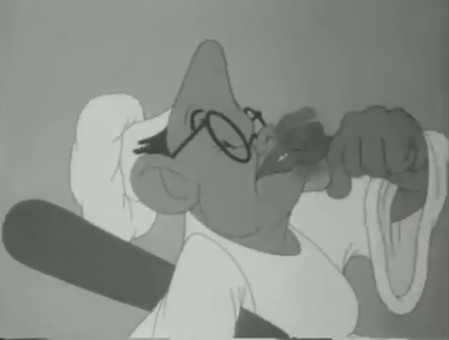
The following scene is more of a satire of Japanese sport players who are also illustrated as physically weak. The player indicated on the screen in a baseball outfit is considered to be the Japanese equivalent of Babe Ruth. Once a fly flies into the scene; the player attempts to swat it but misses and spins in a circle. While the gag might've been an arrogant in emphasising America's superiority; it turns sadistic and unnecessary when the fly responds by grabbing the swatter and whacking him with it.

With offensive stereotypes asides; the short has its share on lame, corny puns that spot-gag cartoons are heavily reliant on - as seen in the ancient ruins scene. One scene in the "civilian defense" segment reveals a listening post - which is nothing more than a pole with key holes covering it. The pun on the aircraft spotter is even more cringeworthy as the plane is literally being painted with spots.


The final segment featuring literal interpretations of marine boats is also riddled with typical visual puns, especially the "minesweeper" gag - which features two mechanical hands sweeping mines away with a broom).

When the ship accidentally explodes - a buoy is featured in the sea with a sign reading: "Regrettable Incident Please". So, the short ends which pokes fun on another Japanese stereotype where they're portrayed as being over-polite. Nevertheless the gag itself doesn't pay off with the results being lame.

It's almost impossible to give the cartoon a rating without giving consideration on historical/social context. While the humour has become outdated and offensive within today's modern society; it's still a fascinating piece of history reflecting on the attitude America had towards their enemies. Withouy a doubt, the short would've been effective on American audiences in giving the notion of hope and patriotism. It's perfectly understandable that the racism would cause uncomfortable viewing, but it can't be judged out of context - especially as history can't simply be ignored and written off. Therefore, the short would be better off viewed today purely for historical purposes, rather than for entertainment--as the stereotypes were certainly intentional. With racial problems asides, it's otherwise, an insipid cartoon, complete with gags that felt forced and stale. While McCabe shows moments of competence as a director - the short remains remotely unfunny, dated, and uncomfortable to watch.

Rating: 1.5/5.