Thursday, 9 July 2015

378. The Squawkin' Hawk (1942)

Warner cartoon no. 377.
Release date: August 8, 1942.
Series: Merrie Melodies.
Supervision: Chuck Jones.
Producer: Leon Schlesinger.
Starring: Kent Rogers (Henery Hawk), Ted Pierce (Male chicken), Sara Berner (Mother Hawk / Hen).
Story: Michael Maltese.
Animation: ?
Musical Direction: Carl W. Stalling.
Sound: Treg Brown (uncredited).
Synopsis: A young chickenhawk is tired of being treated like an offspring, and goes out to claim a chicken of his own.

And so the blog marks the first appearance of our tenacious little chickenhawk: Henery, though only named "Junior" in the cartoon. A Chuck Jones creation who mainly appeared in Bob McKimson cartoons in his repertoire of Foghorn Leghorn shorts. Great directors whom both did good interpretations of the character.

Unfortunately, the copyright catalog doesn't give any indication on story credit of the cartoon, and the fact it's "Blue Ribboned" doesn't help. Digging a little deeper, Michael Barrier's wonderful book: Hollywood Cartoons indicates this was Michael Maltese's first work for Chuck Jones, based on a reliable source from a Chuck Jones 1979 interview who confirmed Maltese wrote the story, while he was still a "floater". Judging by the short's narrative and witty scenarios; it's very strikingly like Maltese's work.

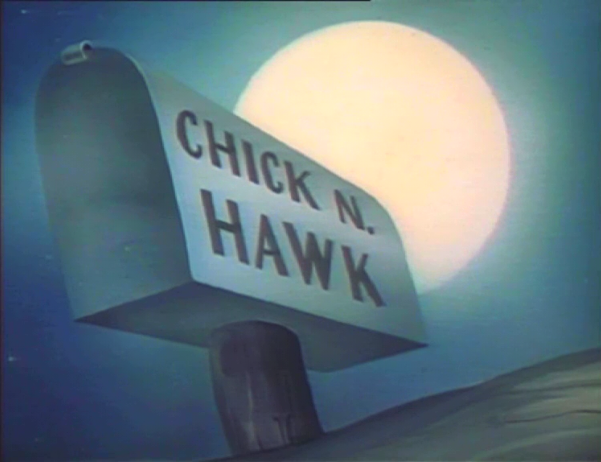
Maltese sets the pace of the opening sequence to a fine start. The establishing shot features the household residence of the appropriately punned, "Chick N. Hawk"; and the camera pans to a silhouette shot of Henery arguing with his mother. Henery is resistant about eating a puny worm, despite his encouragements.


The next scene quietly sets the focus on the worm, whilst the argument between Henery and the mother are kept crucial. The worm is torn at two sides of the argument; he cheers on Henery when he refuses to eat the worm, but his mood quickly swings to melancholy and defeat when the mother insists: "Eat the nice worm!".
Chuck's expressions works to a tee, and it's a very clever scene of showing the worm's perspective without losing sight of the cartoon's story; with off-screen argiung to coincide with it. It's also a golden animated sequence.

Chuck's richness and influence from Disney-like animation hasn't quite died away; as the scene of the worm sitting on the spoon that moves in different angles requires a lot of analysis. The mother shaking the spoon, with the worm struggling to keep in position is very beautiful touch. A top-notch job from whoever animated the sequence. If I were to hazard a guess, the scene is very slow and meticulous in its working; I'd consider Rudy Larriva. As the mother punishes Henery for the old "bed without supper" discipline, the worm remains seated at the spoon, feeling safe and relieved.


Chuck's love for visual metaphors blend nicely in the cartoon. Henery's aspiration for eating chicken starts to haunt his dreams. The cliched visual formula for Henery counting sheep begins to take its course, but his desires turn into a figment of his imagination as the sheep morph into bouncing chickens.

Henery supposedly grabs a piece of chicken and bites, only to wake up from his dreams. Chuck's timing on Henery clapping his beak is very crisp. This finally motivates Henery to desert his home in search for a chicken.

Angrily leaving the house; he frantically makes a run in search for his journey: only to lead him to unknowingly fall off a branch and crash on a rooftop. The rapid shots of Henery falling certainly indicate Chuck's better tastes in timing, and a possible ode to Tashlin's rapid pacing in his late 1930s shorts. Henery leaves he has found himself a chicken, which in the following shot is left vague: picturing a silhouetted rooster for gag purposes. Henery zips off-screen only to crash; as the horizontal pan reveals that Henery crashed into a weathervane. Chuck nails the piece of timing to a tee, particularly as the scene requires direct camera instructions as well as layout.

The following sequence calls for some memorable dialogue from Mike Maltese. Henery has fortunately landed on top of an unsuspecting sleeping hen. Henery climbs on top of the hen's body, inspecting, and to his delight: realises it is a chicken.

The following scene is a memorable gag, only more memorable in Jones' You Were Never Duckier. A top-notch job by animator Ken Harris, who not only animates the hen moving dynamically in perspective, but captures the weight as well as the struggles from Henery's feet as he's having a hard time carrying that weight.


Chuck Jones always assigned Ken scenes that were hardest in the shorts, as well as what required a lot of analysis. Used later again in the Daffy cartoon, Harris would've been the obvious candidate to animate that feat.

Mike Maltese's witty writing takes form when the male chicken misinterprets the scenario. He is awakened by the hen, supposedly brushing his neck with her head; whereas in reality Henery is struggling with coordination.

Baffled, the husband chicken asks the audience: "Does it strike you that my wife is acting a little strange tonight?". He stops her, asking: "Hazel, have you been drinking?" as he interprets her actions as rather wobbly, once again, because of Henery's struggles. He orders her back to her nest, until he spots an oddity; her seemingly short legs. Chuck's layouts assures the comparisons in size, by having the father chicken's feet seem larger than usual. He asks, "Hazel, what happened to your legs?", until he discovers Henery. The wife's double-take on "Chickenhawk?!" adds the spot.

In many of Jones' early cartoons; he appears to love the contrast of small vs. big amongst his characters. It was experimented a lot in the Sniffles shorts, Tom Thumb in Trouble, etc. Chuck still used that here, most notably in the scene of Henery inspecting the hen. It works well without dragging on as far as pacing goes.

It works rather better in the shot of Henery attempting to threaten the timid hen. At this point, the mother hen has hidden henhouse inside a henhouse; and panics over her fear of chicken hawks. He grabs her by the neck and threatens, "Are you comin' along quiet or do I have to--", until his moment is interrupted by the presence of the husband chicken.

He asks her, "Is this man bothering you, Hazel?". Chuck's staging of the three characters blends greatly in so many ways, especially how it emphasises not only the contrasts of size, but also how Henery doesn't stand a chance when challenging the husband chicken. The husband socks Henery away from her palm, and building up to a confrontation between Henery and the husband.

Chuck's direction takes advanage of the witty feuds between Henery and the chicken. As the husband chicken advances towards him, Henery hostages himself inside a bottle. Cornered, he attempts to pull faces at the chicken as a static to scare him away.


The following shot establishes the fact that the bottle is partly broken. Henery leaves the scene when he is caught by the loitering chicken, and zips away. The husband advances and crashes inside the bottle.

Chuck's timing also improves for the better in a a mini chase scene around the haystack. The hen is seen hiding at a corner, hoping to splat the hawk with a mallet at the right time. Due to wrong timing, she accidentally hits her own husband with the mallet. Another greatly conceived gag, that works on a lot of levels. Pierce's delivery on the line, "Thank you, Hazel" is added to great effect for the confused chicken.

At that moment, Henery approaches the husband chicken and challenges him to a fight: "Come on, ya big palooka, get up and fight. Put up yer beaks!" The motivated husband stands up, ready for position; leaving intimidated Henery to stammer at the chicken's figure. At that moment, the husband takes off-screen and leaves the henhouse, along with his wife. Believing he has succeeded, Henery attempts to call them back, only to realise his mother scared them away. Chuck's excellent layouts of the unnoticed mother really adds an alarming and intimidating figure.

Maltese sets the ending by using the same structure of the opening sequence. The scene establishes a friendlier relationship between mother and son. The mother asks rhetorically, "Mother knows best, doesn't she?", in which Henery willingly agrees. The ending brings the worm back into the character, who is brought back as a recurring gag device. Believing that Henery has finally given in, he begins to write out a will while salt shakes on his head. For the last few scenes, Maltese chooses the dialogue carefully, for the last gag of course. The mother asks: "And what does my little man want for his dinner?". Henery replies: "Chicken!", implying he hasn't changed his attitude since the beginning of the cartoon, and ending the short on a ironic note. The worm responds to the decision gladly and kisses Henery on the beak.

For the most part, it remains a largely enjoyable Chuck Jones effort who exceeds in comic timing and approach to humour. To some extent, he still has left traces from his Disney-esque influence, particularly for his like of contrasting size, but it wasn't done in vain and the short was still paced very evenly. Maltese's first collaborative work with Jones is the first, and it's certainly promising for the greater material which is yet to happen. When watching the scenes with the worm, it's done so well from a different viewpoint, it's possible to even produce a different concept centring on that character that it writes itself: a likely followup to The Wacky Worm.

Rating: 3/5.

Sunday, 5 July 2015

377. The Ducktators (1942)

Warner cartoon no. 376.
Release date: August 1, 1942.
Series: Looney Tunes.
Supervision: Norm McCabe.
Producer: Leon Schlesinger.
Starring: Mel Blanc (Various voices), John McLeish (Narrator) (?), Michael Maltese (Mussolini duck).
Story: Melvin Millar.
Animation: John Carey.
Musical Direction: Carl W. Stalling.
Sound: Treg Brown (uncredited).
Synopsis: Political satire of Hitler, Mussolini and Tojo ducks taking power over a barnyard.

George Orwell has been long attributed for his political satire by portraying Communist figures as animals in Animal Farm. Nevertheless, it's not the first time that the satire has been portrayed. This short predates Orwell's book by a couple of years, and satirical illustrations of political figures as animals go back to the 19th century in the infamous Punch magazine.


Norm McCabe, who is mostly remembered for directing cartoons which are considered taboo in today's standards, directs a standout piece of satire by visualising dictatorship into a barnyard concept. The caricatures, too, of the world's leading enemies are wonderfully exaggerated in their rightful place.

The opening sequence is a great hyperbole of how Hitler rises into dictatorship. The narrator establishes the scenario in a barnyard that "a seemingly unimportant event occurred which was destined to vitally affect the future of that little world?".

The opening gag of the father duck giving out cigars to his friends in celebrating of their expected duckling is somewhat dated, as it was a much more common tradition years ago. Upon the arrival of the wailing mother, the dark egg begins to hatch. Millar's witty dialogue, "What's this, a dark horse?", with "dark horse" being a metaphor of a candidate who unexpectedly succeeds. The egg hatches and unveils, revealing a Hitler-caricatured duck who does the Nazi salutes and shouts: "Sieg hiel!"


Melvin Millar takes advantage of creating some wit and humour in the dialogue in the sequences of the Hitler duck's rise to power. This is seen in the scene of the Hitler duck's charismatic speech. The purpose of the shot was for the ducktator to brainwash the public, whereas Melvin Millar takes liberties by poking fun. Here, Millar blends in the Westernised lingo as well as the German-speaking language, oblivious to most audiences.

This is heard between the lines, where he mentions "You dope", as well as a subtle reference to the lyrics "My momma done told me", from the song Blues in the Night. Perhaps a tad nonsense, but the nonsense of it all adds to Hitler's dictatorship.

More fun is poked at Nazis during the salute sequence. The Hitler duck has gained popularity and leadership, and the scene features his recruited followers. One by one, each dog salutes "Sieg hiel". An oddity appears where a black duck shouts in a Rochester accent, "Sieg hiel, boy, I'm from South Germany."

The gag is ironic in many ways: as though the short's subject is considered controversial today, so would the gag alone. Not only does the short poke fun at the Allies' enemies, but also from their own country, at the Deep South. In my opinion, it's a funny little gag, not only for its delivery , but also for contradicting the Nazi's policy, due to their detesting of black people. Not only is the ducktator's power influencing the barnyard, but even the weathervanes, too. Millar's pun on the sickly duck, "I'm a sick hieler, too" works on so many levels.

McCabe's competence as a director continues to grow, and a lot of technical achievements he pulls off in animated cartoons, is sadly overlooked. In a montage sequence of the duck soldiers marching, he appears to pay homage to unusual animation angles and staging, which was heavily experimented by his old colleague Frank Tashlin.

This notably appears in the shots featuring the marching duck's silhouettes, and the closeup shots of the duck's feet goose-stepping. The mud effects are very impressive.

McCabe's timing also works for the better. The sequence of the Mussolini goose and a group of general ducks signing a peace treaty is a direct reference to the lies Hitler made from the aftermath of signing treaties.

The scene of the Hitler duck shredding the treaty in a "Treaty Tearer-Upper", is a likely reference to the 'Treaty of Versailles' which was signed in 1919 by the Weimar Republic after the First World War, which Hitler reportedly tore up. After signing and shredding the treaty, he goes into a violent rampage with the other generals in the room, resulting in an appealing and comically timed tornadoed drybrush effect.

 On the other hand, Norm McCabe also captures the spirit of Tex Avery's personal sense of humour, too - with some gags borrowed from his Warner cartoons. One scene that strikes Avery's humour is the Father Time sequence, proceeding right after the birth of Hitler.

The narrator moves the narrative forward by saying, "And so time pass", and at that moment Father Time zips through the scene rapidly.

This leads to the narrator breaking out of character and shouting, "Hey, bud, not so fast." Father Time replies, "Oh, alright,  but time does fly, don't it, Johnny?". The reference of "Johnny" being lifted from Old Timer in Fibber McGee and Molly.

A gag which is a direct lift-off from an earlier Tex Avery gag is "The Management" card, seen during the Mussolini duck's introduction. The Mussolini goose, voiced by story artist Mike Maltese, supports the Hitler duck's cause: "He's a smart fellow with brains, huh? Like me." At this moment, a title card enters the scene, making an apology to the "nice ducks and geese", which is a fitting gag.

The short also features some excellent satire on Tojo, who appears later in the short. Like in the short, Japan eventually became Allies with Germany and Italy. In the opening scene, the Tojo duck has a picket sign of the old "rising sun" Japanese flag  on a plunger attached to his rear end, and sings alternate lyrics to The Japanese Sandman which is well parodied by Millar. The gag is that Tojo claims what is supposedly a piece of land in a lake with his picket reading, "Japanese Mandate Land". The "land" rises, revealing to be the shell of a tortoise.

The tortoise retialiates, resulting in a chase scene of the tortoise smashing the Tojo duck with the picket. As politically incorrect the sequence may be, Mel Blanc's Japanese dialect is always a delight to listen to. Midway through the chase, the Tojo duck halts the chase showing the badge reading "I Am Chinese", though it doesn't help when beneath the sign it reads "Made in Japan". It's a great little sequence is which somewhat identical to a Daffy Duck strategy. The turtle scoffs at the duck's claim, responding back sarcastically, "Yeah, and I'm mock turtle soup", as he continues to chase him. The sarcastic comment adds to the touch as the scene draws to a close.

A sense of satire and patriotism can be seen during the sequence of the peace dove who woes at any hope of peace. The dove cries poetically and remorsefully, "Oh, what has come to so erase? All thoughts of peace, from off this place?  Have they forgot, 'tis love that's bright and naught is gained by show of night." Mel Blanc portrays a rather convincing poetic dove. Not only does the delivery work, but you feel there is a sense of hope from the general public and the crew on the short that desire peace from their enemies. The peace dove appears once more, late in the cartoon sobbing over the slim chance for world peace. At this point, the dove enters into the fray, as he attempts to halt the marching dictators marching through the barnyard. As the dictators ignore the possibilities of peace, metaphorically the peace dove gets stampeded by them.


Determined to gain world peace, the peace dove is reduced to violence as he storms over towards the dictators. This leads into some funny pieces of action, like the dove stretching Hitler's moustache, and socking him in the eyes. Some American patriotism can be heard slightly as the "Gestinko Gestapo" get pounded by the roosters, with one shouting: "Give them one for Pearl Harbour".

Inventive gags of the Nazi ducks landing one by one in a pedal bin, adds to the charm of the fight scenes. Patriotism continues to play a part in the action scenes, as the U.S. bond mascot springs from the poster and goes into a shooting spree - shooting after the ducktators.

Norm McCabe's timing comes into excellent use during the barrel scene. A barrel zips around the barnyard, with a hand poking out; whacking Nazi ducks with a mallet. The Tojo duck enters the scene, nosily looking inside the barrel: "Peekaboo, Fritz". He gets smacked by the mallet, and up comes a Jerry Colonna caricatured bunny, who remarks: "Busy little bee, aren't I?". In many versions, that was how the short originally ended.

And so, as the cartoon draws to a patriotic close, as the scene dissolves to the peace dove sitting on an armchair, reminiscing the tale with pride to his younger children. Millar uses rhyming couplets for the dove's closing lines, as he sits there with a pipe, remembering: "I hate war, but once begun - well, I just didn't choose to run so I can point with pride and say - there's three that didn't get away." The camera PANS towards the the three ducktators with their battered heads mounted on the walls. And so, ending on a propaganda note: the scene ends on a with a U.S. bond stamp poster, to create awareness and encouragement for the U.S. public.

The Ducktators remains quite possibly McCabe's strongest cartoon he directed. He nails every piece of political satire down to a tee, and for anyone that studies or has some extensive knowledge in World War II history, the parody is timeless. The concept of the political satire, with political figures playing as ducks and geese works wonderfully as a cartoon plot. Mel Blanc's use of vocal caricature on the ducktators (primarily Hitler and Tojo) are wonderfully exaggerated, and appealing; a rare gift you'll find little of nowadays. Although McCabe shows some inspiration from other directors like Tashlin and Avery (well, everyone was inspired by him); he has certainly proved he is a capable director, as well as a foundation of the wonderful Warner Bros. legacy.

Rating: 4.5/5.

Monday, 13 April 2015

376. Foney Fables (1942)

Warner cartoon no. 375.
Release date: August 1, 1942.
Series: Merrie Melodies.
Supervision: Friz Freleng.
Producer: Leon Schlesinger.
Starring: Mel Blanc (Various voices), Sara Berner (Mother), Frank Graham (Narrator / Wolf).
Story: Michael Maltese.
Animation: Richard Bickenbach.
Musical Direction: Carl W. Stalling.
Sound: Treg Brown (uncredited).
Synopsis: A series of gags focused on famous fables, with a recurring gag of a boy crying 'wolf'.

For an alternate concept in a spot-gag cartoon, nothing could be a better choice of selecting a topic by parodying fairy tales. For one, they are very familiar stories immortalised by society (like Jack and the Beanstalk and a lot of Aesop's fables which are in the public domain), so most of the gags would hardly be dated.

This allows the writer a good advantage of creating timeless gags towards timeless fables. The concept has been used similarly in Tex Avery's A Gander at Mother Goose, where the parody focused on children's nursery rhymes, and Maltese takes this concept onto fairy tales. With the wits of Michael Maltese, as well as Freleng's masterful direction - not much should go wrong in making the cartoon.

From the first sequence in the cartoon, Maltese already sets the short to a fresh start, in conceiving an unpredictable punchline. The scene centers on Sleeping Beauty. The scene is set in one of tale's most iconic moments of the prince arriving at her tower, awakening her with true love's first kiss. Just as the prince is about to kiss, he tugs her shoulders shouting: "Come on, wake up! Wake up, you lazy good-for-nothing! Come on, wake up!" A great gag because of its sheer spontaneity.


Another great gag which great unpredictability is shown in the sequence parodying Aladdin and His Wonderful Lamp. This is a good collaboration of talent from both Maltese and Freleng. In this scene, Aladdin attempts to rub a magical lamp to awake a powerful genie. He sings Jeanie with the Light Brown Hair.

To no avail, he attempts to rub the lamp again but in a more furious tone. At this point, the genie appears with a picket sign pointing out from the lamp, reading Genie on Strike, as the picket sign paces around the lamp; protesting. Freleng's timing works in its subtle ways, as the sudden appearance of the picket sign adds to how unpredictable the punchline is.

Sequences which show good parody and gag sense is evident in satirising scenes or infamous features in fables, by contradicting them. Michael Maltese puts this into good use during the Tom Thumb scene. The narrator describes him as "no bigger than a man's thumb."

In a interior shot of the house, we find an elderly couple who care for Tom Thumb. The narrator then asks for his presence, and they point at a direction: leading the camera to pan at an oversized appearance of Tom Thumb. The narrator asks, dumbfounded: "How did you get so big?". Tom Thumb reveals this to be the effects of Thiamine (Vitamin B-1), which he guzzles. A rather obscure reference: thiamine helps fuel the body by converting blood sugar into energy, hence the enormous size from Thumb.


The following sequence is another is parody on the infamous Jack and the Beanstalk tale, but it doesn't work as well as the Tom Thumb sequence. The established scene shows Jack climbing down a beanstalk, narrowly escaping the giant's hand. At this point, the giant slows down and stops running.

The following scene reveals that the giant is bizarrely two-headed. One head is shown to be fatigued, and the other head leans over a roof, sulking. The narrator comments: "Say, you almost had him. Why did you quit?". the giant replies: "Aw, he's been sick." Although the gag is a little bizarre, its punchline lacks pay off as it is a little weak.

Other sequences show rather little or pay off in humour or execution. This is evident in the short parody of The Wolf in Sheep's Clothing. The wolf is described as being the "fifth columnist of his day." He puts on the disguise and begins to hop around masquerading as a sheep. As the wolf encounters a unsuspecting "sheep", the wolf quietly creeps towards it, anticipating an ambush pose.

Just then, the sheep is revealed to be another wolf in disguise who shouts: "Scram, bum! I'm working this side of the pasture." The wolf tosses his disguise to the ground, annoyed at his flawed plan. As a gag it's a little lame, as the climax of the joke doesn't pay off well.


On the other hand, the sequence with the baby really does pay off in terms of execution and spontaneity. The scene is a little out of place, as it isn't based on a fairy-tale, but a nursery rhyme. Nevertheless, the gag is passable so it works on its own.

The scene features a baby who is enjoying his toes getting pinched by his mother who playfully recites This Little Piggy with his toes. Sara Berner's Russian dialect adds to the charming touch of the sequence. As the mother reaches for the big toe, she pinches it roughly - causing the baby to leap in pain, and his giggling noise range into a masculine scream. The baby yells: "For crying out Pete's sake, mother! Be careful! My corn!". Blanc does a solid delivery which adds to the tone of the scene. I believe the accent is likely a Greek dialect, based from a character off the Fibber McGee and Molly show, Nick Depopoulous, who was known for the line: "For crying out Pete's sake!".

Being produced during WW2, this created an advantage for Mike Maltese to produce some war-related gags which would be satirised into infamous fables. However, they don't all hold up well. A striking example is seen in The Grasshopper and the Ants, with the established scenario showing a lazy grasshopper, humming while an ant paces back and forth harvesting.

After pacing back and forth, the ant complains: "You're gonna be sorry. I've worked all summer and put away plenty for the winter. But you, you lazy thing. You're gonna starve!" The grasshopper shakes his head in a "I don't think so" attitude, revealing a handful of bonds he's holding in his hand - exploiting his patriotism.

War-time references which don't hold up too well is seen during The Goose That Laid the Golden Egg parody. Once she ways a litter of eggs, she carries her nest and throws them away. The narrator comments, "Hey, wait a minute! You're supposed to lay golden eggs." Bearing the same voice as Daffy Duck, the goose replies: "Not anymore, brother. I'm doing my bit for national defense". A close-up reveals the egg to be identifies as "Never-Wear Aluminium", which is of course a take-off on "WearEver". Note how Carl Stalling appears to heavy rely on the song We Did it Before (and We Can Do it Again) on war-related gags as well as other themes. The goose dumps the aluminium eggs in a scrap pile, and proceeds to hatch more.


Another gag which is war-related, but works on its own is evident in the Mother Hubbard sequence (animation by Phil Monroe). When the U.S. entered the war, food hoarding occurred almost immediately, due to rations, so this would've been a beneficial gag for Maltese. The scenario shows the mother leading her enthusiastic dog towards a couple.

Like the nursery rhyme, she opens one side of cupboard - which is bare. The dog opens another cupboard - showing a pile of meat stacked inside. And so, the dog begins to back away from the mother, offended. He starts to accuse her: "Why you dirty, double-crossing..". He opens the window and begins to yell accusations to the mother: "Food hoarder! She's a food hoarder!".  A tad dated, it's a gag which still works on its own. Blanc's delivery on the dog is nicely executed as well as the gag itself.

 One of the short's recurring gags is one of the more entertaining ones, yet very predictable. The fable parodied is on The Boy Who Cried Wolf. The scene shows a boy who cries "Wolf, wolf! Help, help the wolf!". This leads to an alarmed hunter to run to the scene, only to be tricked by the boy, who laughs at him. The scene which reappears throughout the cartoon really has no gag, at least not until it's payoff in the final scene.

Most of the scenes were animated by Dick Bickenbach, who animates a convincing performance of the cocky shepherd. The narrator constantly warns the boy to not jinx his pranks. The boy ignores him, relying back cockily, "Go on, go on. Mind your own business. Mind your own business. Can't a guy have a little fun?"

Freleng's timing of the hunter chasing at the scene is clever and it matches Stalling's improvised cues. It pays off in the final scene, even though the gag is very predictable. We know the boy's fate is tied to the wolf, but how is it delivered? The boy cries wolf one last time, and the hunter still answers to these yells. This time, he skids and takes with astonishment. The final scene reveals a wolf leaning by the sign, mimicking the cocky boy's laughter from earlier in the short. The delivery of the wolf's laughter provided by Blanc is humorous, though it seems a waste of pay-off, as it hardly adds up to a funny gag.

As a whole, the theme for a spot-gag short set in fairy tales is a much better concept, for parodying fairy tales can be timeless depending on what context it's presented. Some of the gags work and are pulled off wonderfully, particularly the Genie scene and the Sleeping Beauty sequence. However, there are many gags which are dated due to wartime references which haven't aged very well. Freleng's timing isn't so theatrical in this short, as some of the gags didn't meet to the best of his abilities. However, Freleng times his scenes thoroughly well in order to match the sequences. Admittedly, the recurring gag is a little weak in pay off, as it could've been a little more satirical as some of the other scenes which were portrayed. Overall, it's a passable spot-gag short with some delightful sequences that feature great spontaneity, and others which aren't quite so. It's fair to say it's one of the better spot-gag shorts produced by the Studio.

Rating: 3/5.