Friday, 13 February 2015

367. The Draft Horse (1942)

Warner cartoon no. 366.
Release date: May 9, 1942.
Series: Merrie Melodies.
Supervision: Chuck Jones.
Producer: Leon Schlesinger.
Starring: Mel Blanc (Draft Horse / Army officer).
Story: Ted Pierce.
Animation: Robert Cannon.
Musical Direction: Carl W. Stalling.
Sound: Treg Brown (uncredited).
Synopsis: A draft horse is determined to enlist in the army, and undergoes a series of tests which he is incompetent at passing.


While there are a lot of folks who believe that The Dover Boys was the first short that Chuck Jones made his career, I think that The Draft Horse was the first all-round funny cartoon he has directed. Although he made a couple of attempts in previous cartoons, this is the short where he has successfully blended in the Warner Bros. humour to his own cartoons, and cuts down from his bad habits at mimicking Disney.

Chuck has also successfully managed to create successful pacing, all round; but also great characterisation too, which he previously flawed at. Not to mention, I also believe the factor to the success of this short is attributed to the return of Ted Pierce, whom we hadn't seen since 1938, as he left for the new Fleischer studio in Florida. Pierce was an underrated talent, was also crucial in playing a role by adding the unforgettable humour and energy of the Warner Bros. shorts in the 40s and 50s.

The promises that Chuck has for a great career ahead of him is evident from the start to end of the short. At the opening, the draft horse is seen skipping merrily about how he enjoys being a plow horse. At that moment, he spots a billboard advertisement U.S. army sign for a wanted horse--much to the horse's delight. He rushes out to seek his ambition, but beforehand, he kisses his old master.

The frantic scenes of the horse starting his journey to the U.S. army headquarters shows the possibilities Chuck has in timing, as well as experimenting and pushing the boundaries of timing further. The pan shot of the horse leaving his master is wonderfully achieved in the sense of speed, as the background reveals the tracks from the plow. The montage shots of the plow tracks that follow are also effective.


However, the scene of the draft horse crossing a wooden bridge has great weight towards it, but the timing of the planks arising is a little sluggish and slow, as it forms into a wooden hut--becoming F.H.A. property. When it is revealed that the draft horse has made his journey to the draft office headquarters, we get a great pan shot of an off-screen crash the horse has made--Treg Brown adds to the charm, making the calamity believable. The shots fades to the scene of the damage caused by the plow horse, where he is seen sitting on the officer's lap.

Perhaps one of the most highlighted sequences in this cartoon would be the scene of the draft horse's interview with the army officer. His characteristics are greatly conceived by Ted Pierce's writing and Chuck's energy. He is brash, boisterous, and too confident. He mimics gun impersonations and boasts: "Oh, boy. I'm gonna be a soldier. I'm gonna fight the enemy! I'll annihilate him, that's what I'll do!" The mimicking of the dome dropping and explosions are realistically portrayed, and the energy of the character is incredible.
After several mimics of airplanes, marching, etc. he finally reaches the finale of his performance: a death performance. He covers his chest, and speaks with a weakened voice: "They got me!". Just as he is about to drop, he drops and says "Mother" before dropping dead--until he gets up and mimics the death piece Taps. This wouldn't have been successful, thanks to the marvellous character animation by Ken Harris, who animated this sequence.

To find elements of Ted Pierce's humour, you'll find it in particular sequences which you wouldn't expect from Chuck Jones, typically. One that comes to find is the sequence following right after the horse's energetic performance. The officer orders with rage: "Now, get in there and strip!"

At this moment, the draft horse misinterprets the order by stripping (à la) a stripper. It's a cliched Warners gag that's been used countable times, with the same music cue for stripping played (It Had to Be You). Nevertheless, it still adds to the charm--testing the patience of the angered officer who shouts ("Strip, you lug!").

Another striking example of a sequence with subtle dirty humour by Ted Pierce is evident in the great eye testing sequence. The officer orders the draft horse to read what's read on the sheet. It reads the lyrics of a popular army song: You're in the Army Now

The sheet reads following, line-by-line: ("You're in the Army Now---You're not behind the plow--you'll never get rich--), at this point, the following letters are written in a tiny font ("By digging a ditch--"), before it finishes it with the final words ("You're in the army now"). The gag behind it is that the line is often sung as: "You'll never get rich, you son of a bitch". As it doesn't read it, Ted Pierce and Chuck want the audience to be under the illusion it's written in the chart. Again, it's not a gag that Jones would be most comfortable with.

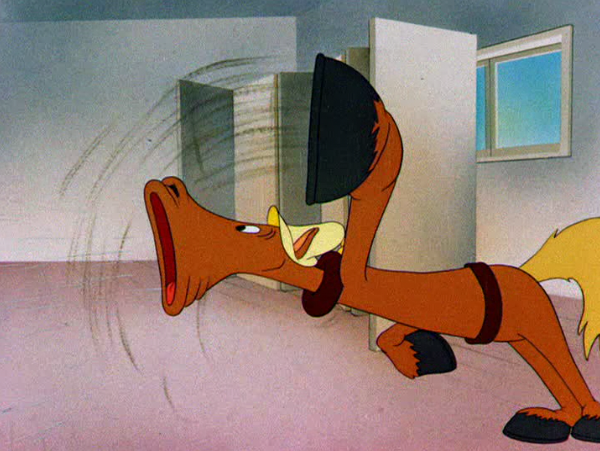
For sequences where Chuck appears to have taken his energy and pacing to its toll, watch the surgery scene, where the draft horse is being tested for medication. The officer inspects his mouth (which is found to be contained with oats and hay), and then asks him to say "ahh" for examination. 

At this moment, the horse shouts "AHH!" at the top of his lungs, creating a wind force which the officer struggles to fight through. For this sort of humour, you'd expect it to appear in a Clampett short, but it's clear that Chuck is having a lot of fun at being a successful director. 

This follows with some funny dialogue exchanged between the horse and officer. The horse questions, "I thought you said to say 'ahh'", this follows with the officer's reply: "That I did, but I didn't tell you to say: AHHHH!". 


Some great comedic touches appears in the sequence where another officer is seen grooming the horse. To make the sequence wackier, Pierce has the draft horse feel ticklish from the brush, and goes into a fit of giggles. The officer is still doing his best to groom the horse as he rolls on the floor laughing. At this point, the horse switches position of the officer, and begins to tickle the officer with the brush, grooming him. Animation wise, it's loose and it has some decent fluidity to it (was this Bobe Cannon anyone?).


Chuck is also a master at making the "impossible things" seen believable in an animated cartoon. You can see for yourself in the sequence where the army officer is testing the horse for posture. As he begins to call out orders, the horse misinterprets them, and it gets so that he has all four legs leaning sideways, sitting in midair. The officer walks over, and corrects him: "Don't you know you can't do that?" causing him to floor and hit the floor.

 Other great cases of where Chuck explores this is seen towards the cartoon's climax. The horse had been rejected by the draft officer, and goes into a dramatic, depressed state ("Other horses get to join the army, and I never get to do anything"). Unknown to him: a giant cannon is aimed towards his head. In this close-up, the horse is breaking down, sobbing, "I'm not good enough for Uncle Sam."

At this moment, the cannon blasts--with the horse questioning: "Say, did I hear something?" He looks directly at the cannon, it blasts again. The smoke unveils to reveal the horse supposedly decapitated, when in reality he's hiding his head underneath his collar. Not an easy scene to achieve in staging, and Chuck makes the dynamics and staging appealing, to make the gag and sharp timing work.

The cannon sequence leads to some fulfilling action scenes of the horse avoiding the battlefield area and the cannons surrounding him. Chuck isn't afraid to use complex staging for scenes of the draft horse running into a cannon and finding himself rising. The horse's encounter with the bombs underneath a field, and the posing of the horse dodging the bombs is entertaining.

At this moment, the horse frantically rushes away from the battle area, and zips wildly back towards the drafting headquarters. We repeat a scene of a quick pan of the horse crashing inside the hall, until we find he has crashed through the hall and zips towards a station nearby, where they are looking for recruits. At this point, we get a satisfying ending where the draft horse is content enough to be knitting Bundles for Bluejackets, as he reveals a 'V' for Victory sweatshirt, with the short ending on a patriotic note.

In conclusion, I still stick to my opinion that this is Chuck Jones' first successful cartoon at achieving comedy and comic timing. After watching and reviewing three and a half years of mundane, repetitive cartoons by Chuck, it's fitting to see him converting to the Warner Bros. humour, as the energy and humour was advancing greatly around this time; so his change to directing funny cartoons couldn't have been better. Chuck manages to create some great characteristics with the horse character, as well as create funny and outrageous sequences which he wouldn't have attempted before (or even rarely use in general). Chuck's expertise at characterising his stars is paid off greatly in the short, as well as his use of experimenting in taking comedy to another level. It's astonishing to believe that just a few months back, one of Chuck's all-time worst cartoons: The Bird Came C.O.D. For a director who had a unbreakable record 15-year streak of turning out wonderful material, this is only the beginning of the best which is yet to come.

Rating: 4/5.

Sunday, 21 December 2014

366. The Wacky Wabbit (1942)

featuring Bugs Bunny
Warner cartoon no. 1942.
Release date: May 3, 1942.
Series: Merrie Melodies.
Supervision: Bob Clampett.
Producer: Leon Schlesinger.
Starring: Arthur Q. Bryan (Elmer Fudd), Mel Blanc (Bugs Bunny).
Story: Warren Foster.
Animation: Sid Sutherland.
Musical Direction: Carl W. Stalling.
Sound: Treg Brown (uncredited).
Synopsis: Elmer Fudd goes in the American desert, in search for gold. He doesn't find much luck when he meets Bugs Bunny.

Although Bob Clampett had already started making cartoons of his own with Tex Avery's old unit, you get the impression that Bob's first colour cartoons have sequences which is almost parallel to Tex Avery, gag-wise or even timing-wise. Bob's 1942 cartoons were rather silly before he completely took a different route later in the year; with edgier-paced cartoons like The Hep Cat or A Tale of Two Kitties. The shorts still contain a lot of Clampett's style of humour, except that each short gradually builds up from the previous short.

The concept for the cartoon is well pulled-off. As this cartoon was produced during World War II, it was encouraged by all animation or film studios to produce patriotic cartoons to gain sympathy and hope from the general public. This cartoon relates to the war effort, except it's only referenced in many subtle ways that today's modern audience will overlook that.


Many today would be under the impression that Elmer is out hunting for gold. Reading between the lines, he is out digging gold for the war effort. You can catch a glimpse of a propaganda bond poster seen in the first shot of a pan shot exploring the American desert.

Warren Foster cleverly conceived that plot, so it can play like a typical animated short rather than making the patriotic aspects more obvious; which is why the American desert scenery adds to that effect. The close-up of Elmer doing the Winston Churchill "V for victory" symbol is more obvious giveaway. Elmer Fudd is singing alternate lyrics to the traditional folk song 'Oh Susanna', which cleverly links to the effort. Note the shot of Elmer carrying the enormous baggage is animated on different levels. His head and the luggage cycle are done on separate levels, which adds depth and weight towards the baggage.

When Bugs steps into the frame, his introduction is a great way in establishing his character. Most of the time, I don't like how Clampett interprets Bugs Bunny, especially in his later cartoons; but the opening scene is more faithful to the character's persona.

Whereas many Bugs Bunny shorts start off with him being a target from hunters or bullies; Bugs plays the bully role, with Elmer being a tamer personality; which works as well. Elmer has played the non-hunter role many times, so this wouldn't be anything new in the short.


Bugs hears Elmer's singing, and he pops out his head out from the skull which guards his rabbit hole. Note the design of the skull on Bugs' head has a very goofy feel towards it, but otherwise it's very appealing too, animated by the masterful Bob McKimson.

Bugs steps out from his hole, wearing the skull head as he joins in with Elmer's singing, with Bugs singing harmony and Elmer does melody. This makes a great showcase for Mel Blanc and Arthur Q. Bryan, who were both had brilliant vocals, without coercion. Bugs randomly finishing the act by impersonating Al Jolson is a pleasant touch, and Clampett's timing on Elmer looking eye-to-eye at Bugs before he collapses to the ground.

Bugs' characterisation in the cartoon is not much different compared to the other cartoons. He features his usual wits and motives, although compared to his previous appearances: you can see Clampett attempting to bring more energy to the character, which I will reflect a little while later.

A great Bugs Bunny scene which Clampett interprets wonderfully is the scene where Bugs stages a discovery of gold, in order to annoy Elmer: "Gold, gold! They found it! Eureka!" he cries to Elmer, who grabs his shotgun frantically searching for it. At this point, Bugs stops Elmer and reveals the gold: which is a gold tooth he possesses in his teeth.

Following that, Elmer sees that as worthless, comparing his own gold tooth to Bugs. Elmer jiggling his jaws at Bugs has a comedic touch to it, and not to mention Bugs' insult to Elmer following that: "You chubby little rascal". He dashes away, but only to return to kiss him on the lips.

Bugs' little dance number later on is a great showpiece by animator Bob McKimson, who had to animate Bugs' singing appealingly in his satire on the traditional song: The Dying Cowboy. Elmer had fallen underneath Bugs' hole, and Bugs digs up the soil to bury him--therefore making the satire of the song work. Bugs' belly sticks out, as he does a little lazy walk which is odd in proportions, but appealing to a tee.

For the few sequences where Clampett appears to explore Bugs a little differently from the rest, you can see it in the dynamite sequence. Warren Foster sets up the gag like any Bugs Bunny cartoon would be set up, but it's Clampett's take on the character which seems to stand out. To start off, Bugs Bunny casually shows a cowering Elmer the firecracker which causes him to climb on top of a cactus, cornered. The irony of Elmer clinging on top of the cactus without feeling pain, and yet so subtle. In a great close-up shot, Bugs Bunny slowly pressures the firecracker with his fingers, causing the firecracker to build up, and to burst with little to no effect.

At this point, Clampett gives Bugs a boisterous scene where he fakes the explosion by roaring: "BANG!", and he places Elmer's head under a tureen, striking it with a spoon vigorously, giving Elmer a vibrating effect. Clampett loved to give Bugs that vibrant persona, and although in later cartoons he overdoes it; it works in the right place in this cartoon.

The sequence involving Elmer Fudd digging the ground with his pickaxe has some Tex Avery influence over it; such as the gag itself. The timing of Elmer digging the earth while singing I've Been Working on the Railroad, has the dynamic feel of a Avery sequence as Elmer is digging in rhythm to the song, though bare in mind it's a trademark for any cartoon director. It goes to show Clampett is taking his time to explore further opportunities, timing-wise.

The dynamite gag doesn't look too much like Clampett's work, as it's the sort of gag that has elements of Elmer and Bugs having a tug of war battle with Elmer's shotgun in A Wild Hare. 

This scene, Elmer has dug up a hole on the ground, where he places the dynamite under the ground to locate gold. However, Bugs' offscreen antics lead to trouble when he consistently tosses the dynamite back to Elmer everything he attempts to throw it back in the hole. Although it's a gag that's nothing new, the beautiful dry brush effects make the gag worthwhile and fresh, giving Elmer a lot of energy. The zip which Elmer closes on the rabbit hole is also a charming addition to the gag.

On the other hand, Clampett experiments with takes and timing to another level..even  on par with some of Tex Avery's inventive takes. It's notable in the scene where Elmer is peeping down the rabbit-hole, Bugs turns up at the scene, casually leaning against Elmer. Just as Elmer begins to double-take, Bugs lets out a calm 'Boo'.
Elmer's reaction is wild and phenomenal in a lot of ways. The colour tones on Elmer exit before his body lines do. This isn't easy to pull off, as not only does this have to be worked out with Clampett's direction, and Scribner's animation; but the gag relies largely on Ink & Paint department to pull it off successfully, and they do! Bugs' reaction on Elmer pointing his shotgun at him is also nicely executed too.

Another marvellous scene which relies on a lot of dry-brushing is seen in the second to last shot of the cartoon. At this point, Elmer had discovered about Bugs' golden tooth, and is determined to get himself gold by force. This leads into a fight between Bugs and Elmer which is distorted with some superb drybrush effects done not only one of Clampett's animators, but pulled off brilliantly by the the Ink & Paint team, too. Because it was a top-notch job, you can watch the action smoothly, as both characters are still identifiable in the action happening.


Only Clampett could get away with the funniest and most inappropriate gag in the cartoon: Elmer's corset. The sheer unpredictability of the gag is what makes the scene gold. Elmer is chasing after Bugs, but he struggles to remove his pickaxe from the cavern. At this opportune moment for Bugs, he cuts the braces off Elmer's pants, where it is revealed that Elmer is wearing a corset. Bugs' perverted whistle at Elmer really adds to the humour.

Elmer, looking embarrassed, breaks the forth wall commenting: "Don't waugh. I bet pwenty of you men wear one these!". The forth wall remark also adds to the contemporary Warner humour, making the characters feel human.

As the cartoon begins to draw to a close, Elmer returns from having been dug up from the earth: staring threateningly at Bugs. They look at one another face-to-face, with Elmer threatening Bugs: "Wabbit, I came here for gold, and I'm gonna get it!". At this point, Bugs goes into a little dramatic pose where he cries: "No, not that; anything but that!". The last shots that feature Bugs' golden tooth which was seen earlier, was an important feature to not only add to the dangerous situation Bugs placed himself to be in, but to also fit a funny closure on the short. 

After Elmer and Bugs fight over the golden tooth, Elmer finds he's in possession of the golden tooth. In the final scene, Elmer cries: "Eureka! Gold at wast!", and his grin reveals his golden tooth as missing. Bugs steps into the scene, mimicking Elmer's words; before revealing smugly that he still maintains his golden tooth. 

In all, The Wacky Wabbit is without doubt, wacky. The idea of the cartoon being war-related and yet a typical Bugs Bunny short is cleverly executed by Warren Foster, who doesn't waste an opportunity for gags in the cartoon. Bugs Bunny is becoming more developed and vibrant as his stardom increases, and Clampett works well with the character here. This isn't anything as outrageous or energetic of Clampett's cartoons in the mid-1940s, but you can still see elements of it in gags here and there: like the corset gag, as well as aspects of timing which require careful work from inking and painting. In all, it's an enjoyable cartoon, and I can't wait to review more Clampett shorts in the near future. 

Rating: 3.5/5.

Saturday, 13 December 2014

365. Daffy's Southern Exposure (1942)

Warner cartoon no. 364.
Release date: May 2, 1942.
Series: Looney Tunes.
Supervision: Norm McCabe.
Producer: Leon Schlesinger.
Starring: Mel Blanc (Daffy Duck / Wolf).
Story: Don Christensen.
Animation: Vive Risto.
Musical Direction: Carl W. Stalling.
Sound: Treg Brown (uncredited).
Synopsis: Daffy Duck refuses to fly south for the winter, which leads him to refuge into a winter shack, trapped by a wolf and a weasel.

This is perfects the first Warner Bros. cartoon where Daffy's personality has been perfectly finalised. He is goofy, but he's also quick-witted and cynical. This was the standard persona for Daffy, until Chuck Jones tinkered with the character in the 1950s, refining his personality once more.


McCabe's interpretation of the character is wonderful. It's perfectly interpreted from the cartoon's opening, and he successfully carries that throughout the cartoon.In this cartoon, he establishes the fact that Daffy's a duck and not just an actor in a duck suit. His established scenario is in a lake, living like a duck. Daffy doesn't see the reason to travel south for the winter:

"Confidentially folks, I ain't going south for this winter. I'm gonna stick around and check up on this winter business!". The charm to Daffy's taste of lust is icing on the cake, as he reveals the front headline of the newspaper labelled "Snow Carnival" with one of the prime features being the 'Snow Queen'. He sees the advantages of remaining south by inheriting the lake on his own, while the other ducks have migrated south for the winter. This leads to Daffy doing a comedic dance around the lake.

As America had entered into World War II, propaganda was being portrayed everywhere in the medium, even animated cartoons. The Warners crew would have to throw in a propaganda scene to fit into the short, such as the scene of the birds flying south. The birds carry out a banner reading: "Buy a bond!". You can also see it in the shack scene where a fatigued Daffy knocks on the door, but it's more subtle than that. McCabe appears to be finger pointed for using the most obscure references in his cartoons, like the bond reference; even though he wasn't the only one plodding them into cartoons.

McCabe's sense of humour is another a great example of what made the humour Warner Bros. cartoons great. Each director had their own different approach to gags: whether its subtle or broad. McCabe seems to have his own different approach, too.


He does maintain gags which would be used from any director, partly in the scene where the group of ducks contradict Daffy's remark about saying south as they quote, "You'll be sorr-ee!"; referencing the game show: Take It or Leave It.

His own style of humour is evident during a blizzard sequence, where he satirises narrative titles which used to be displayed in old live-action movies, mainly in scenic shots. In this short, the title card begins with what audiences would expect: "Thru wind and snow / at thirty below / we find our hero" with each verse written in rhyme. The camera pans back and forth several times, until a narrative appears: "Gosh, we can't find our hero!". This is a greatly executed gag that shows McCabe can create timeless humour in his cartoons.

Then there is a kind where McCabe has his own different tastes of timing. It isn't like Freleng's or Clampett's, but its unique on so many levels. This is noticeable earlier in the film where Daffy takes a big leap and prepares for a big dive in the lake.

Just as Daffy is about to take a dive, the scenery of the mountains and lake flicks quickly with the sky turning to darkness, and everything turning into ice; leaving Daffy to crash on top of the lake.

This isn't easy to achieve, and McCabe could be very daring at pulling off aspects of timing like this, and he meets the goal well. During the blizzard sequence, we find that Daffy Duck is stranded in the blizzard unable to be seen.

 McCabe relies on a lot of snow effects animation for the shot; so the gag is that Daffy can be unseen, but only heard, facing starvation. He cries out in the blizzard: "I'm starving. Nourishment!", "Oh sustenance! Oh sustenance!". At that point, Daffy breaks the forth wall by having his head break through the storm directing the audience: "What'ya laughing at? I'm really hungry!". This is a funny crack from Daffy, considering that Daffy's sudden appearance and remark is unpredictable. The opaque snow effects adds to the gag to a tee.

During the blizzard sequence, this leads to Daffy hallucinating as he imagines a winter tree being a T-bone steak, leading him to lick the tree. This leads him to almost eating himself as he pulls the some barks of the tree and uses his hand to make a sandwich ("Yum, yum! Hand sandwich!").


The scent then leads him towards a shack where the villains of the short are introduced: a weasel and a fox. Storyman Don Christensen relies on exposition for the two characters, who are fed up of being consumed of only baked beans.

The pan shot of the interior shack is great for creating domestic problems the characters are facing: the house is stored almost entirely of beans. The wolf complains about the consistency of beans being eaten every breakfast, lunch and supper. His alley, the weasel is portrayed as a silent character. Then he begins to crave for a "roast duck". The wolf begins to reminisce with desire: "Oh, for that fowl taste that my mouth wants". At that moment, they hear Daffy's knock on the door and lead him inside the mouth to create a diversion.

The sequence of the wolf and weasel is disguising themselves as maids is great satire on the villain's supposedly cunningness. The wolf's cutting remark, "Dear dear, who have we here? As if I didn't know" is greatly executed by Blanc, whose falsetto voice is always the charm. The double take where the wolf remarks, "What is your poison? (clears throat) What would you like to eat?" is also great in establishing the villain being a amateurish one.


The sequence only gets better during the spoof of The Latin Quarter number. The wolf masquerades himself as a maid and pretends to provide some food for Daffy. Unlike many cartoons of that era which featured pointless song numbers for commercialisation, this sequence is all parody, and it's brilliantly executed by McCabe's timing and wit.

This was where the Warner directors actually got it right, by parodying the lyrics of a popular song so it can blend in with the cartoon's activity. McCabe also establishes that he shows skills in creating musical number sequences, and the scene is almost on par with Friz Freleng's great musical sequences.

The wolf's singing and picking up the cans is perfectly synchronised in humour, that it becomes a gag itself. It's also wonderfully executed during the scene where he is cutting the cans into slices, but he does it in sync to the melody. The weasel and the wolf also have to maintain their plan to boil Daffy while singing their song; which isn't easy to achieve in musical sequences: as there's a lot of activity going on.

Upon realising that Daffy is targeted to be slaughtered and eaten, he leaps to his own hopeless defence. To add to the suspense and drama, the use of silhouettes helps convey how menacing the wolf is. To make the scene humorous and suspenseful, Daffy attempts to convince them not to cook him. He pleads: "You don't want to eat me. I'm not a duck, I'm a pigeon", and he attempts to pull off these disguises, by impersonating the figure of a pigeon and a hummingbird. This is greatly conceived to express at how useless Daffy's alibis are in such a perilous situation. Mel Blanc adds a lot of character to the panic-stricken Daffy, especially when he is hopelessly impersonating a mockingbird, which Mel captures in keeping character.

Resulting in a typical chase scene, McCabe makes the chase a lot of fun too. To start, Daffy hides to a nearby tree. Just as Daffy reaches the top of the tree trunk, he encounters the wolf. The gag of the wolf frantically chopping the tree trunk into a totem pole is corny but it works on its own. Daffy's pose on impersonating a totem figure adds to the charm.

Midway a chase scene, Daffy breaks the action as he addresses to the wolf: "Just a minute, bub, just a minute!". At that point Daffy socks the wolf's chin and zips out whooping. This is He disposes of the wolf as he pulls the lead from a log, which leads the wolf to slip off the other side, and to fall a long height.

From the perilous situation he has faced, he immediately flees south from all signs which point down to south. Each different shot of the signs pointing south emphasises on the journey Daffy is travelling. The first shot is still set in north, the following in an American desert, and the last being a tropical place; where the sign emphasises the direction is south: "and we do mean SOUTH". We then fade to a shot of a Carmen Miranda caricature doing a dance, and we find Daffy living on top of her fruit hat. He has the last laugh and line, "Geez, I like the South American way. And I do mean South".

For a director who has a reputation of producing dated, wartime material: this cartoon clearly contradicts his reputation for he was perfectly capable of producing original cartoons in a cartoon world. McCabe is not afraid to explore anything ambitious for animated cartoons, such as a style of comedic timing which is hard to pull off. For a director who is very underrated, he definitely had style.  Norm McCabe nailed Daffy Duck's personality to a tee. As a character he is a lot more refined than his previous appearances. This short was made at just the right time, as the writers were producing much more funnier cartoons with energy and character, and this cartoon happens to be an example of what started the trend.

Rating: 4/5.