Saturday, 2 November 2013

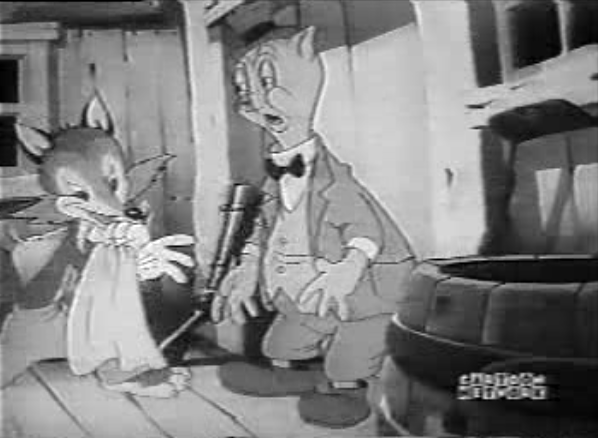
309. Of Fox and Hounds (1940)

Warner cartoon no. 308.
Release date: December 7, 1940.
Series: Merrie Melodies.
Supervision: Draft No. 412. (Tex Avery).
Producer: Leon Schlesinger.
Starring: Mel Blanc (Willoughby / George the Fox).
Story: Draft No. 1312.
Animation: Draft No. 6102.
Musical Direction: Draft No. 158 (too bad) (Carl W. Stalling).
Sound: Treg Brown (uncredited).
Synopsis: Two George-and-Lennie personalities: a sly fox, a dim-witted hound named Willoughby is in hunt for a fox, but never succeeds when one keeps out-witting him.


Before the review can begin, as it appears to be (judging by the copyright catalog) the original titles for the cartoon had a sort of gag to it; where the artists responsible for whichever were credited as digits. A very typical interpretation by Tex, but at the same time a little pointless as enthusiasts don't get to know who the story was credited to, and the animator...but at the same time? Does it even matter? Tex's unit already consisted of Bob McKimson, Rod Scribner, Virgil Ross, Sid Sutherland and Charles McKimson; whereas the story credit was rotated, and at the time: worked in groups. However, it's most likely possible credits or possible writers for the short could have been Dave Monahan or Jack Miller, who were regular writers for Tex in this time period.

The original title card does exist (though it is seen as a small size) through a group of original titles owned by Tim Cohea (Sogturtle); though it would be great to see it blown up into a clearer and bigger size.


Had Tex completely abandoned the Bugs Bunny idea after A Wild Hare and interpreted it as a one-shot cartoon? Of course not, where did I get such nonsense! Obviously, Tex would direct a few more Bugs Bunny cartoons; until he left the Studio...but did Tex experiment the personality formula with other characters? Well, here is the cartoon which is being reviewed.

It was no doubt that A Wild Hare was (and is) a revolutionary cartoon for the whole Schlesinger Studio; but before Bugs would make more appearances--Bugs would use the quick-witted persona for other characters. Here, we see the fox...named George; who is merely Bugs Bunny in a fox suit.

He can manipulate his potential enemies, for example..the bloodhound, Willoughby. He can easily outsmart his opponents, including a slow-witted, stupid hound; as well as a fierce, grizzly bear. Compared to A Wild Hare this cartoon lacks as much creativity and the gags appear to fall a bit flat in this cartoon. It has quite a tepid construction to the story; where it really focuses on Willoughby being out-witted by the sly fox, and falling off the climax. Nothing too original, or as well as exciting.

For what it is worth, the cartoon is a "first" for its reasons. For one, it is the first Warner short (or quite possibly Hollywood short) which is a satire of the very popular Steinbeck book: Of Mice and Men which was published in 1937. The parody between the two characters work so well, and the relationship is very rich and successful that this would revolutionise to more future cartoons using that similar formula (or satirising elements of it).

Also, this is the first cartoon which marks the first appearance of the short-lived character by Tex: Willoughby..who he had used in two other Warner cartoons: The Crackpot Quail and The Heckling Hare. With the 'Of Mice and Men' persona being more revolutionary in the cartoon, the contrast between Lennie and George. It's not so much on the book; but of Lou Cheney Jr's performance on Lennie from the 1939 Hal Roach film of the same name.

It becomes a very rich and believable concept from Tex. The fox being very cunning and sly, as they are known for, and whereas Willoughby just has the look and expressions of a dimwit.

It has an excellent satire that you are convinced you see George and Lennie inside of them, it can see through some excellent character animation by Virgil Ross when the Fox and Willoughby first encounter one another. This just about explains as to why the Of Mice and Men satire is revolutionary for the cartoon; as it would help upgrade the humour in the Warner cartoons by producing more clever burlesque, rather than just over-used, unfunny one-liners from obscure radio shows.

Johnny Johnsen's background paintings also punch up a notch in terms of detail and beauty. We've all seen his for for Tex's cartoons at MGM and Disney, who produces beautiful colours and designs for his shorts...but the panorama opening shows how rich it looks. Whilst Stalling plays William Tell during the opening shot where it is shown as early morning.

The colours of the sky show so much realism and truth to it. A background no nice, that Tex has used it twice: the latter for the MGM short Out-Foxed. Friz himself had also borrowed it for Foxy by Proxy--interesting how Tex still had access to re-use Johnsen's backgrounds when he was over at MGM; and yet Freleng could at Warners.

Note that even the backgrounds show a particular style throughout the film. Note the illustrated cover of the first edition of Of Mice and Men (by Ross MacDonald) actually shows some subtle inspiration in the backgrounds by Johnsen. Although it may not be very evident, but Johnsen's use of colour and the wavy trees give quite a strong connection to the illustrated cover--which could mean Johnsen was inspired by the cover.

On the animation side; Tex Avery is still developing on some characteristic cycles which he is well known for. Look at the run cycle for Willoughby when he running in the forest (supposedly chasing after the fox).

This is a great one which was hilariously animated (probably Bob McKimson) which shows how Tex could even be very wacky and exaggerated in some areas, even if he hadn't quite got into that faze. The cycle is used at least four times in the cartoon itself; which is used as a climax which then results into failure: three times he just falls off at the edge of the cliff, and the first he crashes into a tree "I'm gonna go catch the fox--'cos I know every tree in this forest!" and then he slams at the tree. Perfect timing. What's great about the run cycle is that it nails the dimwitted personality and low intelligence of Willoughby. It implies that Willoughby is that ignorant he cannot run properly.

Despite the cartoon being a little revolutionary in terms of the humour, the animation as well as animation timing--the story of the cartoon, however isn't so much of spectacular as those three which I covered.

The cartoon is really split into acts where the fox outsmarts the dog; and there is really no twists or connections which follow in the cartoon.

The first sequence shows Willoughby, dumbfounded of the fact he is speaking to a fox, and asks for the whereabouts. This means the fox responds:

"Well, I tell ya what you do. You go down to that ol' tree stump, and turn right until you come to a ray of fence. You'll find him right on the other side. You can't miss him". Then, Willoughby runs in his characteristic cycle until he falls, and realises: "Y'know...THAT was the fox!". The next sequence, however, is just a repeat from the previous sequence, except the fox is in disguise of a hound costume.

He repeats the exact same instructions, and then Willoughby crashes again. Tex deliberately makes the sequence a pointless repeat, even by the own words of the fox: "My name's George. Here we go again". The animation, most probably done by Rod Scribner, shows some great character animation as well as weight of the costume, whereas the previous sequence showed great communication animation (by Virgil). Whilst the acting by Blanc and Tex (voicing Willoguhby) is top-notch; the sequence really lacks any depth (and humour) as well as a climax for what is to come, a little irrational.

Then, the pace doesn't pick up until Willoughby follows the fox in disguise; but discovers however that whilst he is under the log; the costume stretches (as it is jammed from the log) and it rips open. So, George the fox then begins to run away from Willoughby, who realises it is the fox: "You know, George was spoofin' us. He was no fox all the time." Then this leads to a brief chase sequence; until the climax finally comes---Willoughby intimidated by an intimidated bear which he mistakens as a friend for trapping George the fox.

Tex's own use of suspense in the shots then becomes evident when Willoughby is hiding on top of a tree, frightened of a provoked, fierce bear.

George, witnessing the intense moment, then attempts to save Willoughby by using his craftiness--the ol' hotfoot. He strikes a match and places it under the bear's foot. The pacing of the shots where the match almost strikes his foot is very effective, as well as Stalling who gives the suspense through music. As though Tex was hardly wacky in this time period, a wonderfully comically timed sequence occurs when the bear is struck by the foot; in which it reflects all the way to the bear's spine, and he dashes off. For the time period it was made in, it shows some great use of speed and delivery.


 Then as the cartoon draws to a close; we find that Tex recycles and repeats animated sequences and bits of action and dialogue all to combine to the concluding gag of the gag. We find the realistic looking trumpeter on his horse; blowing to A-Hunting We Will Go, and all the other hounds follow.

Just then, Willoughby (who has kept George in his kennel) then asks him to help find a fox in which George, responds the exact same words which he used twice previously; in which Willoughby responds: "Well, gee, thanks a lot, George! Thanks a lot!" kissing George.

Then, this results in the crazy characteristic run cycle, Stalling's music cue for the run and he falls off the cliff. This time, hardly a sound---just a little 'ping'. The camera pans down vertically, in which Willoughby (already planned) had landed softly on a bunch of mattresses and cushions, remarking: "Ya know, I ain't so dumb!". A few flaws in the sequence, Willoughby's ignorance and consistent response to George's overused prank just gets carried away; and having a whole sequence full of repeated elements all runs down together. Except, that the concluding gag at least had a continuous bit of logic towards it...and at least a smart move for Willoughby.

Despite the cartoon being revolutionary in terms of its humour; using the Of Mice and Men formula, as well as character relationships...the cartoon itself falls flat and runs down together. The story is full of contradictions, where the results are just weak. The whole first half of the short is incredibly slow, where two sequences are generally the same, and many elements (and sequences) are reused several times, just to get one big laugh--which was the ending shot of the cartoon. It was just one of Tex's little ambitions in hoping to get a laugh, but it wasn't one which he pulled off successfully.


Wednesday, 30 October 2013

308. Porky's Hired Hand (1940)


Warner cartoon no. 307.
Release date: November 30, 1940.
Series: Looney Tunes.
Supervision: Friz Freleng.
Producer: Leon Schlesinger.
Starring: Mel Blanc (Porky Pig / Gregory Pig / Fox).
Story: Dave Monahan.
Animation: Richard Bickenbach.
Musical Direction: Carl W. Stalling.
Sound: Treg Brown (uncredited).
Synopsis: Porky fires a dim-witted guard for the henhouse named Gregory. All goes well until he is outwitted by a sly fox.

This time it's Freleng's shot to direct a Porky Pig cartoon, other than than being typically Bob Clampett. Like Clampett, Freleng also uses Porky very rarely in the cartoon, only making an appearance from the beginning and at the end briefly.

The main star of the cartoon, however, is a dim-witted pig named Gregory; and a streetwise fox, who breaks into the henhouse to steal some chickens. Dim-witted characters were already becoming more popular and frequent as the humour Warner cartoons started to become more evident.

Considering that Clampett or Tex are main examples on dim-witted characters of their creation, Friz Freleng and Chuck himself were also as capable as these two. Friz's interpretation of Gregory the dimwitted pig is pulled off rather well. Notice the particular voice put on my Mel Blanc for Gregory? It appears to be the standard dim-witted voice which Friz Freleng preferred when using dim-witted characters. You can hear examples of that in his cartoons in: Foney Fables, High Diving Hare, etc. Just as Porky has hired Gregory for the job, he attempts to ask him on what his assignment is, in which he responds dimly: "You said, uh, keep your eyes open and watch out for that fox. He's been getting too many of my chickens lately, he's a sly devel he is, and uh, and uh--".

Note the reference in the opening sequence of Porky reading the application layer. At the bottom of the 'P.S.' the line reads: Alright, so he ain't neat! Reference, anyone?

Despite Porky's lack of screen appearance. This is one of the many cartoons where Porky's occupation is a farmer. Too many numerous cartoons which base on that theme, that is is possibly the most popular associated occupation for Porky of all the cartoons he's been in.

As spoken, Porky doesn't really get very many opportunities in this cartoon, as the real stars of the cartoon is a quick-witted fox, and a slow-witted fox: an opposite attract pair.

The cartoon, as a whole, feels more or less like a Merrie Melodies entry; except that the short is in black-and-white; and that Porky at least has some screen time, which makes it into a Looney Tunes product. It's evident from almost up to this point that Leon Schlesinger was becoming a lot less strict with the policies between both cartoons; that even by 1941: one-shot cartoons were appearing in the Looney Tunes series; and by 1944: both series had lost their comparisons and differences.

Dave Monahan, and Freleng's interpretation of the fox has been cleverly constructed and satirised. Of course, foxes have a strong reputation for being very cunning and sly; and that's how we see the fox from his introduction in the cartoon. However, towards the end of the short--he had been accidentally outsmarted by the dim-witted Gregory, and even swallowing the key whilst inside the Incubator Room.  Considering that the fox wasn't "smart as a fox" from swallowing the room key...he then finds himself trapped inside the incubator where he then starts to go into a panic attack: "No. It can't be". 

He then searches around his body, to search for the key...realising he has self-digested it. If that were a Clampett joke, you'd expect a little bit of bathroom humour, in a subtle way. Instead, Friz doesn't go down that path and then gets the fox to go into a over-dramatic phase: "Trapped! I gotta get outta here! I'll fry!" and then the fox proceeds to bang on the door. The whole setup was very amusingly built to this climax, as the writers managed to write up about Gregory managing to outsmart the fox by accident. It is a very looney concept where it implies the smart even fail at times.

 The sequence where the fox corresponds with Gregory shows some great manipulation from the personality of the fox (even though he would later be out-smarted); where Gregory can easily be enticed into a hoax.

When the fox breaks into the henhouse stealing the chickens into a large sack; he is then caught by Gregory who is guarding the door and orders him to return the chickens back to where they were positioned.

Realising the character is a dimwit; he then walks away placing the chickens back into the back and even suggesting that both of them could be potential business partners.

Enticed by the whole idea, Gregory then calls over the fox where they discuss the possible idea, "Wait a minute, Mr. Fox, I didn't say I wasn't interested, but what about Porky?". The fox even suggests the name for their new "partnership": Fox & Gregory. Without knowing, Gregory then places the whole poultry into the sack where the fox then walks to where it should be the exit room, but instead walks into the incubator room. Notice how the sequence is constructed rather uniquely; there are several short scenes in that sequence which fade to black and then fade in during dialogue scenes. It's an unusual piece of pacing which is promising and intriguing and even paces the sequence very evenly.


Of course, let's not forget to mention some of comic timing which was timed by the one and only Friz Freleng, in this cartoon.

Even though this may not be one of Friz's most notable shorts in terms of timing; there is no doubt elements will appear in the short. A great sequence occurs when the fox has broken inside the henhouse and starts to steal some of the chickens. The chicken then begins to start sleepwalking; with his arm raised and his legs taking big steps--am I the only person who misinterprets this as the goose walk? Of course, this wouldn't have been intentional.

The fox then dashes at the scene with the chicken landing in the sack; which shows Friz's genius of timing is evident. Also, Freleng takes advantage of Treg Brown's timing on the sound effect. It all blends in nicely in one sequence. Gregory is snoring in the farm, and as they snore: the chickens snore one-by-one separately and Gregory snores at the last note. You've got to love Friz's creative timing, as well as the ludicrous albeit charming gag by Monahan.

Then going down to the cartoon's climatical ending; Gregory then attempts to break down the door to the Incubator door; and just then; Porky arrives at the scene with a shotgun, after hearing the noise of the commotion. As he manages to open up the door with a spare key to the door: he then asks for anybody in there. Typically, you would expect the cartoon to probably end with a typical catchphrase from a radio show or a celebrity; but at least it ends rather cleverly when the fox has been affected from the incubator that he has shrunk, and then begins to berate at Porky with his "now" size and high-pitched voice. "You'll hear from my lawyer about this!"...a great line to end a particularly amusing cartoon.

Overall, as mentioned earlier, the cartoons in the Looney Tunes series were slowly beginning to take liberties once the strict policies (i.e. Porky Pig appearing in every Looney Tune) started to mellow. It would not be shortly after until the series would be converted to colour. Porky cartoons would begin to appear less frequently to make way for other big shots like Bugs Bunny and Daffy Duck. In 1940, Porky Pig was established with an everyman persona, which was established since his creation. It wasn't until a few years later when his character was revitalised to become more accustomed to broader characters like Bugs and Daffy. The short itself shows some great personality from the characters like the Fox as well as Gregory; despite the lack of Porky's appearance. The short itself is paced and executed thoroughly, indicating that the cartoons were building more promise and potential into cranking out hilarious cartoons, thanks to Friz Freleng--who has so far been the only director of the year turning out really funny cartoons, a tad more so than Tex Avery.


Tuesday, 29 October 2013

307. Bedtime for Sniffles (1940)

Warner cartoon no. 306.
Release date: November 23, 1940.
Series: Merrie Melodies.
Supervision: Chuck Jones.
Producer: Leon Schlesinger.
Starring: Margaret Hill-Talbot (Sniffles).
Story: Rich Hogan.
Animation: Robert Cannon.
Musical Direction: Carl W. Stalling.
Sound: Treg Brown (uncredited).
Synopsis: It's Christmas Eve and Sniffles tries to stay up all night to watch Father Christmas arrive, but will he stay up in time to watch?

Christmas is a rather rare theme when you associate a Warner Bros. cartoon. They hadn't done too many Christmas related cartoons; even if there had been little scenes or parodies; but rarely for the entire cartoon. It seems appropriate for the time the cartoon was made to be given to Chuck Jones when directing it.

There is without doubt, Chuck is intimidating Disney in this sequence, like he usually did in his early cartoons. However, much of his cartoons, at times required a lot of character animation, and were even a visual experience.

Here, however, it is a very kid friendly cartoon. Sniffles is feeling the Christmas spirit on the eve of the day; and is planning on celebrating by staying up through the night to see Father Christmas.

When watching the opening of the cartoon; it feels like a very gentle, mushy cartoon where it feels a little less Jone-esque. The opening sequence features a group of carollers (painted in the background) singing Joy to the World; as we pan vertically across a white, snowy street. A very beautiful, and illustrative view from, possibly, Paul Julian. Then, we hear Sniffles humming from his mouse home where he sweeps up the snow from his doorstep singing Dashing Thru the Snow. He looks through his house, with excitement, and looks forward to the arrival of Santa Claus. Note the little Xmas note pinned where he wants all kinds of cultural cheese.

Then, the remainder of the cartoon feels a lot more like a Jones effort. A Jones effort meaning his choice for strong, bold expressions, as well as several realistic situations which Sniffles attempts to confronts. Of course, he aims to watch Father Christmas all through the night, he has to battle by managing to keep up late.

In order to wait at least "1 hour, 33 minutes and 47 seconds", he engages in several activities to help pass the time, but a lot of the time he fails. First, he makes himself a cup of coffee, and whilst waiting he waltzes to some music heard over the radio (note the NBC chimes heard twice in the cartoon).

He washes his face to help keep him awake as he is in the stages of falling asleep. To show this cartoon isn't even 100% kid-friendly, even in the most subtle parts, he uses cigarette paper as a towel to wipe his face. Just then as his coffee is ready, progress on keeping awake just deteriorates; and as the radio station are shutting down for the night, Sniffles almost falls asleep, with his coffee spilt, and attempts to read a magazine, parodying Good Housekeeping; which is horribly punned as Good Mousekeeping. Then he spends the rest of the cartoon keeping himself awake as much as possible, until he surrenders from his persuasive conscience.


Chuck Jones actually visualises the tiredness and the struggle to keep awake very beautifully and realistically. It requires some very strong character animation as well as a lot of weight on the eyelids to give the impression how Sniffles is struggling to keep awake.

Chuck puts in a lot of dilemmas where Sniffles almost falls asleep. During the radio sequence, when the song switches to a very slow ballad. The smoothness of the song played called Sleep, Baby, Sleep. With the sequence being padded; Sniffles prior that was checking himself out in the mirror but already attempts to fall asleep on top of the powder puff. A lot of believability appears in these Sniffles scenes where you get the impression he is sleepy, but very determined to see Father Christmas.

During the gentle climax of the cartoon, in the Christmas theme of the cartoon, it's safe to say Chuck handles the last sequence greatly. Considering this is a Christmas cartoon, it is appropriate for the short to end rather sweetly.

Even though Sniffles does fail to stay up all night...it shows how Chuck is avoiding cliches on what the audience would expect to see.

His target was to watch the arrival of Father Christmas, but with the bother of his own conscience, he fails and ends up having a peaceful sleep. It is a great sequence as Sniffles' ghost is what finally surrenders Sniffles into going into his peaceful sleep.

This gives his conscience a stronger personality and a negative connotation towards his ambition. Visually, it is very believable and appealing; the backgrounds are very colourful and give the right interpretation of how the bed looks warm and comfortable to sleep in. All acted and planned from his own point-of-view. A great point of view shot appears after Sniffles rinses his face where he watches himself supposedly sleeping. This is what the gentle climax is about to become of, and it is a wonderfully established shot; not just artistically but also for its purpose for Sniffles to give in peacefully.

As Sniffles sits down to read his magazine, after NBC have announced their closure for the night. He decides to read through an issue of Good Housekeeping, I mean, Good Mousekeeping. The use of tiredness appears as a symbolism in the articles themselves, and even from when Sniffles refuses to glare towards his bed.

When he watches his own bed, looking comfortable, he turns away refusing to even look at it, and most of all--attempting to avoid temptation. As he turns around, and peeps his eyes, he finds the shadow of the bed.

Chuck displays some great visual shots where the bed is presented as personification visually, and furthermore encourages Sniffles to procrastinate and go to sleep.

Jones also stages and plans out a small scene very cleverly and splendidly. After Sniffles has gone over to collect his coffee after the kettle boil--he then proceeds to sip down and to drink his coffee to help perk up Sniffles.

As the camera then pans horizontally to the clock ticking its way to twenty minutes later, it pans horizontally to the left where Sniffles was seated. Sniffles is now slouched on the chair, snoozing away with his coffee spilt to the floor, not having a chance to take a sip. Some great little bit of personality animation with Sniffles' pupils in sync to the clock ticking away as he almost falls asleep.

This isn't a sequence which I intended to go through into analysis; but here is the dance sequence where Sniffles waltz to the classical song: Kunstlerleben (Artist's Life), Op. 316 on the radio. The animation timing of Sniffles waltzing show some very smooth animation as well as giving Sniffles a very three-dimensional look. The animator who is responsible for the sequence is Phil Monroe, who remembered it was the best animation he did in the opinion of Chuck. Knowing Phil's style, who had a very loose (and sometimes sloppy) style of animation, this is quite possibly Phil's finest performance. He keeps the animation dance in sync to the music, and hits the beat very nicely and solidly.

Here, Phil remembered his experience with the waltz sequence from the 1987 interview by Michael Barrier: I only worked for Chuck for seven years at the most, and during that seven years, the Sniffles dance was one that he liked, and it was a waltz that I had to choreograph myself, because he couldn't even dance. He could not dance; he didn't have a sense of timing. It sounds funny, doesn't it, because he made so many musicals?

To conclude, Bedtime for Sniffles has a Christmas feel towards the cartoon, and it isn't the typical-cliched story with a Christmas theme. Chuck plays along with the idea of Sniffles struggling to sleep very realistically as well as visually as there are numerous problems which Sniffles struggles to overcome, that it sort of becomes supernatural to him. The way the beds and the glowing candle light being presented as a symbol of surrender really display some excellent dilemma, and the climax being all gentle. The short itself doesn't feel terribly poorly paced, and it is a very well constructed short in story. It is an artistically well-animated short in its form, and this is one of the few Chuck Jones shorts from that particular era which I actually see as a advantage, and not as a crappy poor-paced short.