Saturday, 1 September 2012

203. Porky the Fireman (1938)

Warner cartoon no. 202.
Release date: June 4, 1938.
Series: Looney Tunes.
Supervision: Frank Tashlin.
Producer: Leon Schlesinger.
Starring: Mel Blanc (Porky Pig).
Story: Melvin Millar.
Animation: Robert Bentley.
Musical Direction: Carl W. Stalling.
Sound: Treg Brown (uncredited).
Synopsis: Porky and his fireman team try to stop the fire at a boarding house.

The cartoon begins as we find that the fire station called Hook and Ladder Co. No. 1 seen in a exterior shot. The fire alarm is ringing which means that there is a duty for the firemen to do. We we truck back a bit further - we find that a fireman opens the door but the gag is that the fireman ends up crashing through the walls of the fire station.

As the fire engine is riding straight ahead - we find a point-of-view show of the front part of the engine moving which would've been Tashlin's own idea to feature that. The fire engine then makes a complete stop as we discover that there are these cats crossing the road - which makes the situation and the stopping appear rather amusing before the fire engine continues. Boy, making that fire engine stop in that bit of staging on the camera would've been a very difficult part to animate. As soon as they arrive closer and closer - we fade into an boarding house that is set on fire. There are flames flaming out from the windows with smoke coming out. There are even flames that then start to form the words 'HELP' which makes it as a whole a cartoony effect. Since I know A.C. Gamer was with Tashlin - and even in the credits - he would've done those scenes. As soon as the fire engine makes a complete stop - the truck then starts to fly out of the scene with their fireman. The timing there is very funny. Notice in the background that it the sign featured reads: Opera House To-nite LOONEY TUNES. Which is an in-joke relating to the series. After the engine flies out - the firemen (including Porky) then place it back and walk on to do their duty.

The fireman then start to go over to the punch clock to report that they're on duty. The sign that reads "F.D." would stand for 'fire department'. The first couple of fireman dash at the scene where they place their card in the slot and punch the clock to show they're at work. Porky Pig then approaches the scene - also being a fireman as he also punches the clock. Porky runs back to catch a hosepipe in which suddenly the punch clock then starts to make a noise (with the arms and legs moving backwards). Porky grabs his hat and jackpot falls out - which is the gag.

After placing his hat back onto his head - he makes his way over to the apartment grabbing onto the hose. In the long-shot view - there are fireman firing with their hoses at the burning boarding house. The funny part is that the flames then start to form into words again reading 'THANKS BOYS'. Even the flame then starts to form into hands and they clench onto each other's hand and cheering with it - it makes the gag rather amusing and appealing. Porky is standing outside the boarding house as he is still holding onto a hose pipe. Porky is calling somebody in the background to turn on the hosepipe as the hosepipe is attached to a fire hydrant.

The guy who is standing by the fire hydrant is another fireman but is a dog that puffs a pipe. Porky is asking for the dog fireman to turn it on. The dog that puffs his pipe then starts to walks over to turn on the pipes. What I find that makes the fireman's characteristics very funny is that he follows the exact directions of the hosepipe since's  its scattered to the ground and even takes his time walking. That type of gag was seen before in Porky's Building and it's sort of the same character but it's used again but it feels funnier since he just follows the hosepipe.

The musical song that is played in the background  during the dogs slow walk is called Boulevardier from the Bronx which is his theme and that cue chosen by Carl Stalling is very witty and funny and it goes by really well with the character who just walks around really well - it's a perfect view for walking scenes - particularly in the Thin Man scenes like in Speaking of the Weather or Have You Got Any Castles?. The way that the slow dog even walks through those hosepipes must've been difficult to animate since he had to move upwards in perspective and also that it pans through so some good mathematics would've been used when animating this scene.

The dog then walks over to Porky as he asks:

Slow dog: What did you say?
Porky: I said, 'TURN ON THE WATER!
Slow dog: Oh.

The way that Porky even flied with rage made it rather funny since the slow dog is just wasting time. He then walks back down through the hosepipes - doing it the long way and also the annoying way. A boring scene to animate, perhaps but it makes the joke and the situation funnier. After walking through - the slow dog then turns on the fire hydrant in which a huge mass of water then starts to follow through the pipe as it's even massive. After travelling through the hosepipe - Porky is about to discover that after what we thought was just a huge amount of water coming up - only barely a drop just make out of the hosepipe and that is just hilarious. Porky then starts to run over to catch a bucket of water as he is desperate for it - after the hosepipe wasted a lot of his duty. He runs over in which he then scares the other dogs that are hanging out in their favourite spot - the fire hydrant. After Porky uses a spanner to unscrew the fire hydrant for the use of water as a emergency. Porky runs over to one of the boarding house windows to let the fire out but the funny part features an inanimate fire creature that stands up and grabs the bucket of water away from Porky and then splashes him. He hands the bucket of water back to Porky before he vanishes.

A sign at the front of the boarding house reads: Mrs. Twerp's Theatrical Boarding House. It's amusing that she even has a surname called 'Twerp' which makes her stand out like a sucker. As we pan at the top - we find some screaming from a large lady who screams, 'Save me, put me down! Hurry, etc." The suitcase that she is holding identifies her as 'Mabel the Fat Lady'.

The slow dog then hears the sounds of her screaming in which she walks over - but then cuts directly back her since we didn't want to waste more time of him walking all the way through the hosepipes again. She continues to scream until the slow dog pops over from the ladder and asks, "What did you say?" - her comments then go into a rage since surely he must've heard from her screams, she responds; 'I said get me down out here. Put me on the street. Put me ON the street!' The slow dog thens starts to toss the fat lady off the boarding house as she wished. After the fall - we wait a couple of seconds the dog is just standing there waiting for her fall. After the fall - the camera then starts to shake sideways after the crash. Admittedly I don't find that camera shake to be very convincing or even as effective as Frank Tashlin could've done - but when I compare to how maybe if Clampett made it - he would make the crash feel like an earthquake and Tashlin would as well in years later. But I guess this was the 1930s but the camera shake feels like a 1960s effect.

Meanwhile on one of the higher floors of the apartment building - there is an elderly man in his pyjamas up there as he is screaming, 'Help, help! Save me, save me!' Porky arrives at the spot in which he then starts to climb on top of the ladder after he hears the screams of an elderly an calling for help. The ladder is a very odd but funny design as it features a ladder that reaches its end - and even traffic lights. Porky then stops in which the slow dog walks back down (with his own theme heard in the background) until Porky can then climb up the ladder again.

As he does so - the old man continues to cry for help as he is trapped from the fire. Old King Cole is played in the background once Porky is inside the old man's room preparing to save the old man. The old man stops him from saving him as he shouts, 'Don't worry about me, go save grandpa!' The weird part was that the old man appears to have his own grandfather who'd probably be a tombstone by this point. The old man then jumps out of the window as he is still fit to jump back down. As he dives down the boarding house - he lets his own bears then float like a parachute which makes the gag of it particularly amusing and the comic part of it to be pretty cool.

The hosepipe then starts to squirt water to the flames that appear in each window - and even the flame has facial features which results him in being the villain of the cartoon. Each hit the flame makes when trying to squirt the flame off - the flame ends up in another window and just pulling silly faces.

The amusing part in this silly sequence features - the hoses going from window to window but it's all going curved which is a pretty cartoony concept but silly, too - in a fun way. The conclusion to that gag then features the flame being extinguished from the hose without realising.

Afterwards, Porky then runs over to a fire hydrant as he is in desperate need to fill up more water. The result of the gag is when he almost loses his way of finding the hydrant - he ends up being tied up by the hose before he is unleashed in that twisted speed line effect. Pretty cleverly animated from that point. Porky places the hosepipe on the valve as he opens it up but it turns out that water is spraying on the other end. He then replaces the hosepipe to another valve but discovers that as he turns it on with his spanner - water, again squirts out at both ends. He then tries with both ends and the funny part shows that water sprays at the top as Porky results in a take. A moment of character animation is featured as Porky thinks logically on how he would open up the fire hydrant and wondering what the cause is. After he opens it - it turns out that there is a hand holding onto a squirt gun and squirts Porky which is rather amusing since Porky is now a sucker to that effect. Afterwards; we then PAN along to where we find a manhole as the slow dog walks out carrying a squirt gun.

Meanwhile back at the top of the boarding house windows - there is a bearded lady standing there also carrying her suitcase. The suitcase identifies her as LUCY the Bearded Lady. She then ends up calling for help. Porky is on a ladder which is attached to a fire truck as he warns the bearded lady that she will be saved. After Porky then calls the fireman to extend the ladder - he ends up rolling it too fast which results in Porky then starting to go through building to building and that  the ladder even starts to curve around and ditches Porky after he falls off but at the other side of the hotel.

We then discover that even inside the boarding house there are aerobic people there as they plan to dive down there. As they dive down; they already land into their position as they are also forming aerobics. The last few aerobic guys then land as the music to Shave and a Haircut is played with the banner held by one of them that reads The Flying Leroys. The timing of them even landing as well as escaping makes it funny to me since they're performing a circus act. Meanwhile there appears to be a businessman who is screaming at the top of his voice but then he dives down. As he continues to dive down - he then ends up flying down some smoke in which after being covered by the smoke - he then forms into a blackface in which he is caricatured as Stephin Fetchit - who sure seemed to have appeal with stereotypes.

Porky then arrives at the scene in which he is carrying a bucker of water to which he is trying to extinguish the flames away. He continues to try and then save the objects inside the boarding house that has flames on them but he then finds a way to place the flames from inside the bucket and chucks them inside a fishbowl. After chucking it inside a fishbowl - the fish also turn into a blackface as well.

As the fireman are still trying to get the fire out in this climax sequence - the wall of one of the apartment buildings then collapse but the window stands land on the exact same position as they did they don't suffer from any injuries in that fall but it still makes the gag work. In the next following montage shots - we discover that the large woman is still on top of the same building (What, again??? - or is that somehow ANOTHER large woman?) They are all reuses of the same people in the montage shots and we even find the EXACT same aerobics people. Okay, but this is a situation where re-using animation in montage really, really fails. I mean - what on earth happened? Did they somehow escape but then somehow got their way back into the building? How very incoherent.

After the montage sequence - the boarding house is completely burnt to the ground after that result. Gee, did that REALLY take them a long time to get the fire out? What a crap job. Afterwards - the flame that was the overall villain of the cartoon then starts to peak if any of the fireman are gone (so he could start more flames) in which an entire group of firemen then have their hoses on them and squirt water at the flame. The final part then features the flame getting back at them - though this is just terribly stupid. The flame grabs out a hosepipe and gets back at the firemen in which they all vanish like bullets - and how exactly did that happen?? The flame then starts to bang his chest like Tarzan and he yells like Tarzan before the cartoon ends there.

Overall comments: The fact that the cartoon overall really has no plot and it's just a string of gags performed by the fireman - it does result the cartoon landing in a minimum amount of time. The slow dog scenes I thought were particularly amusing since he just takes his time and is the main result of comedy here. There isn't too much Tashlin techniques featured here although the opening with the fire engine steaming past is definitely a trait of his in those early cartoons. Nevertheless, the cartoon had some funny moments like the Slow Dog scenes which featured "wit" with the music that went along with it and even the comic timing on how long he takes just walking alone the hosepipe. I suppose that concept or pantomime of the gag was reused from 'Porky's Building' 

The fact hat the old man even still had his grandfather went as far as extreme but though amusing in the same way since he would still feel "young at heart". Even visual gags appear to be the main use of gags like the flames forming words like 'HELP' or 'THANKS BOYS' is typically what Avery would've used before in his cartoons so I see some influence there. The aerobics sequence was a rather nice touch as the timing of that was very well done. The montage shots were an epic fail in my opinion because of being re-used animation - wouldn't the audience member just question that by thinking "I thought they already landed to the ground". The camera shaking effect of the large lady falling off the boarding house looks like Frank Tashlin is trying to experiment with a camera shaky effect - but a attempt. Some of the fire gags of the hose trying to squirt the water is sort of Disney-ish gags like seen in Elmer Elephant

Thursday, 30 August 2012

202. The Isle of Pingo Pongo (1938)

Warner cartoon no. 201.
Release date: May 28, 1938.
Series: Merrie Melodies.
Supervision: Tex Avery.
Producer: Leon Schlesinger.
Starring: Mel Blanc (Egghead/Canary Bird/Eskimo&Polar Bear), Gil Warren (Narrator) and Tex Avery (Native Football Coach) (?).
Story: George Manuell.
Animation: Irv Spence.
Musical Direction: Carl W. Stalling
Sound: Treg Brown (uncredited).
Synopsis: Travelogue parody where we take a look at the land of 'Pingo Pongo'.

This is another cartoon that has fallen into the Censored 11 as it features black and racial stereotypes. This is also the first of what Tex Avery would be famous for in his Warner Bros. career which is the many travelogue and spot-gag cartoons that he has made which would he very dated in today's standards.

The cartoon then begins in which the narrator of this cartoon begins his lines for this cartoon: Pingo Pongo - the pearl of the oyster island. The scene then fades to the funnel of a boat where it is called the S.S. Queen Minnie. The sign then reads 'Half Dollar Lines'. The narrator then makes the comment that the 'Queen Minnie' is in fact in New York. The whistle at the funnel of the ship whistles to the theme Shave and a Haircut which is just too typical.

The ship then starts to get sail in which it starts the expedition to Pingo Pongo. As the Queen Minnie then starts to get sail - what I find interesting but I guess this was because of budget purposes as it shows just one drawing of the liner moving away from the docks. Of course - it's cheaper and easier to do so. The Queen Minnie liner then starts to look at a part of New York and even find the Statue of Liberty. The Statue of Liberty then starts to make some movement as it shows that it is the traffic for the liners. As the liners coming past then halt - it turns out that a small boat is rowing past which controls the traffic before the Statue of Liberty can then let the other liners go past. Okay, that is a decent gag idea since the Statue of Liberty could make a good traffic for the ships and I like the little boat that just sails past. There is then a map going from New York all the way to Pingo Pongo and I imagine it was a type up map and world for gag purposes. There is a line that they travel through in which it turns out they end up travelling all over the place.

The ship that then starts to steam past then start to go through some interesting islands as the narrator identifies the islands that they travel past. The islands that they end up travelling are just a mere visual puns that are just in my opinion - not funny. The first sign from a tiny island reads "Los Angeles - City Limits".

The Narrator then identifies the first island being the Canary Islands. The island then features many cages that have canaries in them which is the visual gag as the Canary Islands do exist near the coast of North Africa. Another island then identified is the "Sandwich Islands" - which is one of the Hawaiian Islands. The island then has a picture of a hot dog sitting on of the island as we hear a dog barking - hence the hot dog sitting there. The ship then sails past the 'Thousand Islands' - another island where located in the U.S.-Canadian border - but it is also a brand which is a special type of salad dressing and is still in use. These gags are just too corny for me as I'm not too keen on visual puns. The island next to it as he sail along then features Egghead standing there holding a guitar as he asks "Now, boss?" which is one of the spot-gags that is going to be seen through the cartoons before reaching their conclusion at the end of the cartoon. The narrator then responds to Egghead, "No - not now". That whole scene is Irv's animation (who probably animates all of the Egghead scenes here) but at least the Egghead part is his scene.

The narrator then comments (camera shot done by telescope view) in which he comments that the Queen Minnie has been out at sea for 10 days and finally spots Pingo Pongo "which rises suddenly on the distant horizon. The visual pun then appears as the island then suddenly starts to pop up from the sea which makes it rather interesting and amusing.

As explained by the narrator; before the ship docks slowly to Pingo Pongo - the passengers on the ship then start to throw some coins to the river so that the natives can do so. Irv Spence also animated that short sequence. There is a fat lady who then starts to open up her purse. As she opens her purse there are a couple of passengers standing beside her. She places her hand inside the wallet digging for the coin. As soon as she has finished picking up one coin she then starts to toss it to the native who is sailing on a small rowing boat. The native then jumps under the water to grab the coin which is where the coin landed. Suddenly all the other passengers (except for the large lady) then start to dive under the water as they also want to grab it. My guess is that the gag of the cartoon is that this is still the Great Depression (though not as serious in 1938) and that every penny would be luck which is why they dived down there. Afterwards - the ship then docks as all of the other passengers run out and arrive at Pingo Pongo. The last passenger to leave is Egghead who keeps on asking for his cue in this part but the Narrator replies, 'No, not now'. Okay, but I don't think that long-shot with Egghead looks like a Irv scene - it looks like somebody else. What I forgot to mention is that every time Egghead pops in in case his cue is ready - the music heard in the background is called 'Organ Grinder's Swing' which was used a lot in those 1930s cartoons.

We then start to arrive at the scene near the villages of Pingo Pongo but arrive at tropical foliage. There are birds that are flying around the tropical forest but the narrator describes that the birds are rare and unusual. The narrator then starts to speak about one of the species sitting on a limb that is a hummingbird. It turns out that this 'hummingbird' in fact just stand about humming to himself - which is the visual pun.

After we then view the hummingbird - the next grid to be seen is the mockingbird. The narrator then comments about the specie, 'Intensely interesting is the mockingbird'. The mockingbird then responds back but in a mocking voice - 'intensely interesting is the mockingbird'. That is basically the visual pun shown here but at least Avery is coming up with new gag ideas. The narrator continues, 'Notice it's brilliant plumage'. After the mockingbird then responds with that mocking voice - the narrator responds to his mockingness, 'Mmm - this bird must've been crossed with a cuckoo'. The mockingbird continues to mock what he has said but realises his smart comeback as the mockingbird then shouts out in a reply, 'WHO ME?!' I don't find those visual puns very amusing to me but I suppose it's because I'm not a terrible fan of spot-gag cartoons though. I did like it when the jokes on the mockingbird as he reacted to what the narrator said 'crossed with a cuckoo'.

After the visual puns that feature the mockingbird and the hummingbird - we then PAN forward to how the narrator describes it in his own, descriptive words of a baby canary lying in a bird's nest. The baby canary bird is in fact (as told by the narrator) calling for his mother. The gag that builds up then starts to show the canary bird slowly rising but then shouts out "MAMA" in a loud Blanc voice before resting. We would've expected at least the bird to chirp to his mother but the loud roar to his mother was what I thought was funny.

After the view of the birds in the tropical forest - we then start to go over to a different location as we find that the narrator moves to a different part talking about the intelligent facial features of a pachyderm. It turns out that a mistake happened deliberately on screen as Avery was trying to gain some laughs. Afterwards - the camera flips aside as we find the front part of the elephant as the narrator explains 'That's better'. The elephant then makes a response to the Narrator's comment as he replies back with a "Ohhhhhh yeeeeeeaaaaaah!' which is ANOTHER reference from the Ken Murray show as the line was answered by Tony Labriola's character - Oswald. I do wonder who at the studio was a big fan of that catchphrase as it sure must've been a hit with gags back in that era. Irv Spence also animated that scene with the elephant as the timing and his facial features are there.

After that sequence with the elephant - we then start to view at another sequence where it focuses on the fastest animal running in action - the Pingo Pongo spotted gazelle. The narrator is also calling it the first to be spot in camera. The narrator then comments 'Notice its beautiful markings'. The gazelles then start to zip through the scenes which is some very good timing.

One of the gazelles is then paused in which the narrator comments, 'Whoa - slow down girl, we want to know what you look like'. The humour that is based in that shows that the gazelle then starts to stand up like a model and poses. I'm really unsure of the name of the music that is played in the background to where the deer dances and shows herself. This is also the first time in his spot-gag parodies where we find that a deer or any four-legged animal stand around like a human as they either model or expose themselves. I never particularly found it amusing but I just particularly found rather creepy looking rather than funny. After the gazelle finishes dancing the narrator thanks the deer as the deer zips back replying 'Thank you!'. Egghead pops back at the scene again in which he asks 'Now boss?' but the narrator still isn't ready for Egghead's cue. That whole sequence that is a continuous shot is all Irv Spence's animation - and did all of that sequence - even with the deer. Even though watching the gazelle model in that movement showing herself may not seem to look like the work of Spence - but that's definitely his posing.

As the narrator then starts to PAN forward through the scene moving on to another part of the jungle - all of a sudden we find an Eskimo and a polar bear turn up. The narrator then interrupts his lines as he asks curiously, 'Hey, what are you fellas doing here in the tropic?!' The eskimo and the polar bear then respond to that, 'We're on a vacation' - which makes the excuse reasonable and amusing.

They then pull faces at the camera as the Eskimo continues to feed the polar bear with fishes. Besides; it feels weird that gag since I thought polar bears hated tropical weather - but not in this cartoon. Irv Spence also animated that eskimo scene (but it's still a part of that continuos shot). After the sequence featured with the eskimo (Well, they prefer to be called Inuits now) - the narrator continues the travelogue: 'the islanders are skilled hunters'. As there are some deers standing around - they then spot some hunters coming their path. The hunter that is chasing after the deer turns out to be an African tribe chasing after the deer. As they are seen behind the bush - off-screen violence then goes on. After some violence and punching that goes on - the violence stops and it is revealed that the two deers have caught the hunter in his own stick. The fact that the deers even captured him with so struggle at all makes the satire funnier for the animal hunter.

After the sequence with the hunter captured by the animals - we are then nearing the village of where the Pingo Pongo civilians live. We hear the sounds of African drums that are performed by the natives in the village. The narrator continues, 'We come upon a group of native musicians beating out the savage rhythm that let us all primitive as the jungle itself'. We then start to get even closer as we find the natives are walking around in a circle to the tribe.

In a median close-up shot - we find that the natives are beating on the drums to the savage rhythm. As they continue to repeat that serious beat and even with serious - the atmosphere then changes. Suddenly they then get rid of their own drums and they stand up singing the song to She'll Be Coming Around the Mountain When She Comes. There are three backup singers from that group as they sing the lyrics whilst tapping their feet and the other native at the far right is playing the guitar to the traditional folk song. The atmosphere change is rather amusing in my opinion as we expected some seriousness going on but then they start to lighten up by singing folk songs which Avery was trying to make laughs with that change. As they continue to sing the lyrics - I really like it when the native playing the guitar yodels like a yokel - makes the stereotype even funnier. After a moment of singing a folk song which lightened up the sequence - they stop playing music and return to the drums. They continue with their serious faces just banging on those drums repeatedly over and over to the same rhythm.

In the next sequence - the narrator then narrates the next part of the civilisation in the Pingo Pongo village. We find that there is a villager walking around and eating a peeled banana. The narrator explains that the native is untouched by civilisation and rather ignorant about the cameraman, the narrator and 'their presence'. The response to that lineup results with the villager taking a snapshot from a camera. The words that pop up then reads 'Life Goes to a Party'.

That is rather funny since he proved him wrong. The animation where he walks chewing the banana is just very solid and I love that walk he makes which feels very realistic. The music heard in the background is the 'Congo' music. Another part of the civilisation in the village shows the villagers enter their own restaurant that is called Dark Brown Derby. The reference to the name of the restaurant is a reference to an old, food-chain restaurant called Brown Derby which was very popular around Los Angeles back in that era - it was even changed exactly like a brown derby but huge in size. Inside the restaurant we find a native that is cooking a meal for the native which is some boiled eggs as well as a ice-cream to go on top of that. I see that a reference to that is the lower mouth is a black stereotype because they would have a lower lip sticking out quite a bit but its greatly exaggerated for it to be used as a plate inside the restaurant but again I guess it would also come in handy since you could just eat it in one bite.

The narrator then moves onto the next part and explains that a popular drink to the islanders and villagers is the milk coconut. The native is holding onto a can opener to open up the coconut. That is a rather cool and interesting way to open it. After opening up the coconut - the native then guzzles it down his mouth and throat. I love the looseness Irv Spence animation where the liquid flows through his lips. The native then starts to hiccup in which his slinky neck springs up - which is a stereotype to their slinky necks that they would have.

After that sequence - the narrator then reports on another part of the island until all of a sudden footage from out of nowhere then appears. It is footage from a horse race in which the narrator then starts to yell "Hey...I'm sorry folks, I'm sure I don't know how it got in here". The satire there is also very amusing and that is also Avery pushing the boundary to where he is using stock footage on purpose just for laughs which you must give Tex credit for that. After the footage of the horse races finish; the travelogue then starts to focus on a part about culture in the island - beginning with sports. The sports that the natives play is equivalent to what the Americans would play which is American football. The coach then starts to call for signals for several numbers - as he mentions '34'; the native then responds to that '34 - that's ma number!' Okay, but I don't understand that gag but it feels really dated.

The narrator then moves to another part in this travelogue where we listen to the sounds of the drum beating and mentions the villagers are having a native celebration. We PAN around as we find that the natives are seen with partners as they are about to dance. Their dancing starts off to begin as they are dancing very slowly and formerly as the animation there was rotoscoped. The designs of the natives there in my opinion look really ugly with rotoscopes and those huge lips, too - it really doesn't look right as well as their own bodies that is featured there, too.

After that slow and smoothing introduction to the dance - the rhythm starts to quick up the voice which more liver music heard. A Fats Waller native then pops over at the screen then says, 'OK' - I think before going off. The natives then start to dance to the music to the song Sweet Georgia Brown. The way that they are dancing to one another is that they appear to be moving their heads close together up and down and they continue their dance. Notice that the animation from where the natives start off their dancing was later reused animation five years later in Bob Clampett's classic Coal Black and De Sebben Dwarfs.

After the natives then start off their own dancing - the natives then start to sing in the microphone to the song Sweet Georgia Brown as it even looks like a radio microphone - which makes it slightly amusing as they appear to have their own radio station. The small letters of the radio station is called 'Foo'. As the vocalists are singing the song - the Fats Waller stereotype villager is walking up and down but is picked up every time when he sings the verse 'Georgia Brown' in his gruff singing voice.

What I find rather amusing is that every time he gets placed back down - the native that keeps on picking the Fats Waller caricature up for the backup rhythm voice effects but then keeps on holding onto him and keeps on picking him up and down but it is only shown here in a subtle way. The native even starts to change his body position where the Fats Waller caricature is even standing on his backside and he sings his part. The whole vocal groups that they have then finish off the song 'Sweet Georgia Brown' with Waller providing the vocal effects that were heard. A part of the song or at least the music was heard earlier on in the cartoon Buddy in Africa but I suppose much of you would've probably have forgotten about that cartoon.

After that song sequence; the natives then play the drums along with the song. The natives that are playing music then start to show Pingo Pongo's own orchestra band which I believe shows a similar finale to what Avery previously had in The Penguin Parade. We find a large native couple that dance to the music. Another stereotype is featured as we find a native using his own big lips to play a type of trombone sound.

Some reused animation even turns up as we find that it is the famous reused scene from Clean Pastures. There is one part that I do quite like where it features this couple as they appear to be almost puckering their lips together but they both move upwards and downwards but not at the same time - if you know what I mean and I like that rubbery animation on that. The band then still continue to jam to the music until the music itself then fades out.


After the sequence with the tribal music and their own band dancing is now over. The scene now reaches sunset as we have reached the conclusion to the travelogue parody at Pingo Pongo. The narrator comments, 'But - all good things MUST come to an end'. We then start to hear the music to 'Aloha O' in the background as we continue the pan through the  village during the sunset setting.

The narrator then starts to conclude the travelogue parody in which we view the actual sun standing by the sea. The narrator then comments as he is finishing his part, 'As the sun sinks slowly in the west'. There is no movement of the sun sinking slowly at all as it is still staying afloat. The narrator then tries again believing he could've delayed himself. 'As the sun sinks slowly in the west!' As he is about to try again the third time - Egghead then enters the scene (as we almost forgot about him) as he enters the scene asking for his cue, 'Now boss?' - the narrator then finally found the appropriate time for him to turn up in this part in which he replies, 'Yeah now'. Egghead grabs out a gun out from his guitar case as he shoots straight towards the sun. The sun then reacts to the shotgun in which he then sinks downwards and we reveal nightfall at Pingo-Pongo. Egghead laughs at his own little trick he did to get the sun to sink down in that Irv Spence scene which finishes off the cartoon. Egghead in this cartoon was the recurring gag of this travelogue parody and was the result of the conclusion which shows it's rather amusing since he interrupted moments in the travelogue when not needed.

Overall comments: With that being Tex Avery's first travelogue parody and also being a part of the Censored 11 - I personally think more of it as a spot-gag cartoon of the 1930s. Tex would later love to experiment with dated spot-gag cartoons later on in his period and even influenced the other directors, too. This cartoon being the first of Tex would later encourage him to make more of those parodies which did get too much afterwards. As also being a Censored 11 - I have to say that I really don't think of this cartoon as much of an offensive cartoon at all. There is very little or if, no stereotypes in this cartoon other than the designs that they were given. I don't feel as though the cartoon would be enough to carry the Censored 11 title since only about half of the cartoon really features the black stereotypes. I mean September in the Rain managed to be cut in such a short amount of time  - and they could've done it that way if it was on television but yet again - it would feel pointless to do so.

What interests me about this cartoon is that this is another approach to Tex Avery himself. Before that -he was really developing satire in the past and really focusing on humour and getting edgier in his cartoons. It really feels like the humour and style he's trying to make is really no edgier approach at all as it feels much milder being a travelogue parody but I feel as though he managed to try and pull it well. However most of the time he would have to heavily focus on the backgrounds in the cartoon where there wouldn't be a lot of on-time animation on the screen as Avery was trying to make the narration seem serious so that the gag can be developed. It would later on differ the way the animators worked since they even ended up having to draw realistically to make the gag work. Avery didn't appear to be taking any risks with humour at all whatsoever. However he was mainly trying to aim for laughs which is what the audience would've got but that's what Avery really wanted. The fact that Egghead who became the recurring character is a very interesting sub-plot as well as they keep on coming in the picture a couple of times with warning before their own fate/situation which happened in many Warner Bros. cartoons.

Wednesday, 29 August 2012

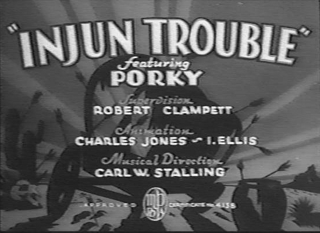
201. Injun Trouble (1938)

featuring
PORKY
Warner cartoon no. 200.
Release date: May 21, 1938.
Series: Looney Tunes.
Supervision: Robert Clampett.
Producer: Leon Schlesinger.
Starring: Mel Blanc (Porky Pig / Sloppy Moe / Trail Boss) and Billy Bletcher (Injun Joe).
Animation: Chuck Jones and Izzy Ellis.
Musical Direction: Carl W. Stalling.
Sound: Treg Brown (uncredited).
Synopsis: Pioneer Porky Pig is on the lookout for Injun Joe who controls the territories.

This is the 200th cartoon in the Warner Bros. cartoon library that I'm reviewing (exc. 'Bosko the Talk Ink Kid') and that would be by one-fifth of the challenge completed - officially. Later on about roughly 30 years later of the same name it would be called 'Injun Trouble' but would be the final WB cartoon of then entire original series. The cartoon would be remade seven years later but called Wagon Heels also directed by Clampett.

The cartoon then begins as we find a map of the United Sates long, long ago. The East Coast part is labelled the 'USA" while the rest of U.S. is controlled by a territory called the Injun Joe Territory and it shows that it is controlled by a lot of Indians. We then start to get a close-up view of the map as there is a card pointing to a wagon spot that reads A WAGON TRAIN LEAVES NEW YORK FOR CALIFORNIA.

The wagon then starts to make a track as it's being animated here through the U.S. map. As its being shown through animation - it turns out it is a "wagon-train" as there are a line of wagons and cattles riding past but it also features a boiler at the top as we see that makes the wagon look more like a locomotive. As the wagon train then starts to steam by we then discover that Porky is riding on his horse trying to catch up with the wagons. As Porky then manages to catch up with the conductor on the train who is riding the wagon and also chewing tobacco. He then turns to find Porky as he calls for name, then spits tobacco and shouts for his name again. "Injun scout ahead (?). Keep a sharp lookout for Injun Joe". He appears to keep on spitting every time he finishes a sentence. "Dat varmint" he calls Injun Joe who appears to be an injun who controls must of the terroties in the United States.

After getting the alarm from the sheriff inside the wagon Porky then responds to the alarm as he is fully aware. Even the horse then starts to spit on the ground which makes it rather amusing since he's copying the sheriff's spitting habit. Porky then starts to get his horse to ride faster as he rides past the wagon and then he reaches the territory line. The sign at the board then reads: Boundary Line - PALE FACE KEEP OFF LAWN. Injun Joe.

One thing I must say is that the animation of the horse is pretty fantastic to look at. The horse then starts to make a move as he tiptoes over the boundary which is pretty cleverly animated. The horse and Porky then start to reach the bottom of the cliff as they look under for the spot of Injuns. The horse then whinnies and makes a big take but then starts to slide down the cliff. The whinny take was a rather funny animated scene to look at. After sliding down the hill the horse continues to trot but ends up leaving his legs still dangling in the air which I find is also pretty cool to see as well and also humorous to the audience. Porky and his horse have already discovered something pretty shocking as they discovered that there have been a lot of wagons destroyed by the pioneers that were setting out west to California. Just burnt

After the arrival at the scene with the destroyed wagons - Porky then jumps off his own horse and realises that he knows the cause for this. He makes a hat take which is subtle but shouts 'Injun Joe' knowng that he caused that. He then start to PAN forward as there is the body marks of Injun Joe that ended up walking past a rock as it so appears.

Porky and his horse are then on a investigation on the search for Injun Joe as Porky is carrying his magnifying glass by investigating the massive foot prints that would've been stood by Injun Joe. The animated scene of Porky with his magnifying glass and the horse walking past is a Chuck Jones animated seene for sure with the very good timing but also the drawing too. The plant that they then walk past turns out that it isn't a plant. It turns out that the "plant" was a beard of a type of hermit that then appears and the music completely changes as he shakes his own beard as there are arrows that fly out of the way. I love the subtle part where he uses his own beard to take the arrow off the beard which was pretty amusing. It turns out that he was one of the survivors of the Injun Joe attack as it's shown here. The character named here is Sloppy Moe - but at least in Wagon Heels he was called that so I can perhaps call him that in this cartoon if it's safe for me to do so.

Sloppy Moe then starts to walk over to Porky and his horse jumping over as we still hear carny music. He then starts to jump over in that really kooky Clampett fashion where he jumps with excitement but sings with substitute lyrics to the song London Bridge Is Falling Down. He sings to Porky a secret, "I know something I won't tell, I won't tell, I won't tell. I know something I won't tell!" in which he then kicks Porky and laughs off the last part of the rhyme.

Porky then gets back up as he asks Sloppy Moe, 'What is it?' Sloppy Moe then starts to get into that uncontrollable chuckle where he is about to explain to him what it would be. "Well it's just that---" until he just breaks down with laughter and doesn't appear to be in control of what he is trying to say. Afterwards as he is about to say - he just leaves at the scene refusing to tell Porky or anyone. After all, he did say he wouldn't tell. It appears that Sloppy Moe has left the scene through that rock that was crushed through the body of Injun Joe. Porky and his horse then continue to follow the tracks to discover the investigation.

After that dopey sequence with the dopey hermit - we then starts to change location at a different setting where we see a mountain at the distance. At first we would think that the mountain location would look pretty nice looking as though there is nothing that could be going on. We start to find that the mountain looks as though it's about to erupt but instead - it just splits in half by Injun Joe who is walking his path.

In the background we hear the music to 'The Sun Dance' which is a popular music piece for Native Indians. As Injun Joe is still walking down as he owns the territory - we find some gags and it shows that he is so tough that he can also walk through a pair of trees that are standing close together. As Injun Joe walks past through them - the shape of the trunk on both trees are square-shaped. What even amuses me is the fact that as Injun Joe is just walking past as though he controls the territory - his chest is so tough that he can even break through trees with his own chest and without any effort as well. As we breaks through the trunk of the tree - the top half of the tree then starts to get lower as it then bounces back down making the tree look very short. Standing behind Injun Joe then features a black bear who creeps behind him and growls at him. Injun Joe then responds back to that by roaring back loud at him with a much more aggressive tone and even growing taller than the bear in which he shrinks by comparison. The brown bear then starts to cry like a baby and the baby-crying sounds is a rather funny sound effect heard here.

After the bear then ends up crying like a baby - Injun Joe then starts to dash all the way up to the top of the mountain and he brings the top of the mountain down to the bear as it looks a lot like a bowl of ice-cream. Of course this cheers up the bear as he gets to have the bowl of ice-cream but bringing the top part making it look like ice-cream was a very good gag. As the bear is still holding a spoonful of ice-cream - Injun Joe then starts to gobble it all up - even chewing on the bear's spoonful.

The bear then starts to cry like a baby. I imagine the ice-cream gag was just a part of the Great Depression at the time which was still going even until the 1930s but wasn't a terrible damage effect but it didn't last until around the end of World War II. The fact that Injun Joe brought down the ice cream for the bear just to eat it I thought was very funny as it shows that he's not even caring one bit - also a big bully, too albeit dangerous. The bear crying is very funny. Injun Joe is still walking around the territory but as he is still walking past - his foot ends up being caught in a bear trap. After being caught in a bear trap - he then ends up biting the entire bear trap off his feet in which the bear trap then starts to yelp out of the way like a dog whining. These gags of Injun Joe just walking past and being off his strength become funny gags in my opinion that even work itself.

Meanwhile Porky Pig and his horse are still on the lookout for Injun Joe. As they are still on the lookout - they then start to come across a river as it is streaming by. Porky and the horse then approach closer to the river as they realise that it wouldn't be easy for them to cross. The horse then starts to stand up like a human in which he tiptoes to the lake and unrolls his sleeve so he can reach underwater.

Underwater we find the horse's hand then trying to find the plug to the lake and he unplugs it like taking a plug out of a bathtub. The water then sinks away in which it falls down the drain. Porky and the horse then start to walk on crossing the river.  That was funny since considering that they must be sissies of going through the river but yet again it is flowing so how would they be able to go across? After crossing the river Sloppy Moe then appears at the scene again as his face pops out of a log and we hear that kooky carny music again. Sloppy Moe steps out once again as he then goes into and scampers about jumping over towards Porky and his horse. He once again chants "I know something I won't tell, etc." Sloppy Moe then starts to grab Porky's Davy Crockett hat and stretches it down to his feet as he is caught in it. Porky then places his hat back to normal size on his head. Porky asks him again 'What'ya know?' - Sloppy Moe then replies in that chuckle, but comments 'It's a secret' as he keeps on zipping and running all over the place.

Injun Joe is now on the look out for any deserters in his territory. Whilst on the lookout for any deserters that are coming towards his area - he then manages to spot a wagon-train steaming by. As he then spots the avon that is sailing by - he then plans on an attack to them. He starts to jump from the edge of the cliff like a diving board and then dives down. When I notice him about to dive off - the cape that he's wearing to cover his privates then start to swing up and down but who cares - he doesn't have one in this cartoon.

Injun Joe then starts to make a dive down in which he then quickly transforms into a dive bombing plane. Injun Joe then starts to dive by landing into a parachute - and I recall in the tribute; it was remade with Injun Joe landing to the ground but the timing was much more edgier and sharper than this cartoon - when comparing it. After Injun Joe then lands on his parachute to the ground - he looks over and finds in a shock that the wagon train is coming past. As the train then starts to come to his path - Injun Joe is hiding behind a rock and he is going to use the strength of a branch to move the tracks of the wagon-train physically.

As Injun Joe then manages to do that successfully and physically - the wagon train then starts to go through that path but it turns out that path is a dead-end as there are no tracks leading to where they need to go and it ends up causing the wagons to then circulate in the middle of the dessert as they have fallen into Injun Joe's trap.

Injun Joe then surrounds the entire wagon field as he is so tough and dangerous that one injun against a couple of wagons will still make Injun Joe undefeated. I like how that Injun Joe is pretending to be riding a horse but it turns out that he is only riding on a log. One of the pioneers in the wagon then starts to screech with horror as he grabs out a shotgun and begins to fire at Injun Joe. The shotgun that he is carrying turns out to have a mouth at the end that spits out bullets and makes a ding sound when firing which is some pretty good gag development. Even one of the cattles then also take part in the fight against Injun Joe as they are carrying a machine gun with them trying to fire directly at him. Injun Joe is still alive and still active as he then starts to use the log as he was pretending to ride it like a horse. He uses the horse like using a enormous bow and he uses huge arrows to shoot at the wagon tents.

One of the shooters inside the wagon then fires at Injun Joe. The arrow then shoots straight into the tent of the wagon and the wagon then starts to burst and float down. The pioneer then steps out and pumps it up so that it can still stand before returning back into the wagon. The pumping scene was a clever gag to get it still working which I quite like there. After the wagon is back up again - the pioneer then continues to fire.

One of the pioneers is shooting from his shotgun straight to Injun Joe but then starts to make a halt in which he then starts to look at his gun but we find that the Davy Crockett hat turns out to be a real raccoon shooting straight towards Injun Joe which makes the hat-gag amusing. The pioneer with that shotgun then starts to fire straight at Injun Joe but Joe then starts to collect the bullets in his hand as it wouldn't even come close to giving him pain when he carries the whole stack of bullets. Afterwards - Injun Joe then starts to grab out the bullets from his hand and into his mouth as he starts to chew them. After he has finished chewing the bullets inside his mouth - he then starts to spit out one huge bomb out of his mouth. Very good gag there where he has chewed the bullets to make it up to one huge bullet in which it turns into a bomb as it lands onto the field with the wagon trains. After that effect - suddenly they start to fall back down in the same position - as well as the mountains, etc.

Porky and the horse are still on the lookout for Injun Joe in this cartoon as they are still locating and following his foot prints. The horse and Porky then start to make a take as they find Injun Joe. The horse then makes a trot for it in which Porky is still holding onto the reins as the horse trots on.

As Injun Joe is holding onto an axe after the pioneers - he turns around to look to see who is after him as he makes a 'take' as Porky and his are after him. Porky then slides down his horse as he starts to walk up to Injun Joe. Injun Joe is then about to attack Porky with his axe - but Porky jumps from his trousers (still standing) before jumping back down again. In the copy I am watching there appears to be a weird cut from the part where Injun Joe is swinging his axe which turns into a type of circular saw but there appears to be an awful television cut where the tree he cuts turns into the Statue of Liberty. Then the circular saw controlled by Injun Joe starts to go on top of a building as it forms civilisation buildings. As soon as Porky keeps on running away - he then suddenly reaches the edge of a cliff and is cornered by Injun Joe which means Porky has no other part to escape.

Porky Pig is still standing at the edge of the cliff but then Injun Joe starts to pick up Porky by grabbing onto his hair string. As soon as he arrives at the spot about to chop off Porky - Sloppy Moe arrives at the scene to stop the fighting going on. He then jumps up chuckling "I know something I won't tell" once again. Injun Joe then picks up Sloppy Moe at the spot as he asks "What do you know?" (a Chuck Jones scene).

He then starts to reveal the secret which results being the whole gist of this cartoon "It's just that Injun Joe...is...ticklish". He then ends up tickling Injun Joe as Joe then breaks down very ticklish. He soon then manages to let go of Porky in which Injun Joe just breaks down into laughter because of him being ticklish by Injun Joe. Sloppy Moe then tickles him with his beard which results for Injun Joe to be standing by the edge of the cliff. After being tickled off the edge of the cliff - he then gets tickled again by Sloppy Moe who is standing in a parachute. Injun Joe lands into a chopped down tree as a result in which he is trapped. Well, I thought he was so tough he could break that tree open. There is some very loose and fluid animation of where he is being tickled from the tree which I think is some very funny animation of how he moves and all. Porky walks over to shake Sloppy Moe's hand for saving him. Afterwards - whilst being tickled (the iris out then stretches back) as he breaks the forth wall 'Do you want some more? I think that ending scene with the tree might also be Chuck Jones' scene but I'm not too sure to be exact.

Overall comments: I find that with this cartoon that this is one of Clampett's stronger cartoons of 1938 and he was already at that stage of bringing the word "looney" into Looney Tunes - and I feel that here this may be one of his first attempts to really put that into this cartoon. Of course - we already have experienced the craziness from Daffy Duck but here he has some kooky characters here like Sloppy Moe who prances around singing 'I know something I won't tell' which is rather charming to watch - although there is no lip-sync on the character so I wouldn't call it completely appealing animation but its serviceable. The design of Injun Joe is a pretty cool design but I felt that with his under clothing could've been a bit more 'subtle' but at least the design was.

When I compare the animation to this cartoon and 'Wagon Heels' in the era where Clampett was remaking many productions - I think that it makes a huge difference to Clampett's timing. There were some new elements in 'Wagon Heels' but the ending part was altered as Porky and Sloppy Moe were chosen as territory heroes but the ending where he gets crushed to the ground which forms the United States was just animated with perfection. Clampett certainly had a much edgier and sharper timing than he did earlier where in this era his timing was very fluid and I'm mentioning this because I feel it would be interesting to keep going through the years when we watch Clampett's timing get sharper through those years.

Monday, 27 August 2012

200. Now That Summer Is Gone (1938)

Warner cartoon no. 199.
Release date: May 14, 1938.
Series: Merrie Melodies.
Supervision: Frank Tashlin.
Producer: Leon Schlesinger.
Starring: Mel Blanc (Junior / Gambler) and Billy Bletcher (Father).
Story: Fred Neiman.
Animation: Bob McKimson.
Musical Direction: Carl W. Stalling.
Sound: Treg Brown (uncredited).
Synopsis: Summer is gone and squirrel goes on rambling addiction.

Here I have managed to review 200 cartoons out of the challenge that would be roughly 20% of the entire series reviewed and even completed one-fifth. A year ago - I probably thought that I would never surpass the reviews of the Bosko or Buddy cartoons but I really have come quite far. What I didn't realise until a while ago was that the blog already had a year's anniversary about a month ago and I'm still kicking.

Funny enough since the cartoon is called 'Now That Summer is Gone' - Summer is coming to an end soon and it feels like the right time to post this review here.

The cartoon begins as we find that there is a beautiful scenario setting where we find a waterfall that is flowing down a river. The leafs moving down is quite a nice effect but I have to give a lot of credit to the background painter of that scene for the choice of beautiful colours to present Autumn with the leaves falling.

The song I believe is also the title of the same cartoon. Notice how that during the PAN as the leaves are just flowing nicely - the music and the leave movement then start to change. The animation of the leaves then starts to move in a type of razzle-dazzle movement as the music then changes what sounds like some sort of Samba. That type of gag would've been typical in those 1930s cartoons - even coming from Warner Bros. I imagine that the effects animation there done by AC Gamer would've been a challenge to calculate the PANS while still animating it on paper as well as so many leaves at the scene. I've happened to draw so many leaves on paper but it must've been hard to turn out like 30 feet of effects animation a week. After the effects animation with the Autumn leaves covering up the entire scene - we then move over to the woodlands as we find there are a lot of squirrels and we see the certain activities that they are doing. As there are an off-screen chorus that sing the squirrel's activities we find them collecting nuts for the winter season. We then find one of the squirrel's picking acorns off a tree but does that by shaking the tree violently. The gag then ends up resulting from the tree coming to life and whacks the squirrel from attacking it. Although Tash said before he was influenced by Harman-Ising's cartoons - I see an influence there. I notice in that scene it's the same Freleng animator that likes to smear around but I still don't' know about that animator.

One of the squirrels is standing on a limb of a tree also collecting some acorns to survive through the winter. The gag-type that is shown here focuses on the squirrel as he unscrews the acorns as though it looks like unscrewing a lightbulb and he places them inside a basket. The same squirrel shaking the tree still wakes up by grabbing his own branches and shakes the squirrel.

Afterwards we then pan to a squirrel during the song as we find he walks over to a tree where it also has a slot machine. The gag is that he places a coin but as he gets the same results from the slot a pile of acorns then fly down at the scene and land on him which shows he can survive the winter with that. Another gag in relating on catching more acorn then focuses on a pinball fashion style.  The rock that the squirrels then use to push but release it in which the rock starts to whack at these trees which results with acorns flying out of the sky and landing to the ground. Another gag then relates to a squirrel to appears to be using a machine where it uses a towel to shake the tree to get the acorns falling to the ground as we truck back to find the squirrel who is standing by the tree and winks to the audience for his trick.

These are just gags that are being shown here of collecting acorns presumably made up by the gagmen while the off-chorus singing of Now That Summer is Gone is played but who's going to be listening to that type of music when they're interested in the gags? One of the squirrels then place their own sacks full of acorns where they are taken into boxes so as (I guess) they are used to be examined as they fall into the three different boxes of different height like "small", "medium" or "large".

 One of the squirrels then starts to stamp the acorns in which each acorn being stamped appears to show a Kosher sign which is a dietary regulation in the Jewish language - so I imagine this is a Jewish reference there?? All of the other squirrels then start to walk down to a tree but there is a sign that reads "First Nutional Bank" which is spoofing the name like a national name but just for a sake of a pun. The music then finishes off from the off-screen chorus after they finish the title song of the cartoon 'Now That Summer is Gone'. The animation cycle of the squirrels walking down to the tree is a rather solid cycle.

After the song sequence has finished - the camera then irises out in which there is an adult squirrel with grey fur who walks down to the front lawn of his home. His home is of course a tree but with windows as he walks to the front part where he has his own gates. He walks down the gate in which he turns his head arounds looking around. He then takes his specs off his eye as he blows at his glasses to polish them.

As he polishes his own specs - it appears to be that he has no lens on the glasses so what would be the point of him wearing them with no lens unless that is supposed to be the gag of this part. If that so is the case of the gag since I don't think it's presented very well. After cleaning up his own glasses with his cleaning cloth. After cleaning up his own glasses he then starts to call for his own son as he shouts out "Junior, Junior!". Is it me or is there somehow a  rather weird animated effect look on his fur as it appears to spike up unless that is just a part of the poor assistant work. We then starts to PAN down towards as we find that Junior is in fact hiding behind a red Autmn bush. A hand of his pops out in which he is shaking a dice as he is gambling with other squirrels as it appears. He then shouts out begging for luck "Come on, you seven!" and of course wants a seven so he can win some luck on the game as he has to win acorns. He then continues to shake the dice for luck "Oh, dice, don't fail me now".

Of course - as he is shaking the dice with his hands with some other friends he's gambling with his other peers to take all of the other acorns as he doesn't appear to have any of his own. I like the idea of gambling for acorns since it's similar to money but acorns are worth a lot to squirrels. He then continues to boast these typical lines when wanting luck "Papa, needs a new pair of shoes".

After he rolls the dice there is a VERY decent animated effect that we see in perspective as it involves the dice being unrolled by Junior as the dice move in a larger scale which must've been difficult to animate. Even the heads then start to move in perspective as they look over the dice to see the results. It turns out that the dice in fact has turned into a seven in which he has won the game. It results the other players to walk off angry as they just give up to participate and leave Junior on his own. The male squirrel then sings to the others "You boys must be trenched (?) in the head!" He appears to be singing the substitute lyrics to the title song 'Now That Summer is Gone'. As he gathers and collects all of the nuts to himself - his father then arrives at the spot tapping his feet (though we only see the lower half of his body). As he sings - the father then gives Junior a slap in the face very angry at his gambling activities. Junior rolls out of the way in which he lands into a tree as acorns fall on him. He then comments on his activities "So, gambling again, eh?" All the other squirrels (as we pan on the right) then laugh at Junior for being slapped and comment through the song that it's not the way for him to collect acorns in winter. Junior then drums his fingers to the ground not amused.

The following montage shots then feature the squirrels preparing their own harvest as they are collecting their acorns. It's practically the same animated scenes that we saw earlier on in the cartoon but Tashlin has used it as these montage shots which gives it a very interesting animation effect. I wonder if Tashlin really was the first director to use the montage shot effects as he claimed in the interview.

At the end of the montage effect we fade out but fade in as we find that the squirrels then are seen carrying big sacks of nuts with them. As they are carrying past with them sacks of acorns - they then walk past a tree. They are not seen from that tree as it turns out that they are caught by Junior for his gambling activities again. It turns out that Junior has won the gambling game again in which it causes the three squirrels to walk out as they lost the gambling game and leave with absolutely nothing. After Junior has won the gambling game again - he is caught once more by his father who is tapping his foot waiting for his attention. Junior then makes a take as he realises that he has been caught in which Junior then slaps himself the same way his father would slap him. After Junior then slaps himself he then rolls over and hits the tree rather dazed until the scene then fades out.

In the next shot after the incident with the gambling again - the father then reports to Junior on some orders he has to do. He then asks Junior: 'Get some nuts from the bank and get back before the snow falls. And remember, no gambling'. That was a nice reflective effect from the pond which would've been also difficult for the animator too.

After that shot with the warning of no gambling from his father - he then walks over to the 'First Nutional Bank' as he is to collect acorns for the winter. The squirrel then starts to walk out of the national bank as he already is carrying with him a bag of nuts to collect home which is orders from his father. A really cool animation effect is shown in that one particular scene when you watch it as the squirrel is walking down the path but the scales of him being animated then gets much larger as he walks in perspective again until we find that we only see his two feet walking. That was a very good Tashlin effect and I do wonder how the exposure sheets looked like since I imagine his exposure sheets must've been very precise and detailed. As we find that only his legs are seen there is a gambler seen in the distance who tempts Junior, 'Indulge in a little game of chance, sonny?' Junior then dashes over to him as he couldn't resist - the timing there from only his feet to his full self (in a long-shot) must've been difficult to stage as well but the scene and how it was staged is just incredible.

After Junior then zips along to the gambler who is seen in a moustache, bowler hat and cigar - Junior responds with an "Okay". The squirrel then starts to place his own nuts across the trunk of the chopped down tree as he is ready to gamble completely forgetting about the nuts he's supposed to return home to his father and his cautious warning on 'No gambling!'

The gambler then starts to gamble as the first dice he rolls he wins a seven in which he comments to Junior - 'You lose, sonny'. This would be the first time since Junior could possibly get beaten as he is facing a champ. In these next montage shots - the camera angles and staging shows some serious work that is being done by Frank Tashlin as the way he's organised the shot of the gambler's hands throwing the cards or even the way he then tosses the cards and a pack of cards pop up one at a time in the screen. It makes it very appealing to look at and a very good montage effect. As we find through the montage - Junior keeps on losing more nuts from playing as the gambler ends up winning more acorns. There is a gambling board that circulates which makes it a excellent effect that shows the game still continues onwards. I'm not too sure but from what I'm looking at it looks as though the board that is spinning was a real life one that was placed into an animated shot.

After many attempts from Junior as he kept on gambling until he had finally ran out of nuts. In that long-shot view the gambler responds to that, 'What no more nuts? Tut-tut. Well, better luck next time'. As he then walks off laughing. I wouldn't call the gambler a villain I mean - he completely showed Junior by losing him. Junior so far in this cartoon has been a bit of a dick by just gambling squirrel's money away and what he got was what he deserved.

The snow then starts to fall as he is supposedly meant to return home with his father but where he will also catch hell from him. He continues to walk on through the snow where it is snowing rather heavily. What I like about that effect is that it is a background effect where it appears to change from the autumn effect to it and even a very snowy effect to it as the ground then starts to change as its covered in snow. During that winter sequence - Junior then starts to walk through a terrible storm as he struggles to walk through the blizzard and even on the way home, too. As his struggle to walk back to his home continues - there is a quick PAN as it features the father squirrel is sitting down by the fire reading the newspaper waiting for his son to return home and rather enjoying himself as it appears.

Inside the house we still see the father squirrel sit down by an open fire. The fire effects animation in the background is pretty cool - in my opinion. Junior then finally makes it into the home after walking through that terrible blizzard. He slams the door and walks down the steps shivering. He then starts to act pantomiming as though something has happened.

Junior: Oh, they got me.
Father: Who got ya?
Junior: A gang of bandits. They robbed the nuts. They jumped me. Oh, I put up a terrific struggle and beat them all. When 50 more jumped me.

While is still lying about what has happened the father then starts to put on his disguise outfit as it turns out to be the exact same disguise outfit that he had worn when Junior had lost the gambling and it turns out that he has been conned by his own father. He then starts to lean closer towards him in the outfit asking, "How many?" and Junior replies "50 of them". He continues to try and lie at his story in which he realises that he is in trouble as he shouts "Uh-oh". The father tells him off for gambling again - he then grabs Junior by his tail as he is prepared to give him a spanikng. "I'll give you ten lashes you won't forget". After hearing that he responds, "Look, I'll flip you, Pop. Double or nothing, huh?" and that appears to be another gambling reference there but he then gets spanked with a paddle as his screaming and shouting even continue over the 'That's all Folks' credits.

Overall comments: Frank Tashlin in this cartoon has obviously been experimenting with a lot of perspective animation as well as montage shots as it appears to be the main focus of his film techniques in this cartoon. It must've been a difficult challenge for the animators to have worked with Tashlin and probably would've found it unusual of him for what he wanted on the screen but it really stands out really well from the other Warner directors which makes his cartoons look great. The animation of that overall cartoon looked really great as the character designs (of course heavily focused by Tashlin) but the animation even going in perspective looked amazing as it would consist of animators for him like Ken Harris, Bob McKimson or Robert Bentley since he now had a team of solid animators which is what he wanted in the past as he said in his own interview.

Also, as well as focusing on many techniques - I believe that around this period when producing 'Merrie Melodies' cartoons that he was also trying to bring back some of the story lines that would've been reused from the Harman-Ising days as he would have song numbers as well as the type of story lines heard as he said he was influenced by those guys and it's shown here in this cartoon and the 1938 Merrie Melodies he made - evidently. What really interests me is that I wish we could know a bit more about Fred Neiman who was only at Warners for a short time around that period but mostly associated with Tashlin but Mike Barrier only speaks a bit about him in the commentary of the cartoon.