Sunday, 13 November 2011

57. Wake Up the Gypsy in Me (1933)

Warner cartoon no. 56.
Release date: May 13, 1933.
Series: Merrie Melodies.
Directed by: Rudolf Ising.
Producers: Hugh Harman, Rudolf Ising and Leon Schlesinger.
Cast unknown.
Animation: Isadore "Friz" Freleng and Larry Silverman.
Musical Score: Frank Marsales.

 I first saw this cartoon when I was about 10 years old, when it used to be on YouTube for a very long time, I quit liked that cartoon - and now I'm going to be reviewing it.

The cartoon starts off in Russia, and we see some Russian dancers in a gypsy village. There is a Russian dancer doing the Cossack, and there are Russian bands that are playing in the village. It seems that this takes place before the Russian Revolution back in 1918, and Russia was known back then (when the cartoon was created) it was known as the USSR. The band conductor tips his Russian hat and it is revealed to be s Paul Whiteman caricature. The dancers continue to dance until the Cossack dancer dances RIGHT at the camera.

There are a group of Russian guys that are holding their mugs with beer singing the song, The Song of the Volga Boatmen which is a very well-known Russian song, and it's very good. The song was later reused as a Gremlins song in Russian Rhapsody. The guys then guzzle down the beer in their throat and they gurgle to the Russian song. We then see a group of men that are pulling a rope with the music rhythm to Volga Boatmen and the animation timing is very good. The rope that they were pulling, that they struggled was a dog at the end chewing the rope - which is a funny gag, since a group of tough men are trying to challenge a puppy.

We then see a Russian singer who is playing pan-pipes, and behind him is another man who is shorter, and then another man (shorter), and the last comes behind his back (shortest). Both those men all line up together (smallest to tallest) and they are singing the title song, Wake Up the Gypsy in Me. As soon as a dog comes onto the stage, a dog comes up and barks in which their Russian hats are revealed as cats hissing that scare the dog away.

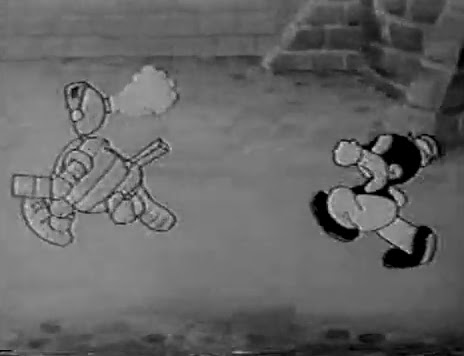
We then see a gypsy come out oh her caravan, and she has a tambourine that she is playing with. All the Russians are dancing to the music. But then a bit further away from the dancers, we see a mysterious man who is wearing a jacket which is very tall. The mysterious person steps outside the palace and he opens his jacket and reveals four pairs of bombs, and on top of the bombs are eyes drawn with a Russian hat on top. He then enters the palace.

We then get a shot of a sign that reads, Rice Puddin' - the Mad Monk and Rice Puddin (who actually is based on Grigori Rasputin who was a Russian monk at the time) seems to be a monk of the Russian village, who is mad - as it said on the title card. Rice Puddin' is sitting at his desk and we has some jigsaw pieces scrambles over the table, and his puzzle is only half done. He then picks up a chunky jigsaw piece and realizes that it's too big to even fit into the pieces, so he cheats by sitting off parts of the piece by using a pair of scissors in which he fits the piece into the puzzle perfectly and evily laughs. The monk here has personality, and we can even tell on how "evil" he really is and also a "cheater" as he cheats on his jigsaw puzzles.

Meanwhile, the person carrying the bombs in his jacket enters the palace, but notices that there is a guard standing in the hallway. The person carrying the bombs, hides behind the wall, and enters the hallway by disguising the bombs a pair of boobs and walks past disguised as a woman walking to distract the guard. The plan worked.

Rice Puddin' continues to cheat at his jigsaw puzzle game as he finds another piece that won't even fit into the puzzle, and the monk throws it to the ground in a rather frustrated attitude. He finds a picture of a King tied to the wall (King of Russia??) and he cuts his face and places it at the back end of the donkey which fits perfectly, and laughs since he is meant to be a "jackass". He then grabs out a pair of binoculars to look at the village people, and mutters "Bah! the fools", and he is watching his people mainly dancing and singing, and he spots a gypsy dancing with her tambourine.

The monk then orders one of his guards to go and get the gypsy girl and bring her to him. The monk then takes out a cigar from one of his chests and the guard walks off. Rice Puddin places the cigar in his mouth and brings out a lighter in one of his pockets, in which a mouse comes out of the lighter with a matchstick and lights his cigar. Somehow, he doesn't really remind me of a monk - as he reminds me of a leader of the village, who doesn't like his people.

The guard then walks in holding onto the gypsy girl. The monk then presses a button in which there is a trap floor that causes the guard to fall. The monk then says "Give old maestro big kiss, eh?" which scares the young girl and ignores him by shouting "Pooh pooh.

The gypsy panics out of the window and she calls for the villagers for "help!". She starts to run away from the window, as the monk's hand grabs her, and she runs down the hallway until she is cornered. Rice Puddin' is about to grab the girl until he sees out the window an angry mob trying to seize him. The monk turns to the audience, "Holy mackerel - an evolution!" There you go, the start of the Russian Revolution - since Rice Puddin' is meant to be Rasputin who was part of the Revolution in 1917.

 Rice Puddin' (Rasputin) runs out of his palace and lands onto a horse that rides along fast. All the group of crowds are catching up to him and are running at his speed. One of the Russians place a bomb on his pants, and Rice Puddin' then pulls his horse's tail that causes him to fly with his ears like a helicopter. He laughs until he finds a bomb that was placed to his pants, which explodes and then we see Rice Puddin's reaction after the explosion - and that's all folks.

Well, this has been a while since I saw this as a child, but it all has been very interesting to watch again. It showed a good part of history, which was probably the very start of the Russian Revolution. Of course, I've never studied about that in my school, and I vaguely know the concept. I don't think it started off with a monk trying to capture a gypsy, but I understood the whole concept when I read the book Animal Farm a few years back, when it was based on animals. Overall, I quite enjoyed this cartoon and it was interesting to watch.

Saturday, 12 November 2011

56. Bosko's Knight-Mare (1933)

Warner cartoon no. 55
Release date: April 29, 1933.
Series: Looney Tunes.
Directed by: Hugh Harman.
Producers: Hugh Harman, Rudolf Ising and Leon Schlesinger.
Starring: Johnny Murray (?).
Animation: Bob McKimson and Robert Stokes.
Musical Score: Frank Marsales.

The short starts off with Bosko sitting on his rocking chair and is happily reading a book, sitting by an open fire, while Bruno is on the floor snoozing in front of the toasty warm room. Bruno starts to scratch but Bosko then asks him to listen to Bosko's favourite part of the story. "Listen Bruno, and then the bold brave knighht...", Bosko chants with excitement while Bruno just razzes not even listening to Bosko. As it is 8 o'clock (according to the radio) Bosko doesn't like what he is listening to, and he switches to the next channel, where Bosko switches to the song Knights Are Bold that he enjoys listening to, but after rocking in his chair continuously through the song, he gets rather sleepy and goes off in a very long kip and dreams that he is a knight.

There is some good personality going on between Bosko and Bruno, and it's one of them cartoons where Bosko is in a deep sleep and goes off into dreamland where he is a knight. There is some pretty good personality animation on Bosko's dog Bruno - who is a favorite of mine in the Bosko characters. The voice of Bosko sounds very different here, it sounds like a very soft version of a Mickey Mouse voice - I don't think Johnny Murray did the voice there. I wonder why he wasn't - was Murray ill, or busy - and Harman-Ising were meeting deadlines and replaced another actor who did the falsetto voices.

The dream then dissolves in as we go back to Medieval times, and Bosko is on his horse and he is a knight - he continues to sing the song what was being played on the radio. Bruno is in the dream as well, and he is wearing a suit of armor. As Bosko arrives at the castle, he pole vaults off the horse with his jousting sword. He makes a groan groan so the guards can draw the bridge. The guards all welcome Bosko with their trumpet playing sounds, but their face masks of their knight helmets drop and as the face marks drop, much of the trumpet comes off, with the soldiers playing the trumpet in such a bad note.

Bosko and Bruno enter the castle as Bosko is singing his version of Peanut Vender - they both enter the castle with a groovy walk style. Interesting to find this Knight who lived in Medieval times to even use this dance method since it didn't even exist back then and the days before charisma. Of course, it makes it more entertaining and interesting to watch - a Knight doing a rumba in the castle.

Bosko enters the castle, and down the steps he finds the Knights of the Round Table in which is based on the famous King Arthur and his Knights at the Round Table. All the knights at the round table greet Bosko with a "hi ho", and they pull off their helmets and are revealed to be celebrities that were very famous at their time - the Marx brothers. They raise their glasses of beer and they sing. Bosko jumps onto the round table where he dances with the Marx brothers. Bosko starts his dance routine and there are knights clothing that even come to life too. Now looking at it, it really is a dream - where it shows very famous celebrities, and charisma.

Unfortunately in my copy that I'm reviewing, there is a section part but it was removed where we see caricatures of Stan Laurel and Oliver Hardy doing impressions as knights - but it was cut in Nickelodeon back in the 1980's (probably time wise?), but it's not in my copy and I don't know what else to say.

Meanwhile there is a knight that is singing the tune to Knights are Bold on his horse, and waits outside the tower of the castle, where he is waiting for a damsel - and that damsel is Honey who appears to be the princess. Honey looks out of the tower rather coldly towards the villain, which causes his anger and he starts to open the locked gate, by biting off the padlock with his very strong teeth. Honey then starts crying for help as she is trapped because of the villain ascending his way at the top of the tower. Bosko then hears Honey's cries as he is to the rescue.

Bosko starts to charge towards the villain, and he is running, but in front of him is his suit of armor that runs too, but Bosko jumps into his knight suit and runs towards Honey. Bosko then arrives at the tower where he run hear the sounds of Honey screaming, as the villain is ascending his way up the stairs. Bosko then quickly rushes to the top of the stairs, where he tries to act brave and stop the nasty knight. "Stop, you mug!", and then the knight closes his face mask, and using it as a lighter to light his chunky cigar. He blows smoke on Bosko's face and walks to Honey's room.

It is one of the many Looney Tunes stories in the early years (at least up to around 1934 or 1935), when there was a boyfriend and girlfriend story, and there was always a villain to steal the girlfriend, and it was up to the boyfriend to take him. I bet that the audience finally got ticked off with the same old stories and they were wiped out. Of course, this is a part of Looney Tunes history.

The nasty old villain then jumps out of the tower window with Honey on her hand, as he's got the damsel. The horse then prepares to get steady for being squashed by the fat knight. The knight causes a hole in the ground, with half of the horses' body stuck under as well. That is a funny gag, and powerfully executed. Honey then cries for Bosko (somehow in this story they know each other). Bosko then rides on a mule (different from what he rode on earlier), and his mule then doesn't move and becomes stubborn. Now, that is a great joke - once you understand it. There is a famous simile "stubborn as a mule" which is part of the gag.

Honey's cries continue to keep on screaming, in which Bosko then falls off his mule as hit halts by coming across a lake. Bosko jumps into the lake and his knight suit automatically turns into a submarine going fast underwater. This section has some great gags I have to say - the suit, the mule, and all.

The nasty villain holds Honey to his gloomy castle, in which he goes through, and Bosko enters quickly. The bridge then moves out (like a tongue) and closes it like closing your mouth. The villain ascends his way up stairs, and closes the door inside his bedroom. Bosko was hiding all along under the bed in which he uses a machine gun to shoot bullets at his bum (but his suit would be bulletproof). The villain's temper rises very fast, and he rolls up his metal sleeve (I like that idea a lot), and whacks Bosko that causes him to skid on a row of spears. Bosko lands on the bed, and Honey tries to wake him up by stroking his cheeks...

 ...and the stroking was actually Bruno licking Bosko's face in reality. Bosko then wakes up and he walks to a suit of armor statue that he has displayed in the hallway. He grabs an axe and he chops the suit of armor into many pieces (but how is that possible though). Bosko quickly skips to his bed, and then he lands on his bed that retracts to the wall - and that's all folks.

This cartoon was much better to review than my previous one (The Organ Grinder) and it was more interesting. I'd say that throughout the cartoon there were different stages on how the plot and overall cartoon went. The short started off like a normal Bosko cartoon, throughout the middle we saw some charisma with the knights and caricatures that somehow existed in Medieval times - and towards the end of the short we saw some great gags. So, it's been a very interesting showcase, and it was much easier for me to review it.

Friday, 11 November 2011

55. The Organ Grinder (1933)

Warner cartoon no. 54.
Release date: April 8, 1i33.
Series: Merrie Melodies.
Directed by: Rudolf Ising.
Producers: Hugh Harman, Rudolf Ising and Leon Schlesinger.
Cast unknown.
Animation: Rollin Hamilton and Thomas McKimson.
Musical Score: Frank Marsales.

The short starts off with an Italian organ-grinder and he has a pet monkey that is trained to do tricks. The organ grinder is playing music with his grinder, while his pet monkey is behind him, making monkey sounds and dancing to the music. As the monkey hears a whistle up in the window, he sees a girl up the window and then he pulls out his cap for a coin to go in, in which it does. The monkey then slides down the lamp post, and follows the Italian organ-grinder.

The monkey continues to keep on walking on, and then he finds a banana hanging around and he then he peels of the banana skin one side at a time, by zipping it down. Oh man, I wish I could a special type of banana that I could peel down.

As the Italian organ-grinder and the monkey continue walking down the streets, we then see a large woman in her apartment scrubbing some clothes in some soap water. She looks at the clothes, with a quote "What a man", as if her husband has got some six-pack or something. She looks down at her apartment window at the monkey outside playing music, and she is shaking her bum by singing the title song, The Organ Grinder. I must say the voice for the large woman is appropriate - and her singing skills.

The woman then pulls out a coin and signals the monkey to grab it. The Italian grinder asks the money, "Tony, go and get da money!" in a Italian accent. The monkey then starts to climb up the apartment by swinging up the barber pole that moves up for him - what a great gag. The monkey then uses window shades to go up window-to-window. The lady who has her head at the apartment window, then gives the monkey a coin in which he places it in his jacket and not in his hat. The monkey then goes onto a long piece of underwear string and moves himself to another part of the apartment building where the large woman gives him the coin.

The monkey jumps out of the underwear and holds onto a sock and suddenly the sock rips that causes the monkey to fall down. The monkey falls down from the ripped sock and lands on different awnings, and lands on a long piece of underwear, and comes out of the rear end. He returns the money to the grinder, and pats him for doing a good job.

We then see children running in the streets as they see the monkey and they want some entertainment. The monkey starts off with a dance, when the grinder asks him to do something more entertaining, in which he shakes his booty. He then rages at him "Whasamattayou?" He asks him just to dance for money by demonstrating it with a cup. The monkey then shakes his coins, and whispers him to get going with the entertainment. He then dances to a sleeping cat and pulls his tail in which it "meows" the rhythm like a gramophone. The cat then hisses him away.

The monkey then goes up to a mannequin in which he climbs up the draws, and he takes the wig off the mannequin, and he puts the wig on his head, and then he places a top hat on top of his head in which it is a caricature take of Harpo Marx - in which it is pretty good, although so many people have caricatured Harpo over the years, and watching it today is just tiring.

The monkey then jumps over the mannequin and then he starts to play the harp (still wearing the Harpo Marx wig). The monkey (Tony) then pulls a string from the harp and he uses his tail to bounce like springs - okay, so that's an original gag. He entertains the children easily, and he then goes to a poster displayed of Laurel and Hardy, and he does a caricature of Stan Laurel at first, and then a caricature of Oliver Hardy. The caricatures are amusing, but I don't imagine Bob McKimson animated that - maybe Rollin Hamilton?

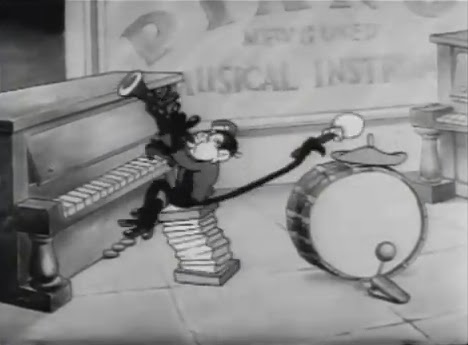
The monkey bounces to a piano lying in the streets, and he uses his tail to slide the keys up and down. The monkey starts to play 42nd Street on the piano, with the children singing the song. Of course, 42nd Street was released in cinemas in Febraury 1933, and this cartoon was promoting the music to try and attract the audience to watch that movie (and Young and Healthy). After the shot of the children singing, we then see the monkey continuing  to play the piano and somehow there is ANOTHER PIANO beside it?? What did the monkey somehow drag the piano magically, or some type of monkey business.

The next thing you know is that the monkey hasn't got a second piano with him this time is that (after the singing children) the monkey has a drum and a accordion, and playing the clarinet. He uses the accordion to move upwards to play some type of percussion, and then back down. He then uses a cat's tail as a double bass instrument, before the cat hisses away. Okay, we do see some monkey business entertainment, and the same cat from earlier on in that cartoon.

The monkey then steps onto a vehicle parked by the pavement, in which the car runs over a cart full of apples and the grocery seller is knocked over. The cart is brought back together in correct pieces, in which the man falls down on apples in which he starts to shout and complain. A woman is delivering a basket of laundry, but runs off as the car keeps moving, and the basket lands on the car, with bras covering the indicators and pants covering, too.  

 The Italian grinder is now starting to panic and worry, as his pet money as caused the trouble. The car then CRASHES into a music shop where the grinder was hiding. The monkey comes out with several brass instruments on the car, and the Italian man coming up delighted with the children cheering on - and that's all folks.

It's really hard to describe on how good this cartoon was or even on how boring it was. It certainly wasn't a bad cartoon, and it was hard to review it as there was not very much to go on about. It was just very ordinarily done, and yet again the animation is in good standards, with some fine gags - and no reuses. I can now see that Harman-Ising are in bigger budgets.

Wednesday, 9 November 2011

54. Bosko the Speed King (1933)

Warner cartoon no. 53.
Release date: March 11, 1933.
Series: Looney Tunes.
Directed by: Hugh Harman.
Producers: Hugh Harman, Rudolf Ising and Leon Schlesinger.
Starring: Johnny Murray (Bosko).
Animation: Isadore "Friz" Freleng and Paul Smith.
Musical Score: Frank Marsales.

The short starts off with Honey reading a newspaper with a picture of Bosko, with the headline BIG AUTO-RACE TODAY and turns to the audience asking "Is he the greatest?", and then she turns another page to another racer who is Bosko's racing rival, with the headline THE CHAMPION IS FAVORED TO WIN. Honey looks at the paper disgusted and turns to the audience disgusted, "Pooh-pooh," she says.

We then see Bosko with his racing car as Honey is watching by sitting on a backyard fence, and Bosko is putting some oil in the wheels to get ready for the race. Bosko is in full focus of the race, and let's hope he wins that time, unlike last time when he was boxing in Battling Bosko he was at a great defeat.

We then see other racers (animals) that are working on their race cars, such as a dog pumping up the wheels, a pig sowing a patch on a tire. We then see the crook (who is favourite to win), and he is sorting out his exhaust pipes. Bosko is busily sweeping his car, so that it looks fancy and not tatty. Notice how that his car number is 13 - which could be a sign of bad luck. Honey comes in the scene and comments on the car "Oh Bosko, that looks swell!" Suddenly the crook enters the scene standing at the end of his fence.

If you ask me, that character who is Bosko's rival looks an awful like Peg Leg Pete - a famous Disney character who is rivals of Mickey and Donald Duck. The only part that doesn't look like Pete is the hat to disguise and avoid copyright, with no Billy Bletcher voice to support it, but avoid it. The rival then lights a match on Bosko's front part of his racing car that leaves a horrible mark that is physically impossible to remove, and would cost money to be redone. Because of what happened, this makes Bosko even more determined to beat the "meanie" - he'll fight fire with fire!

Honey then steps onto a stage where there is a piano there to help "tune" up his engine. As she hits a key, Bosko turns on an engine that plays the exact same key. Bosko then uses his engine to play music like Honey does. Bosko then hears a noise from the microphone that announces that the race will begin any minute, Honey asks him to hurry. Bosko then gets his engine ready that starts to play Yankee Doodle Dandy really well.

Bosko is on his car, and arrives at the starting line in which his crowd cheer for Bosko with more cars arriving. The man with the timer then starts his call: "On your marks - get set - (stutters) scram!" He waves the flag and the race begins. The flag man seems to have a stutter problem, but he didn't last very long - one character with a stutter problem would later be very popular (Porky Pig).

Some of the cars at the start of the race seem to progress slowly, and even a dog in some type of bicycle isn't doing much effort. We then see some good car animation going on with the cars driving past, and some shots of the wheels going fast. We then get a PAN shot of a very long car, with other racers driving it. As the exhaust pipe explodes with a puff ring of smoke, a car jumps through the loop of dust. Even the ornament on the car is blackened from the smoke coming out of the exhaust pipes. The ornament opens the lid in which there is water, so he dives in and gets back up into a normal colored ornament.

As there are more cars driving, we then see Bosko who is directly in the middle and there is no way to drive through those cars blocking his space. Bosko's rival is driving in front of Bosko and is in the lead, he keeps on checking back and forth to see if anyone had tried to overtake him. Until he notices Bosko (off-screen) catching up. The rival plans on cheating by getting a small box of tacks and chucking them behind him in the middle of the tracks, so that Bosko's wheels will get tight. In fact, a lot of other cars get reactions from the tacks when driving in the middle of the tracks.

Bosko notices something strange about his back tire, and he halts his car to fix the wheel (Oh no, he might not win the race!), and there is a cat sitting on a fence minding it's own business. Bosko then grabs hold of a cat on the fence to help jack his car so Bosko can fix his tire by replacing it with a new inflatible part of the tire. After Bosko is done, he pats the cat for helping him, but as soon as another car ZOOMS past, Bosko realizes that he ought to hurry and he drives like crazy as he steps back onto his racing car to continue the race.

Bosko then starts to overtake cars that had tire problems, but had it half-fixed. Bosko then starts to drive like crazy as he's even competing with his rival who is in the lead. I love the speed of the cars that the animators used. The rival discovers that Bosko is catching up and likely to be overtaking him. The rival gets his way, by pulling his exhaust pipe in which black smoke goes on Bosko, covering his goggles black. Bosko then turns on the windscreen in which he can see better.

Bosko then tries to overtake his rival by turning different sides, but his rival already knows his maneuvers . As there is no other possible way to overtake, the car does the job himself by coming to life and biting the rear end of the car that causes the rival's car to jump and yelp, as Bosko's car sneakily creeps through and is in the lead. This is a situation in which cartoons can break the rules, and it was used as an emergency. I like that.

 
 Bosko is finally in the lead, and it is clear that he has already won the race with the crowd cheering. Honey runs in the middle of the tracks with a crown to award Bosko as the "speed king". Bosko accepts his award, and they both kiss on the lips. Since they are doing it in public, Bosko then pulls the engine in which black smoke covers them as they kiss in private - and that's all folks.

This was one of the shorts in which Bosko takes part in a race, and this time he was won it and his number 13 car was proved wrong. Overall, I didn't mind this cartoon at all - and there were some decent gags, and not a harmful cartoon at all. I've noticed how there seems to be little reuses so far in Harman-Ising cartoons in 1933. I would imagine that Leon Schlesinger gave Harman-Ising a much bigger budget for the 1932-1933 season, and probably that's why there is hardly reuses lately, although I can't get my hopes up.

Sunday, 6 November 2011

53. Young and Healthy (1933)

Warner cartoon no. 52.
Release date: March 4, 1933.
Series: Merrie Melodies.
Directed by: Rudolf Ising.
Producers: Hugh Harman, Rudolf Ising and Leon Schlesinger.
Cast unknown.
Animation: Rollin Hamilton and Larry Martin.
Musical Score: Frank Marsales.

The short starts off with a portrait hanging on a Wall of a fountain, with a palace at the view. We see a pair of squires walking down the royal stairs blowing their trumpets as the king is walking down the stairs. Another pair of squires, are rolling down the carpets by using their legs (the little squire looses control of its legs, and spins!). Then we see a dachshund walking down sweeping the carpets that may be dusty. Then we see another man throwing flowers over the stairs. Then, (how many men walking down the stairs are there going to be??), we then see knights walking down with a small squire holding on to the crown sitting on a cushion.

We then truck in to finally see the fat, pompous king. The crowd cheer on the king, but the king doesn't appreciate his people cheering on him, as he's a very grumpy king. I really like that walk-cycle for the king, as he moves one one leg in front, and then places his other leg to the other - it really gives that king personality and character.

The king then walks to his throne chair (as he walks quite slowly to his throne chair). He then sits down rather bored and depressed of ruling a kingdom. He then asks his soldiers standing to "scram", and sits down on his chair. Since no one was in the room looking, he decides to fall asleep in his chair. It seems that middle-aged has finally got to him. What a character that King is - it's great to see some personality going on, I think Harman-Ising were great with King characters, like the pig king in The Queen Was in the Parlor.

The queen then walks into the throne room who is a rather ugly-looking middle-aged queen, who has a very long train around her. She is singing the title song, Young and Healthy as she claims that she is that. At the end of her very long train is an old man in a wheelchair holding on to the end of the train, also singing the title song, as he claims he's "young and healthy", but appears to be right as he stands up and does a dance, and has a lot of energy - for an old person. 

The king is woken up from his sleep, and then he hits a jack-in-the-box in which a Jimmy Durante face pops up, which entertains the King as he does a very loud and broad laugh. The queen then stops at a group of soldiers, and she asks if "is his Majesty ready for the ball," in which the soldiers spread "the ball" from man to man. Jimmy Durante in the box spreads the last word "the ball" to the King, but the King doesn't care for balls and refuses to do so.

The queen then tries to wake up the King, as she is singing to him, and mutters "Time flies" to him. The King reponses by singing Let's Put Out the Lights and Go to Sleep. Jimmy comes out of the box and says to the Queen, "Let's put out the lights and go to sleep", in which the Queen responds by smacking him.  Jimmy comes out of the box shouting his phrase "I'm mortified, Am I mortified?" and then dies. The King walks off wailing at his broken Jimmy Durante-in-a-box, and he walks to the balcony bawling.

The King couldn't believe his eyes, when he finds a group of young children playing and having fun with their lives. The King chants "Oh boy, oh boy, oh boy!", and he wants to go down there and play with the children himself. The King then feels young, as he decides to go down and join them - by sliding down the stairs. There is an honest personality of the King here, as he wishes to be young again, and the children playing outside have made him feel young again to go play outside.I suppose that mid-life crisis for the King is finished for him.

The King is now sliding down the stairs in a very happy mood. The children find him sliding down, and they run to fetch a barrel of water in there, so that the King can get a happy landing. The King has been sliding down the bannister of the stairs for a long time, and one of the kids take off a railing, in which the King slides down uncomfortably and lands onto the tub of water. All the kids laugh with amusement, and the King laughs with them as well - as he brings his children with him as well. The King sings the title song, as he is feeling rather "young and healthy" himself.

The queen steps out at the balcony tapping her foot, looking at the King but becomes astonished when she finds him playing with children. One of the kids grab her dress and they run around like in a Merry-go-Round style. Her dress starts to spin around from the children, until it falls completely down and we see the Queen's long pair of underwear, and she runs off screaming at the camera.

The King looks at the Queen mortified and he roars with laughter, but the little kids run under his legs, that causes him to trip and fall down the stairs. The kids are inside the palace mucking around inside the house. The King continues to fall down the stairs as he lands inside a fountain, and blows water out of his mouth, like a mountain. We then pull back with the portrait of the King inside the fountain - and that's all folks.

I must say that this was indeed a great cartoon, with great characters and even a plot. The music was very good, and the King certainly had a lot of personality. Of course, many of the Merrie Melodies cartoons were just nothing special and they were just singing-and-dancing, but those cartoons weren't just singing and dancing and they really did fit the story well. One of the best written Merrie Melodies cartoon AT ITS TIME.

Saturday, 5 November 2011

52. Bosko in Person (1933)

Warner cartoon no. 51.
Release date: February 11, 1933.
Series: Looney Tunes.
Directed by: Hugh Harman and Friz Freleng.
Producers: Hugh Harman, Rudolf Ising and Leon Schlesinger.
Starring: Johnny Murray (Bosko).
Animation: Rollin Hamilton and Bob McKimson.
Musical Score: Frank Marsales.

The short starts off with the curtains reading "Bosko in Person" and they rise slowly, following a asbestos curtain that suddenly burns, in which we see Bosko performing a vaudeville show of him playing the piano. Bosko is playing the tune to Whistle and Blow Your Tunes Away which was the Looney Tunes opening song introduction at the time. He welcomes the audience by saying, "Howdy folks!"

Honey then slowly enters the stage by dancing with her feet and clicking her fingers. They both start to greet one another by singing. They do a very complicating dance routine, in which they use their feet and hands to do it. It is a very entertaining dance routine, and I like how something different finally came up. I would imagine that scene would've been complicating to animate, I bet.

Honey gasps, "Gee Bosko, you're swell", in which Bosko steps in the centre of the stage as he is going to perform a song about his love for Honey. He also does some weird poses as he is holding onto a note for a while, while he is singing about his love for Honey. She then steps back onto the centre of the stage in which they run off to the corner of the stage where they are hiding behind the curtains, as their act was over and the audience applaud.

Bosko enters the scene again as he sits on his stool to play some jolly music on the piano. While Bosko is playing some tunes, and watching Bosko playing may seem boring to watch, but as he swings his glove out of his hand: his glove rolls down the keyboard which makes the sound of running the piano keyboards down (later a Carl Stalling trademark).

The glove is animate, and his glove lands on Bosko's knee. Bosko starts another piece of entertainment by telling his glove, "Well, what can you do?" and asks his audience to do a sketch or any piece of entertainment for the audience. The glove is rather reluctant to do anything at first, until the glove finally gives in and blushes as Bosko suggests to recite the nursery rhyme Mary Had a Little Lamb. The glove talks in a squeaky, violin voice which is a suitable choice for a glove. The glove finishes reciting the poem and jumps back onto Bosko's glove as he plays more tunes on the piano. 

 Bosko steps off his piano, as he is looking directly at his audience while tapping on his left foot. His body is being controlled as he is moving right, until he finally looses control and falls to the ground causing his audience to laugh. Bosko then walks back on the stage as he hurt his back by mistake, to redo the tap dance scene again, as he humiliated himself in front of his audience. Bosko continues to do the tap dancing part again but he does the same mistake again - he falls down on stage. I think Bob McKimson had involvements in those scenes, as the animation is very subtle, and it was released at a point when McKimson was in a car accident and became a better draftsman.

Honey then enters the stage and she does her bit of entertainment by doing an impression of Aunt Jemima who was an African woman stereotype back then. Honey is stereotyping with the dance movements, and even the voice, too. After her performance of Aunt Jemima, she then pulls on an impression of Greta Garbo, as you can tell from her moody face, straight hair, and big shoes and the attitude. The Greta Garbo parody movements are incredible animation, but the voices are just not right for Honey - I wonder who did the impresisons of Aunt Jemima, but certainly not Greta Garbo as it's voiced by a man.

Bosko then enters the stage, with an immediate impression of Maurice Chevalier, with his lower lip sticking out, and the walking movement. Bosko sings a song that Bosko was playing earlier on the piano, with the Chevalier impression. The next part of what Bosko does is he blows a balloon, and places it on his nose with an impression of Jimmy Durante, which is just hilarious. As Bosko is playing the piano (what Durante does), Bosko says a one-liner which is just priceless, "I know I'm not good-looking folks, but that's one opinion against a million." The audience appear to be booing at Durante, in which Bosko puts on a huff-and-puff temper for Jimmy and bellows "I'm mortified!"

The audience respond to the impression and applaud for the brilliant performance by Bosko (even Honey applauded). The animation here of the celebrity impressions are just incredible movement and caricature. I would imagine that Bob McKimson would've definitely had some involvement in the Maurice Chevalier and Jimmy Durante impressions, as it's very gracious animation.

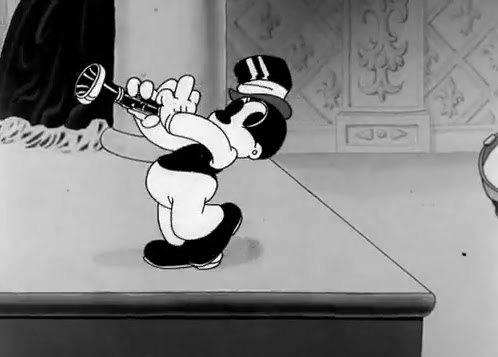
Bosko then asks his audience in his Durante accent, "Is everybody happy?" and starts to play the trumpet in a very jazzy way with such awesome movement. He starts to tap his feet on the drums, acting mental and playing the clarinet with his top hat on. Bosko continues to be playing through all the other instruments until he finally looses his balance while he is tilting, and hits the drum and cracks a hole, All the other instruments that were up in the air fall down into where it was, and Bosko comes up in his Jimmy Durante face stating "Am I mortified?" His audience clap for a very entertaining part.

Bosko steps out of the drum, and asks his audience "Is everybody happy?", and he carries a drum with Franklin D. Roosevelt holding a pint of beer, (who at the time was just to be elected as President of the United States in March 1933). It seems that Bosko was supporting for Roosevelt to be president, and Honey runs to the stage waving the American flag which is a note to tell the audience to vote for Roosevelt - and that's all folks.

Wow! What a wonderful cartoon that was, it had so much appeal in the animation. The animation was just marvellous to look at, all the animators on that cartoon were top-notch on that short. There are exciting dance routines going on and a very entertaining vaudeville show it certainly was. I think that this is one of the greatest Bosko shorts, and this was the best cartoon of 1933 for the Looney Tunes/Merrie Melodies series.

You know what? I think that the reason why the cartoon was so great was that it was all thanks to Friz Freleng, who directed the dance routines and the vaudeville business. See, it was great for Harman-Ising to hire Friz Freleng as a director because they couldn't turn in much great stuff - only mediocre. Bob McKimson contributed to great animation (as well as other animators), and Frank Marsales' score was a delight. Freleng probably went over-budget there with a great cartoon, and it shows of how much of a "perfectionist" he was here. Unfortunately, his directing years from 1934-1938 were downhill, due to the budgets, but Freleng became an extraodinary director by 1940, when he arrived back at Warner Bros. from MGM.