Wednesday, 8 April 2015

375. Bugs Bunny Gets the Boid (1942)

Warner cartoon no. 374.
Release date: July 11, 1942.
Series: Merrie Melodies.
Supervision: Bob Clampett.
Producer: Leon Schlesinger.
Starring: Mel Blanc (Bugs Bunny, Vultures), Sara Berner (Mother Vulture), Kent Rogers (Beaky Buzzard - "Killer").
Story: Warren Foster.
Animation: Rod Scribner.
Musical Direction: Carl W. Stalling.
Sound: Treg Brown (uncredited).
Synopsis: A bashful buzzard is out in the desert looking for dinner, and chooses Bugs Bunny to be his would-be victim.

Being a fresh, innovative director: Bob Clampett was still open towards popular cultural references in this era, and to include them in his shorts, much like everyone else did at Warners. In this case, Clampett uses the bashful Mortimer Snerd, a famous puppet based on ventriloquist Edgar Bergen to be the personality for the buzzard.

According to Michael Barrier, the buzzard was originally known as the "Snerd Bird" based on production papers. According to a Clampett interview by Mike Barrier, Ernest Gee (Flash Gee), a former story artist at Schlesinger who supported Clampett with story issues by doing uncredited work on this cartoon, even though Foster has story credit. Clampett used the Mortimer Snerd reference which was immortalised in the buzzard, who later would become Beaky Buzzard. Only appearing in a couple of cartoons, Beaky Buzzard (known as "Killer" in the cartoon) was wonderfully characterised by Clampett and Warren Foster, that he belonged in the excellent Warner Bros. legacy.

Warren Foster (or Flash Gee, according to Barrier's interview with Clampett) sets the cartoon's opening to a fresh start. The establishing scene reveals a mother buzzard ordering her children to collect some food for dinner, and giving each of them selective choices. As three of the buzzards approve, ("Okay mama dear!"), there is bound to be subtle war-time references, such as when the buzzards take off like aircraft.


The mother vulture double-takes when she realises Beaky is the only buzzard who hasn't left, she exclaims: "Why, Killer, what you waiting for? Get a move on! Get going! Scram!"

At this point, Beaky is revealed to be a mamas boy who shies over to his mother, smothering his forehead at her chest, saying: "No, no no! Nope! I don't wanna." It's a neat little set-up, emphasising there is always one in every family: the vulture being too shy to leave its home.

So, the reference to Mortimer Snerd fits with the personality. Kent Rogers does a solid performance at voicing Beaky, as well as a decent impression of Snerd. The mother attempts to encourage Beaky, "Well, at least go out and get a little rabbit, or something." The part where the mother kicks Beaky's rear end away from the nest is cynical, and today it would be considered inappropriate.  Clampett's timing on the mother anticipating a kick as well as her attitude is hilarious.

Then, Beaky Buzzard is left in mid-air. His attempt to keep his flight steady by flapping his wings shows some nice overlapping action. It gets more entertaining when you listen to Beaky Buzzard humming Arkansas Traveller, as Kent Roger's vocals adds to his dim-witted personality. His characterisation works wonderfully in the scene, and the buzzard's dimly flapping his wings as he flies works right down to the frame.

Johnny Burton's camera department do a decent job in shooting a point of view shot of Beaky looking down at the almost uninhabited desert. At this point, Beaky double-takes when he catches a glimpse of Bugs Bunny in a typical introduction shot of the character: sitting of his rabbit hole, reading "Hare-Raising Stories" and chewing his carrot.


Preparing to dive at Bugs, he hides underneath a clouds, bragging: "I'm a-stalking a victim!" and then rapidly soars down. Bugs notices this, leading him to take and zip down his rabbit hole.

To give Bugs a rather brash start, he enters the scene disguised as a air-traffic controller commenting: "Come in, B-19. Come in, B-19. Ceiling: 500 feet. Visibility: seven yards. Now level off. Steady now. Easy dear. Easy does it." Of course, the B-19 is a reference to the infamous bomber aircraft during World War II. Clampett has a rare ability of turning a predictable gag into a suspenseful one, and allowing it to pay off. Bugs slowly records at the soaring buzzard, until Beaky suddenly crashes outside Bugs's hole. The spontaneity in Clampett's sharp timing as well as how sudden it was, makes a rather predictable gag pay off. Bugs proceeds to flick Beaky's rear end, causing hint to tilt back immediately. It makes sense to give the sequence to Rod Scribner, who does a first-rate job in animating Bugs in his exaggerated form, as well as creating Beaky's collision convincing.

In a brief sequence where they first meet each other, Foster cleverly creates some substitute lyrics from Blues in the Night as part of Beaky's dialogue: "My mama done told me, to bring home something to dinner." After realising Bugs is Beaky's target, he quickly sets up a strategy, asking Beaky to wait.

Clampett's juvenile sense of humour then begins to take its course. Beaky is seen waiting outside Bugs' hole, who is heard singing alternative lyrics to the same song Beaky sung. Beaky has an epiphany, "You know, I think he's a trickening me", and proceeds to drag Bugs Bunny away from his hole.

The gag revealed is favourite amongst the Warner directors: Bugs Bunny in drags. He rises from his hole: covering himself with a towel, wearing lipstick as well as wearing a bathing cap. Bugs flirtatiously prods Beaky's noise, "You naughty, naughty boy!". It's a great little gag where Clampett's subtle humour always has a charm of its own.

This results in a hilarious reaction from Beaky, who blushes and chortles. Bugs spinning the towel tighter to slap Beaky's rear end is solid in exaggeration, also animated wonderfully by Rod Scribner, who shows great weight and believability in animating pain. The following scene of Bugs fiddling with Beaky's adam's apple is a little favourite scene of mine.

Perhaps the wackiest and most celebrated sequence in the short is the scene of Bugs Bunny believing a part of his body is skeletal. The scene is lifted from Harold Lloyd's The Freshman, where Lloyd believes a part of his body is missing, which turned out to be a tackling dummy.

Bugs Bunny has fallen from a great height, and lands on top of a carcass, which leads Bugs to go in a dizzy spell and the skeletal parts drop in the right places. Bob McKimson does a beautifully convincing job in animating Bugs' belief he is partly skeletal. Mel's voice characterisations of Bugs are wonderfully versatile and human.

He touches the ribs of the remains like a xylophone, and then places his finger inside one of the ribs. This leads to Bugs wailing loudly over a horrific situation. Midway he interrupts the act commenting, "Gruesome, isn't it?" as he continues to wail. Bugs's feet arise from the ground, where Bugs slowly changes his emotions from wailing to laughter. At this point he scoffs, commenting: "I do it all the time". It's a nicely executed sequence, where Clampett is exploring the possibilities in approaching a classic gag to please audiences. This shows that digging inspiration from a comedy legend (being Harold Lloyd) works to its advantages.

Like in a lot of Clampett shorts, you'll find a lot of inventive, far-out pieces of animation. The scene may not be so far-out, but it has a great cycle by Bob McKimson. The buzzard carries Bugs by the ears, and he is seen skating in mid-air. At this point he takes, pulls out one of Beaky's feathers and tickles him - causing Bugs to fall. This then leads up towards Bugs' skeletal sequence.


One of the more inventive pieces of animation is in a Virgil Ross scene of Beaky attempting to assault Bugs. Bugs and Beaky have a scuffle, as they fight all over the scene. Bugs almost turns at a 360 degree in perspective during his fight.

Then, the scene transitions where both Bugs and Beaky spontaneously dance together. According to Mike Barrier's interview with Clampett, the gag appears to have been attributed to Flash Gee. As they both dance, this leads to a corny scene of Bugs poking fun of dancing scenes in romantic movies. Clampett's sneaky humour is evident in the lines where Bugs asks Beaky "Why don't we do this more often?", Beaky replies: "You mean just what we're doing tonight?" leading Beaky to blush furiously.

As the short reaches its ending, Bugs whirls Beaky into the carcass pit. Believing he is partly skeletal, Beaky cries out to his mother who immediately dives at the scene. The mother buzzard's take works well, as she spins her neck collar. She confronts Bugs, "Hey, what have you done to my poor little kid?". Bugs responds back, calming her: "Keep your shirt on, lady. The kid's okay", and drags Beaky up from the ground. In the final scene, Clampett takes the opportunity in making the final gag unpredictable. The mother buzzard confronts Bugs again, believing he is about to be threatened. She immediately changes emotion, and declares: "And you...you are my hero!", kissing him on the lips. Bugs's face morphs into a Mortimer Snerd caricature as he smothers his face towards the mother, bashful and furiously blushing: "No, no, no, etc."

Being one of Clampett's earliest Bugs Bunny cartoons, this is certainly one of his more memorable ones, being one of the stabling cartoons that led to Bugs's stardom. As well as one of the best Bugs shorts he's directed. Bugs is brash towards the buzzard, but his characterisation is in the right place. Being the first appearance of Beaky, he may not be a challenging opponent to Bugs or even the funniest antagonist, but as a character he's very loveable - which makes the short a perfect showcase. As a short, it's animation and timing is still fairly mild in Clampett's usual standards. It shows Clampett isn't yet ready to set himself loose and push the boundaries further. It's an enjoyable cartoon with some great sequences and dialogue, especially the skeleton sequence which is personally one of my favourite Bugs Bunny moments.

Rating: 3.5/5.

Saturday, 4 April 2015

374. Wacky Blackout (1942)

Warner cartoon no. 373.
Release date: July 11, 1942.
Series: Looney Tunes.
Supervision: Bob Clampett.
Producer: Leon Schlesinger.
Starring: Mel Blanc (Misc. voices), Sara Berner (Cow / Mrs. Bird), Kent Rogers (Woodpecker, Baby bird), Thurl Ravenscroft (Carrier pigeon). (Informaiton provided by Keith Scott)
Story: Warren Foster.
Animation: Sid Sutherland.
Musical Direction: Carl W. Stalling.
Sound: Treg Brown (uncredited).
Synopsis: Spot-gag cartoon set in a farm, showing various animals preparing for war.

If there is any part of the short that lives up to its title, I'd say the opening title cards, which as a gag is very subtle as far subtlety goes in Clampett cartoons go. The first shot reveals a civil defence worker watching a woman by her window undressing. In the second shot, everyone is checking her out, and bizarrely enough: including the pets (referenced from Tralfaz's entertaining post).

It's not the last spot-gag cartoon created at Warners, but it's the last from a long, exhaustive streak of three years' material of mundane, repetitive spot-gag cartoons. An occasional spot-gag would be produced once in a while, like Chuck Jones' The Weakly Reporter. Tex Avery would carry that trademark a couple more times at MGM, the spot-gag shorts being superior.


This is also the second time Clampett has based a spot-gag surrounding agriculture (see Farm Frolics), but the content is slightly different. Whereas Frolics mainly satirised animals, Clampett and Foster both poke fun at farm animals used for the war effort. Some key moments of Clampett and Foster's takeoff is seen in the sequence of the cow, as reported by the narrator gives "5000 quarts of milk a day. That seems like a lot of milk, but 5000 quarts is what she gives."

At this point, the cow contradicts the narrator, complaining and sobbing: "Gives, nothing! They come in and take it from me." The scene is less funny and more predictable, because the gag formula has been used a lot of times, making the gag more tiresome. Rod Scribner's animation of the cow wailing is a lot of fun, though.

Another sequence which isn't based on an animal participating in the war effort, but it merely another scene where the narrator's comments are deemed threatening. As the turkey continues to eat corn greedily, the narrator comments:

"When he reaches twenty pounds, he'll be ready for the oven." The turkey gasps with horror, "Twenty pounds? Oven?". He quickly spits the corn out and proceeds to go on an "18 Day Diet". He desperately attempts to work out on a machine to prevent his fate, which works well from Warren Foster's witty comedy.

Another sequence shows Clampett attempting to experiment with recurring gags by making it seem wild and inventive. This is seen in the sequence where the narrator introduces a very elderly cat named Old Tom. He comments: "Why, he's been around for the last three wars and he knows this one will turn out all right too."

After making the alarming statement, the scene is interrupted by a woodpecker pecking the bark of a tree. The narrator comments: "Now, I bet you I know what he's aiming to be when he grows up. I reckon he plans to be a riveter at Lockheed."

I suppose the take on the joke is the young woodpecker is supposedly an avid pecker, and is sorely tempted to jab the cat's tail. He comments, quoting a famous line from Red Skelton's character, Mean Widdle Kid: "If I do, I'll get a whipping. I dood it!" The cat screams from the pain, but lands on top of the woodpecker, crushing it.

Clampett's timing on the crush is effective. This recurs during the turtle-egg scene where the woodpecker interrupts the scene claiming, "I dood it", while running away from the cat. We see the cat one last time, having the last laugh: "I good it", as the woodpecker drills around his stomach - revealing he has been eaten. It's a more ambitious gag than how they're typically shown, but the way the gag was conceived seemed a little unfocused and out of sorts.

In some of Clampett's spot-gag shorts, he appears to have the knack of cutting corners. This is likely a strategy he uses to prevent going over-budget. His cutting corners strategy is evident in the opening sequence, where a farmer's trained dog helps put out the fire at a barn. Only the fire and the dog's head is animated as the dog spits the fire out, one-by-one. Clampett has the ability to make the gag effective, no matter how limited the animation is.


Other cases of Clampett's animation saving is seen during the firefly sequence. The sequence is established with a group of fireflies preparing a blackout. The scene cuts to a turtle, who is warned by the narrator to hide underneath its shell during a blackout.

Only the turtle's body is animated, whereas the shell is a part of the layout. It still works as a gag itself, as the shell doesn't really require movement at all, so it's a sensible decision made by Clampett. As the turtle reluctantly hides underneath the shell, the narrator asks: "Why in the world didn't you wanna go into your shell?". The turtle replies, to the point: "Well, uh, I'm afraid of the dark." While Clampett succeeded in cutting corners, the gag itself didn't succeed.

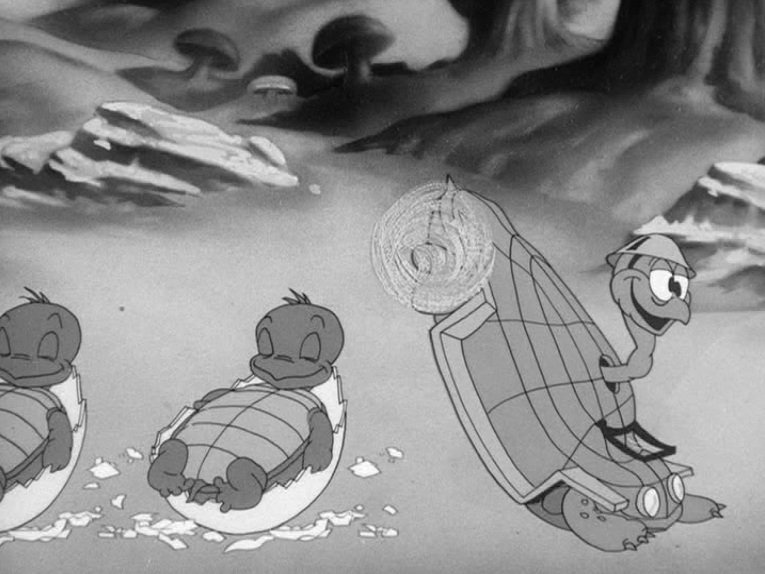
Like many spot-gag shorts, there are devoted sequence which is built-up slowly to create a wacky punchline. This is evident during the turtle egg sequence. The narrator remarks that the turtles were born "with a natural bombproof shelter on their backs." The first two turtles hatched are rather identical as they're sen cradling on top of the hatched egg. Stalling's cue of Rock-a-Bye Baby sets the mood of the scene. As the third egg hatches, the atmosphere changes as the hatching timing is rather frantic. The third turtle is seen driving in its shelter rapidly across the screen, confusing the narrator. Stalling's ability to change from one cue to the next (playing In My Merry Oldsmobile?) rapidly works well in this scene. The baby turtle identifies itself, commenting: "Beep, beep! I'm a jeep! Jeep, jeep", and continues to ride around the scenery chuckling wildly.

In a spot-gag, Clampett couldn't miss an opportunity of adding elements of his sneaky sense of humour. The narrator chuckles when the sequence centers on a farm dog "a-courting his sweetie." The scene dissolves to a dog couple in silhouette, with a bashful dog stammering to her: "Oh, Marie-Alana, um, uh, would you be my--uh, etc.".


The scene dissolves to the stammering dog and Marie-Alana, as the stammering dog comments, "Oh gosh. I wish there was a blackout". At that moment, the dog receives a warning and shouts "Blackout!". The lights blackout and turn on, leaving the dog excited with glee from a intimate moment.

Clampett's own wacky sense of humour is also evident during the firefly sequence. The scene features an establishing shot of the fireflies in a single-file, and can be identified by their lightbulbs. The narrator discovers that one lightbulb is missing, after creating a blackout. Dissolve to a close-up, one firefly is indeed missing one: the leader. He stops the line, and shouts: "Hey, who's the bulb-snatcher?". It's revealed the firefly next to him snatched the bulb as an immature prank. A bit of a corny scene, but Blanc's delivery adds the charm.

To finish off the review, here is a reflection of some bird-related gags that link decently to some of the war-related gags. The first scene shows a mother bird teaching her baby son to fly. She gives a demonstration by flapping her wings elegantly. The baby bird refuses to make an effort, in which he responds: "Aw, ma! I wanna be a dive-bomber!". The bird mimicking a plane engine is amusingly well delivered, particularly the groggy voice by Kent Rogers.


The last scene in the short reveals the final recurring gag of the cat and woodpecker, as I've spoken about earlier in the review. The scene trucks in to a birdhouse to reveal two elderly carrier pigeons with arthritis. They look proudly at their picture frame of their numerous sons serving in World War I, frame dated 1918.

Clampett enjoys changing the atmosphere and energy of a character, which is seen of the elderly male pigeon. He comments: "Well Ma", and then breaks out energetically, and marching very fluidly singing: We Did it Before (and We Can Do it Again). The final montage shot shows the pigeon couple watching the warplanes advance and a live-action shot of the American flag, ending the cartoon on a patriotic note.

As a short, this is still rather flat as a Clampett entry, even though it's clear he's attempting to break out of the spot-gag routine. A lot of gags intact are still a little vulgar in creating an all-round funny spot-gag short. Admittedly, the title card openings were probably the highlight of the short. The hidden gag is incredibly subtle and promising, that it makes the entire short a letdown - lacking the promises it could've had. Not to mention, Clampett's cartoons are becoming slightly more energised, even though it's not as innovative as what would become. Clampett and Foster make a few attempts in turning a cliched gag and making it look fresh, particularly the woodpecker and cat scene. Even though it didn't work as well, you've got to give both of them credit for trying. Not to mention, it's an interesting showcase for historians in satirising the infamous blackouts conducted by large cities which were a threat for bombing.

Rating: 2/5.

Wednesday, 1 April 2015

373. Double Chaser (1942)

Warner cartoon no. 372.
Release date: June 27, 1942.
Series: Merrie Melodies.
Supervision: Friz Freleng.
Producer: Leon Schlesinger.
No cast.
Story: Michael Maltese.
Animation: Gerry Chiniquy.
Musical Direction: Carl W. Stalling.
Sound: Treg Brown (uncredited).
Synopsis: A mouse uses a bulldog as protection to repel the cat, although little to the mouse's knowledge is that the dog is an unreliable ally.

When you associate with pantomime with animation, the link usually goes to Chuck Jones. He wasn't the only master of it: Michael Maltese was too. Later in his career, Maltese has the ability to achieve successful pantomime as well as keeping the narrative coherent and straightforward.

In this short, Maltese experiments with the typical animated formula: the cat, dog & mouse routine. In an attempt to make it original and fulfilling, Maltese observes the behaviour of each animal, so the characters can be portrayed differently.

The cat and mouse both act like a typical animated character, whereas the bulldog is a little different. It's cliched to portray bulldogs as masculine dogs to protect vulnerable characters, but Maltese makes the character much more unreliable in terms of picking an ally: as at point he allies with the black cat, targeting the mouse: which doesn't add up in a cliched formula. Upon reviewing the cartoon, we'll see whether or not the formula paid off from both Freleng and Maltese.

With many cat-and-mouse cartoons, it starts off with a sequence of the cat (in design, no relation to Sylvester) plotting at the mouse: a useful device to establish the character's relationships. The cat's trap is very straightforward, as he plants a piece of cheese by the mouse hole, as bait to catch the mouse. The cat hides behind the wall, ready for the mouse.

Freleng's unit create some rather comical, and stunning visuals of the cheese scent morphing into a spiritual form. It follows the mouse hole, and takes the mouse outside with it, enticing him to the scent and delights of cheese.

An old gag indeed, but it's still a great visual, portraying the process metaphorically. The mouse double-takes at the spiritual scent, and rushes back to his hole. Tempted, he quietly reaches over for a cheese and proceeds to return to his hole.

Without caution or alertness, he runs inside the cat's jaws into his body unknowingly. Some appealing timing created by Freleng of the mouse wriggling down the cat's tail and back out. This follows with a small chase scene that occurs outside, and the encounter of the bulldog establishes the rest of the cartoon. The mouse uses the bulldog to protect himself from the cat. By using him, it is rather physical as the mouse forces the bulldog's eyelids open to frighten the cat, without any activity with the dog whatsoever.

With that said, Maltese makes it intentional that the bulldog hardly acknowledges the mouse at all, or to even have a motive. The bulldog is mostly concerned with resting in his kennel. At times when he acknowledges the mousse he supposedly "protected", he glares at him menacingly as shown in the scene of the mouse nibbling cheese, showing he is unreliable.


Maltese is still open to inventive gags and sequences relating to the bulldog. This is evident in the sequence where the cat unintentionally buries him. The cat advances towards the mouse, nibbling the cheese. Realising he is unprotected by the bulldog, he hopelessly whistles for him.

In a hurry, the mouse hides underneath a hole - and ends up cornered by the cat. In a desperate attempt to claim the mouse, the cat digs up the ground for the mouse. In the process it's revealed the cat has dug the bulldog from the ground unintentionally.

It's a bizarre gag and scenario to begin with, but Maltese's wit and spontaneity has a charm of its own, which you'd expect from a Warners short. The scene finishes with the cat pushing the bulldog's head underneath the ground, and digging the ground back.

Friz Freleng's greatest skill, timing, comes to great advantage in several sequences. One great sequence that comes to find is the fence mimic scene. The cat who hides behind a fence, tiptoes behind the fence cautiously. As he crosses a gap with no planks, he tiptoes quietly and on the other side the mouse mimics his actions.

It's a great showcase for Freleng and Stalling who cooperate well in achieving the gag as well as comic timing. The sequence gets goofier, when the mouse controls the bulldog to mimic the cat's actions, leading him to double-take.

Maltese turns the gag even more broadly when an exact image of the cat mimics himself. The spontaneity of that scene is what makes the sequence an underrated gem for Friz's sense of exaggeration.

Believing he has the mouse trapped - he dives to the other side of the fence, reaching for him. He quickly leaves the scene when he is ambushed by the bulldog who naturally chases him. Another scene accomplished by Friz and his animators is the scene of the cat inside the shed, with the mouse on top of his head. The cat is on the lookout for the mouse, without realising that he is sitting on his head. It may be a straightforward scene, but its a little trickier in staging, and it pays off with an exaggerate take from the cat, upon seeing the mouse.

Perhaps the funniest sequence conceived by Mike Maltese, is the sequence where the cat masquerades his chicken performance, in over to trick the bulldog. In a desperate search for the mouse, he investigates the nest area, throwing the hen out the scene. As he is narrowly close to catching him, the bulldog enters the shed.

He quickly disguises himself as a hen, by placing a rubber glove on top of his head as well as make clucking noises. The scene of the eggs hatching rapidly, as witnessed by the bulldog is hilarious in terms of circumstance.

The bulldog's dumbfounded take at the chicks and the cat from observing their different proportions says it all, and yet it's very subtle. The cat hopelessly attempts to full the bulldog once more by mimicking a chicken walk, as he continues to cluck. The bulldog grabs the hen and cat together, observing the pair of them suspiciously. The hen clucking wildly leads into a frantic chase sequence with the cat and bulldog.

The chase scene is rather short but also productive in energy. The shot of the bulldog anticipating a chase action is very broad and energetic. The bulldog notices the cat hiding behind the barrel as the mouse gave away his hiding spot. This cuts to a quick montage of the mouse revealing different hiding places of the cat through whistling. The montage is fast paced and it's the right sort of energy required for a chase, as its inventive and fresh. In the last hiding spot, the bulldog chases the cat through a bush where it creates off-screen crashes and chaos. The bulldog has crashed at a junkyard, and struggles to release his head from a cuckoo clock. Whoever animated the sequence, the bulldog shaking his jaws is very appealing, and solid. The jaws continue to shake when it reveals the cuckoo, supposedly inanimate has life. The cuckoo snuffs the bulldog for the crash and leaves.


As the cartoon is close to finishing, the bulldog has turned against the mouse: recognising it as a foe. This is a great setup by Michael Maltese, who now has the two opposites attract (cat & dog) ally together to chase after the mouse. The bulldog whistles to the cat to catch the mouse, where they both cooperate.

Desperate to scare them off, the mouse finds an apple and a tin of black paint, which he uses to disguise as a black bomb. He superfluously lights the match on top of the stem, and successfully scares the bulldog and cat away.

What you can admire about the classic Warner Bros. shorts is how unpredictable the ending can be, and this ending is a striking example. As bizarre the gag does, the apple explodes like a bomb: and it is revealed the mouse has passed away, and transformed into a spirit ascending to heaven. He stops pointing at the apple until he realises he is spirit; aware that he has screwed up.

Overall, it's a decent effort with some fun comic timing by Friz Freleng, as well as some witty pantomime created by Michael Maltese. Maltese manages to benefit something from the cliched (cat-dog-mouse) formula, and create a funny twist in the short's ending: even though the ending is a little cynical. It's not the greatest twist to the formula Maltese has written, though his early experimentation clearly had something to show for it in his future, superior work. Some sequences worked really well in pantomime, whereas some scenes were a little lacking, but that's about it as far as criticism goes. The gags in the cartoon are very broad and subtle which was what Friz was a master of. He was capable of conceiving a gag that is really exaggerated and bizarre and make it beautifully subtle - which was what he did in the fence sequence.

Rating: 3/5.