Showing posts with label Friz Freleng. Show all posts

Wednesday, 16 May 2018

422. Meatless Flyday (1944)

Warner cartoon no. 421.
Release date: January 29, 1944.
Series: Merrie Melodies.
Supervision: Friz Freleng.
Producer: Leon Schlesinger.
Starring: Cy Kendall (Spider), Mel Blanc (Air Raid Warden).
Story: Michael Maltese.
Animation: Jack Bradbury.
Musical Direction: Carl W. Stalling.
Sound: Treg Brown (uncredited).
Synopsis: A fat, jolly spider attempts to catch a fly for prey; but his traps are consistently foiled.


THE COBWEB HOTEL
(Fleischer, 1936).
The premise of a malicious spider preying on helpless flies was already a cliche in cartoons, by the time Meatless Flyday was in production. The source material can be traced back to John Heywood's pseudo-epic poem, The Spider and the Flie in 1556. Mary Howitt's opening line in her poem of the same name: "Will you come into my parlour? said the spider to the fly", remains one of the most recognisable quotes in English poetry.

Courtesy of Devon Baxter.
By the early 1940s, the Schlesinger studio began inserting twists to old cartoon formulas, ranging from cat-and-canary shorts like Puss 'N Booty. The "victims" were being portrayed as hecklers to the antagonist, which called for stronger gag dynamics and hilarious characterisation.


Michael Maltese's take on the spider vs. fly formula is enriched by some aesthetic characterisation for the short's antagonist. The spider is portrayed as a jolly, loveable rogue - whose sinister motive marks as a deliberate contradiction to his personality.

His persona echoes Tex Avery's laughter and mannerisms, that he previously portrayed in shorts like The Bear's Tale and Ghost Wanted. Tex had already settled at MGM in 1941; so the character's voice is performed by Cy Kendall. Kendall is best remembered as a prolific character performer for over a hundred features, and his Tex "impersonation" works fine. A part of myself suspects that the characterisation has traces of Thockmorton P. Gildersleeve, despite the lack of his signature laugh.

The opening scenes establish conventional traps plotted by the spider, but his bubbly personality almost overlooks them. His first plot is to entice the fly with a sugar cube, attached to a string. He jovially laughs: "Come and get it". It's already indicated that the mute fly is a heckler to the spider, as he advances towards the sugar cube to pick it up. The spider, holding onto the piece of string, is caught by the force of the fly, who holds the cube on top of the ceiling.


In an impressive 3/4 down shot, the spider is hanging perilously from the thread. But, the spider cuts the rope with scissors - leading to the spider's fall as his head is clobbered by several sugar cubes. The spider's jovial personality increases his likability by laughing off his foiled plan and addressing to the audience: "Caught me off my guard."


The following sequence sets up another scenario, only to be foiled again by the heckling fly. The spider is seemingly watching the fly perform a trapeze act with the kitchen hooks - and awaiting his fate. The spider still finds some humour in the scenario as he mocks the fly, "Look at him, tryin' to heckle me! A poor man's Bugs Bunny". So, he laughs some more!

In the spider's first attempt to eat him, the fly narrowly escapes a close call. He stretches his tongue like a rubber band and releases it, causing him to stagger. In the second attempt; the spider is hanging onto one of the hooks; and momentarily traps him. A la Bugs Bunny, the fly kisses the spider and gives him the hot-foot.


Michael Maltese's lighthearted approach to the spider enhances the comedy to more the standard scenarios, seen in the earlier sequences. The spider finds himself in greater peril compared to the previous scene, once he's falling from the hook with his burning feet.

Even when facing calamity, he continues to find amusement from it. He laughs and speaks to the audience: "Look folks, I'm a Zero!". It serves as a funny metaphor that implies the spider is portrayed as a kamikaze pilot, plummeting to disaster. Instead of destruction, he's clobbered again by sugar cubes.

For the following sequence; Friz Freleng's use of direction and dynamics turn to a more menacing approach. The first few shots puts emphasis on the spider's hand preparing another plot for the fly: which involves painting a buckshot, to disguise it as candy. It's nicely executed in staging to emphasise peril.


For a moment, the plan succeeds as the fly gulps a handful of buckshots down his mouth. The weight of the buckshots make it incredibly difficult for the fly to leap out of sight - resulting in a small chase scene.

Freleng's crisp timing starts to takes its course, once the spider casually holds a magnet out for the fly. As he attempts to resist, the power of the magnet increases to the point when a door forcefully opens; leading to knives and other cutlery speeding towards the spider. Freleng's timing turns to a brutal effect as the knives supposedly finishes the spider off.


The camera pans to reveal that the spider narrowly evaded his end. Friz adds an additional piece of horrific value, when a meat cleaver supposedly slices off a part of his leg. In a close-up, the audience are reassured that his toes remain intact, as they pop up from his partly-cut shoe one-by-one.

Freleng's timing solution works to great effect in a detonation gag. The spider spots the fly posing as a figurine in the ambiguous feature of a wedding cake in a household. The spider poses next to the fly's disguise as a groom, and cackles with cruel irony: "Hello, Sweetie-Face". The scene is at first depicted in close-up of the spider, but the camera trucks back to reveal a firecracker the fly replaced off-screen. The spider menacingly says, "How about a little kiss?" to the "fly", unbeknownst to him. As the spider kisses in anticipation, the cracker detonates. A classic testament of how comedy is executed through clarity and staging.

Friz Freleng's masterful timing is highlighted in an elaborate chase sequence, of the spider and the fly's chase through an electrical conduit. The chase is comically interpreted through effects animation. The fly is visually represented as a yellow light; and the spider being red.

Some wonderful touches are added for comedic effect; such as the fly's take, which reads as "Yipe!". The pair chase run down the conduit separately, creating a figure eight until they crash into each other.

Soon, the effects animation depicting the chase becomes more absurd. At the center of a conduit, random pieces of imagery like flowers and other assorted things start to flash to Carl Stalling's score. The gag is reminiscent of a neon billboard gag, seen in Freleng's Light's Fantastic. It also serves as a forerunner for the mine sequence in Chuck Jones' Beep Beep, many years later. 

The multicoloured flashing lights catches the attention of an air raid warden, who yells: "Put out that light!". And so, the lights flickers out in succession - leading the pair back inside the house. It's probably an animated highlight of the entire cartoon. It's beautifully elaborate and funny, to the credit of Freleng and Stalling; and the effects animation.

For the closing sequence; the spider finally catches the fly. The scene fades in to reveal the spider scraping his knife, ready to feast on the fly. The audience are expecting a twist that intervenes with the fly's demise. But, the payoff is a tad disappointing and predictable. The fly points a calendar to the spider, which reveals the date to be "Meatless Tuesday": a WW2 government campaign to encourage the public by rationing their meat for the war effort.


The spider responds with great irritation and angst, that he takes the matter over to the U.S. Capitol. The final shot of the Capitol's window depicts the spider's off-screen complaints to government officials: "You can't do this to me! You just can't!".

It's a satisfying and humorous gag to close the cartoon, but a part of the problem of its predictability is that it links to the cartoon's parodying title: Meatless Flyday. The payoff would've been executed had a different title been suggested. Despite my nitpicking, it's plausible that WW2 audiences overlooked that detail.

To conclude: Meatless Flyday, despite being relatively short, serves as a nice potboiler; enriched by funny characterisation. Michael Maltese's forward-thinking approach to story makes a somewhat tired formula feel fresh and inventive. A portion of the gags are heavily themed with wartime references, but the premise itself has a timeless quality. As discussed, the electrical conduit sequence wonderfully showcases Friz Freleng and Carl Stalling's timing - which is a challenging feat from a lot of levels. Despite the jolly, Tex Avery-persona used several times in cartoons - it never fails to charm.

Rating: 3/5.

Thursday, 20 July 2017

420. Little Red Riding Rabbit (1943)

featuring BUGS BUNNY
Warner cartoon no. 419.
Release date: December 25, 1943 (see below).
Series: Merrie Melodies.
Supervision: Friz Freleng.
Producer: Leon Schlesinger.
Starring: Mel Blanc (Bugs Bunny), Billy Bletcher (Wolf), Bea Benaderet (Red Riding Hood).
Story: Michael Maltese.
Animation: Manuel Perez.
Musical Direction: Carl W. Stalling.
Sound: Treg Brown (uncredited).
Synopsis: Bugs Bunny and the Wolf battle each other inside Grandma's house; during her absence of contributing to the war effort.


Typically, I'd place Little Red Riding Hood as a 1944 release; as it shows up with a release date of January 4th on that year, in many filmography lists. With special thanks to Yowp's research - a newspaper ad from Hamilton, Ohio on December 23, 1943 reveals that this cartoon was already in theatres by that point.

Although an official release chart indicates its January release date - it appears that posted release dates of classic era shorts aren't entirely accurate. Perhaps the short opened first at smaller towns, before entering general release in January?

What I find a little perplexing in the advertisement, that it supposedly represents a Paramount theatre in Ohio; but it's also advertising an MGM musical, Best Foot Forward, and a Warner Bros. cartoon. Perhaps block booking wasn't practiced at smaller theatres in smaller towns?

This cartoon also marks the first time Mel Blanc gets billing credit in a Warner Bros cartoon. Such practice of granting voice artists screen credit was unheard of in Hollywood films. Even Walt Disney's earliest features omitted credit for vocal talents - likely to maintain the illusion of fantasy for audiences entranced by the magic of animation. For more information on Blanc's screen credit steal; see Keith Scott's article on Cartoon Research. The short also includes performances by Bea Benaderet and Billy Bletcher, who are both uncredited yet very talented.

The cartoon itself is another showcase of how the Schlesinger studio took liberties on parodying fairy tales. That same year, MGM released a very risque parody of the Riding Hood tale; Red Hot Riding Hood, by Schlesinger's former director, Tex Avery. The majority of the cartoon challenged film censorship since it was built around lust. Friz Freleng's parody of the same fairy tale might not be edgy; but it excels for its funny characterisations and smart writing by Michael Maltese.


Michael Maltese's take on Red Riding Hood opens up to a lot of gag opportunities. Many versions of the fairy tale typically depict Red Riding Hood as a sweet young girl with endearing qualities. Maltese portrayal, however, lacks such traits. Many cartoons previously parodied Red with a Katherine Hepburn persona. Instead, Red is stereotyped as a loud, obnoxious bobby-soxer teenager - vocalised irritatingly by Bea Benaderet with great comedy values.

The character was the inspiration of radio comedian Cass Daley - and Michael Maltese's young daughter! Daley was known for her energy and loudness; but some of Red's childlike dialogue ("ta-have!") was adapted from Maltese's daughter.

The opening sequence showcases Red's personality very vividly that realistically portrays the awkwardness of adolescents. Like the story, Red journeys through the woods with a basket -- but sings ear-splittingly in her rendition of Five O'Clock Whistle. An obnoxious piece of delivery makes Maltese's portrayal of Red, all the more hilarious!


Bugs Bunny arises from his basket, asking casually: "Watcha got in the basket, gorgeous?" Red responds loudly: "Ahh've got a little bunny rabbit which I'm taking to my grandma's. Ta-have, see?". Red's purpose of bringing Bugs as a gift is kept vague. A pet gift or a plate of rabbit stew? Depends how you see it.

Animated cartoons had come a long way from wholesome, cutesy interpretations of Red Riding Hood from the 1930s, popularised by Disney. MGM's Red Hot Riding Hood even claimed, "Every cartoon studio in Hollywood's done it this way!". Red is deliberately parodied as an unlikeable loudmouth that even a casual viewer would love to hate!

The traditional storytelling of the fairy tale slowly starts to change direction once the wolf appears. He diverts Red's route; whilst approaching Grandma's house. As discovered, it's revealed she's away from home contributing to the war effort, by working a "swing shift at Lockheed".

The wolf puts on the disguise; and even shoos away other wolves hiding under the covers on the bed, hoarding the spotlight, as he yells: "Come on, come on! Take a powder. This is my racket!". The disgruntled wolves leave the bed, muttering.

By the time Red Riding Hood enters Grandma's house for the traditional lines, Michael Maltese diverts the story from that standpoint - adding a comical twist to make way for Bugs' antics. The wolf overhears Red shouting, "I brought a little bunny rabbit for you, ta-have!".

And so, eating a rabbit appeals to the wolf more than Red. The wolf grows irritated by her presence as she attempts to speak the infamous lines from the tale: "That's an awfully big nose for you; ta-have!". Red is quickly shuffled out of the door by the wolf, who turns his attention towards Bugs Bunny, residing inside the basket. The twist is both spontaneous and build by characterisation - as the characters themselves take the cartoon in a different approach.

Michael Maltese would take advantage of Red's irritating personality; by using her as a recurring gag throughout the cartoon. Maltese is innovative enough by mocking traditional values of a fairy tale story. He understood parody well enough to not rely too much on the source material - if better gags are called for.

Sporadically, Red would re-appear in several scenes - still asking the wolf questions based on the fairy tale: "What sharp teeth ya got, Grandma!". The wolf would always respond by disposing Red out of the house.

At the height of his annoyance, the wolf expresses courtesy towards Red, by speaking French! I don't know what the rough translation is; unless Billy Bletcher improvised it. This is soon followed by an unwelcoming yell from the wolf: "Get out!". The comedy delivery works as an amusing juxtaposition of etiquette and rudeness!

Freleng's comic delivery comes to advantage in a short interruption of Red knocking on the door, and questioning loudly. Inventive smear animation by Gerry Chiniquy, the animator of that scene, comes into effect when the wolf slams the door in front of Red.

The most complicated and highlighted elements of Friz Freleng's comic timing are showcased authentically in this cartoon. Applying musical timing to animated action isn't an unheard trait of Freleng, but the short features some very fine examples.

A remarkably complex piece of timing occurs in a gag involving Bugs Bunny running up the stairs and closing the door, whilst in pursuit of the wolf. Bugs then reappears through different doors during an in-and-out routine. The layout work is relatively simple; but it's an unbelievably complicated piece of action.

Both Bugs and the wolf's stepping movements are arranged by different instruments respectively. To keep the musical timing consistent whilst Bugs is deceiving the Wolf is an incredible tour-de-force on Freleng's part. For a gag executed successfully, it would eventually have its encore in Buccaneer Bunny (1948).


A less difficult but engaging piece of musical timing applied to action is featured in a scene introducing the wolf. As seen, the wolf is hiding behind a tree while spying on Red's trail. The wolf would discreetly tiptoe his foot towards another tree nearby, and slide his body forward without exposing his presence.

Stalling's use of musical pantomime amplifies the wolf as a conniving and sneaky character. The scene, animated by Dick Bickenbach, indicates some strong poses of the wolf's tip-toeing action, whilst keeping on form with Friz Freleng's timing pattern.

Much of Bugs' escapades in this cartoon is matched with a certain kind of energy seldom practiced by Friz Freleng. In a scene of Bugs Bunny striking the wolf with a paddle, and deceiving him of his whereabouts - it shows a standard use of smear animation that enhances animated energy.

For more intriguing dynamics, Friz Freleng practices his own cutting style during a scene of Bugs whistling his whereabouts to the wolf, but zips out of shot when he arrives.

To begin with, the pacing is kept stable. Once a series of consecutive shots of Bugs whistling at various places of the house takes place, the cuts become more rapid.


Friz seldom practiced fast-cutting amongst his directorial abilities. His style of cutting might not be as dynamic as Frank Tashlin's, but it works well enough to assimilate the cartoon action.

The fast-cutting ends with a pay-off once Bugs Bunny points towards a cupboard. He exits upon the wolf's arrival, but he opens to find Bugs hiding inside. Freleng's timing is both subtle and zany in its execution. The action flows very quickly with such subtleties that otherwise could come across as contrived.


Mel Blanc and Billy Bletcher both play off each other with sublime fashion, in a sequence of Bugs mimicking the wolf's actions. Bugs finds himself cornered, but his quick wits enforces him to copy the wolf's speech and posture. They both yell, "Why you... / Hey, now! / Cut that out or... / Say, wise guy! / Oh, yeah?"), and are both perfectly synchronised at the further of delivery  of "Yeah!".


The mimicking works so well from many departments - from the duo's voice collaboration right down to its animated form. Intentionally, Bugs is out of sync for much of the mimicking, to create a realistic scenario. Only Friz Freleng's meticulousness could do a scene such justice.

Gerry Chiniquy's animation is met with many challenges. Imaging seeing an exposure sheet for that scene, which would've required complicated charting. It's one of the few times in animation, when twinning the characters' poses are called for.

Then, Bugs takes control through psychology by shouting out nonsense words, and distracting the wolf by muddling up his speech, and breaking into the song: Put On Your Old Gray Bonnet. A Tex Avery-esque gag quietly appears as Bugs holds a "Silly, isn't he?" card.

A part of myself is curious if Blanc and Bletcher might've recorded their lines together for that scene? Not only would the delivery work better, but it could've saved expenses of sound film stock - had they recorded their lines separately. Still, the sequence has strong comedy merit from those talented men, as well as Freleng's direction. Such a gag like that could've easily gone wrong without the importance of team effort and careful planning!


Suspense builds up as the wolf creeps towards a dark room. An elaborate scene of a fireplace reveals Bugs Bunny is hiding underneath the gown - as indicated in a reflection. Much of the suspenseful action contains lavish composition. This is evident when the wolf enters a dark room, with Bugs' hot coal as the only source of vivid light.

The darkness ends in the blink of an eye when the wolf shoots upwards from his gown - screaming in pain from Bugs' hot coal. Bugs places a large shove full of hot coals - causing the wolf to catch his feet on the edges of two benches. The vibrating action has some nice timing to it.

From this moment, Bugs Bunny has finally outwitted the wolf, and is ready to give him the coup de grace. Bugs punishes the wolf further by dumping heavy objects on the wolf's hands. The scene dissolves to a tall structure of house objects. The camera pans upwards as Bugs is ready to apply some finishing touches until...

..."GRANDMA!", Red cries off screen. Bugs has finally had enough of Red's earsplitting voice! Her presence prompts a new motive on Bugs, who remarks: "I'll do it, but I'll probably hate myself in the morning."

Animation by Virgil Ross.
Bugs climbs down the ladder, and the next shot reveals another twist: Bugs had switched the wolf with Red; whose now given the burden of carrying all that weight whilst avoiding her rear end from getting scorched. The camera pans towards Bugs and the wolf, now friends, as they both share a carrot and watch Red's torture with satisfaction.

And a satisfying ending it is! Red's recurring presence is paid off in a hilarious gag, that merits shock value. It probably represents a more sadistic nature for Bugs - but justice feels truly met. Michael Maltese's use of twists are excelled in this cartoon. The overall ending is hilarious by its entire execution - right from the storyboards onto the finished product.

For a director whose sometimes criticised for being "conservative", this cartoon is anything but that! It's arguably one of Freleng's most energetic and spontaneous cartoons he did for Warner Bros - and its entertainment values are sky high! The cartoon highlights Freleng's true talents as a director. Much of the short is built on constant activity and fast pace which creates excitement. Michael Maltese reconstructs the fairy tale for his own parody, with wonderful spontaneity and twists. His characterisations are very funny; especially when the characters themselves drive the story away from its traditional roots. Much of Maltese's structure has a natural, loose feel towards it which is anything but forced. Little Red Riding Rabbit is the least bit pretentious, and it still serves as one of the most entertaining and thrilling cartons produced by Warner Bros.

Rating: 5/5.

Friday, 14 July 2017

SNAFU: Rumors (1943)

Director: Friz Freleng.
Release date: December 1943.
Starring: Mel Blanc (Snafu / Various voices); Frank Graham (Narrator).
Music: Carl W. Stalling.
Sound: Treg Brown.
Synopsis: Snafu spreads a rumour about a recent bombing that grows more exaggerated - eventually leading a panic at the base.


The Snafu series utilise the message of "loose lips sink ships" satirically yet effectively, like in Spies, which exaggerates the potential threat of eavesdroppers. Rumors follows a very similar message; but it also illustrates the potency of rumours and its side effects.

Rumours and gossip might be a part of human nature, but it can be dangerous for a large number of factors. It's an endearing feature of the human psyche; evoking emotion and sparkling attention. The more spread the rumours are, the more exaggerated and ridiculous they become. Rumours that become misleading can potentially start panics amongst soldiers - creating distractions and weakening courage.

The opening sequence showcases Snafu's ignorance as he misinterprets a fellow comrade's remark, "Nice weather for a bombing" during small talk in a latrine. Diagram shots are applied heavily during the opening scenes; such as Snafu's mind visually portrayed as a hot stove, receiving and repeating: "Bombing weather".

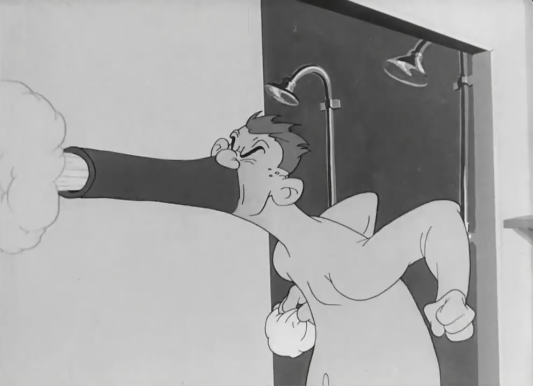
This motivates Snafu to begin a rumour next to a man shaving. So, Snafu tells him about a possible bombing occurring at their base. The use of visual metaphors applied in animated form are innovative in its portrayal of how gossip travels - such as the "hot air" shown as steam ascending to the listener's ears.

So, the listener informs the rumour to another person - but more misinterpreted than Snafu's message. Frank Graham's narration supports the diagram shots of the human mind, as he remarks: "That's right, exaggerate it! Stretch it! Multiply it!". The diagram of a listener's head reveals its mind operating like gears; as mechanical hands stretch out a piece of baloney.

Consequences of travelling rumours are largely satirical throughout this cartoon. The rumours are personified through imagery as zany-looking characters who fly through the camp once the gossip spreads like wildfire. To begin with, the rumours are symbolised as "flying baloneys". The visual metaphor/pun literally features flying pieces of bologna with wings.


The layout work is stunning by portraying anxious soldiers speaking of rumours inside their tents. The soldiers are featured in silhouette - an effect used similarly for the celebrating clowns in Disney's Dumbo.

The rumours grow more exaggerated, as soldiers speak such tales like: "They blasted the hell out of Brooklyn Bridge", "What's the matter with our planes? They popped them off like kites!". In one tent, it sounds like Mike Maltese and Ted Pierce provided their voices to some of the conversing soldiers.

Much of the surreal imagery in this cartoon feels heavily influenced by Ted Geisel's (Dr. Seuss) work. Geisel had contributed to the earlier Snafu cartoons and his presence is felt as far as visual storytelling and character designs are concerned. Such analogies like the "flying baloneys" are used to represent false information taken seriously, and the possible consequences following.

Animation by Gerry Chiniquy.
Soon enough, the rumours begin to haunt Snafu in surrealistic fashion. In a sequence of Snafu eating breakfast inside a mess hall; the piece of bologna begins speaking to him - claiming it has "nothing to fight with". Once the piece of meat flies away, Snafu ignores it by cracking a boiled egg - causing a horned bird to arise, shouting: "And furthermore, the Japs are in California!" (line corrected: see comments below).

The following climax is a hilarious and yet surrealistic portrayal of Snafu's panic amidst flying baloneys or horned creatures taunting him of such rumours. The visual imagery represents how rumours can haunt the person who begun them.


So, Snafu runs across the army camp; attempting to seek refuge from the gossip; but he can't escape them. He attempts to escape inside dustbins and on telephone wires, but discovers even inanimate objects are plagued by rumours.


Much of the creepy imagery feels like a throwback to early 1930s cartoons produced by the Fleischer Studios or Van Beuren - the former's Swing You Sinners comes to mind. The use of inanimate objects briefly forming to life is certainly feels reminiscent of that era.

The climax involving Snafu attempting to escape the zany creatures are disturbing enough in execution. Friz Freleng's cutting style and the use of voice effects add to that effect. They haunt Snafu with more outrageous rumours concerning the war: "The Russians have surrendered", "The British are quitting", etc. Soon, Snafu falls to the ground after falling off a flying baloney - as he falls, a cloud of dust speaks melancholily, "It's all over. We've lost the war...", until Snafu crashes.

At the cartoon's resolution; it's been revealed that the army camp has been quarantined for "rumor-itis". The camera pans to a padded cell, which dissolves inside to reveal Snafu as a patient, driven insane by his rumour episode. Snafu wriggles and incoherently blabs "Rumours", whilst laughing hysterically.


Snafu stops wriggling and momentarily regains his conscience, remarking: "Nice weather for a rumour". A baloney arises from a patch of padding with both characters jumping across the cell.

After the cartoon's iris close, an additional gag is inserted of a cameraman rolling a film camera. He forces a piece of bologna inside the camera like a grinder - with slices falling from the lenses. The cameraman turns at an angle facing an audience, with the camera trucking in on the words: "Sees - Hears - Knows - Nothing". The gag is a nice little touch that sums up the unreliability of rumours. The composition of the scene serves as a parody for the closing newsreels featured in Paramount News.

All Snafu cartoons are built around morale and hard lessons, but Rumors remains unique for portraying an important message in surrealistic fashion. The use of "flying baloneys" are absurdist in its conception - but it's an innovative portrayal of how dangerous rumours can be, and the possible consequences that even a nation could suffer from. The themes are dramatised through both wit and nightmarish scenery. Friz Freleng enhances the zany imagery believably; enough to make the creepy imagery have a lasting impact amongst army recruits watching this short. Despite the cartoon's age; its overall message and theme hasn't dated at all. It remains a strong testament of how rumours can travel fast through word of mouth, and before the existence of social media or e-mail!