Showing posts with label Warren Foster. Show all posts

Sunday, 9 July 2017

419. Puss n' Booty (1943)

Warner cartoon no. 418.
Release date: December 11, 1943.
Series: Looney Tunes.
Supervision: Frank Tashlin.
Producer: Leon Schlesinger.
Starring: Bea Benaderet (Woman); Mel Blanc (Hiccups).
Story: Warren Foster.
Animation: Cal Dalton.
Musical Direction: Carl W. Stalling.
Sound: Treg Brown (uncredited).
Synopsis: Rudolph awaits for a new canary to arrive, with the intention of eating it. Little does he realise how resilient his prey is.


By April 1943; Warner Bros. had ordered for all cartoons from the Looney Tunes series to be produced in colour for the 1943-44 season. Not only would all of Leon Schlesinger's cartoons feature colour, but the distinction between the Looney Tunes and Merrie Melodies segment would cease to exist. Prior to the demand, only a handful of cartoons from the series were still being produced in black-and-white under Frank Tashlin.

Tashlin's first few cartoons during his second directorial stint at Schlesinger's that screamed with lavish film techniques and strong uses of cinematic staging. Once Tashlin moved over to colour cartoons - he begun experimenting more with design work and angular movement.

For the final Looney Tunes short produced in black-and-white; Tashlin ends the tradition with a satisfying sendoff. If Porky Pig's Feat was Tashlin's finest cartoon in terms of its successful use of comedy and experimental filmmaking blended together; then Puss 'n Booty is arguably Tashlin's finest cartoon as far as dynamics, pacing and audacious camera angles.

The cartoon's premise is a cliched formula, which consists of a duelling cat and canary. Warren Foster brings innovation to the characterisations - by making a seemingly harmless canary more potent based on its true colours. Foster finally has an opportunity to showcase his talents as a story man. Although he worked on many classic Bob Clampett cartoons - the stories always feel more like Clampett's than Foster's. The concept is largely a forerunner for the Sylvester and Tweety series. The cartoon itself would be remade with the duo in I Taw a Putty Tat (1948). Frank Tashlin turns such a formula-ridden idea into a cinematic experience!

Tashlin's ability to stage animated scenes in the style of a cinematographer never fails to impress. Such planning might've been a burden for the layout artist or the cameraman; but the results were worth it.

In the opening scene of the lady entering her house, the shot is depicted from point of view. The camera pans at various corners and edges of the house; once the woman discovers the disappearance of her missing canary, Dicky - (gettit?).

Johnny Burton's camera department have the delicate assignment of nailing the timing of the panning; to make the simulated P.O.V. convincing. The mistress's point of view ends once her cat Rudolph, is introduced to the audience, supposedly snoozing away.

The mistress asks for the whereabouts of Rudolph, who shakes his head. The evidence is revealed once Rudolph accidentally hiccups bird feathers from his mouth. Tashlin applies some intriguing timing of the cat burying the evidence with him. Much of Rudolph's frantic action of retrieving the feathers consists of approximately twenty frames: one feet and four frames in animation, or just slightly under a second. The following frame immediately cuts to Rudolph pretending to be asleep; which looks very jerky in motion whilst freeze framing. Such jerkiness works to an advantage by adding emphasis of a cat, hiding his crimes.

Although Tashlin's keen usage of cinematography is evident, he doesn't go too farfetched to the point it could potentially interfere with scenes involving character personalities or bits of exposition. Tashlin keeps a fair balance between characterisation and cinematic techniques.

Following the opening; Rudolph's character is devoted some time - by establishing his conniving persona. He tricks his owner by opening a window, mimicking canary whistles, and pretending to cry of despair.

The mistress is tricked into believing the canary had flown away. A fair use of exposition reveals that five canaries have been eaten by Rudolph in a month - but "lost" from the perspective of the owner.

It always strikes me as odd how the mistress never suspects Rudolph of her "missing" canaries, in that short span of time - especially when her cat is home alone regularly. I'd imagine Rudolph pulls the same trick on the lady for each canary. Such naivety would be legit for a Warner Bros. cartoon, that oughtn't to be questioned.

The sequence ends with a simple solution for the mistress: order another canary from the pet shop - to the satisfaction of both the lady and Rudolph. The shot of Rudolph curling around his owner's legs is very striking and insightful of the character - who hides his sinister nature in the presence of the lady. Rudolph's two-faced personality and motive has firmly been established by the end of the sequence.

Suspense and tension begins to build during a sequence of Rudolph impatiently awaiting for the delivery of the canary. The dreaded wait is hilariously illustrated through Art Davis' animation. Rudolph paces back and forth on top of the front wall of 1605 Maple Drive. Once Rudolph turns to pace back; his head turns after his body begins walking!

Carl Stalling's music enhances the tension of the wait - further emphasised in Rudolph's restless walk cycle on the wall. Stalling also briefly uses a part of Powerhouse with a tense musical arrangement that fittingly provides atmosphere to the cat's desperation.

Tashlin experiments with scene transitions when a different truck representing a gas company drive past the house. Rudolph is already standing on the sidewalk; attempting to attract the attention of the driver by literally ripping off the house sign from a brick wall!

In a side shot, the truck drives through the shot - but once the vehicle disappears, Rudolph has returned to pacing anxiously on top of the wall. It's a dangerously ambitious piece of staging, that makes the transition very unique as far as timing's concerned.

Already Frank Tashlin was gradually experimenting with angular, stylised poses for his characters. It would eventually take its course during his last few cartoons for Warner Bros. - but elements of it started to crop up in his black-and-white shorts. A scene of Rudolph whistling desperately for the pet store van is not only broad in animation; but also shape-like in proportions.


Once the delivery man walks to the front door of the house; Rudolph discreetly sneaks behind. Rudolph's tiptoe cycle is economical, but without lesser quality. Rudolph's body is a held drawing, but only his paws and feet are animated. It's an innovative, stylised piece of animation that might cut corners, but still exemplify Rudolph's slyness.

It looks like Tashlin was influenced by the avant-garde layouts Dave Hilberman provided for him. In one shot; Rudolph's body aligns with the shape of the porch steps as he follows the delivery man carrying a cage.

By the time the canary, now named Petey, has settled into its new surroundings and left alone from the mistress - the action begins. Extensive use of fast-cutting and perspective heightens the tensity of the scene. To begin with, the mistress places a saucer of milk on the floor and leaves the scene. Rudolph spits out the milk with heartfelt disgust, and sneakily advances towards the birdcage.

Perspective animation is applied to create the illusion of a continuous shot; as Rudolph's body obstructs the camera, and walks to the birdcage - facing rearwards at the audience. The technique isn't quite perfected, as an obvious cut occurs once Rudolph's body blocks the camera. It's a daring device that deserves credit for effort.

After the elaborate perspective shot; Tashlin's fast-cutting makes up a lot of the action of the cat pouncing coinciding with the canary's reaction. The intercutting builds suspense and danger for the canary; whose seen as helpless from a viewer's perspective.

Spontaneously, the canary lifts the birdcage upwards; causing Rudolph to narrowly miss his prey. The spontaneous delivery of the canary is a nice payoff from Rudolph's pouncing action staged as a nail-biting moment. The cat crashes onto a wall; taking the physical shape of a coin that rattles on the floor after the impact.

The nighttime sequences occurring during the cartoon's climax; exhibits Tashlin's finest use of a cinematic mode. The layout work of Dave Hilberman (who worked with Tashlin around that time), is a masterpiece in dynamics. Each shot is uniquely staged and framed; and it flows effortlessly in continuity action. The build-up and use of dynamics are comparable to auteurs like Alfred Hitchcock or cinematographer Gregg Toland.

The scenario consists of very imposing camera angles, as well as an emphasis of low-key lighting and silhouette. It's largely a homage to the film-noir style of filmmaking - which was all the rage during 1940's Hollywood.

Samples of beautiful staging are too many to analyse. Very impressive ones feature a low-angle shot of the canary looking up at Rudolph sneaking up on the rafters. The scenes manage to use the 180-degree rule effectively from very complex camera angles.

Effects animation is strikingly utilised in a shot of Rudolph's paw seen in silhouette form - attempting to slowly catch the canary. Unexpectedly, the canary quickly responds to the threat by striking Rudolph's paw with a cartoon mallet. Elements of comedy are applied in this sequence; but the complex staging is applied extensively to emphasise suspense and buildup.

After an artistic tour de force of suspense and staging; the final battle between Rudolph and Petey commences. The cat pounces on top of the bird cage - resulting in some broad action of Rudolph crashing upwards and downwards. The canary almost encounters a close call; as he narrowly escapes the jaws of Rudolph.


The rest of the battle isn't seen, but interpreted through crashing noises - as the scene focuses on the disturbed mistress, who wakes up from her sleep.

The cartoon's ending works as a juxtaposition of the opening scene. In a throwback to much earlier, the camera pans across the room from the P.O.V. of the mistress, concerned of Rudolph's absence. She "awakens" Petey, asking: "Have you seen Rudolph?".

Petey shakes his head; but accidentally hiccups Rudolph's ribbon from his mouth - strongly implying his own demise. The punchline is both wacky in its depiction, if considering the laws of physics. The element of dark humour may be jarring; but serves as fine justice for poor Rudolph!

For the final black-and-white cartoon in the Looney Tunes series - you'd wish to see more shorts paying homage to the film-noir technique. Puss 'n Booty is perhaps Frank Tashlin's greatest cartoon, in terms of impressive staging and suspense. The use of camera angles are not only sublime; but its masterful pacing and structure that's almost equivalent to the works of Alfred Hitchcock. The short also remains funny in its characterisation and timing; with the talents of Warren Foster fulfilled. The canary is illustrated unpredictably - a fine showcase of how there's more than what the eye sees! Although the tradition of black-and-white would fade from the series - it's last cartoon is a testament of how visually appealing it can be.

Rating: 5/5.

Saturday, 8 July 2017

418. An Itch in Time (1943)

Warner cartoon no. 417.
Release date: December 4, 1943.
Series: Merrie Melodies.
Supervision: Bob Clampett.
Producer: Leon Schlesinger.
Starring: Arthur Q. Bryan (Elmer Fudd), Mel Blanc (Cat / Dog), Sara Berner (A. Flea) (Thanks Keith Scott).
Story: Warren Foster.
Animation: Bob McKimson.
Musical Direction: Carl W. Stalling.
Sound: Treg Brown (uncredited).
Synopsis: A dog must resist himself from scratching; despite been tortured by a hillbilly flea.


An admirable quality of Bob Clampett is his ability to turn basic narratives into something innovative and spontaneous; which is conspicuous in An Itch in Time. The short follows a relatively straightforward scenario: a dog must resist himself from scratching, or otherwise, he'll be given a flea bath - much to the dog's heartfelt dislike.

Such a concept might be beneficial for a Disney cartoon featuring Pluto - except it'll likely be hampered by awkwardly slow-paced sequences of Pluto struggling. In the hands of Clampett, not only does he feature the dog's burden but also some insightful perspective of the flea - in wild and unconventional ways!

Of the Looney Tunes cast; Elmer Fudd takes the role of a housemaster - but he's rather underplayed throughout the cartoon. Elmer sporadically appears throughout the cartoon to keep a watchful eye on his dog. Elmer's supporting role still plays a pivotal part in the narrative's angle - as his intimidation is shown from the dog's viewpoint.

The principal character of the short, is A. Flea; whose characterisation fits perfectly with Clampett's outlandish style. The flea is portrayed and dressed like a country bumpkin and consistently sings the irritatingly catchy song, Food Around the Corner. Written by Bob Clampett himself, its intentionally unsophisticated by adding character to the unrefined flea.


Sara Berner, whose voice is sped-up for the character, provides an obnoxious performance that fits with Clampett's vision of the character. Such a personality makes the dog's heavy burden all the more hilarious in scenario.

The flea's main desire is to find food; as seen from his actions and his song. He uses the dog's skin as an opportunity to find some meat - which he discovers through a telescope by yelling "T-Bone!" in Mel Blanc's voice. Not only is Blanc's delivery sublime - but the extra touch of the flea applauding in a juvenile fashion fits with the unsophisticated persona to a tee! The memorable appearance of the flea would eventually merit a second appearance in the Bob McKimson short; A Horsefly Fleas (1947).

Rod Scribner was always a reliable choice to embellish Clampett's zaniness on the screen. His talent is utilised uniquely in several close-ups of the dog, earlier in the cartoon. For example, when the flea leaps on top of the dog's snout - his nose bounces and jiggles vigorously; unparalleled by Clampett's wild timing.

To escape from a vulnerable position; the flea softly sings a lullaby inside the dog's ear. The following close-up is a greater contrast of the wild animation seen in the previous shot. The close-up of the dog drifting off sleepily from the flea's lullaby contains much slower action.

Such subtleties would be a challenge for any skilled animator. Rod Scribner not only pulls off the slow movement convincingly - but even uses the opportunity to draw exaggerated poses of the dog yawning - featuring Scribner-esque teeth. There's also a lolw-key background colour change; as indicated from both frame grabs. The second close-up enhances the sleepy atmosphere fittingly.

Elmer going by the book! 
By the time Elmer enhances the bath caution; the dog attempts to put up with the escapades from the flea. Clampett's exploration of dynamics and struggle are priceless right down to the frame. The dog anticipates a scratching action several times, but only to be watched over by Elmer. A striking close-up of Elmer reading a Looney Tunes comic book is lavish not only in detail, but by emphasising his warning.

Animation by Phil Monroe.
In a short sequence; the dog attempts to cheat his way from scratching, by strategically kicking a domestic cat to clawing his back. Animator Phil Monroe displays sharp timing on the clawing action - as well as some very funny poses of the dog at a climax of relief. But, such luxuries aren't possible when Elmer Fudd glares down at the pets.


Bob Clampett experiments with gags of the dog's torment from scratching - that he takes an approach that's outlandish and absurd; but also bizarrely believable from that standpoint. Not only is the dog's burden beautifully captured in painstaking drawing seen in several close-ups; but also in scenes that's dependent on the ink and paint department.

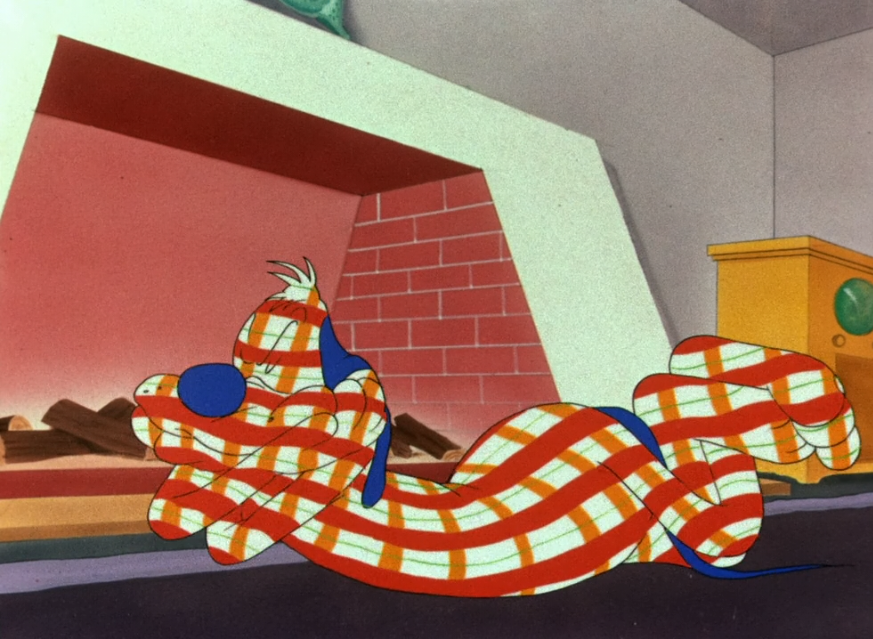
The dog's resistance from scratching becomes increasingly difficult, to the point when the dog starts to change colour. At first, the dog's body turns blue - until the colours get more absurd in the process; including a tartan look. 

The more painful it becomes for the canine; the crazier the colour choices get. The animation itself is primarily secondary in comparison to the ink and paint work. It's a very unorthodox method - but Bob Clampett enhances the pain convincingly.

Clampett's cutting style is used to an advantage as the shots of the dog struggling coincides with the flea's antics in the jungle of fur. The gags involving the flea searching for meat are hysterical in its execution. To begin with, the flea harmlessly pours ketchup and mustard on the dog's skin.


Over the course of the cartoon; the gags become more sadistic and silly - that the result is riotous. Whilst searching for more meat inside the dog's fur; the flea uses tools such as a pickaxe and a jackhammer. Whilst intercut with the dog's reactions; his struggles are much more justified.

In preparation for the cartoon's climax; the flea begins to use explosives inside the dog's fur. The gag becomes far-out when the dog scents smoke rising from his rear end. This results in a series of airbrush fireworks rocketing from his bottom - a Clampett approach of a gag indeed.

Clampett's love for edgy albeit juvenile humour goes unnoticed in a lot of his cartoons. One of his more famous dirty gags appears during the dog's frantic scratching frenzy across the living room. At one point, he halts and informs the audience, "Hey, I better cut this out. I may get to like it." Such a kinky confession is a symptom of Clampett's boyish charm.


One of Clampett's more obvious samples of juvenile humour appears early in the cartoon - during the flea's introduction. The flea pulls out a telescope to scout for potential flesh. The following shot is point-of-view from the telescope.

The flea moves across to discover a lavishly drawn rear-end of the dog. The effect of the flea double-taking and vibrantly looking back at the dog and whistling features some nice timing. An intriguing assignment I imagine for a character layout artist drawing out such lavish albeit crude detail.

Some samples of Clampett's timing blending neatly with comical action is evident during the scene of the flea escaping the dog's biting chops. The action itself is timed to Raymond Scott's Powerhouse - which was becoming a trendsetter of Carl Stalling's musical compositions.

Much later, during the dog's scratching spree - Clampett explores some fast intercutting - of an approaching Elmer Fudd. This follows into a hilariously exaggerated skid; that's so intense the dog ends up gripping its nails onto the rug.

The dog backs away as Elmer advances towards him. Once the characters are off-screen; an unseen crash is interpreted through a camera shake. Elmer walks back into the scene; with the reluctant dog attached to a door ripped off its walls.

And so; the cartoon reaches an incoherent ending. Elmer ends up scratching himself, presumably from the flea, which follows up some smear animation of Elmer scratching himself pose-to-pose.

After both characters end up slipping inside a bathtub - they are unexpectedly carried away by the flea onto a dinner plate; labelled as a blue-plate special. This leads to the flea: "They'll be no more Meatless Tuesdays", in the same rhythm of his song - delighted over not having to ration.

Such a spectacle comes as a complete surprise to the domestic cat - seen earlier in the cartoon. Losing the will to live, the cat remarks: "Well, now I've seen everything" - and commits suicide on the spot. This holds my nomination of one of the nuttiest endings in a Clampett cartoon. The gag itself has been used several times, like Horton Hatches the Egg, but ending the short abruptly during that scene - is both dark and hysterical in shock value.

For a relatively basic narrative, Bob Clampett is always full of surprises! His carefree, wild approach to cartoon filmmaking are exceeded here. His exploration of angst on the dog is a personal highlight - from both an artistic and comical perspective. The characterisation of the flea is ingenious albeit deliberately corny. The flea's uncanniness and obnoxiousness still holds up as memorable - even if Clampett's song is the prime reason. The short's ending felt a little contrived, but what Clampett does is what's given - enough to let it slide by!

Ratings: 4/5.

Sunday, 14 May 2017

415. Falling Hare (1943)

Warner cartoon no. 414.
Release date: October 30, 1943.
Series: Merrie Melodies.
Supervision: Bob Clampett.
Producer: Leon Schlesinger.
Starring: Mel Blanc (Bugs Bunny / Gremlin), Bob Clampett (Vocal effects) (Thanks Keith Scott).
Story: Warren Foster.
Animation: Rod Scribner.
Musical Direction: Carl W. Stalling.
Sound: Treg Brown (uncredited).
Synopsis: Bugs Bunny becomes tormented by a war-time gremlin who attempts to sabotage an aircraft.

How do a lot of people perceive Bugs Bunny generally? A carefree rabbit with a trickster personality. A cartoon involving Bugs Bunny becoming a victim would be entirely out of the question. In the hands of Bob Clampett, it is so the case - and how he approaches it.

Making Bugs Bunny a victim of another foil is an extremely dangerous feat; as it depends entirely on who Bugs' opponent is - based on potency and wit. Bob Clampett's choice of candidate is much more amusing and in context of his cartoon style - by having Bugs run afoul of an unseen power - a fictitious gremlin.

The origin of gremlins go back to the myths of airmen from the Royal Air Force (RAF) in the United Kingdom - the myth that gremlins are impish creatures who have the ability to sabotage aircrafts. In 1943, Welsh author Roald Dahl (best known today for a highlighted career writing children's books) was perhaps first attributed for making the myth known worldwide, by writing his first children's book for the Walt Disney Studios simply titled The Gremlins.


Roald Dahl had served in the RAF during World War II, explaining his awareness of the myth amongst airmen. For what it's worth, Dahl himself was involved in a plane crash during his post at Libya in September 1940.

Reportedly, the concept created a lot of superstition amongst many airmen. And so, it enhanced further possibilities for wartime animated cartoons. By placing Bugs Bunny in that environment, Clampett and Warren Foster don't shy away from limiting the possible consequences Bugs would face once he encounters a gremlin.

Bob Clampett must've taken a liking to the Dahl story, as well as the gremlins concept - enough so, it warranted another directed-cartoon, Russian Rhapsody which was released shortly after this cartoon.

The opening sequence has a very satisfying yet unpredictable tone. From any first-viewing experience, it's difficult to determine what Clampett has lied in store. For much of the short's first minute of running time; it's animation free - which is possibly attributed by Clampett's careless management skills.

A Clampett-esque sign gag is featured as the cartoon's establishing shot which is followed by a slow pan shot of an air base, whilst Carl Stalling plays We're in to Win in the background.

The lack of new animation is soon compensated in the following scene - which features some of the most beautiful character animation ever conceived by the studio. Bob McKimson's work of Bugs' introduction is usually hailed as a tour de force piece of animation - and rightfully so. Not only is Bugs drawn very appealingly in proportions; but he feels very human. It also serves as a welcoming opening for what's yet to appear.

Bugs is seen as his standard self - sitting on top of a blockbuster bomb, eating his carrot and reading a book which title plays on Alexander P. Seversky's book, Victory Through Air Power. Bugs chuckles over a page he's reading on gremlins - followed by a point of view shot, featuring an illustration of the creatures, along with their descriptions.


Mel Blanc adds some wonderful touches to Bugs' delivery as he reads the text, such as Bugs' misreading on "dia-boo-lickal saa-boh-tay-jee". Bugs laughs mockingly over the notions about gremlins - utilised beautifully by McKimson's acting. Bugs' mocking gesture from his line, "Oh, murder" reads beautifully.


Bugs continues to laugh skeptically about gremlins ("Gremlin! What a fairy tale! Little man. Oh brother!") - until one passes by him. And so, Bugs feels an unusual strike coming from the nose of the blockbuster bomb, causing his body to vibrate broadly. He timidly laughs until he feels another strike.

After a surprisingly calm opening sequence for Bob Clampett - the cartoon effortlessly moves forward.

So, Bugs watches the gremlin attempting to strike the nose of the bomb with his large mallet - in synchronisation to I've Been Working on the Railroad. Bugs is completely unaware of who he's conversing with. The gremlin reveals to Bugs, "The blockbuster bombs don't go off 'til you hit 'em just right!" - broadening Bugs' entranced amazement.


And so, Bugs Bunny is deceived by the gremlin into testing the blockbuster bomb, by borrowing the mallet: "Hey, Mac. Let me take a whack at it". McKimson animates Bugs with an extreme anticipation - causing Bugs to twist his body several times; until he violently halts, hollering "What am I DOING?!".


Clampett's sheer energy begins to kick in a close-up of Bugs Bunny animated by Rod Scribner. Bugs stutters and speculates, "Hey, I bet that was a -- Say, do you think that--? Hey, could that have been a...gremlin?". The gremlin, standing on top of Bugs' whiskers yells in Bugs' ears: "It ain't Wendell Willkie!".

Scribner's timing of Bugs reacting to the holler is excellent in its frantic delivery. The use of layouts and colour styling in Clampett cartoons is always intriguing. Note how in the close-up; Mike Sasanoff only uses one colour to signify suspense. It's quite a risk in changing backgrounds very drastically; but it works well effectively.

Bob Clampett conceives some of the most surrealistic gags surrounding Bugs Bunny ever turned out by the studio. Clampett's energetic gags are typically far too broad for Bugs Bunny - and yet, he experiments with it with surprisingly great results.

Once Bugs Bunny chases after the gremlin, he strikes Bugs on the head with a monkey wrench. After an assembly line of inventive smear animation by Virgil Ross, Bugs momentarily alters his persona to dim-witted Lennie from John Steinbeck's novella, Of Mice and Men.

He dimly asks the Gremlin, "Which way did we go, George?" before collapsing frontwards. Mel Blanc provides a dim-witted voice for Bugs Bunny, to enhance the absurdity of the scene. In the following close-up animated by Rod Scribner, Bugs' posing and expressions are outrageously broad and hysterical as drawings.

The Gremlin pulls open Bugs' eyelids, checking to see if he's fine. Bugs responds, quoting Lou Costello "I'm only three-and-a-half years old" (Correction: See Yowp's comment below), and then flaps his lips in a screwball fashion. Typically, such a scene like this would be completely out of character for Bugs Bunny. Bugs' typically suave disposition would normally deprive from such boundaries. Only Clampett's boyish charm and Scribner's wild animation could bring make a feat pass. The sequence still has shock value today, taking into consideration that Clampett's perilous take on Bugs Bunny hasn't been paralleled.

Clampett's broadness and dangerous experimentation don't end there. Extensive exaggeration is highlighted in a scene of a vertigo Bugs Bunny, whose heart pumps out a 4F rating. Following that, the cartoonish energy is topped as Bugs slams into the wall of the plane. His body compresses into a flat penny - and gracefully shimmers.

Animation by Phil Monroe.
Once the gremlin boards an aircraft to sabotage it; Bugs ambushes him - in a desperate plea for retribution. Bugs, unaware that the gremlin has already started the plane, looks out for the creature by deceivingly calling after him whilst holding onto a monkey wrench. The gremlin appears but kicks Bugs' rear end; whilst hiding behind the aircraft door - laughing the the first few notes of Yankee Doodle. Typical piece of added character from Clampett.

Angered, Bugs attempts to strike the gremlin with the monkey wrench - only breaking the window. This follows in a wonderfully timed, suspenseful piece of action featuring Bugs attempting to run into the aircraft doors - taking a step back farther each time, hoping for greater impact.

The action gets broader to the point where Bugs begins to violate the laws of physics. His feet start up with great anticipation, to the point were the weight of his feet causes the aircraft walls to tilt back. Phil Monroe's animation shows a great use of weight that makes a seemingly preposterous gag look believable from impact.

Carl Stalling's use of the Russian folk song, Dark Eyes fits effectively to build suspense whilst timed accordingly to Monroe's animation - which is now considered a dead art. At the right moment, the gremlin opens the aircraft door - but Bugs' impact is too great as he zips out to an open sky.


One of the short's highlights, asides from observing Bugs Bunny getting tortured, is the animation itself. Arguably some of the most inventive, outlandish pieces of animation ever cranked out by the studio. A scene worthy for analysis is seen in Virgil Ross' animation of Bugs' visual concussion from the monkey wrench that struck his head.


Smear animation dominates a large chunk of the cartoon. Some of them are more conventional, like the smear frame of Bugs, as indicated from the frame grab. Others are more far-out and brave. It's astounding how animators and assistants were able to creatively invent new kinds of smear animation - by still keeping the cartoon action maintained. At times, the stars truly have aligned when it comes to an artistic venture!

From a casual viewing experience, the smear work doesn't scream for attention - but it evidently shows the enjoyment and endless possibilities of animation.

From a cartoon standpoint, a lot of the gags conceived are fairly standard - but Clampett's animators enforce so much energy to make results more effective than what would be typically acquired. In a repeated gag of the gremlin striking Bugs with the monkey wrench on his foot - another inventive smear is thrown into the action.


The cartoon even features one of the oldest, and most cliched of slapstick gags - the banana peel. It's one of the rarest of occasions when a banana skin gag is actually inventive and hilariously executed.

Bugs Bunny zips back inside the plane after his exposure towards an open skylight. As he reenters the aircraft, he slips on several banana skins planted by the gremlin as sabotage. The action is very quick and energetic. The staging shows some strong dynamics that blends with Clampett's brisk timing. Notice how very daring the animator is on moving perspective within a a couple of frames. Both scenes provide an excellent showcase on how broad animation can improve generic gags.

For the cartoon's climax - Clampett builds up the suspense as Bugs and the gremlin race towards the earth in a diving bomber. Not only is the sequence a masterpiece in dynamics and ambitious staging - but also in comic delivery.

A speed meter that channels
Tex Avery.
The climax is kept exciting and nail-biting. Bugs Bunny has been terrorised by a gremlin throughout this short. It gets to the point where Bugs' fate becomes unpredictable based on Clampett's uncanny handling of the character.

The layout staging and fast cutting are potent in execution. The shots cut back from a diving aircraft, that's animated beautifully as its body begins to strip apart from impact. Hilarious shots cut back to a nauseating Bugs - burdened by fate and sickness.


The pacing and suspense feels like a throwback to Tex Avery's cartoon The Heckling Hare; except in Clampett's cartoon, the pacing and camera staging has far advanced.

Once the moment of impact is present - the aircraft engine sputters; causing the plane to completely halt in mid-air, barely just above the earth. The unpredictable delivery and absurdness of the punchline makes its payoff the more hysterical. In the closing shot, the gremlin reveals that the plane has run out of gas. Bugs confidently eats his carrot whilst confiding to the audience, "You know how it is with these 'A' (gasoline ration) cards" - revealing an 'A' card next to him. Although the gag itself has aged over time, there's no denying that Clampett's hilarious punchline couldn't have been outmatched.

Perhaps my favourite Clampett-directed Bugs Bunny cartoon - Falling Hare is a home run! It's wonderfully thrilling and inspiring, and yet downright hilarious. Admittedly, I'm not a fan of the savage-like persona Bob Clampett later gave Bugs in Hare Ribbin' or Buckaroo Bugs; but his experimenting on characterisation remains unparalleled. Admiration for Clampett continues to escalate by astonishingly observing the risks he took and his fearlessness. Other cartoon directors would shy away from such an ambitious experiment, but Clampett's confidence shines. As a director, he took great pride by the creative freedom he was blessed with. It remains a wonderful insight in seeing somebody outwit Bugs Bunny to terrorising levels. At the same time, Clampett remains faithful to its source material - by restoring Bugs' charisma at the cartoon's end. Overall, an excellent cartoon that holds a testament to why Warner Bros. cartoons are exciting to watch. They're original and spontaneous.

Rating: 5/5.