Monday, 26 May 2014

332. The Wacky Worm (1941)

Warner cartoon no. 331.
Release date: June 21, 1941.
Series: Merrie Melodies.
Supervision: Friz Freleng.
Producer: Leon Schlesinger.
Starring: Mel Blanc (Jerry Colonna Worm / Crow).
Story: Dave Monahan.
Animation: Cal Dalton.
Musical Direction: Carl W. Stalling.
Sound: Treg Brown (uncredited).
Synopsis: A crow is in the search for a worm, but catches its attention on a Jerry Colonna-like worm.

What Friz Freleng was great at when creating a cartoon, was a story which would center on two foes, as well as the struggle for survival of the fittest. Striking examples include Sylvester and Tweety, or Yosemite Sam, who don't make appearances until much later on.

In this short, this is one of the many formula shorts he directs, though it's an early take for Friz.

This short features a crow attempting to tackle a worm, but to give the worm more of a identity, the worm is shown as a caricature of Jerry Colonna, hence the moustache and Italian accent, performed excellently by Mel Blanc. Colonna was a popular radio personality of that era, well known for his phrase "Greetings gate!", and did Colonna actually speak in rhyme during comedic shows? Being a popular celebrity reference for many Warner Bros. shorts in the early 1940s; this short quite possibly tops the other shorts in terms of impersonating Colonna, being a star of the short.
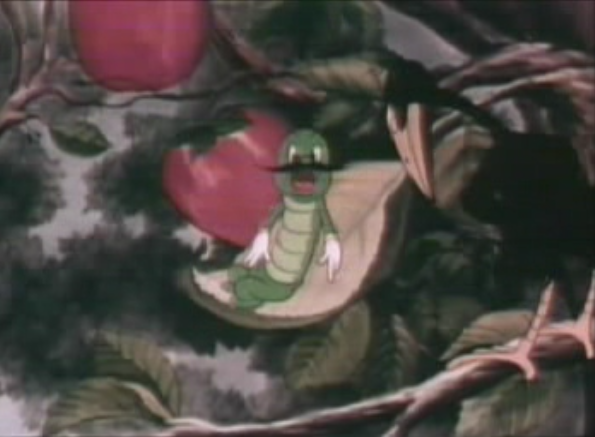
The short's story is pretty straightforward, and perhaps a bit unfocused. The short begins with a peckish crow who is on the lookout for a crow. After having no luck, chance comes when he hears the Jerry Colonna worm off-screen singing Daydreaming (All Night Long).

After being spotted by the crow, the worm responds: "My word, a bird". Afterwards, this then results in the term being chased by the crow and follows by a string of gags. That is pretty much it in terms of how far the story goes to.

The story feels rather unfocused at that point, as it appears to have no tone. The string of gags that just immediately follow just run don together in a monotonous sense. The gags that appear are at times rather amusing in terms of timing and delivery, but it just isn't paced out evenly well, and going from one scene to another feels rather rushed. The story does appear to at least go to several point at least later on in the short, but in-between let's speak about the decent parts of those sequences.

Freleng's timing certainly comes to great advantage with Stalling's choice of music to fit perfectly to action. Throughout the chase scenes that is heard in the cartoon's score: the crow's run cycle is well-synchronised towards Harry Warren's Tango Muchacha. The crow's legs change at various angles during the different scales played in the music, and it works so well in the crow's run.

Another highlight in terms of Freleng's timing is during the toothpaste sequence.

The Jerry Colonna worm goes to hide away from the crow by hiding inside an abandoned toothpaste in a junkyard. The crow, who attempts to unscrew the lid and remove it, is struggling to set it loose as the worm is still attached to the lid.

This is rather great timing which once again Stalling takes advantage of the timing in terms of music beats. The animation of the worm crawling inside the toothpaste is also surreal to a extent making the crawl look rather believable.

A highlight of the string of gags, in my opinion would be the apple gag. The worm has landed in one of the apples which are scattered in the ground. The crow arrives and shouts, "I know where ya are - you're in one of these apples". One of the apples behind the crow then begins to make little steps towards the left, causing the crow to turn suspicious and suspect an apple behind him is moving. The timing of the apple moving is rather well-done, and the mind-playing of the crow is well satirised.

The crow, believing that the apple moving has the worm inside, then the crow tiptoe towards the right whistling innocently. The wackiest part of that sequence, then spontaneously shows the entire group of apples scattering around--perhaps suggesting there are other worms in there, or just a gag for the hell of it to confuse the crow further. This wacky and surreal gag really pays off the sequence, and thus making Warners jut different in their approach to humour, which is very original.

After a series of gags that don't take the story further, the worm then hides inside a medicine bottle which its alcoholic beverage is rated as 110%. It always seems to be that cartoons like to exaggerate the beverage rate to make the gag more bizarre. The worm, having drank the alcohol, then slides out feeling intoxicated.


Feeling unable to walk and adjust properly, the worm then approaches the crow with intoxicated confidence. Note the Henry Binder reference to the can (which the worm hits his head during his hiccup).

The worm, who attempts to challenge the crow then orders by speaking in rhyme: "Listen crow, you better go!". The worm then attempts to face the crow into a fight, but then goes on to suggest, "I dare ya to strike me first".

This is a great little sequence, as this finally gives writer Dave Monahan the chance to use satire on the Jerry Colonna caricature. Prior to the short, during the chase and action scenes, the worm was very much underplayed during these scenes. I feel that Monahan doesn't completely take advantage of the caricature and impersonation, though he does use it in several scenes: it could have made some of the comical-timed gags appear funnier in terms of delivery.

And so, the cartoon then reaches its closure. The worm once again hides inside one of the apples under a apple tree. The crow, losing his track on the worm, then immediately suspects he is hiding under one of the apples. Vowing revenge, he declares: "Okay, come on out. Come on. I'll find ya if I have to eat every one of these apples. And I will too".


And so, the crow begins his time consuming task of eating all the apples that are scattered under the ground. After eating so much apples later, the crow then begins to feel very ill from eating too many apples.

The animation is very believable of the suffocated crow who is tired from eating al these apples. It really captures and persuades the viewer to not eat many apples. Stalling also captures the torture of eating too many apples with the music from Melancholy Mood. Discovering the worm is hiding in the last apple available, it just so happens by bad-luck a woodpecker pecks on the tree, with a number of apples falling from the tree. From the grief and suffering he is going through, he finally quits his target on the worm, "Who wants a worm anyhow?" before he faints.

Overall, this short feels more of a missed opportunity in terms of its parody as well as story construction. For a short where the main character is a parody of Jerry Colonna, this short managed to pull it off well, except I wish they could have explored with the parody further, especially in the scenes where the worm was underplayed. The sequences and the pacing in-between felt rather unfocused and rushed, and thus they just run altogether. Freleng's timing is certainly at the top of his game, and he continues to surprise the audience with each cartoon he turns out. This was a rather average short which could have been better, and could have explored the satire a lot more. The Colonna worm was amusing, but personally I don't believe the short was good enough to warrant a sequel: Greetings Bait. I suppose the short was popular amongst its audience, and probably was the reason for giving the worm one last appearance.

Rating: 2.5/5.

Sunday, 25 May 2014

331. Porky's Prize Pony (1941)

Warner cartoon no. 330.
Release date: June 21, 1941.
Series: Looney Tunes.
Supervision: Chuck Jones.
Producer: Leon Schlesinger.
Starring: Mel Blanc (Porky Pig).
Story: Rich Hogan.
Animation: Ken Harris.
Musical Direction: Carl W. Stalling.
Sound: Treg Brown (uncredited).
Synopsis: A horse attempts to become Porky's steeplechase, and goes so once Porky's horse becomes too drunk to race.


Compared to many of Chuck's cartoons which are mostly 'mood swings' lacking narrative or dialogue, Chuck appears to be trying to create a straightforward story in this short. Unlike Joe Glow the Firefly which was just absolute visualised nonsense, this short appears to at least have a purpose, at least for the clumsy steed who attempts to become Porky's racer.

The short starts with a horse who has been kicked out of the "Elite Stables", and upon discovering Porky's stable, he aspires to become his steeplechase.

In order to get from one point to another, Chuck still hasn't the ability to get to that point yet, so midway through the cartoon follows a series of several, failed attempts from the horse which results in a number of padding and consistency in terms of timing. He attempts to prove of his physical capabilities in which Porky a majority of the time, just ignores; and the horse's clumsiness proves his uselessness.

Porky is rather underplayed in this short, as he usually is. He is underplayed to the extent where he is given little to no dialogue whatsoever. He only speaks/sings during his introduction, where he sings We're in the Money whilst he is his noble steed a shine, for the county fair race.

He also appears to show at least some personality or action where he mocks the horses' poor attempts of being an eligible steeplechase for the county fair. Throughout the short, he does appear in small scenes here and there, where he is just a passing by character during one of the clumsy horse's chances.

Though, his role doesn't appear until the short's climax during the race. Despite more appearance, Porky's appearance is very passive in terms of action or dialogue. His actions in the latter part of the short are as equivalent towards a fly in the wall during a meeting conference. He is given very little to do other than being the jockey, and this thus shows how underplayed Porky could go to.

The horse's encounter to Porky in his theatrical greeting is rather a pleasant highlight to watch in some aspects. His use of pantomime is well communicated, through the use of signs: a common trademark for Chuck Jones.

The use of the signs are certainly believable and well character-animated in those scenes. The timing of the horses' poses where he attempts to prove he is of "excellent condition" are rather sharp and focused.

The drawing is solid, and so the scene is successful in those aspects. However, what really kills that scene is what follows afterwards. The tail of the horse is not adjusted to the posing from the horse's pose. The tail moves at an inappropriate angle where it is not in keeping with the sharp proportions the horse is attempting to make.

The first attempt was rather comical and subtle from Chuck's perspective. What then "kills" the scene, is the horse then attempting to adjust his style several times, taking up roughly half a minute of screen time. Chuck's obnoxious pacing is still evident, in which he just can't let a scene play, or just get from shot to shot, by having useless padding.

Possibly the worst sequence in the short with really eyesore pacing would be the horse attempting to struggle loose from a bucket. This is one of many of Jones' attempt of going Disnified, where he would require the characters to think like Pluto, and do Pluto stuff.

Watching the horse's hoof being caught in the bucket, and then following with all four legs being caught is quite pain some to watch, not just because of the pacing, but also because of how believable the animation use.

The squash and stretch, the posing is really top-notch, and thus this really does make the viewer feel the annoyance of being trapped. Despite being well-animated, the pacing still needed to get on the road.

One could ask what the sequence had much to do in terms of the short's story: the answer is very little, although this did pay off by the moving the story forward, and thus ending the horse's failed attempts of impressing Porky. The horse crashes towards the stable, where the interior part shows a bottle of horse liniment tipping from the shelf, coming from the reaction of the crash. The liquid falls, thus causing Porky's racehorse to drink from the bucket. However, oblivious to the horse is that the bottle has a very high alcoholic beverage rate of 125% which shows only cartoon characters could survive a physically impossible rate.

One animated gag that could have worked a lot better in terms of pacing and speed, would be the horses' attempt to prove he is eligible for racing is his attempt at high jumps. From how Chuck visioned it, the horses' first jump and into mid-air looks rather promising for the horse: only to find he crashes inside a house. The off-screen crashes and circumstances occurring in the house is rather effective and comical in how it has been achieved, and Chuck certainly pulls it off well.

The horse then exits the house where the gag results in the horse being bizarrely dressed like an old hermit, sitting in his rocking chair. No objection to the bizarre gag, as its amusing in itself, but it could have worked better in terms of its pacing, as the camera movement felt a tad too slow. This is only a minor complaint, on a rather minor gag but Chuck was still learning on improving his timing.

In other words, Chuck's coming certainly does appear to be kicked up a notch a couple of times in the short. He expresses certain wackiness where he is gradually trying to catch up with the other Warner directors, who are also attempting to turn out faster shorts.

Two striking examples are when the horse is dressed as a hermit, he rushes off-screen leaving only the long piece of underwear visible in mid-air, and still riding like a horse. This was rather wacky for Chuck in that time era, and it's definitely full of charm.

The second, shows Chuck giving the horse a characteristic, funny run cycle. Notice the gallop he is making, where Chuck expresses his clumsiness towards the horse where the back part of his legs are not in sync towards the front part of the gallop. It's the sort of characteristic walk that Tex Avery could have used, and this is surely evident that Chuck was desperately attempting to escape from the style of shorts he's making, but isn't yet ready to do so.

Having discovered that Porky's horserace has passed out from the alcohol he drank, Porky faces a brief dilemma. The race is at the procedures of starting, and he desperately needs to find a horse for racing. The clumsy horse, realising his advantage, then proceeds to race to the tracks, taking Porky with him.


As for the horserace sequence, I must admit I quite enjoy Chuck's use of pacing in this racehorse, as it felt as though it was in good taste and it captured the speed and franticness of a horserace rather well.

Chuck creates an effective race where Porky and his horse race through a bush, in which results a steam-locomotve gag, emphasising the speed they are racing at. A rather cute gag, and this also shows Disney influence from the Donald Duck short The Hockey Champ, a short which also had rather rapid pacing. Despite the horse's clumsiness and lack of skills in the race, such as breaking through stumps and landing underwater at a pool, his great speed and cheating goes unnoticed in the crowds, and thus Porky and his horse win the race. A great success for Porky, but the horse discovers his hoofs are caught in the trophy, a rather cute recurring gag from previously.

For a Chuck Jones short where he relies on pantomime, I would consider this short as passable..at least passable to a low level. The short itself had a straightforward story and appeared to at least go from one point to another, even if Chuck's sense of timing was still slow and in bad shape. Chuck and his animators definitely have the clumsy horse an identity and took advantage of that rather well, in which it was paid off successfully. The pacing of the short, however was still slow and aggravating to watch, and Porky's role was too underplayed, either using or losing him for the short. This short, once again, shows elements of Chuck's potential which is still not fully recognised or successfully achieved.

Rating: 2/5.

Saturday, 24 May 2014

330. Hiawatha's Rabbit Hunt (1941)

Warner cartoon no. 329.
Release date: June 7, 1941.
Series: Merrie Melodies.
Supervision: Friz Freleng.
Producer: Leon Schlesinger.
Starring: Mel Blanc (Bugs Bunny / Hiawatha).
Story: Michael Maltese.
Animation: Gil Turner.
Musical Direction: Carl W. Stalling.
Sound: Treg Brown (uncredited).
Synopsis: Little Hiawatha is on the hunt for a rabbit, but upon discovering Bugs Bunny, Hiawatha's wits never succeed, in sequence after sequence.

Another team up with Friz Freleng and Michael Maltese, in which both of them work for the first time on Bugs Bunny: a character both men would become closely associated with. This time, Mike Maltese is satirising the legendary Hiawatha, a Mohawk who is said to have existed in the 12th and 13th century of the Americas.


Instead of how the legend tells about the figure, Maltese mocks the character with the simple-minded, Elmer Fudd-like personality. From the beginning of the short, you can see that Maltese and Freleng establish the opening shorts very carefully and delicately in order to achieve comedic purposes that would carry on the short.

Starting off with Bugs' narration, the scenery is rather beautiful where an audience member would get the impression the short is being influenced like the previous Silly Symphony short.

The waterfall effects are rather stunning, and Hiawatha zig-zagging through the steepy river is rather cute. Bugs Bunny, who happens to be sitting by a tree reading about the Hiawatha story, reads about Hiawatha's adventures, such as "slaying the forest rabbit". Bugs, realising he is the victim of the story, then immediately begins with a strategic plan to fool Little Hiawatha. By the way, does anybody else agree that Hiawatha ISN'T a caricature of Disney animator Ward Kimball? He resembles a much more Elmer Fuad than any of Kimball's distinctive features.

The simple-minded satire of Hiawatha is well broadly-handled by Friz's comic timing, as well as with Maltese's humiliation and ignorance displayed on the character. Mel Blanc himself provides the dumb voice for Hiawatha rather realistically, beginning with the first line: "I'm gonna catch me a rabbit, and I'm a-gonna cook him in this pot right here, right here"--already putting emphasis on "right here".


And as for Freleng's comic timing, he certainly adds depth to his ignorance and clumsiness as he giving him a characteristic trait to carry out through the entire short. When Hiawatha is chasing after Bugs, or following his tracks; he has his bow and arrow ready, but each run he makes, he consistently trips clumsily.

Carl Stalling also puts emphasis on the clumsiness to great execution, as Hiawatha's run is heard through the sound of drums, but each trip interrupts the suspense with a cymbal crash. This is excellent satire from Friz's timing where it is just excellent mockery on the legendary, brave warrior.

From watching this short and being the first directed Bugs Bunny by Friz Freleng: you'll notice that Bugs goes through several different crude-designs in the short. The model of Bugs resembles little to what was seen previously in Tex's cartoons, and Bugs' design would come to settlements with Friz, (as well as Chuck's unit) for at least a couple more years.


Without doubt, Bob McKimson was known for giving Bugs's standard design, but it appears to be in the earliest shorts by Freleng that Bugs' design would range from passable to just crude, very off-model drawing.

Two very striking examples of the different crudeness in drawing is evident in Bugs' rain dance over Hiawatha (animated by Cal Dalton), and Bugs relaxing inside the cauldron pot (animated by Gil Turner). The rain dance sequence, with Bugs looking quite possibly the crudest, shows how low-brow the sloppiness of drawing could get.

Whilst they are rather amusing gags and wits coming from Bugs, one would feel rather disturbed of the evident designs that change throughout the course of the short. Whereas this is mostly just my opinion, the clearest answers of why Friz did not appear to follow the standard McKimson model for Bugs appears to be explained in the Phil Monroe interview, who mentioned the settlements on design "couldn't have any consistency". This evidently must have occurred at a time before Bob McKimson was in charge of keeping the characters looking on-model from all units.

One of the greatest sequences where Bugs is at the top of his game appear in two sequences that come to mind. The first shown is Bugs relaxing in the cauldron pot sequence. From a 1941 audience viewpoint, one would feel sympathy for Bugs to not get captured and stewed by Hiawatha, but watching him bathe and hum When the Swallows Come Back to Capistrano.

Watching this short chronologically in line of many of Bugs' shorts; this is rather hilarious in the sequence, as the boiling cauldron does no harm or threat to Bugs, and instead just sits in the cauldron like he's taking a hot bath.

Some excellent character personality of Bugs stepping into the cauldron, as he responds "Easy does it" before sinking his body in.

And so, as Hiawatha is cutting carrot slices--the great delivery sense of that gag is that Bugs chews on them anyway, which is just excellent delivery. And so, Bugs responds: "Hey, what's cookin', chief?", when asking Hiawatha what's for dinner (the answer being rabbit), Bugs double-takes on the word "Rabbit?!" before attempting to escape.

Another great sequence shows Hiawatha carrying a piece of rope in hope to tie up Bugs. Much like Bugs' manipulating ways of tricking slow-witted antagonists, he speaks to Hiawatha normally who declares, "I'm gonna tie you up!.

Bugs responds to this by laughing at Hiawatha in a ridicule manner ("Oh, that's a pip. Gonna tie me up!"). Bugs' laughter then leads into Hiawatha's attempted outburst in capturing Bugs, only to have Hiawatha tied to a pole where Bugs performs a small rain dance surrounding him. This is a rather great little sequence where the the audience would question Bugs' strategy, such as laughing what what would be considered a dangerous threat: but the delivery and karma pays off.

Some great uses of comic timing from the master, Friz Freleng himself comes to great use. Bugs attempts to distract Hiawatha once more by challenging him into a jump challenge. Freleng's comic timing is certainly very slick and appealing, with a lot of appealing brushwork. Bugs them lands, leaning on a stick hanging onto the edge of a cliff.


Hiawatha then repeats these actions, with the same speed and pacing that were repeated by Bugs only to find himself standing at the edge of the cliff, where a lollipop labelled 'sucker' is shown as an overlay opaquing him, to show emphasis on what a loser he is.

Standing in mid-air, in quite possibly one of animation's oldest gags, meets his fall.

And so, after Hiawatha's fall...it then appears to be that Hiawatha has already made his last attempt at capturing Bugs Bunny. He gets sail onto his wooden canoe and begins to sail through the river, much like the opening of the short. This is a rather unusual sense of closure for the short's ending, at least how Mike Maltese is depicting it. Like the opening, the short concludes with rather rich-looking backgrounds and staging of Hiawatha's departure, especially the last shot with the sunset which is parallel to the Silly Symphony short. Bugs Bunny finishes off the narration of Hiawatha who then begins to set sail through the shores. Responding, "Fairly well" to Hiawatha's departure in the horizon, Hiawatha quickly rides back to give justice to Bugs. Hiawatha ends with the last laugh by kissing Bugs in the lips before setting sail before, perplexing him. A rather unusual choice of closure for the short, but only Maltese could have created a better idea of payback for Bugs.

All in all, this is a rather decent introduction for Friz Freleng, being his first Bugs Bunny short, as well as for Mike Maltese. They both adapt to the character very faithfully to Tex's previous shorts, and Friz continues to direct some of the best Bugs Bunny shorts ever made. The satire on Hiawatha in this short has been nailed by Maltese, for his clever use of dumbing-down a heroic figure, and Friz has certainly nailed his own interpretation of Bugs in this short. The comic timing and use of scenery is certainly rich and entertaining at the same time, especially giving Hiawatha a personality of consistently tripping. Bugs' interpreted design, however, is still a major problem from Friz's unit, and this would continue to be a problem for a couple more years in his years, as Bugs had not yet been given a consistent design. Despite the creative and design issues the studios was facing with Bugs, this didn't stop Bugs from his great antics and entertaining scenes that is scattered throughout the short.

Rating: 3/5.