Saturday, 8 December 2012

220. Porky in Egypt (1938)

Warner cartoon no. 219.
Release date: November 5, 1938.
Series: Looney Tunes.
Supervision: Bob Clampett.
Producer: Leon Schlesinger.
Starring: Mel Blanc (Porky / 'Da Voices' / Various Egyptians) and Dave Weber (Humpty Bumpty).
Story: Ernest Gee.
Animation: Norman McCabe.
Musical Direction: Carl W. Stalling.
Sound: Treg Brown (uncredited).
Synopsis: Porky ends up missing a tour guide of the desert and sets himself out to the desert as he suffers from hallucination.


According to Mike Barrier in his 'Hollywood Cartoons book - after Clampett was promoted to a director; Ray Katz (management of the Clampett unit) hired Clampett's old high-school friend Ernest Gee to help come out with gags as his stories appear on a few cartoons around 1939 - as well.

So the cartoon begins as we find a citizen in one of the towers who appears to be singing Egyptian music out of his window as I guess it shows they're waking up. There are some Egyptians sitting down in the street as one of them wakes up and yawns.

Then the action and Clampett pace finally gets going as he has a pair of dice with him as the group start gambling. I like how Clampett experiments with his attempt of slow animation and then suddenly gets the pace going. While it was a good attempt, I feel he needed a strong animator for that assignment - perhaps he could've brought back Chuck Jones? Hmm. He squirms, "Baby needs a new pair of shoes. Don't fail me now!" which is a rathe typical line for when you gamble. That voice by Blanc there - I find, is rather degrading to listen to.

Meanwhile - an Egyptian woman walks out of the scene as she has her mouth covered with a veil and walks balancing a water pot on her. Even though the walk is likely rotoscoped - there is a crowd off-screen (presumably the audience) whistle at the look. The woman removes her veil and we real a hideous face as she shouts, "Hello boys" as she chuckles rather spastically - with jerky movement.

The movement is rather clumsy - but we know that it would be a difficult assignment to animate back then. So we pan through as we find there is an Egyptian sitting on a bed of spikes. What we can see is clearly exaggerated and cartoony is he has a sword through his abdomen and yet - and has survived that fatal trick. He swallows a club of fire into his mouth. Just after a few seconds - he ends up screaming on fire as those magicians have finally felt pain for the first time and that's rather funny and cartoony of Clampett.

I love the wacky animation of the Egyptian which is very loose. I love how he grabs out a water cooler to try and cool his mouth and extinguish the flames. Meanwhile there is an Egyptian caller who yells out to tourists to see an attraction of "mummy stars" and even yells "And we're pulling right out" in English.

So, a crowd of tourists then rush through to see the attraction. Some rather interesting designs on the tourists that look very simplistic. They all hop along inside the camel as the camel appears to have too many lumps which is Clampett being imaginative as usual. Also rather cute and funny is the scene where the camel also pulls a trailer that is reserved for the skunks - which is typical to see in cartoons, too where they are portrayed as outcasts. I love how Clampett jokes with Egyptian tourism compared to how Americans would display it - like using a bus for tourists but instead in Egypt they use a camel.

Meanwhile Porky arrives at the scene but is found too late as the camel riding tourists has already left. As he sees the camel leaving - he ends up having to ride a slower camel. So as they ride through the desert - as the slow camel he uses starts to sweat. He shouts for the name of the camel: Humpty Bumpty (pun for 'Humpty Dumpty') and shouts for him to "swing it!". Weird, because I thought camels can survive in a desert for days but not that camel as it does appear.


As he rides through the desert - the first signs of hallucination (perhaps) appears as the sun starts to set anger and 'burns up' extending the heat even further as he then starts to breathe fire as the temperature is only increasing. Porky ends up sweating as he stutters: "Gosh, it's roasting" where there is some nice frying effects of the sand steaming up. Another really cool use of effects animation where the sun beams the light on palm trees as they set fire and burn to crisp - and the lake ends up evaporating.

The lack of water in the desert causes the camel to start collapsing in the desert as the rhythm of the 'Death March'. Porky walks over to the back of the camel in an attempt to push his rear end to keep the camel walking through the steamy desert. As the back part of the camel's legs manage to keep on standing - Porky sweats terribly - but the legs loose balance and they land straight on Porky.


Some cool animation appears as the camel tilts upwards after sitting on Porky. There is some cool vibration effects as the beam of the sun forms into a fist and ends up socking the camel. No - the hallucination really does begin there as the camel ends up becoming rather weary and dehydrated. The cool camera effect then begins as the background location dissolves. Whilst the dissolving continues - the camel ends up hearing random voices in his head which appear to be sung in Egyptian language - and it definitely is presented as rather creepy. Then all of the voices end up using the camel's name: Humpty Bumpty. They mention his name numerous names which starts to frighten the camel. This causes the camel with his scared takes (even as the backgrounds continue to rotate and dissolve) which is a cool dissolve as full animation takes place. The camel jerks at hearing the voices as he starts to get afraid. The camel ends up freaking out and shouts "STOP!"

The camel ends up losing his mind as he ends up acting rather dramatic: "The voices, they got me". This is definitely over-the-top humour which is funny. I love how he just stretches up and shouts "It's a desert MADNESS!" The camel also ends up acting rather weird towards Porky as though he is dying which is part of the joke and he also ends up crying.


Afterwards - there appears to be a line of camels which appear to be what the camel is probably visualising - or a part of his hallucination. This is pure exaggeration in terms of acting and also animation (see the eyes widening) as he shouts "The camels are coming!" Mmm, Oscar winning performance anyone? As if something could get any gayer or even stranger - the camel ends up playing the bagpipes - which just came out of nowhere - and also performs the Highland fling before performing the bagpipes again.

As the camel runs away in the desert (suffering from the hallucination) - Porky sweats and orders for Humpty Bumpty to return to him. In a point of view shot - we find that the camel is seem bathing in a swimming pool and laughing like Hugh Herbert. Porky goes into a solid hat-take as he runs over to the pool - as he runs over to jump into the pool. However - the pool dissolves to sand and after diving he lands into the sand. Great, so now Porky is suffering from hallucination.


Causing the camel to act so strange - he ends up kissing Porky on the lips and oddly enough appears to act rather excited over the kiss. This is Clampett and story man Ernest Gee having with gags and hallucination piling up together.

So as the horse acts excited - he even zooms in closer as he reveals a brief facial feature of Bert Lehr chuckling like him - and that was also very amusing to me, and he remarks; "Camels is the craziest peoples" which is a spoof of Lehr's famous line "Monkeys are the craziest peoples". It's also been a longtime gag reference in the cartoons, too. The horse ends up rather acting kooky as he shouts out the Lone Ranger's notorious quote: "Hi-ho, Silver - away!" which is also a popular reference as it still is today. The horse ends up crashing into a tree which causes the horse to regain his consciousness again. So, after getting back to himself; the horse remarks: "Gee, I guess the heat got me. I'm okay, now". Porky is already by his side and is rather relieved that he is okay (and even Porky appears to be okay, as well). The camel then ends up hearing anonymous voices again - and ends up acting batty again.

As the voices come back again (and they're set in a rather creepy form). The camel ends up picking up Porky runs off (even though hitting a palm tree by accident). The voices still keep shouting "Come back" which even creeps me out. I wonder how the children reacted to that when the cartoon first came out.


As the camel and Porky dash out of the scene - they then arrive back into the Egyptian village again where the camel locks up the doors so he wouldn't hallucinate anymore or hear the sounds of the voices. "Safe at least" he sweats. Porky then agrees at the statement, but as the camel starts to turn sane again - Porky just ends up acting rather cuckoo as he grabs out a pirate's hat and goes into these goofy manoeuvres that Daffy Duck would've turned out.

Overall comments: This cartoon gives Clampett a clear mind and also inspiration as he has set out ideas for a cartoon where Porky is in a desert and his camel suffers from hallucination. However, when I watch the whole cartoon - it feels like Porky is only playing a minor role in the cartoon whilst as the camel plays a much more extended part than Porky as he is given short sequences usually to himself - even though Porky is there but only "beside him" most of the time. The hallucination scenes were rather staged out wonderfully in this cartoon - particularly where I believe the sun shows some proof of it - like the beam having some personality (by turning into a fist) and we know the sun has a lot of personality as the sun is Porky and the camel's enemy in the cartoon. The camel is probably the highlight of the cartoon - and to be honest - some of the exaggerated and over-dramatic acting of him reminds me of what Mike Maltese tagged along some years later when he wrote 'Often an Orphan'.

Also - Clampett and his animators definitely show some exaggeration of the animation - since it's possible true that exaggerated, fluid and vigorous animation was demanded in order to make the camel hallucination scenes actually work - and it managed to go along well. In 'Hollywood Cartoons' according to John Carey - Clampett would sometimes animate the whole scene to get the action accurate - and it could be possible he did that as the action was meticulously followed by Clampett's timing. The camel and the exaggerated scenes really do have a lot of weight in them as well as power with drawing (notice the screenshot with the camel smacked to the pine tree which really looks as though its painful). Also - the animation at the beginning was rather experimental with the exaggeration - notice the scene with the Egyptian woman who looks rotoscoped and an attempt on realistic movement but afterwards we real a cartoony, ugly hag which was needed as necessary. The gag works itself even though the rotoscoping may not have been done so well - but it did the job.

Friday, 7 December 2012

219. Johnny Smith and Poker-Huntas (1938)

Warner cartoon no. 218.
Release date: October 22, 1938.
Series: Merrie Melodies.
Supervision: Tex Avery.
Producer: Leon Schlesinger.
Starring: Mel Blanc (Egghead / Indian Chief) and Berneice Hansell (Pocahuntas).
Story: Rich Hogan.
Animation: Paul Smith.
Musical Direction: Carl W. Stalling.
Sound: Treg Brown (uncredited).
Synopsis: Egghead cast as Captain John Smith and explorers are set out to explore the new world - but are trapped by indians and only to be saved by Pocahontas.

Our cartoon begins where we find that a silhouetted view of a ship sailing in the distance as there is a journey to the new world. Avery, at first, opens up with his own opening gag as he dedicates the cartoon to those who sailed the Mayflower - but with clear exaggeration.

He exaggerates by using the the amount of "zeros" that it stretches much more further than needed in the title card that it causes the "total amount" to slide down and through so we know there were that many. Of course, the Mayflower was a famous ship that sailed over to the United States that was sailed by many English Pilgrims that were sailing to pioneer the United States mostly in the 17th century. Avery uses a gag on the sign at the back playing around with words as the ship apparently used to be called "March Flower", "April Flower" with crosses covering it but not is called 'Mayflower' with a modernised propeller at the back of it. It's basically just bad puns - once again.

Our main character (well at least in Avery's cartoons) is Egghead where he is playing the lead role as Johnny Smith, and at the time when Avery made parodies - he used that character to play the leading roles; so Egghead was the satire of those cartoons. The captions identify him as 'Capt. John Smith' and there is a cool part where he tries to hold the captions and the letters fall down like a pile of dominoes.

Egghead then chuckles gleefully and announces: "I'll be in history books, because I came over from the Mayflower". He grabs out his own telescope where there is a cool, jerky take as he has finally arrived at America. That little scene was of course Irv Spence's loose animation of Egghead. From the telescope's point of view - we find a cool billboard sign that reads: AMERICA and a little gag that announces 'free loans' since America was just discovered by those pilgrims there. We can hear in the backgrounds to (I Wish I Was) in Dixie' which is of course the Confederate anthem. They have arrived at Virginia which is where the Pocahuntas setting takes place.

We then get to view an indian village where it looks like a modernised downtown for the 17th century as there is a teepee that has a bar sign outside. Inside the teepee we find a barber shop where a indian barber uses a razor to give an injun a haircut which is a scalp treatment - which is rather amusing as Avery is playing on words with the word 'scalp' referring to an indian but also the type of 'scalp treatments' that you would get for your hair.

More injun gags appear as there is an injun mother where there is a sign that reads "Minnie Ha Ha" which is referencing Canadian silent actress 'Minnie Devereaux' who was also Indian - she was nicknamed 'Minnie Haha' - we find her outside the teepee just repeatedly yelling 'ha-ha', etc. of course I wonder if that gag was even dated since she was only famous as an actress in the 1910s?


Meanwhile there is an injun out in the distance on the lookouts for incoming Pilgrim travellers. He wears his own injun hat (with feathers at the back as indians were portrayed for wearing). At the back is a gag which I find funny where it turns out that there is a turkey at the back. It kind of makes the character look rather foolish in that scene.

The Indian lookout finds a ship about to dock into the New World and the Indian rides on his horse to report the news. Now only amusing that they have wired telephones over there (even not existing over at the 17th century) but the fact that when he rotates the numbers - the telephone itself turns into a different angle. Over at the teepee where they deliver messages, there is the "No Stop, No Stoop and No Squint" which was a directory reference of the time. There is a very cool ringing effect with a drumstick beating on tom-toms at the beat. The directory Indian answers the phone and discovers the news through blabbering noises. He steps out and as he is given the call (through Indians) he steps out in front of a crowd in front of the villagers.

A messenger Indian then makes a note to the villagers (and even using the 'no squat, no stoop, no squint' line). He appears to act rather broader and broader as he presents the Indian Chief of the village where he stands in the corner.

It is rather amusing as the excitement of the character is purely exaggerated as it also exaggerates on references a little (even for the 17th century time period). The Chief announces to his people "Ug" where the injuns cheer. That is rather amusing you there is a drumroll at the beginning of that, we'd believe that he is about to come out with a threatening message, but instead blurts out with a laconic "Ugh" sound which makes the Indians applaud - rather funny and typical of Tex in the 1930s as he is pretty much parodying an intense moment.

So, John Smith and his crew manage to dock at the American coast successfully and as they are about to embark on their adventure - Smith shouts, "Last one out is a rotten egg" in a childish form. All the other pilgrims dash out stampeding Egghead so he is the rotten egg. It's rather childish but charming in this type of scenario where the adventure (back then) was supposed to be taken seriously.

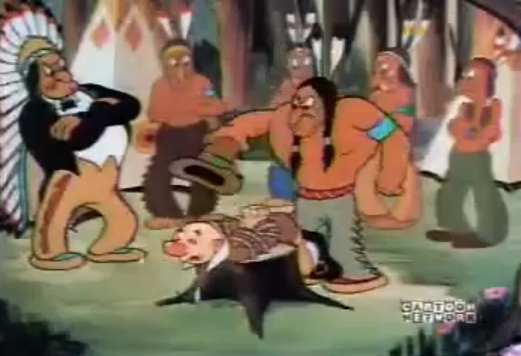
So, Egghead and his Pilgrim explorers are out hunting to develop their own land. As they hunt - they come across a sign reading, "Beware of Scalpers". At the spot - the injuns jump out with the Chief carrying a dagger as they plan an attack on the Pilgrims. In this Irv Spence sequence, Tex even uses more intense drama being parodied. As we believe that John Smith has been captured it turns out that the Injun Chief is offering a ticket to Egghead to watch a football match.

Egghead rejects the offer: "No thanks, I've got 6 to sell myself. I'm illuminous" as he chuckles gleefully. Egghead runs out of the scene as he is still being savaged by indians. As he runs off from the indians - a deliberate Avery gag (that even Tex would use in more pictures for fun) where a title card ends up being thrown in at the screen reading about the 'thrilling chase scene' being cut to shorten the length of the cartoon which was endorsed by the management. Of course; it was common for cinemas back in those days - so Avery spoofs it there and it was a very well done gag. The management even asks for Johnny Smith's opinion with a title card reading "Is that O.K. with you, Mr. Smith?" and that is just a wonderful use of satire for the title cards used in cinemas - as Tex is getting rather personal with the audience members watching the cartoon. Mr. Smith's response to that is "I'm under contract anyway" and proving that cartoon characters are also actors - something that Tex really knew how to show with his characters. I like how he quotes, "These redskins will NEVER catch me" before he laughs in his supposedly characteristic laugh. Of course 'redskins' would be rather politically incorrect these days...

So, after Egghead's unthoughtful comment - we find that he has been tried on a chopped down tree stump where the infamous execution of John Smith event is to take place. He cries as he is tied up, "Woe is me, woe is me" and even cries of being in agony. An executioner grabs out an axe through a breaking glass emergency one on a tree which is amusing, and even more amusing as cheerleaders cheer on the execution.

Some funny satirical dialogue appears as Egghead pleads:

Egghead: Hey you guys can't do this to me because I came over---
Indians: ---on the Mayflower (bleegh)
Chief: Gee that stuff gets me!

Goes to show how all the executioners have heard the same stories from many Pilgrims that were executed by the Indians. Just as the execution is about to occur - the executioner lowers Egghead's collar where there there dotted lines around is neck that read: "Cut on Dotted Line" which is hilarious. Just as the begins - there appears to be a weird cut from where the indian rubs his hands to where Poker-Huntas is in her teepee - I wonder if that was just a television cut - but there doesn't appear to a source to show which scenes were censored.

Meanwhile as the execution is supposed to take place - as Poker-Huntas is late for her cue - she is instead listening to Walter Winchell on the radio. Winchell announces the latest news of Johnny Smith's execution which she turns to shock from hearing. As she realises this is her chance she shouts:

"Ooh, I better get going" and Winchell responds, "Yes, you better sister. If you want this picture to have a happy ending". Funny gag which Avery liked to use with the radio actually having personal talk with the listener. So Poker-Huntas runs out of the scene to save Johnny-Smith as it did happen in reality. She uses her car to drive over to Johnny Smith with the executioner but Poker-Huntas stops the execution and escapes with Captain Johnny Smith by running over the indians. The fast-pacing shots where she drives fast (and as the chopping off scene is about to occur) make the action rather exciting. They dash through a photographer - but zip back for a photo of both of them before they continue their own escape. Stalling uses the 'Western Scene' cue which was a popular cue he used for action scenes western style. The indians notice the escape - and some funny Avery humour (and yet child humour) is where the Indians count (adding on 5 each number '5...10...15...20, etc.' before they continue the action which is done in a hide and seek style.

The Indians then ride inside their car as they chase after Johnny Smith and Poker-Huntas in this exciting car action sequence. As they drive - they drive through logs and stones which forms into a log cabin. As the chase sequence continues - the police catch the fleeing Johnny Smith and Poker-Huntas as they chase after them in their motorbikes.

The Indian officers then ride out of their motorbikes as they appear to ride invisibly which is the gag. It appears to be a gravity type gag I suppose. They stop as they notice their mistake but get run over by their own motorbikes. As the chase sequence continues - there is a lovely bit of loose animation of the car that appears to almost fly out of the edge of the cliff but manages to keep track on the road. The amusing part is where the reckless indian drivers appear to drive straight through to chase after them and somehow - they don't fall down.  After they stop - the Indian Chief announces, "Hey fellas, ain't this so fun?" as the indians shout "Yeah! Let's get some more!" before continuing on. Of course - even they aren't taking the chase scenes very seriously - like a game on the playground.

So, as Johnny-Smith and Poker-Huntas escape for their lives; Poker-Huntas giggles: "Now don't you people half-get excited? Because you see, the indians don't ever catch us and we escape on a ship--". Johnny Smith interrupts as there is personal conversation going on: "Aww come on Poker, don't tell them the whole story - let 'em guess!" That is definitely rather humorous.

So they manage to escape on the ship (as she has described almost the entire story) and they managed to flee America. The ship is rather  inanimate as the anchor pushes itself away from the harbour and back to England. Mmm, looks like Avery got some influence with inanimate objects from the 20s and early 30s cartoons. They wave away from the indians and they share their own kiss at that romance scene (even her feather tail appears to get erected - which is rather subtle humour). Much later on - as they have returned to England, we find they are already married (as identified on their letterbox). They are both reading a book titled, "The Last of the Mohicans" as Poker-Huntas questions, "Oh yeah?" and pan towards their own infants which is a combination of Eggheads and Mohicans which is a rather funny conclusion to this parody of the real-life event of Pocahontas.

Overall comments: What Avery was famous for in his WB cartoons (and even through his MGM cartoons) were parodies and satires to stories, fairy tales, travelogues, etc. Of course - we know he was probably more famous for his fairy-tale spoofs like 'Cinderella Meets Fella' or his MGM masterpiece, 'Red Hot Riding Hood'. Of course he's well-known for punching out too many dated and weak travelogue parodies as well as spot-gag cartoons. He was very good, most of the time with satire, and here he satirises the real-life events of Captain John Smith and Pocahuntas where he has fun with the story. The gags that were used in this cartoon were very amusing and he certainly has created some originalities here. That sequence with the 'Management' was very original that Avery would repeat those gags for his other future cartoons, and it's the first usage of that being seen here. No surprise that a female role for these parodies would go to Berneice Hansell as she was probably cast as appropriate for satirising the original characters - I suppose.

Avery's star characters that he was using by this point were Egghead and Daffy Duck. Of course, Egghead (or if you insist on using 'Egghead's brother') were used as they were the reason of satire - and of course Avery turned out two Daffy Duck cartoons after the first (Porky's Duck Hunt). It's rather interesting that he used him a lot but it took him so many cartoons to evolve into Elmer Fudd. Indian stories for animated cartoons appear to have been very popular among the Warner cartoons and other animation studios of the 1930s as I suppose its history was rather popular of the time period the cartoons as being made. This cartoon has its original titles that exist through Sogturtle's (Tim Cohea) nitrate film frames of some of the Avery films but it's cropped. You can see it in the 'Warner Bros. Titles' website - it's cropped with the exact image of the silhouette ship (although you can't identify the writing).

Thursday, 6 December 2012

218. Porky's Naughty Nephew (1938)

Warner cartoon no. 217.
Release date: October 15, 1938.
Series: Looney Tunes.
Supervision: Bob Clampett.
Producer: Leon Schlesinger.
Starring: Mel Blanc (Porky Pig / Mouse / Horse) and Berniece Hansell (Pinky Pig).
Story: Warren Foster.
Animation: Robert Cannon.
Musical Direction: Carl W. Stalling.
Sound: Treg Brown (uncredited).
Synopsis: Porky spends an afternoon at the beach with his menacing nephew who manages to cause Porky's day out like hell.

The first story credit where Warren Foster is credited - who at the time worked in the Clampett-Katz unit. Of course, I think this cartoon at least is the first to show a very slight decline in Clampett's quality - because before that he was at a perfect streak when working with Chuck Jones - as this is also the first cartoon where Clampett didn't write a story. But, of course - Warren would later have an excellent story career at Warner Bros. working with Clampett until 1946, and even with story credits spanning through the cartoons of Frank Tashlin, Bob McKimson, and of course, Friz Freleng.

Our cartoon begins as we find a sign that tells us a swimming competition is to be taking place. To show that this is evidently a cartoon world - Bob Clampett has chosen to use the words 'cartoon animals' who will be competing in the event. I guess, Clampett or Foster just wanted to be a little bit more unique with their choice, and to show Clampett is full of cartoony ideas - we can see it here. Clampett even adds a silly pun at the end: "Elephants must wear trunks while swimming!"

So, there is a line of 'cartoon animals' that line up for the swimming tournament. A group of cutesy looking animals walk straight through a bath house which is some clever animation timing of as they walk out of the house - they are already in their swimwear. There is some gags of the animals where there appears to be a joey creature who has a swimsuit that is too large. He turns on the tap on a sign that reads "bathing suit fitter" - after turning on the tap - the swimsuit turns in perfect shape. A dog arrives at the scene who wears a bathing suit too small - after turning on the tap - he shrinks to fit the size and walks out of the scene. A rather clever and exaggerated gag.

So, we find that Porky is in his swimwear carrying beach supplies at the beach with his rather obnoxious chatterbox who pesters Porky with questions. To add the annoyance; it's no surprise that Berniece Hansell (probably) provides the voice of the nephew. Porky turns around towards his clingy nephew stuttering, 'Keep your (tries to stutter 'pants') diapers on!'

Of course - his nephew just blows a raspberry towards Porky with disrespect. Porky finds a spot of sand to place his umbrella so he could rest. It turns out that after he stabs the umbrella - there was a dog lying town who yells 'OWW!' that was a rather funny gag as it was totally unexpected of him. The dog socks Porky out of the way stuck on the umbrella.

Porky lands in a spot where his nephew turns out to have chosen the spot. After the land - the umbrella and Porky begin to vibrate. So, Porky's head, pretty much, vibrates for a few seconds until it ends with his nose but he slams his face to stop the vibration. So Porky finds his time to relax by the reach under supervision of his nephew.

Porky's nephew is therefore, noticing Porky is asleep - the nephew walks over to Porky to play a rotten prank on him. The nephew whacks him with the spade which causes Porky to wake up and discover his nephew has tricked him - disguising he is building his own sandcastle or whatever he is doing. After shaking his head numerous times; Porky believes that a fly has got his face - but how can he think that since flies are really harmless compared to a smack on the spade? Unless he ignorantly thought that his nephew was using the spade as a flyswatter to get rid of the fly? There is a whole sequence where we find the nephew trying to whack Porky but Porky turns around to find he's been had.

After being whacked again (to the theme of 'Shave and a Haircut') Porky wakes up and he mistakens a toddler sitting near him to be the criminal of this situation and victimising Porky. The toddler looks like a type of toddler that character designers for Cartoon Network or Nickelodeon shows would be influenced from. Porky walks over and gives him a telling off as he is telling off the wrong kid. Porky snatches the small spade off him but the toddler comes out with a bigger spade to Porky's surprise. So the toddler whacks Porky with a spade as he walks with heap.

Porky's nephew walks over at the scene grabbing the big spade acting tough towards the toddler, "Hey you - lay off my uncle Porky" - he is about to whack him with the spade but whacks by which is either accidental or likely deliberate. But, anyhow Porky is attacked by his naughty nephew.

After that incident; Porky is slammed by the spade which causes him to fly out of the scene and lands to the ground again. His nephew runs out of the scene and jumps into a small pond pretending to act as though he is drowning. Porky wakes up as he hears the fake calls of his nephew "drowning" which causes him to almost jump out of his swimsuit (saved by his straps) and Clampett even shows Porky bare in that scene.

He runs over in an attempt of being a hero saving his nephew. Porky dives at the scene but only to have his head knocked as the lake is very shallow. He wiggles around the lake as Porky's nephew laughs making a fool out of him. Porky gets back up to find a starfish in his face but after an attempt of pulling it off it smacks back into his face. His nephew offers to help out pulling off the starfish but only 'painfully' where it causes Porky to yelp in pain. What I can say is that the yanking off part really did NOT look painful as it lacks a lot of weight animation-wise or even realism.

After the episode - Porky has a plaster on top of his head from the bump he had in the lake is is looking rather tired out. His nephew is willing to make an offer of apology towards him, "Gee, I'm awful sorry Uncle Porky". His nephew then tries to persuade Porky he will be a good nephew 'forever and ever' - and asks to build a sandcastle for him, and his name is identified here only as Pinky. Porky immediately forgives him but only to find the truck dumping a load of sand on top of him - as Porky is going through a lot of bitter moments.

Afterwards - there is a trumpet call that announces the swim race is to begin - which Porky Pig is competing himself. A duck uses his bill to make the call and holds out a sign reading "Swim Race" and then sticks out his rear end with the word boasting "NOW" - a cute little Clampett idea. All of the other animals then rush at the scene stampeding over the duck.

All the animals are at the starting line, so Porky rushes out of the sand and he joins into the tournament. There is a little mouse who is the referee of the tournament who shouts out with his gruff voice, "Get on your marks, get set..." - we see some dramatic action with the music arranged by Milt Franklyn and after he pulls the trigger to start the race - a traffic light pops with the 'Go' sign to begin. A rather amusing set-up with the fake-dramatic setting.

The race begins as all the other animals decide to cheat with peddles and such to speed them up in the race whilst Porky is the only contestant swimming properly. There is a dog who is a caricature of one of the commentators of horse racing that shouts: "There they gooo!" As Porky swims - there is a duck with a propeller who swims in front of Porky whacking him with the propeller as he is over-taken.

A lot of the sequence features reused animation from Bernard Brown's 'Pettin' in the Park' - particularly the scenes with the crane riding on a unicycle underwater working her way through her legs which appear to stretch. Other reused animation features an ostrich running underwater (with the head above the water) but runs into a chest of draws and ends up caught in there. Since this sequence does involve a swim race competition - and that concept was used in 'Pettin' in the Park' - its suitable to reuse some of the animation for that purpose - so it works well.

Some new animation and evidently one of the writers' own sense of humour where there is a jockey and a horse riding through the scene but they also sink under the water as the horse whinnies from almost drowning. The horse then blurts out "This can't be Santa Anita" - which is of course referencing the Santa Anita Park which is famous for hosting the horse races. The horse and jockey scene was animated rather cleverly - even if having to be realistically.

Meanwhile a goose is swimming at the scene where there are a group of insects on a tiny canoe as a leader calls out "Stroke, stroke, etc." - the goose swallows the boat with curiosity and we see that after being swallowed they are still shouting out 'stroke!' (with the skin stretching out of the oars rowing) which gives it a cartoony effect.

We find that Eddie Cantor is one of the contestants of the tournament - which is weird as I thought this tournament was for 'cartoon animals' and not celebrities. He ends up crashing into a buoy as he his head vibrates because of that. There appears to be a dated reference (perhaps in radio or film) as Cantor claps in one of his characteristic trademarks and shouts to the audience, 'At last a buoy' which is just a horrible pun. He carries the buoy like a baby.

A deer swims at the scene and notices that the ostrich is overtaking him in the competition. The moose decides to try and overtaking him further by using his antlers to create sails to he could travel quicker.

Porky's nephew turns out to have been hiding inside the buoy the whole time and he grabs out a ship model which he places in the water with the sails being disguised as a shark's fin. Porky's nephew shouts out, "Help, uncle Porky! A shark!". So Porky turns around where he makes a wild take where he almost jumps out of his suit (saved by the straps) and he ends up swimming frantically surpassing all the other leading contestants all because of his nephew's prank.

Porky wins at the finishing line as he crashes into a tree - his naughty nephew hops to the stream to try and convince Porky that he was only being chased by a sailboat but as his nephew pulls out the 'sail' of the boat - it turns out that there is really a shark fin under there. This makes his nephew the butt out of his own prank and Porky wildly scrams out of the scene, as does his nephew. One part that I really do question is why would there even be a competition taking place with a shark already living in the lake?

Overall comments: This cartoon - I think shows one of the early signs where Clampett is beginning to get bored of directing Porky cartoons - he made Porky a straight character who was versatile (and often some very good cartoons with Chuck) but here he has made Porky the victim in this cartoon because of his naughty nephew - and Porky would later be a victim from vaudeville characters later on - so I believe it shows some good signs, but I feel this cartoon was just a bit too bitter on Porky. It could've been funnier, but for a while the story really goes off-topic where we find that the swimming race competition appears to go on for quite a long time with just gags and reused animation of the swimmers swimming and there was no focus on Porky.

Maybe the one or two gags, but it was a bit too much. Clampett's own idea to use the reused animation was probably for budget costs and it was good reuse. Warren Foster (or Clampett) appear to be engaged with silly puns that are used in the cartoon like the elephant one at the sign in the beginning, and the Eddie Cantor with his "buoy". At least that is the only cartoon that we see of the nephew who was an obnoxious little bastard. There were some cool takes that Clampett got to experiment with Porky - particularly that swimsuit gag which he almost flies out of. Being it was Foster's first credit; his great streak wouldn't really begin until around '42 when he was working with Clampett on 'Merrie Melodies' colour cartoons and would later have a great career from then on.